Who’s Liable for a Self-Driving Car Accident in Texas?


Every article on this site is researched by our internal team, reviewed for legal accuracy against current Texas law, and held to State Bar of Texas advertising standards before publication. We do not publish content that overstates outcomes or makes promises about results.
Learn more about our
editorial standards .
Key Takeaways
- Texas uses its proportionate-responsibility "51% bar" system to allocate fault among multiple parties in self-driving crashes, including drivers, fleet operators, manufacturers, and vendors.
- Texas Transportation Code Chapter 545 treats an engaged automated driving system as the "operator" for traffic-law purposes, but civil liability still requires proof of negligence or product defects.
- Preserving ADS event logs, camera footage, and system data immediately after a crash is critical because this evidence can be overwritten, and it is often essential to proving fault.
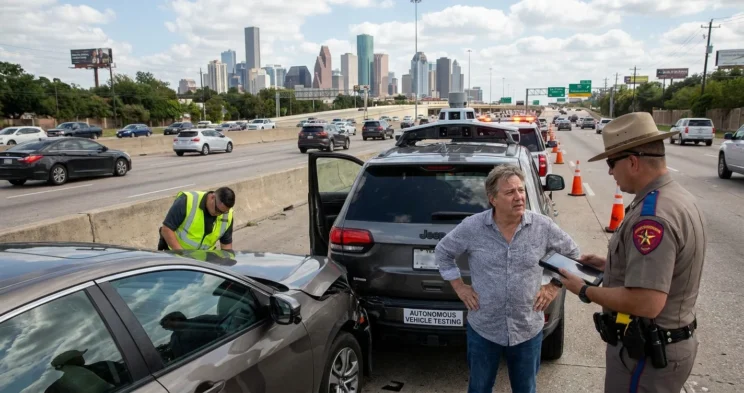
You were driving home on I-10 near the Galleria when a vehicle in the next lane suddenly merged and crashed into your door. The other driver says the car was in “self-driving mode,” and the system failed to detect you. Now, you’re dealing with injuries, vehicle damage, and an insurance adjuster who seems unsure who should pay. When automation is involved, figuring out who is at fault can get complicated fast.
How Texas Determines Fault in a Self-Driving Crash
Texas doesn’t have a single “autonomous vehicle liability” rule that replaces traditional crash law. Instead, fault is assigned by combining two legal frameworks: Texas’s proportionate-responsibility system, and Texas Transportation Code rules about who counts as the “operator” when an automated driving system is engaged.
The proportionate-responsibility system (often called the “51% bar“) determines how much each party contributed to the crash. If you’re found more than 50% at fault, you can’t recover damages. The Transportation Code stipulations address who receives traffic citations, and who must meet certain operational requirements when ADS technology is active.
In these cases, multiple parties can share fault. The human driver, vehicle owner or fleet operator, car manufacturer or software developer, and maintenance vendors may all bear some percentage of responsibility. Those percentages directly affect what you can recover. Understanding how partial fault works in Texas car accidents is essential before evaluating any self-driving crash claim.
Texas Laws That Control AV Fault Disputes
Texas Transportation Code Chapter 545 includes automated motor vehicle provisions that treat an engaged automated driving system as the vehicle’s “operator” for traffic law purposes. When ADS is engaged and operating as intended, citations for traffic violations can be routed to the ADS owner or authorization holder, rather than a human driver.
These provisions also require operational prerequisites. Vehicles operating with ADS must have recording devices that are capable of capturing data before, during, and after a collision. They must also meet insurance requirements under Texas Transportation Code Chapter 601, which establishes minimum liability coverage of $30,000 per person, $60,000 per accident for bodily injury, and $25,000 for property damage.
For civil liability and damages, Texas Civil Practice and Remedies Code Chapter 33 controls how fault is allocated among multiple defendants. This proportionate-responsibility framework applies whether the crash involves a traditional vehicle or one with autonomous features.
“Operator” for Traffic Rules vs Civil Liability
There’s an important distinction between who Texas treats as the “operator” for traffic-law compliance, and who can be held liable in a civil lawsuit.
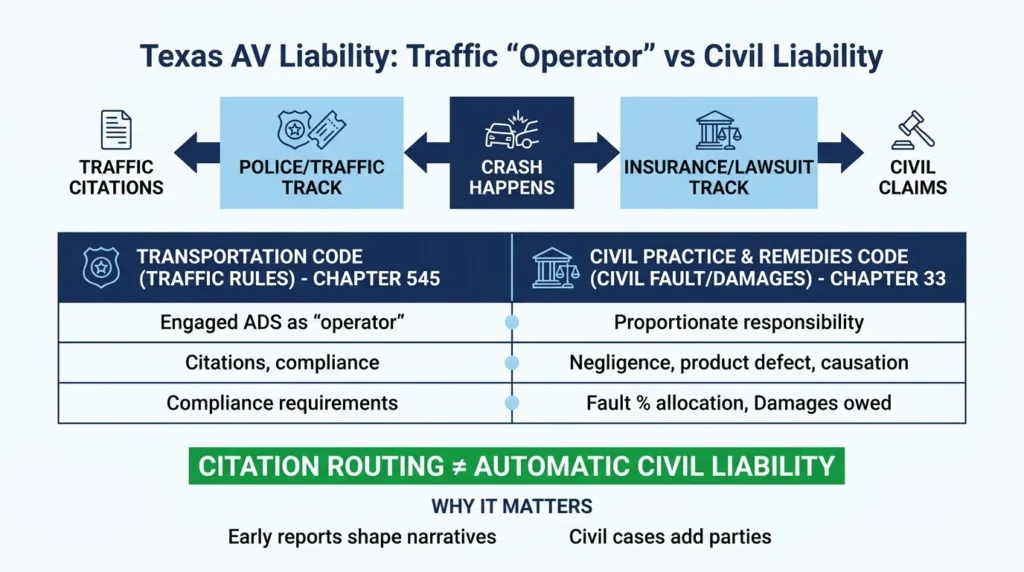
The Transportation Code’s operator designation primarily affects citation routing and regulatory compliance. Civil liability still hinges on proving negligence or product defects and allocating fault percentages under Chapter 33. A citation going to the ADS owner doesn’t automatically mean they bear all civil responsibility.
Both concepts are relevant because crash reports and citations shape the early narrative that insurers use when assigning fault percentages. The question of whether ADS was actually “engaged” at the moment of collision is often contested, which makes technical proof vital in these cases.
How the 51% Bar Works in Self-Driving Crash Cases
Under Texas’s proportionate-responsibility system, you generally cannot recover damages if you’re assigned more than 50% of the fault. In multi-party self-driving cases, insurers and juries often split percentages across several defendants.
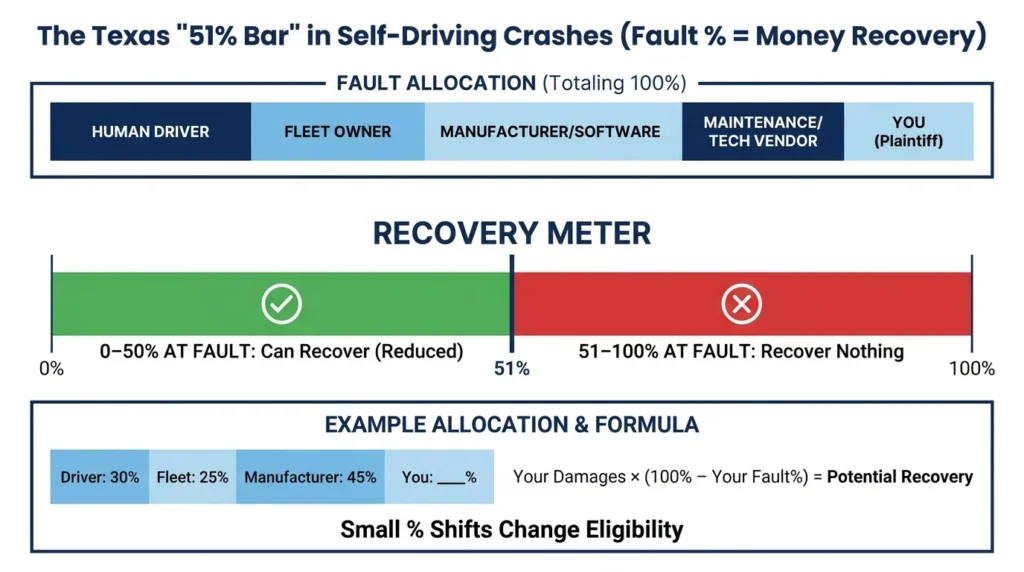
Here’s how it works: if a jury finds the human driver 30% at fault for failing to intervene, the fleet operator 25% at fault for inadequate training, and the manufacturer 45% at fault for a sensor defect, each defendant pays their percentage of your damages, but if you’re found 51% or more responsible, you recover nothing.
This makes evidence critical. Every piece of documentation that moves fault percentages below or above that 51% threshold can determine whether you receive compensation. Knowing what information to collect after a car accident becomes even more important when autonomous technology is involved.
Common Self-Driving Crash Scenarios & Fault Patterns
Rear-end collisions often involve disputes about following distance, whether the human driver was attentively supervising, and whether the ADS braked suddenly or failed to brake at all.
Lane-change crashes raise questions about sensor detection capabilities, proper signaling, blind-spot monitoring, and how quickly the driver was able to take over when the system requested intervention.
Intersection collisions typically focus on right-of-way compliance, traffic signal recognition, and whether the ADS correctly perceived the situation, or the human driver should have intervened sooner.
Who Can Be Liable in a Texas Self-Driving Crash
Self-driving crashes are often “multi-target” cases. Liability depends on three things: who was responsible for ensuring safety, who failed to meet that responsibility, and how that failure contributed to the collision.
Possible responsible parties include:
Human driver or safety driver: Even when ADS is engaged, most current systems require human supervision. Distracted driving, failure to react to alerts, or misuse of driver-assist features can all establish driver negligence.
Vehicle owner or fleet operator: Commercial fleets that operate autonomous vehicles in Houston, Dallas, or other cities in Texas may be liable for negligent maintenance, inadequate driver training, improper deployment decisions, or policy violations. Similar principles apply in truck accident cases involving commercial operators.
Car manufacturer or software developer: Product liability claims against manufacturers typically focus on design defects, manufacturing defects, or a failure to disclose known limitations. These claims require different proof than negligence claims and often involve expert testimony about industry standards and safer alternative designs.
Maintenance and tech vendors: Third parties responsible for sensor calibration, software updates, repairs, or remote monitoring may share liability if their errors contributed to the crash.
How Citation Routing Affects Your Case
When a citation goes to the ADS owner or authorization holder under Texas Transportation Code Chapter 545, it can influence how insurers initially position the claim, but citations aren’t the final word on civil liability.
Civil cases often add defendants beyond whoever was cited once technical evidence is reviewed. Whether ADS was actually “engaged” and whether the vehicle was operating within its “authorized” parameters can be disputed facts that require data preservation and expert analysis.
Determining Fault When the Car Was in Self-Driving Mode
In this case, fault determination is typically done in three steps:
Step 1: Confirm the operating mode. Was the vehicle in manual mode, driver-assist mode, or full ADS-engaged mode? Time-stamping transitions between modes is critical because duties shift depending on who or what was controlling the vehicle.
Step 2: Map responsibilities to parties. The human driver has a responsibility to remain attentive and intervene when necessary. The fleet operator has a responsibility to maintain the vehicle and train their drivers. The manufacturer has a responsibility to design safe systems and disclose any limitations. Vendors have a responsibility to properly service and calibrate their equipment.
Step 3: Prove causation and allocate percentages. Using technical and conventional evidence, each party’s breach must be connected to the crash, and fault percentages must be assigned under Chapter 33.
Product Liability vs Negligence Claims
Self-driving cases often mix negligence claims with product liability claims. Each requires different proof.
Negligence claims focus on whether someone acted unreasonably. Did the driver pay attention? Did the fleet properly maintain the vehicle? Did the vendor correctly calibrate the sensors?
Product liability claims focus on whether the product itself was defective or warnings were inadequate. Did the ADS have a design flaw that made it unreasonably dangerous? Did the manufacturer fail to disclose the conditions in which the system performs poorly?
Sometimes, both of these apply. The system may have performed poorly, while the humans who were responsible failed to intervene. Chapter 33 allows fault to be split across both the product itself and the humans maintaining it.
Evidence That Matters Most in Texas AV Crash Claims
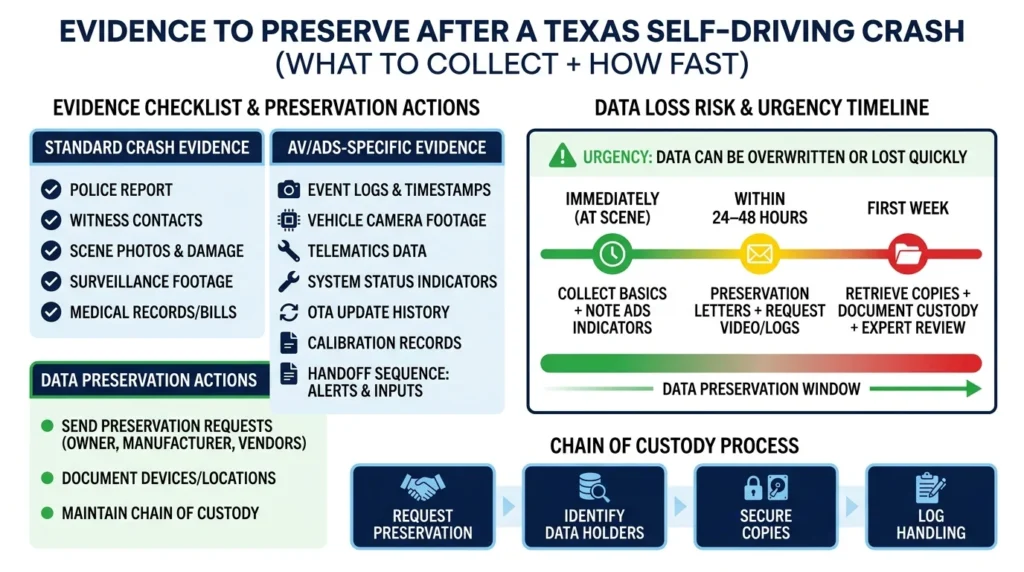
Standard crash evidence (such as police reports, witness statements, scene photos, surveillance video footage, and medical records) are still important, but AV cases also add critical categories of technical evidence, as follows:
ADS-specific evidence includes event logs, vehicle camera footage, telematics data, system status indicators, over-the-air update history, and calibration records. This data can show whether ADS was engaged, what the system “saw,” and how it responded.
Data preservation is urgent. Some vehicle data can be overwritten quickly. Sending preservation requests immediately to owners, fleets, manufacturers, and vendors will prevent data from being destroyed, altered, or lost. Documenting storage devices and maintaining the chain of custody will be crucial if the case goes to trial.
Proving whether ADS was engaged often requires mode indicators from the dashboard, app notifications, system timestamps, and user settings. The “handoff sequence” (alerts to the driver, time-to-intervene, and steering or braking inputs) can determine whether the human driver had an adequate opportunity to prevent the crash.
Navigating Insurance & Who Pays in Texas Self-Driving Collisions
Most claims still start as insurance claims. Texas’s minimum liability coverage (30/60/25) is a starting point, not a guarantee of adequate coverage for serious injuries.
AV cases often involve multiple policy layers: the driver’s personal policy, the owner’s policy, commercial fleet coverage, umbrella policies, and potentially vendor coverage. Identifying all available coverage requires careful investigation.
Insurers use comparative fault aggressively. Early statements about “autopilot” or “self-driving” can backfire without documentation supporting your version of events. What you say to adjusters before understanding the technical evidence can affect how fault percentages are assigned.
Deadlines & Early Moves That Can Protect Your Claim
Texas generally imposes a two-year statute of limitations for personal injury claims under Texas Civil Practice and Remedies Code Chapter 16. However, the longer you wait, the more at risk you are of losing critical ADS-related data that may be overwritten, destroyed, or misplaced.
Immediate steps to take after a crash include getting medical attention, documenting the scene, and preserving AV-related data sources. For self-driving crashes, this means requesting that the vehicle owner or fleet preserve all logs, footage, and system data.
Consider involving legal counsel early when injuries are serious, the operating mode is disputed, commercial fleets are involved, multiple insurers are pointing fingers, or there’s any indication of a defect or recent software update.
Talk to a Texas Lawyer About Your Self-Driving Crash
If you’ve been injured in a crash involving autonomous or self-driving technology, the legal questions are more complex than in typical collisions. Multiple parties may share responsibility, and critical evidence can disappear quickly.
Angel Reyes & Associates has over 30 years of experience handling complex car accident cases across Texas. We offer free initial consultations and work on contingency, meaning you pay no fee unless we win. Our team can help preserve critical evidence, identify all responsible parties, and pursue the compensation you deserve.
Contact us to discuss your case. We’re available 24/7 and serve clients throughout Texas from our more than 20 locations statewide.
Self-Driving Accident Liability FAQs
Does a recall automatically mean the manufacturer is at fault for a self-driving crash?
Not necessarily. A recall can be important evidence, but you still usually need to prove that the recall is connected to the crash and your injuries.
What if the other driver says they thought the car would handle everything on its own?
A driver’s misunderstanding of a vehicle’s limits does not automatically excuse unsafe driving. In many cases, investigators will look at the system’s instructions, warnings, and the driver’s actions before the impact.
Can a company that serviced the vehicle be responsible for a self-driving accident?
Yes, if poor repairs, missed maintenance, or bad sensor calibration caused the crash. This is particularly important if a shop, contractor, or fleet maintenance provider worked on the vehicle before the collision.
Will a police report decide who wins a self-driving car accident claim?
No. A police report can influence the early insurance process, but it is only one piece of evidence and can be challenged with vehicle data, video footage, expert analysis, and witness statements.
Is there a difference between driver-assistance features and a truly autonomous driving system?
Yes. Many crashes involve advanced driver-assistance features, rather than a fully autonomous system, and that difference can affect what responsibilities the human driver had at the time of the crash.
About the Authors

Angel Reyes
Writer
Angel L. Reyes, III is the Founder and Managing Partner of Angel Reyes & Associates. A nationally recognized trial attorney and business leader, Angel has helped over 70,000 injury victims recover more than $1 billion since founding the firm in 1993. Named to the Texas Super Lawyers list annually since 2008, Angel brings Wall Street experience, Ivy League education, and a deep commitment to client advocacy. He is a frequent legal commentator and published author with extensive contributions to legal scholarship, trial strategy, and consumer protection.

Kyle Nicolas
Editor
Kyle Nicolas is the Web Content & SEO Manager at Angel Reyes & Associates. He has more than 10 years of experience as a marketing co...

Angel Reyes
Reviewer
Angel L. Reyes, III is the Founder and Managing Partner of Angel Reyes & Associates. A nationally recognized trial attorney and business...