Can You Still File a Claim If You Were Partially at Fault in Texas?


Every article on this site is researched by our internal team, reviewed for legal accuracy against current Texas law, and held to State Bar of Texas advertising standards before publication. We do not publish content that overstates outcomes or makes promises about results.
Learn more about our
editorial standards .
Key Takeaways
- Texas law bars any recovery once your assigned fault crosses 50 percent.
- Insurers assign higher fault percentages to lower how much they are required to pay claimants.
- Evidence, including documentation, can fight back against an assigned percentage of fault and increase recovery.

You’re merging onto I-45 in Houston when another driver clips your bumper while changing lanes without signaling. The police report notes you were driving slightly over the speed limit. Now the other driver’s insurer says you share the blame. Sharing fault in Texas does not automatically end your right to recover compensation.
Can You File a Claim With Partial Fault in Texas?
Yes. Under Texas’s modified comparative negligence rule, you can still recover damages as long as your share of fault is under a certain percentage. Cross that line, and the law bars any financial recovery.
A partial-fault crash happens when two or more drivers each contribute to causing it. You might have been following too closely while the other driver ran a red light, or you made an unsafe lane change while the other driver was texting.
That contribution usually traces back to a specific violation, the same kind of factor that determines whether you were at fault in your Texas car accident to begin with.
How Texas’s 51 Percent Bar Rule Works
Texas caps your recovery at your percentage of fault, and eliminates it completely once that percentage passes 50%. Under Texas Civil Practice and Remedies Code § 33.001, a claimant cannot recover financial damages if their responsibility for the crash is greater than 50 percent.
The math works like this. Say your damages total $100,000 and a jury finds you 30% at fault. Under Texas Civil Practice and Remedies Code § 33.012, your recovery drops to $70,000, the full amount minus your share of the blame.

That formula holds only up to a point. At 40% fault, you would still collect $60,000. At 50% fault, you would still collect $50,000. At 51% fault, the math stops mattering entirely. Texas law bars you from recovering any money at all.
How Texas Compares to Stricter Fault States
Texas’s comparative fault rule is far more forgiving than a contributory negligence state, where any share of fault, even 1%, blocks recovery completely. Under Texas’s modified comparative negligence system, most partial-fault drivers still walk away with a meaningful financial recovery.
How Insurers Use Fault Percentages to Cut Your Payout
Every percentage point an insurer assigns to you is a percentage point it does not have to pay. That is why adjusters push your fault number up long before a court or jury ever weighs in.
The incentive is simple math. A $100,000 claim shrinks to $70,000 at 30% fault, but only $55,000 at 45% fault. That is a $15,000 gap created by 15 fault percentage points alone, without a single new fact about the crash.
Insurers build that initial number from citations, accident reconstruction, witness statements, police reports, and video evidence, the same categories that determine how fault is determined in a Texas injury case.
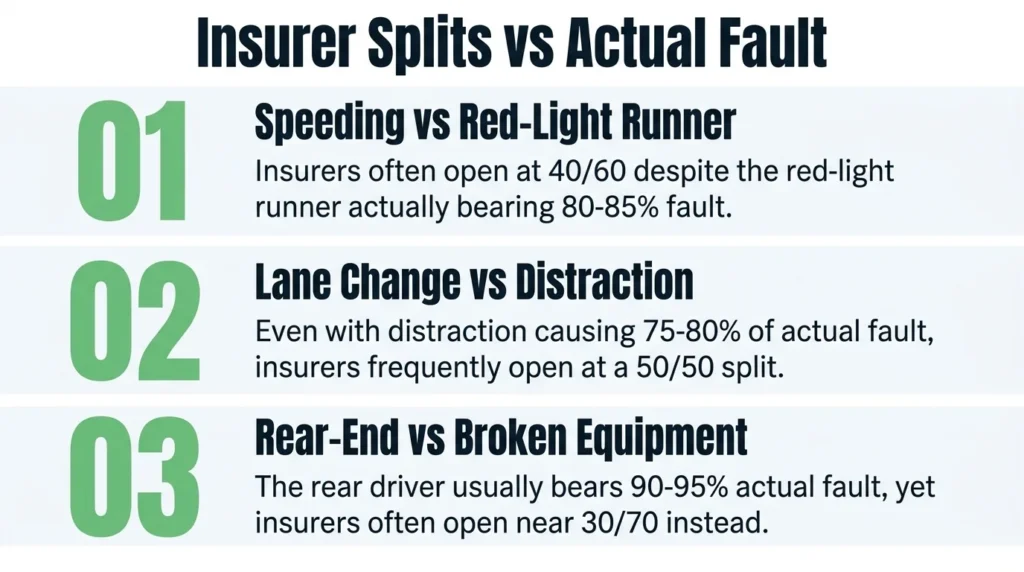
Three common disputes show how far an insurer’s opening number can drift from the eventual split:
- Speeding driver hit by a red-light runner. Fault often lands near 15-20% for speeding versus 80-85% for the red light violation, yet insurers frequently open with a 40/60 split.
- Unsafe lane change into a distracted driver. Fault often runs 20-25% for the lane change versus 75-80% for the distraction, yet insurers often open at 50/50.
- Rear-end crash involving a front vehicle’s broken equipment. Fault often lands near 5-10% for the front driver versus 90-95% for the rear driver, yet insurers sometimes open near 30/70.
Evidence That Lowers an Inflated Fault Percentage
A fault percentage is not fixed once an adjuster states it. Specific, timely evidence is what pulls an inflated number back down, and that number stays negotiable until you settle or a jury decides.
Photograph every vehicle’s damage from multiple angles right away. Capture road conditions, traffic signals, weather, skid marks, and debris while they are still visible. Get names and contact information from every witness before memories fade.
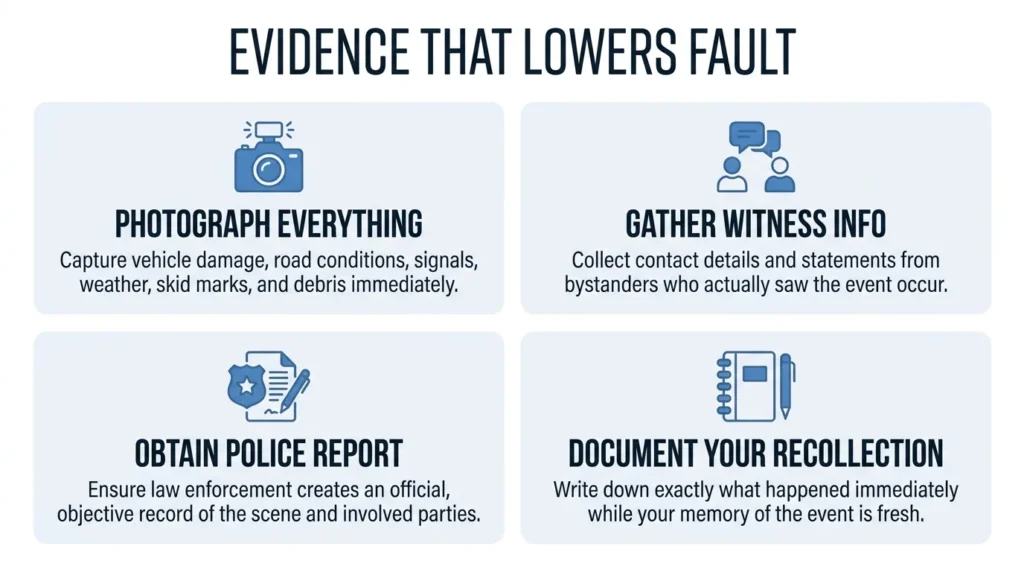
Request your police report within days and check it for accuracy. You can request a correction from the investigating officer for inaccurate details, and submitting a supplemental statement or corrected record before an insurer relies on the original report can help move your fault percentage down.
When both drivers blame each other for the crash, the right documentation carries the most weight.
Seek medical evaluation within 24 to 48 hours. A gap in treatment gives an insurer room to argue your injuries were minor or unrelated to the crash, which can indirectly inflate your assigned share of fault.
None of this is final. Your fault percentage stays open to negotiation right up until you settle or a jury rules, and new evidence can shift it even after an insurer’s first determination.
Work With an Experienced Attorney After a Partial-Fault Crash
Angel Reyes & Associates has spent more than 30 years helping Texas drivers push back against inflated fault percentages. The firm investigates the evidence, challenges unfair splits with insurers, and works on a contingency basis, so you pay nothing unless you win. Clients describe that approach in their own client reviews, citing clear communication and strong results even in contested fault cases.
If an insurer has assigned you a fault percentage that does not match the evidence, contact Angel Reyes & Associates for a free case review.
Past results do not guarantee future outcomes.
Partial Fault Car Accident FAQs
How long do I have to file a car accident claim in Texas?
Texas generally requires you to file a personal injury lawsuit within two years of the crash date according to Texas Civil Practice and Remedies Code § 16.003.
Can I still recover if three or more drivers share fault in the crash?
Yes. A jury or insurer assigns a whole-number fault percentage to every driver involved under Texas Civil Practice and Remedies Code § 33.003, and you remain barred from recovery only if your own share exceeds 50 percent.
Does admitting fault or apologizing at the scene hurt my claim?
Yes. Even a simple apology can be treated as an admission of fault and used to raise your assigned percentage, so stick to factual statements with police and insurers.
Can I use my own uninsured or underinsured motorist coverage if I'm barred from recovering from the other driver?
Texas requires auto insurers to offer uninsured or underinsured motorist coverage, and that coverage applies the same 50 percent fault cutoff and reduction rules as a claim against another driver.
Does a DUI or other serious violation by the other driver affect my fault percentage?
Driving under the influence counts as “negligence per se,” which helps establish that driver’s fault, but it does not automatically make them 100 percent responsible for the crash.
About the Authors

Angel Reyes
Writer
Angel L. Reyes, III is the Founder and Managing Partner of Angel Reyes & Associates. A nationally recognized trial attorney and business leader, Angel has helped over 70,000 injury victims recover more than $1 billion since founding the firm in 1993. Named to the Texas Super Lawyers list annually since 2008, Angel brings Wall Street experience, Ivy League education, and a deep commitment to client advocacy. He is a frequent legal commentator and published author with extensive contributions to legal scholarship, trial strategy, and consumer protection.

Kyle Nicolas
Editor
Kyle Nicolas is the Web Content & SEO Manager at Angel Reyes & Associates. He has more than 10 years of experience as a marketing co...

Angel Reyes
Reviewer
Angel L. Reyes, III is the Founder and Managing Partner of Angel Reyes & Associates. A nationally recognized trial attorney and business...