Do Air Taxis Have Pilots? FAA Rules, Autonomy Plans & Texas Liability Basics


Every article on this site is researched by our internal team, reviewed for legal accuracy against current Texas law, and held to State Bar of Texas advertising standards before publication. We do not publish content that overstates outcomes or makes promises about results.
Learn more about our
editorial standards .
Key Takeaways
- Near-term passenger air taxi operations are expected to be piloted under FAA powered-lift certification rules, not fully autonomous.
- Texas was selected for the FAA's eVTOL Integration Pilot Program, with phased testing that starts without passengers before expanding to passenger service.
- After an air taxi incident, multiple parties may share legal responsibility under Texas proportionate responsibility law, making early evidence preservation critical.
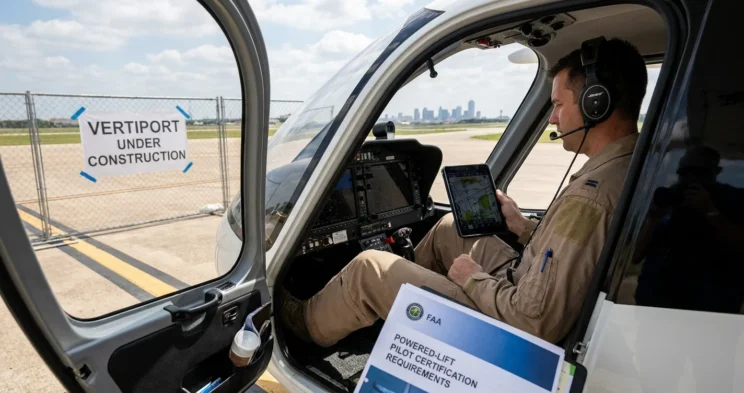
You may have read that air taxis are coming to Houston. Maybe you saw a headline about “autonomous” flight testing that will take place here, or watched a video of a sleek electric aircraft lifting off without a runway.
Now you’re wondering: if something goes wrong, who’s actually flying the thing? And who’s responsible if you get hurt?
These are fair questions. The technology is new. The terminology is confusing. And the answers matter if you’re considering riding in one of these aircraft or if you’ve already been involved in an incident.
What Counts as an “Air Taxi?”
An eVTOL (electric vertical takeoff and landing) aircraft is exactly what it sounds like: an electric aircraft that can take off and land vertically, like a helicopter, but often transitions to forward flight like an airplane. “Air taxi” describes how these aircraft might be used: short urban or regional trips, often booked through an app.
The FAA categorizes many of these aircraft as “powered-lift.” This is a regulatory classification that recognizes these aircraft don’t fit neatly into existing airplane or helicopter categories. They take off vertically using powered rotors, then transition to wing-borne flight.
For passengers, the aircraft is just one piece of a larger system. You might interact with:
- An operator or booking app
- A vertiport (the takeoff and landing site)
- Charging and maintenance crews
- Dispatch and air traffic coordination
Each of these entities could play a role in safety. Each could also be relevant if you need to pursue a claim after an incident involving public transportation.
Early Air Taxis Are Expected to Be Piloted
In the nearest-term future, passenger-carrying air taxi operations are expected to have human pilots. The FAA’s framework for “powered-lift” aircraft is built around pilot certification and training requirements. According to the FAA’s air taxi hub, the agency has been working toward integrating these aircraft into the national airspace with safety as the priority.
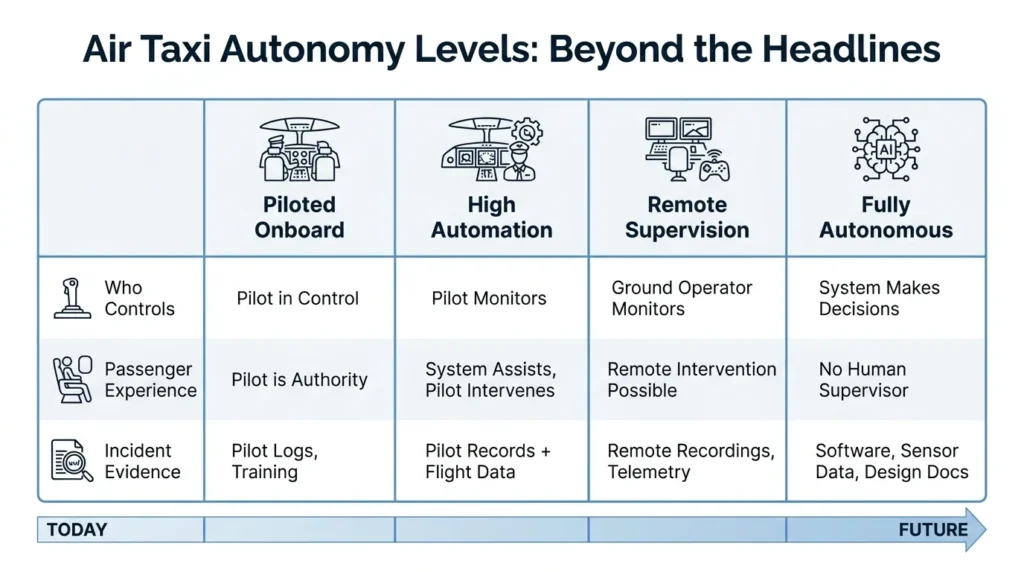
That said, “autonomous” isn’t a single concept. It can mean:
- High levels of automation assisting a human pilot
- Remote supervision from a ground station
- Eventually, no onboard pilot at all
Some developers and Texas programs are testing paths toward autonomy or remote supervision. But for commercial passenger service in the near term, expect a qualified pilot to be involved.
Why does this matter in Texas? The piloted-versus-autonomous distinction affects oversight, training standards, and who may be legally responsible after an incident. Understanding this distinction helps you know what questions to ask and what evidence to preserve if something goes wrong.
FAA Powered-Lift Rules Put Pilots in the Early Passenger Model
In October 2024, the FAA finalized rules specifically addressing powered-lift pilot and instructor qualifications. According to the FAA’s announcement, this rule was designed to enable safe integration of these aircraft into passenger service.
The rule establishes:
- Pilot certificate and rating requirements for powered-lift operations
- Instructor qualification pathways so pilots can be properly trained
- Operational standards that commercial passenger service must meet
For passengers, the practical takeaway is straightforward. Commercial air taxi operations under this framework require pilots who have met specific FAA qualification standards. This isn’t a free-for-all.
What Pilot Certification Involves
The FAA’s powered-lift FAQ explains that pilots need appropriate certificates and ratings. They may also need aircraft-specific qualifications called type ratings for particular powered-lift models.
Think of it like this: a commercial airline pilot needs both a general pilot certificate and specific training on the aircraft they fly. Powered-lift air taxi pilots will follow a similar concept.
What should passengers take from this? There’s a regulated pathway for who can fly these aircraft in passenger service. When evaluating an operator, look for safety disclosures rather than just marketing language.
Are eVTOL Air Taxis Autonomous?
Headlines often blur important distinctions. “Autonomous” can mean very different things depending on context.
- Piloted onboard: A human pilot is physically in the aircraft, making decisions and controlling flight.
- Piloted with high automation: A human pilot is present, but automated systems handle many tasks. The pilot monitors and intervenes when needed.
- Remote supervision: No pilot onboard, but a human operator monitors from a ground station and can intervene.
- Fully autonomous: No human pilot onboard or actively supervising. The system makes all decisions. This remains a future concept for passenger operations.
Regulators typically move in phases. Testing happens first, often without passengers. Then limited passenger operations begin under close oversight. Expanded service comes only after demonstrated safety.
When will autonomous air taxis carry passengers? There’s no universal date. It depends on testing results, demonstrated safety records, and regulatory approvals that haven’t been granted yet.
The Importance of the “Autonomous” Distinction
If you’re injured in an air taxi incident, investigators and insurers will ask different questions depending on who (or what) was controlling the aircraft.
For piloted operations, questions focus on:
- Pilot decision-making and training
- Operator procedures and oversight
- Weather planning and route selection
For autonomous or remotely supervised operations, questions shift to:
- Software and system performance
- Remote operator staffing and training
- Design decisions and sensor accuracy
The evidence differs too. Piloted incidents involve training records and pilot logs. Autonomous incidents involve software versions, telemetry data, and remote-ops recordings.
More entities may be involved than in a typical car crash on I-35E or Loop 12. Potential parties include the operator, manufacturer, component suppliers, software providers, maintenance contractors, and vertiport owners. This complexity is similar to what we see in commercial truck accident cases where multiple companies share responsibility.
What’s Happening in Texas: Testing First, Passengers Later
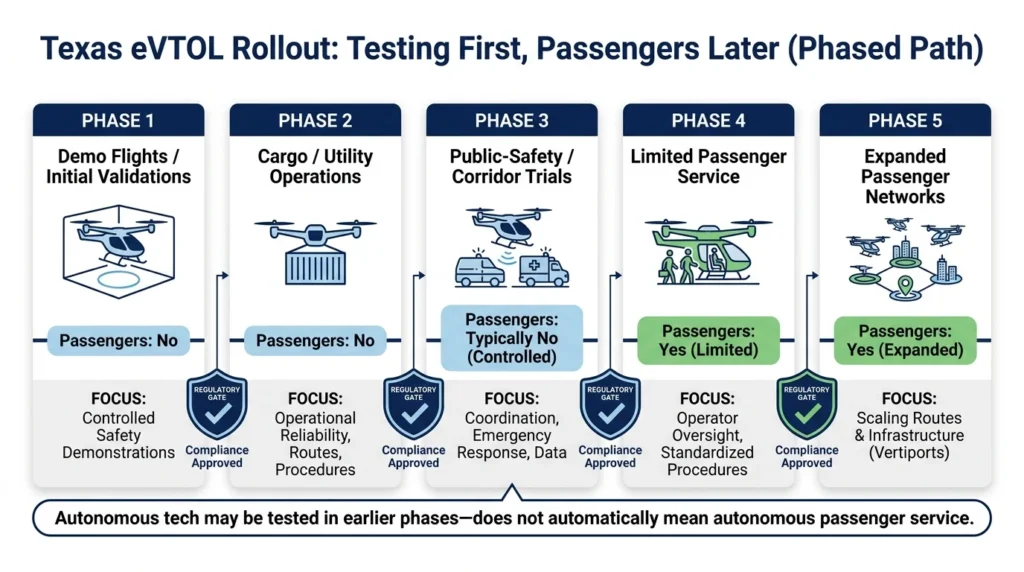
Texas was selected for the FAA’s eVTOL Integration Pilot Program. According to TxDOT’s announcement, this multi-phase approach starts without passengers and builds toward passenger “air taxi” flights across the Texas Triangle connecting Houston, Dallas–Fort Worth, San Antonio, and Austin.
The program references “autonomous flight technologies” as part of the broader initiative. But testing autonomy doesn’t mean passengers will ride in autonomous aircraft immediately. Early phases focus on demonstrating safety in controlled conditions.
What might Dallas–Fort Worth residents see first? Demo flights, cargo operations, public-safety trials, and limited corridor testing. Passenger service requires additional approvals beyond initial testing phases.
Safety Oversight: Who’s Watching
The FAA handles aviation safety regulation and aircraft certification. This is the baseline framework you’ll see referenced most often.
State and local entities like TxDOT may be involved operationally. They coordinate on sites, infrastructure, and emergency response. But federal aviation safety rules come from the FAA.
If you’re considering riding an air taxi, ask two questions: Who is the operator? What safety framework are they operating under?
Who May Be Legally Responsible After an Air Taxi Incident in Texas
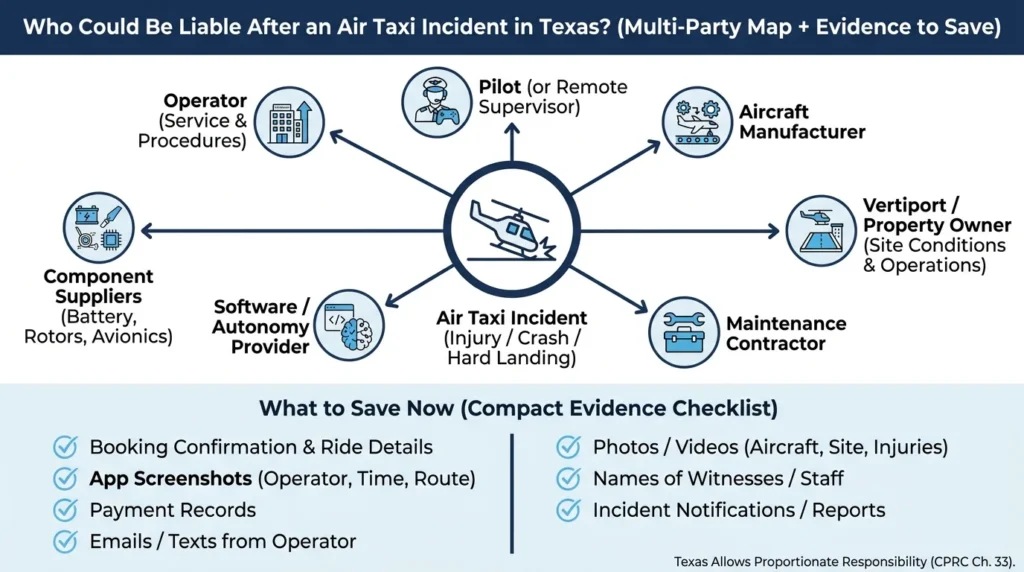
Texas law allows fault to be allocated among multiple parties. Under Texas Civil Practice and Remedies Code Chapter 33, courts can assign proportionate responsibility to each party whose conduct contributed to an incident.
Potentially responsible parties may include:
- The operator who provided the service
- The pilot or remote supervisor
- The aircraft manufacturer
- Component and software suppliers
- Maintenance contractors
- Vertiport or property owners
Claims may involve commercial insurance policies, product liability issues, and multi-layer investigations. Early documentation matters. Save app screenshots, ride confirmations, operator communications, and any photos or video you captured.
Don’t rush a settlement. Insurance settlement timelines vary, and early offers may not reflect long-term care needs.
When to Talk to a Lawyer
Consider speaking with an attorney if:
- You suffered serious injuries
- Multiple companies were involved
- You’re unclear who operated the aircraft
- You’re being pressured to sign documents quickly
A lawyer can identify responsible parties, send preservation letters to protect evidence, coordinate with aviation and technical experts, and negotiate with insurers. This is similar to handling complex rideshare accident claims where multiple parties and insurance policies intersect.
How Angel Reyes & Associates Can Help
Air taxi technology is new, but the principles of injury claims remain consistent: identify who’s responsible, preserve evidence, and fight for fair compensation. At Angel Reyes & Associates, we’ve spent over 30 years helping Texans navigate complex injury claims. We’ve recovered more than $1 billion for our clients across all types of cases.
We offer free consultations and work on contingency. You pay nothing unless we win. Our team serves clients throughout Texas from more than 20 locations, and we’re available 24/7.
If you’ve been injured in an air taxi incident or any transportation accident in Dallas–Fort Worth or across Texas, contact us today to discuss your options.
Air Taxi Piloting FAQs
Can weather delay or cancel an air taxi flight in Texas?
Yes. Like other aircraft operations, eVTOL flights may be limited by weather, visibility, wind, lightning, or other safety conditions, so service may be interrupted even on short routes.
Will air taxis use the same airports as commercial airlines?
Not always. Some operations may use airports, but many plans also involve vertiports or other designated landing sites built for shorter urban or regional trips.
What records should a passenger keep after an air taxi incident?
Save the booking confirmation, app screenshots, payment records, emails or texts from the operator, and any photos or videos from before or after the event. These details can help show which company provided the ride and what happened.
Does signing a waiver automatically prevent an injury claim?
Not necessarily. A waiver may affect a case, but it does not automatically erase every possible claim, especially if the facts suggest negligence or another party’s conduct contributed to the injury.
Could a government agency be involved after an air taxi crash or serious incident?
Yes. Depending on what happened, federal investigators such as the NTSB and the FAA may become involved in reviewing the event, separate from any insurance claim or lawsuit.
About the Authors

Angel Reyes
Writer
Angel L. Reyes, III is the Founder and Managing Partner of Angel Reyes & Associates. A nationally recognized trial attorney and business leader, Angel has helped over 70,000 injury victims recover more than $1 billion since founding the firm in 1993. Named to the Texas Super Lawyers list annually since 2008, Angel brings Wall Street experience, Ivy League education, and a deep commitment to client advocacy. He is a frequent legal commentator and published author with extensive contributions to legal scholarship, trial strategy, and consumer protection.

Kyle Nicolas
Editor
Kyle Nicolas is the Web Content & SEO Manager at Angel Reyes & Associates. He has more than 10 years of experience as a marketing co...

Angel Reyes
Reviewer
Angel L. Reyes, III is the Founder and Managing Partner of Angel Reyes & Associates. A nationally recognized trial attorney and business...