The Waymo School Bus Incidents in Austin Explained


Every article on this site is researched by our internal team, reviewed for legal accuracy against current Texas law, and held to State Bar of Texas advertising standards before publication. We do not publish content that overstates outcomes or makes promises about results.
Learn more about our
editorial standards .
Key Takeaways
- Texas Transportation Code § 545.066 requires drivers to stop for school buses displaying visual signals, with limited exceptions for physically divided highways.
- NHTSA opened Preliminary Evaluation PE25013, and Waymo issued recall 25E-084, but these actions don't automatically establish fault in specific incidents.
- The NTSB's investigation into the January 12th, 2026 incident is ongoing, and conclusions have not been reached.
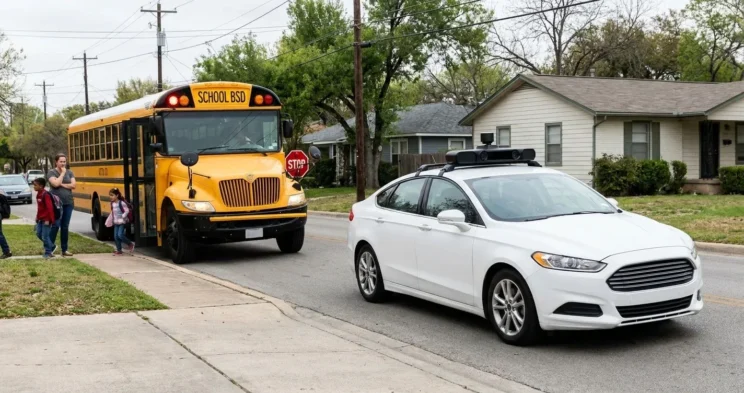
Your child’s school bus stopped on a street in Austin last week. The stop arm extended, red lights flashed, and kids started stepping off. Then a Waymo robotaxi rolled past without stopping. No one was hurt, but the close call left you shaken. You want to know what the law says, what federal agencies are doing about it, and what options exist if something like this happens again.
Waymo accidents are more common than you might think. Austin ISD has documented at least 24 stop-arm violations involving Waymo vehicles during this school year alone, and federal investigators are now involved. Understanding the timeline, the Texas statute that governs school bus stops, and the federal response can help you make sense of what’s happening and what steps you might take.
Recent Waymo & Austin ISD Incidents
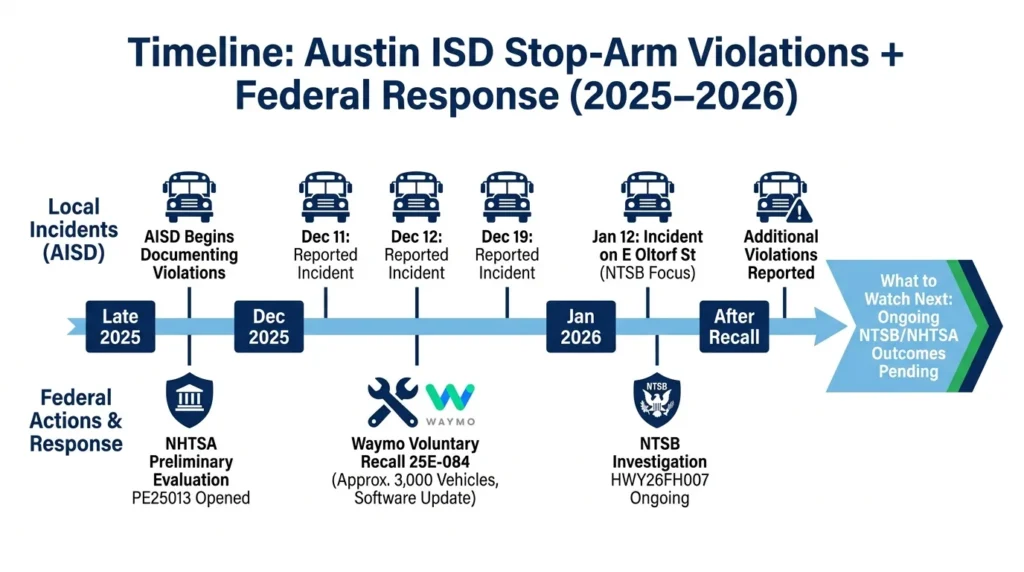
Austin ISD began documenting stop-arm violations involving Waymo robotaxis in late 2025. According to local reporting from Community Impact, the district recorded incidents on December 11th, 12th, and 19th, 2025, followed by another on January 12th, 2026.
Is Anything Being Done to Prevent These Types of Incidents?
Since these incidents took place, Austin ISD has publicly urged Waymo to pause operations during student pickup and drop-off hours.
Here are a couple of examples of steps being taken to protect against these types of accidents:
- The National Highway Traffic Safety Administration (NHTSA) opened an investigation (Preliminary Evaluation PE25013*) to examine whether a safety defect exists in Waymo’s automated driving system.
- Waymo filed Safety Recall Report 25E-084**, a voluntary recall affecting approximately 3,000 vehicles. The recall addressed software that, according to Waymo’s filing, could cause vehicles to proceed before a school bus’s visual signals are fully deactivated.
Despite the software update, AISD reported additional violations after the recall took effect. The January 12, 2026 incident is now the subject of a separate federal investigation.
*Note about PE 25013: NHTSA’s Office of Defects Investigation (ODI) opens a PE when it receives information suggesting a potential safety defect. The agency gathers data, requests information from the manufacturer, and determines whether to escalate the investigation or close it. A PE does not, by itself, establish that a defect exists or assign fault for any specific incident.
**Note about Recall Report 25E-084: A recall does not automatically establish liability in a civil claim. It’s one piece of evidence that may be relevant, but fault in any specific incident depends on the full set of facts: what the vehicle did, what the roadway conditions were, whether harm occurred, and what caused that harm.
What the NTSB Says About the January 12th, 2026 Incident
The National Transportation Safety Board (NTSB) investigation HWY26FH007 has revealed a critical detail about the January 12th event on East Oltorf Street. According to preliminary data, the Waymo vehicle’s automated system correctly identified an obstacle and initially stopped for the bus.
However, the vehicle then triggered a “remote assistance” prompt, asking a human operator if the bus had active signals. The operator, located in a remote support center, mistakenly signaled “No.” Relying on this human input, the Waymo vehicle resumed travel and passed the bus while students were present. This highlights that “remote assistance” is not just a monitor; it is a decision-maker that can override the vehicle’s cautious defaults.
The investigation is ongoing. The NTSB’s current summary is preliminary, meaning it presents initial facts without conclusions about probable cause. Final findings may differ as investigators analyze video footage, vehicle telemetry, remote assistance logs, and roadway context.
Texas Laws Regarding Stopping for School Buses
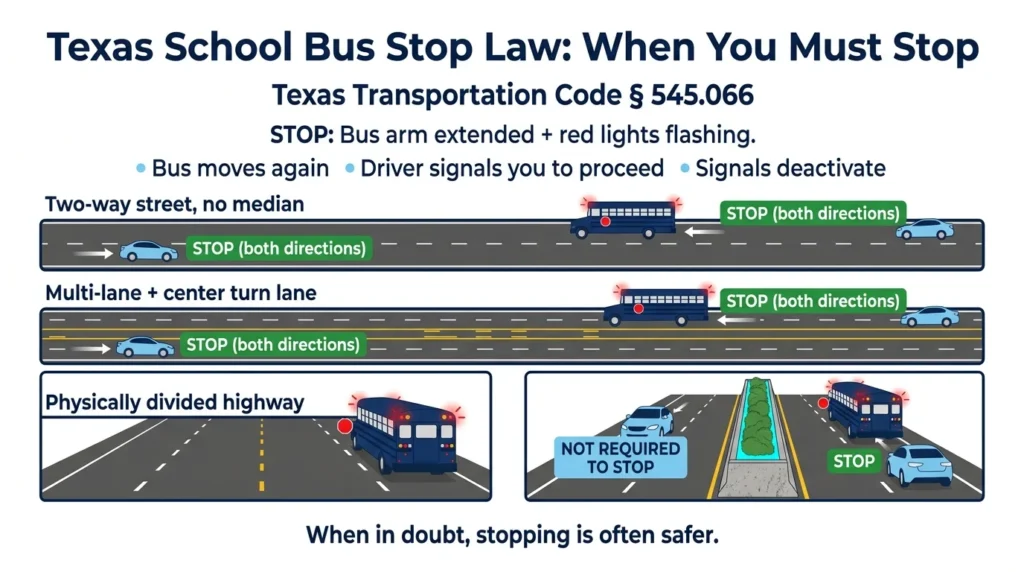
Texas Transportation Code § 545.066 states that when a school bus is stopped and operating its required visual signals (the extended stop arm and flashing red lights), drivers approaching from either direction must stop and remain stopped until the bus resumes motion, the driver signals you to proceed, or the visual signals are no longer activated.
This statute treats passing a stopped school bus with its visual signals activated as a criminal offense. Penalties can include fines, and repeat violations carry increased consequences.
The Most Common Points of Confusion with School Bus Laws
One of the most frequent questions is whether you must stop on a divided highway. According to Texas law, if you’re traveling on a highway with roadways separated by an intervening space or physical barrier, and the school bus is on a different roadway, you’re not required to stop.
The key distinction is physical separation. A center turn lane or painted median does not create a “divided highway” under this exception. A concrete barrier, raised median, or unpaved strip between roadways does.
Here are some common points of confusion:
- Two-way street with no median: Stop in both directions.
- Multi-lane road with center turn lane only: Stop in both directions.
- Highway with a physical barrier between directions: Drivers on the opposite side of the barrier are not required to stop.
When in doubt, stopping is often the safer choice.
What to Do If You Witness a School Bus Pass or Close Call
If you see a vehicle pass a stopped school bus, or if you were involved in a close call, there are several steps you can take to protect safety and preserve evidence.
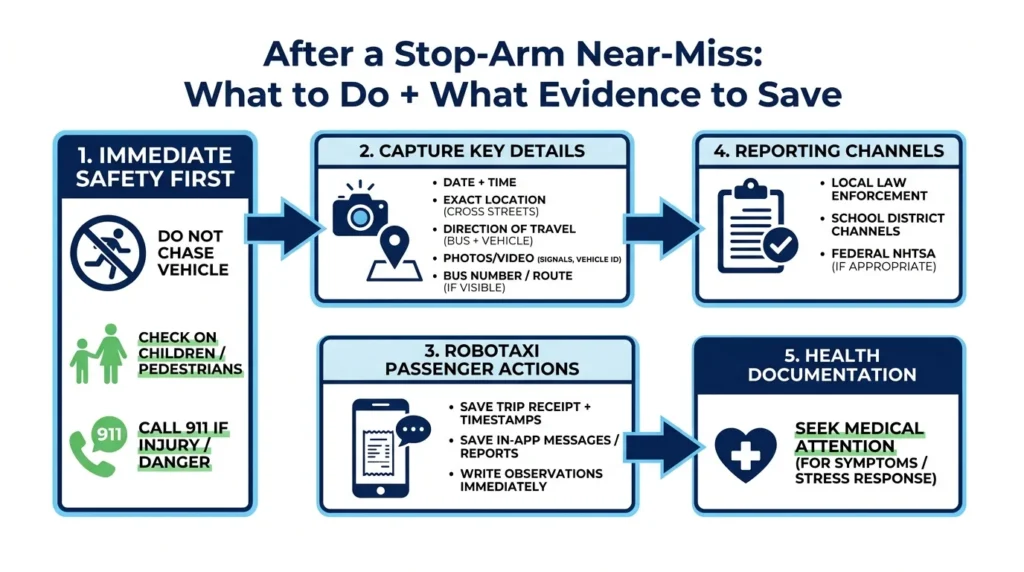
Immediate priorities include:
- Do not chase the vehicle.
- Check on children and others nearby.
- Call 911 if there’s any injury or ongoing danger.
Evidence to capture includes:
- Date, time, and exact location.
- Direction of travel for all vehicles involved.
- Photos or video of the scene, the bus, and any identifying details.
- Bus number (if visible).
- If you were a passenger in a robotaxi, save your trip receipt and any in-app communications.
Here is where you should consider filing a report of the incident:
- Local law enforcement.
- School districts.
- Public reporting portals.
What to Do If You Are a Passenger in a Robotaxi During a Stop-Arm Event
Passengers in autonomous vehicles have access to trip data that can be valuable later. Save your trip details immediately, including timestamps, route, and any communications with support or remote assistance. If the app allows you to report an incident, do so and save the confirmation.
Write down what you observed while it’s fresh. Did you see the bus’s stop arm extended? Were the red lights flashing? What did the vehicle do (stop, slow, or proceed)? These details can matter if questions arise later.
If you experienced any physical impact or significant stress response, consider seeking medical attention. Documentation of your condition, even after a near-miss, can be relevant if symptoms develop.
Legal Accountability in Texas: From Violations to Claims
In Texas, there is a significant difference between a traffic citation and a civil claim. While a police officer can issue a ticket for a stop-arm violation based on the law alone, a civil claim requires proof of compensable harm, such as medical expenses, physical impairment, or property damage.
Negligence Per Se
The strongest tool in these cases is a legal doctrine called negligence per se. Because Texas Transportation Code § 545.066 is designed to protect a specific class of people (children) from a specific type of harm (loading/unloading accidents), a driver’s violation of that statute can be used as automatic evidence of negligence.
However, even with negligence per se, the claimant must still prove “proximate cause” that the violation was the direct reason the injury occurred.
Identifying Responsible Parties
In robotaxi incidents, determining who is at fault is more complex than a standard car accident. Evidence that can help determine fault in these types of claims includes:
- Onboard Diagnostics: Telemetry data showing when the vehicle detected the bus and why it chose to proceed.
- Remote Assistance Logs: Records of any communication between the vehicle and out-of-state human operators.
- Video Evidence: Footage from the school bus’s external cameras and the Waymo vehicle’s 360-degree sensors.
If a violation occurs but there is no contact or physical injury (i.e., a “near-miss”), there may be no grounds for a civil lawsuit, even if the vehicle’s behavior was illegal. In those cases, the best path to accountability is reporting the incident to NHTSA or AISD to aid their ongoing safety investigations.
What to Watch for Next
This situation is evolving. The NTSB’s investigation remains open, and its final report may include analysis and conclusions that differ from the preliminary summary. NHTSA’s evaluation could escalate beyond the preliminary stage, result in additional recalls, or close without further action.
Locally, Austin ISD has publicly requested that Waymo pause operations during school hours. Whether that happens and any further accidents will shape the ongoing conversation about autonomous vehicle safety in Austin neighborhoods near schools along routes like Lamar Boulevard and in areas like Mueller and Travis Heights.
Protecting Your Family After a Close Call
If your child was on a bus that a vehicle passed, or if you witnessed an incident near an Austin school, you’re not alone in wanting answers. Federal investigations take time, and the full picture of what happened (and who bears responsibility) may not emerge for months.
At Angel Reyes & Associates, we’ve spent over 30 years helping Texas families navigate complex situations after car accidents and other incidents. Our consultations are free, and we don’t charge a fee unless we win. If you have questions about a specific incident or want to understand your options, reach out to us today.
Self-Driving Vehicles & School Bus Law FAQs
Can a school bus camera ticket alone prove a civil case in Texas?
Not by itself. Bus-camera footage can be important evidence, but a civil claim still usually requires proof of injury or wrongful death, property damage, or another legally recognized loss tied to the event.
What should a parent document if their child saw a near-miss at a bus stop?
Write down the date, time, exact location, bus route or bus number, and what your child remembers as soon as possible. If nearby homes, businesses, or the bus itself may have video, that footage can be easier to find if identified quickly.
Can a software recall help show what went wrong in a later incident?
It can be relevant, especially if the recall involves similar behavior, but it does not automatically prove why a specific event happened. Investigators and insurers still look at the exact vehicle, software version, roadway setup, and other available evidence.
If no one was hit, is there still anything to report?
Yes. A close call can still be worth reporting to local law enforcement or the school district because it may help document a pattern and preserve evidence while memories are fresh.
About the Authors

Angel Reyes
Writer
Angel L. Reyes, III is the Founder and Managing Partner of Angel Reyes & Associates. A nationally recognized trial attorney and business leader, Angel has helped over 70,000 injury victims recover more than $1 billion since founding the firm in 1993. Named to the Texas Super Lawyers list annually since 2008, Angel brings Wall Street experience, Ivy League education, and a deep commitment to client advocacy. He is a frequent legal commentator and published author with extensive contributions to legal scholarship, trial strategy, and consumer protection.

Kyle Nicolas
Editor
Kyle Nicolas is the Web Content & SEO Manager at Angel Reyes & Associates. He has more than 10 years of experience as a marketing co...

Angel Reyes
Reviewer
Angel L. Reyes, III is the Founder and Managing Partner of Angel Reyes & Associates. A nationally recognized trial attorney and business...