Waymo Accidents: Key Statistics & Information About Your Rights


Every article on this site is researched by our internal team, reviewed for legal accuracy against current Texas law, and held to State Bar of Texas advertising standards before publication. We do not publish content that overstates outcomes or makes promises about results.
Learn more about our
editorial standards .
Key Takeaways
- Crash-rate data is collected and reported by Waymo and NHTSA. It is important to understand that this data demonstrates involvement rather than fault.
- Texas law treats the automated driving system as the "operator," but proving civil liability still requires evidence of negligence, causation, and damages.
- The Texas statute of limitations for most personal injury claims is two years, and preserving AV-specific evidence like sensor logs requires fast action.
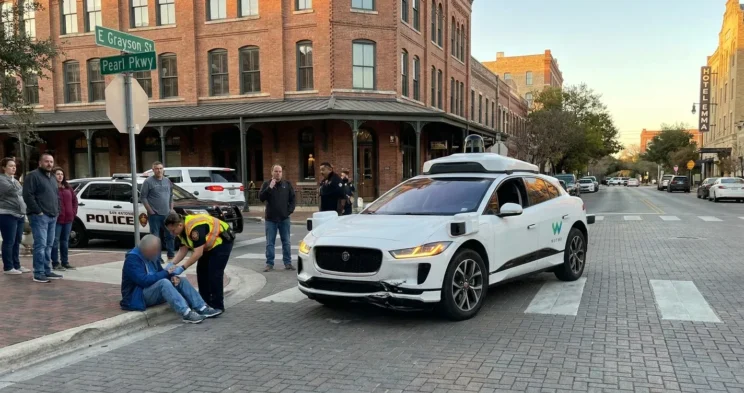
Autonomous vehicles like Waymo robotaxis are expanding across Texas, operating in cities like Austin and preparing to launch in Houston. When crashes happen, injured people deserve clear answers about what the data actually shows, how Texas law treats these vehicles, and what steps protect their rights.
Where to Find Waymo Crash Data
Two main public data sources exist for understanding Waymo crash frequency. Neither tells the whole story alone.
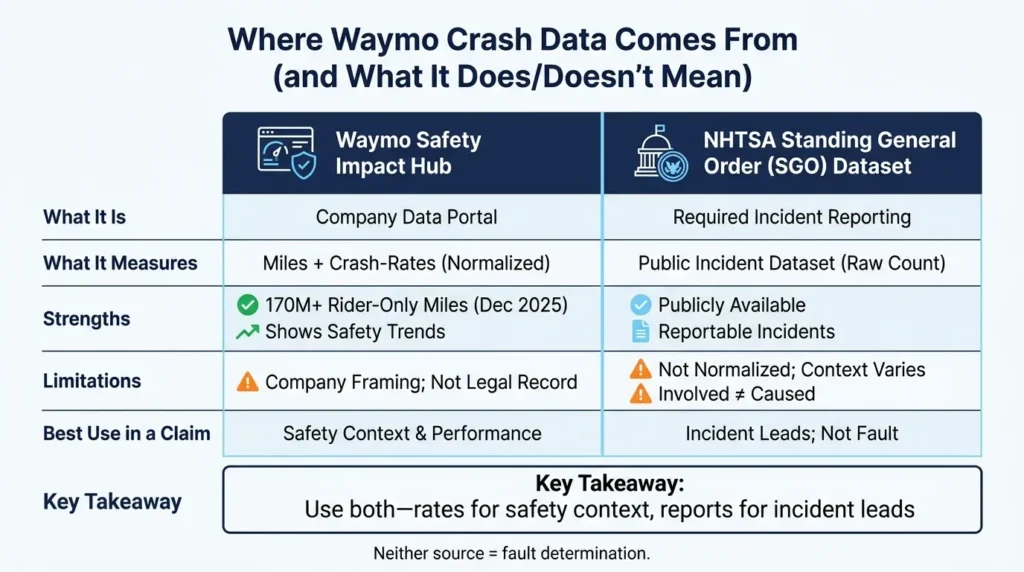
Waymo’s Safety Impact Hub publishes miles driven and crash-rate comparisons. This data is normalized, meaning it accounts for how many miles vehicles traveled. As of December 2025, Waymo has officially surpassed 170 million rider-only miles.
These miles were accumulated across key operating markets, including Austin, Los Angeles, San Francisco, and Phoenix. The city of Austin alone accounts for nearly 11 million of these miles.
NHTSA’s Standing General Order (SGO) requires companies to report certain incidents involving vehicles with automated driving systems. These reports create a public dataset, but NHTSA explicitly warns that totals are not normalized by miles driven and do not assign fault.
How Many Accidents Has Waymo Had?
Determining exactly “how many” accidents Waymo has had depends on whether you are looking at raw incident reports or safety performance relative to human drivers. As of April 2026, the data shows two distinct stories.
The Raw Numbers: Total Incident Reports
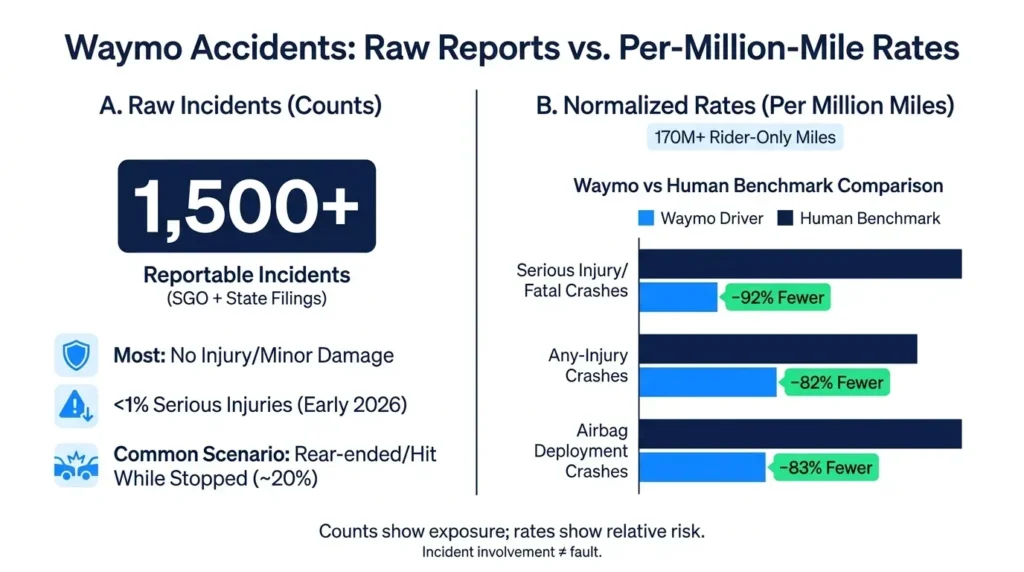
According to the NHTSA Standing General Order (SGO) and state-level filings (like the California DMV), Waymo has been involved in over 1,500 reportable incidents since mid-2021.
The vast majority of these reports involve no injuries or minor property damage. By early 2026, only a small fraction (less than 1%) resulted in serious injuries.
A significant portion of these incidents, nearly 20% in some recent windows, involved other vehicles reversing into a stationary Waymo or rear-ending it at a red light. In these cases, the Waymo vehicle was involved in a crash but did not cause it.
The Performance Data: Crashes Per Million Miles
Because Waymo has now driven over 170 million rider-only miles, raw counts can be misleading. To get an accurate safety picture, we look at “normalized” rates (how many crashes occur for every million miles driven).
Recent peer-reviewed analyses and Waymo’s 2026 Safety Hub data reveal that compared to human drivers in the same cities (Austin, Phoenix, Los Angeles, and San Francisco), the Waymo Driver achieved:
- 92% fewer serious injuries or fatal crashes.
- 82% fewer crashes involving any reported injury.
- 83% fewer crashes where airbags were deployed.
In Austin, Waymo’s injury-causing crash rate is significantly lower than the local human benchmark, proving the system is adapting well to Texas road complexities.
Why This Data Matters for Your Claim
While the statistics suggest that Waymo vehicles are statistically safer than the average human driver, those averages don’t change your rights if you are the one involved in a collision.
If you are hit by a Waymo, this data helps your legal team identify patterns of failure. For example, if telemetry shows a specific software version struggles with “unprotected left turns” or “heavy rain in Austin,” that data becomes the foundation of a product liability or operational negligence claim.
Why “Incident Reports” Aren’t the Same as “Waymo Caused a Crash”
A high number of incident reports doesn’t automatically mean a company caused more crashes. A vehicle that drives millions of miles will naturally appear in more reports than one that barely operates. And “involved in an incident” is not the same as “caused the crash.”
Regardless of what the statistics show, your rights after a collision remain the same. Evidence and deadlines matter from day one.
SGO reports document certain ADS and Level 2+ driving system contexts. They don’t establish negligence, causation, or damages. Those elements still require investigation, evidence, and legal analysis.
For injured Texans, this means you build a liability case the same way you would after any car accident: gather evidence, establish who breached their duty of care, prove that breach caused your injuries, and document your damages.
Why Waymo Cases Are Not “Standard” Car Accidents
In a typical Texas crash, you sue the other driver for negligence. In a “no-occupant” Waymo crash, there is no driver. Through Transportation Code § 545, Subchapter J, the automated driving system (ADS) can be treated as the “operator” for purposes of traffic laws.
This shifts the legal battleground from “Did the driver look away?” to “Did the algorithm fail?”
Liability theories in these cases typically focus on:
- Algorithmic Negligence: Did the software make a predictable error that a human wouldn’t?
- Fleet Oversight: Did Waymo’s remote monitors fail to intervene when the vehicle entered a complex construction zone?
- Product Liability: Was a specific sensor or LiDAR unit defective?
Can Citations Support My Claim?
A traffic citation is evidence, but it’s not the same as civil liability. If a Waymo vehicle receives a citation for failing to yield, that citation can support your injury claim. But you still need to prove the full chain, including duty, breach, causation, and damages.
Who May Be Liable When a Waymo Self-Driving Car Crashes in Texas?
Liability depends entirely on the facts of your crash.
Common scenarios include:
- Another human driver caused the collision. If a distracted driver rear-ended the Waymo vehicle you were riding in, that driver’s negligence and insurance are primary targets.
- The ADS failed to operate safely. If the autonomous system made a decision that a reasonable human driver would not have made, the fleet operator may bear responsibility.
- Product defect. If a sensor, software component, or vehicle system malfunctioned, product liability claims against manufacturers may apply.
- Multiple parties share fault. Complex crashes often involve shared responsibility. Your attorney’s job is to identify all potential sources of recovery. Multiple parties may appear in an autonomous vehicle injury claim, including:
- The fleet operator (Waymo or its corporate entity).
- Any remote assistance personnel monitoring the vehicle.
- The vehicle owner.
- Other drivers involved in the crash.
- Component manufacturers (in product liability scenarios).
Insurance obstacles with these types of claims can be difficult to navigate. This is because multiple policies may apply, including the other driver’s liability coverage, the fleet’s commercial policy, and your own UM/UIM coverage.
Don’t assume “the company will just pay.” Insurance companies, including those covering autonomous vehicle fleets, aim to resolve claims for the lowest possible payout. This is also why you should avoid giving recorded statements until you understand your injuries and rights
Evidence That Can Make or Break an Autonomous Vehicle Injury Claim
You must prove someone breached their duty and that breach caused your injuries; because of this, evidence matters.
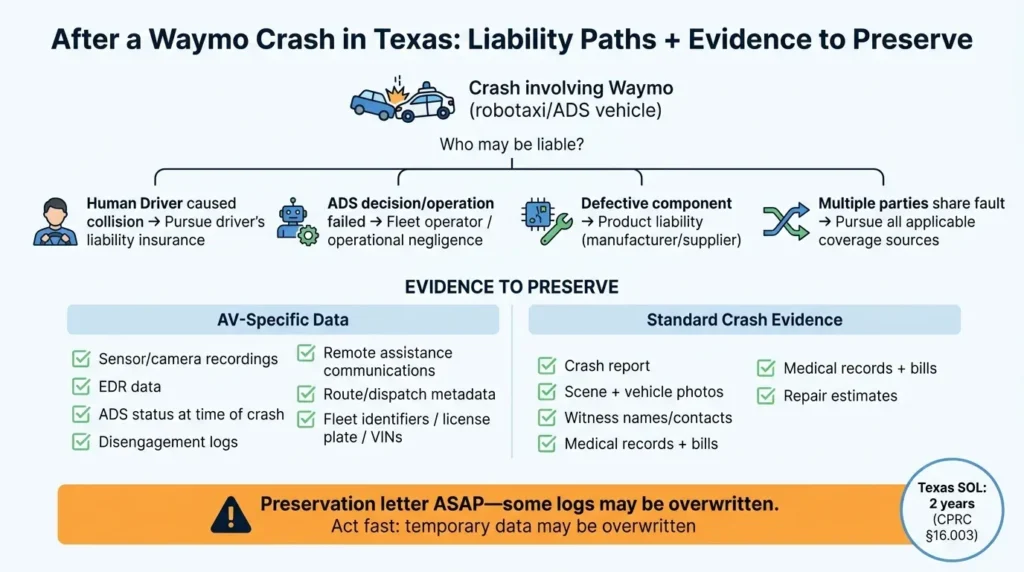
You should collect as much information from the crash as you can, including:
- Vehicle sensor and camera recordings
- Event data recorder (EDR) information
- ADS operational status at the time of the crash
- Disengagement logs
- Remote assistance communications
- Route and dispatch metadata
- The crash report
- Photos of the scene and vehicles involved
- Witness contact information and statements
- Your medical records
- Repair estiamtes
- Fleet identifiers and license plates
- VINs on all vehicles involved
Some of this data may be overwritten or stored only temporarily. A preservation letter sent early can prevent critical evidence from disappearing.
Whether you were a pedestrian, cyclist, occupant of another vehicle, or a robotaxi passenger, collecting ample evidence can help you protect your claim and rights.
What to Do If You Were a Waymo Rider vs. A Driver or Passenger in Another Vehicle
Waymo riders should save trip receipts, app screenshots showing pickup and dropoff locations, any in-app support messages, and incident reference numbers.
Other drivers, cyclists, and pedestrians should collect evidence and note any nearby security cameras that may have recorded the crash.
Ask witnesses to text you their name, phone number, and a brief description of what they saw. Memory fades quickly. Getting information in writing or recordings immediately helps preserve accurate accounts.
Deadlines for Personal Injury Claims in Texas
The statute of limitations for most Texas personal injury claims is two years from the date of the crash. Under Texas Civil Practice and Remedies Code § 16.003, missing this deadline typically bars your claim entirely.
Waiting too long to file a claim creates additional risks beyond the legal deadline, including the disappearance of evidence, losing witnesses, etc.
Autonomous vehicle cases often require more technical investigation than typical crashes. Experts may need to analyze ADS data, reconstruct the incident, and explain complex systems to insurers or juries. Starting early gives your legal team time to build the strongest possible case.
When to Talk to a Lawyer After a Waymo-Related Crash
Consider consulting an attorney if:
- You required emergency room treatment
- You’re experiencing head, neck, or back pain
- You’ve missed work due to your injuries
- Fault is disputed or unclear
- A commercial fleet was involved
- An insurer is pressuring you for recorded statements or a quick settlement
An attorney can send preservation letters immediately, coordinate evidence requests, manage communications with multiple insurers, and identify all available coverage sources.
Protect Your Rights After a Self-Driving Vehicle Crash
Self-driving car crashes raise questions most Texans never expected to face. The technology is new, but your right to compensation for injuries caused by someone else’s negligence remains the same.
At Angel Reyes & Associates, we’ve spent over 30 years helping injured Texans navigate complex claims. We offer free consultations, and you pay nothing unless we win. Our team has recovered more than $1 billion for clients across the state.If you’ve been hurt in a crash involving a Waymo or any other vehicle, contact us to discuss your situation. We’re available 24/7 and can handle most of your case remotely, no matter where you are in Texas.
Waymo Accident FAQs
Do Waymo crashes have to be reported to the federal government?
Certain crashes involving an automated driving system must be reported under NHTSA’s Standing General Order, but that reporting rule is about disclosure, not fault. A report can exist even when another driver appears to have caused the collision.
Can a police report alone prove who was responsible for a Waymo crash?
Not usually. A police report can be important evidence, but insurers and courts may also look at video, vehicle data, witness statements, and the full crash investigation.
What if I was a pedestrian or cyclist hit by a self-driving vehicle in Texas?
Your basic injury claim rights are generally the same as in any other traffic crash, but identifying nearby cameras, witnesses, and vehicle markings can be especially important. If possible, document the exact location, signal timing, and direction of travel before the scene changes.
Could more than one insurance policy apply after a Waymo-related crash?
Yes. Depending on the facts, there may be coverage through another driver, a commercial fleet policy, and sometimes your own uninsured/underinsured motorist coverage.
Can a Texas injury claim still move forward if no human was behind the wheel?
Yes. The absence of a human driver does not automatically prevent a claim, but the case may depend more heavily on company records, system-status evidence, and how Texas law applies to the vehicle’s automated driving system.
About the Authors

Angel Reyes
Writer
Angel L. Reyes, III is the Founder and Managing Partner of Angel Reyes & Associates. A nationally recognized trial attorney and business leader, Angel has helped over 70,000 injury victims recover more than $1 billion since founding the firm in 1993. Named to the Texas Super Lawyers list annually since 2008, Angel brings Wall Street experience, Ivy League education, and a deep commitment to client advocacy. He is a frequent legal commentator and published author with extensive contributions to legal scholarship, trial strategy, and consumer protection.

Graham Griffin
Editor
Graham Griffin is the Web & Content Manager at Angel Reyes & Associates, where he oversees content strategy, AI-powered workflows, a...

Angel Reyes
Reviewer
Angel L. Reyes, III is the Founder and Managing Partner of Angel Reyes & Associates. A nationally recognized trial attorney and business...