What Percentage of Motorcycle Accidents Are Fatal?


Every article on this site is researched by our internal team, reviewed for legal accuracy against current Texas law, and held to State Bar of Texas advertising standards before publication. We do not publish content that overstates outcomes or makes promises about results.
Learn more about our
editorial standards .
Key Takeaways
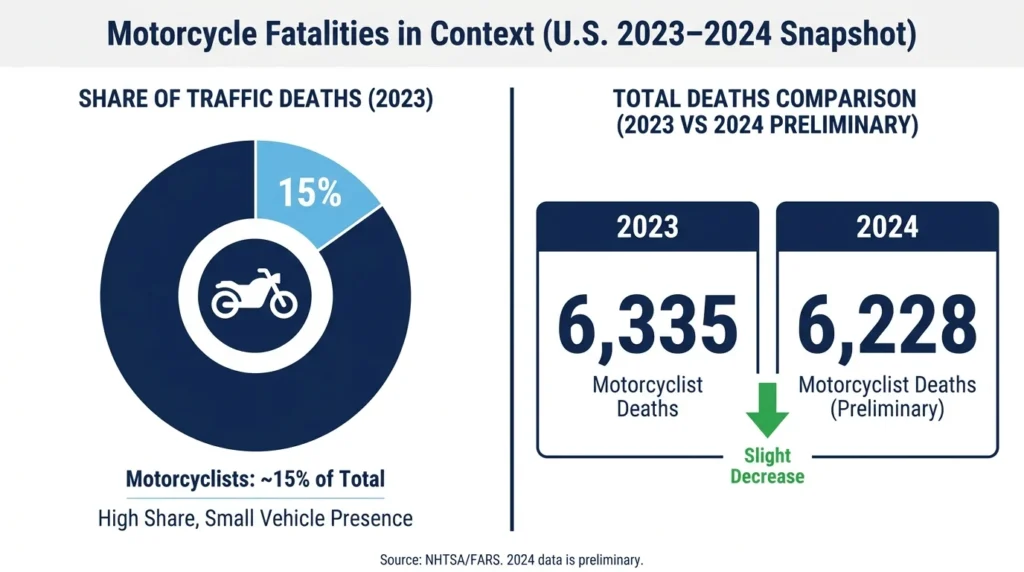
- Motorcyclists made up 15% of U.S. traffic deaths in 2023, with 6,335 riders killed nationwide.
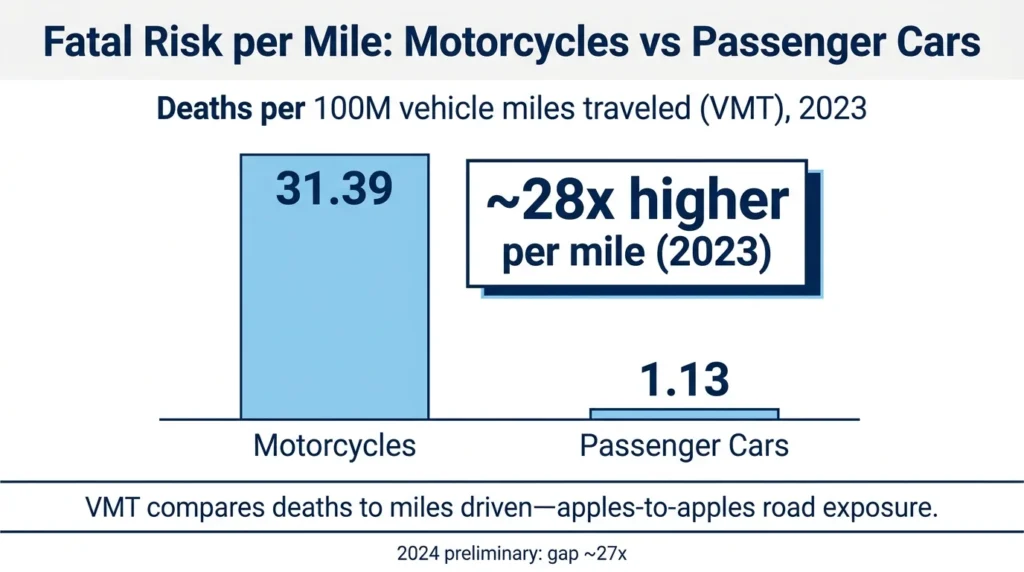
- Per mile traveled, motorcyclists died at about 28 times the rate of passenger car occupants.
- Texas recorded roughly 599 motorcycle fatalities in 2023, a 7% increase over the previous year.
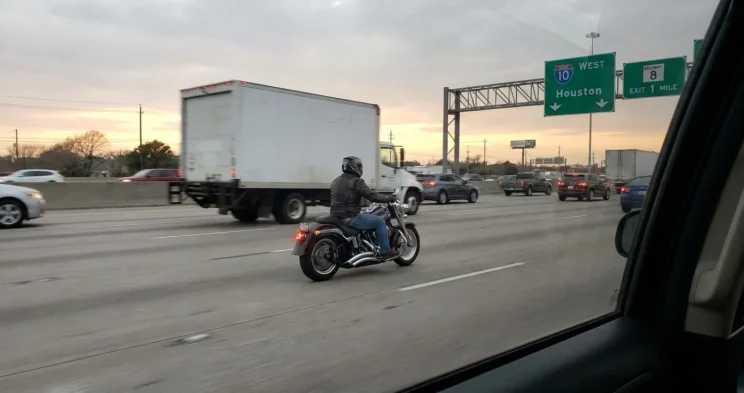
You finish a shift in Pasadena and head west on I-10 toward home, weaving past a slow-moving box truck near the Beltway. A friend just texted you a news clip about a fatal bike crash on the Gulf Freeway, and the question won’t leave your head: How dangerous is riding, really?
Motorcycle Accident Fatality Rate Nationwide
Motorcyclists made up about 15% of all U.S. traffic deaths in 2023, even though motorcycles are a tiny share of registered vehicles and miles driven. That year, NHTSA’s Fatality Analysis Reporting System recorded 6,335 motorcyclist deaths nationwide. Preliminary 2024 figures show 6,228 killed, a small drop but still near record highs.
Motorcycle riders die at a rate far out of proportion to how many of them are on the road.
That gap between exposure and risk is the key here. Two-wheeled vehicles offer no crumple zone, no airbag, and no metal cage to protect you. When something goes wrong, you absorb the impact directly, which is why motorcycle accident injuries tend to be more severe.
Motorcycle Deaths per Mile vs. Car Deaths per Mile
Per mile traveled, motorcyclists died at roughly 28 times the rate of passenger car occupants in 2023. NHTSA’s final motorcycle fatality rate figures show 31.39 motorcyclist deaths per 100 million vehicle miles traveled, compared to 1.13 for car occupants. Preliminary 2024 data narrows that gap slightly to about 27 times.
What does “per 100 million vehicle miles traveled” mean? It’s a way to compare risk fairly across vehicle types by measuring deaths against actual road exposure, not just total trips or registrations.
The longer trend is also worth noting. The National Safety Council reports motorcycle deaths have climbed roughly 24% over the last decade, even as overall traffic safety improved in some categories.
The per-mile rate is the cleanest way to picture comparative risk. Riding your motorcycle for five minutes to H-E-B is not 28 times more likely to kill you than driving there in a sedan in absolute terms, but each mile you travel on a bike carries more fatal exposure than each mile in a car.
If you ride often, the national numbers are worth knowing. They give you a baseline before looking at how Texas compares.
Texas Motorcycle Fatality Statistics
According to Texas CRIS data, Texas recorded 575 motorcycle fatalities in 2025, placing it once again among the states with the highest absolute fatality counts in the country. However, there is good news in this stat: that’s a 1.7% decrease in rider deaths compared to 2024. Of those fatalities, 167 occurred at intersections, or around 30% of the statewide total.
Some of Texas’s high motorcycle accident fatality count reflects sheer scale. The state has more drivers, more registered motorcycles, and more total miles ridden than most others. A larger pool of riders produces a larger fatality number, even when per-rider risk is similar to other states.
That adds context, but it doesn’t soften the trend. More Texans are dying on bikes year over year, and intersection crashes are climbing the fastest. While it’s not illegal to drive beside a motorcycle in Texas, drivers may be distracted when driving through or turning at an intersection.
Helmet Use & Motorcycle Fatality Outcomes
What the National Data Shows
NHTSA estimates helmets are 37% effective at preventing fatalities for motorcycle riders and 41% effective for passengers. Those effectiveness rates have held steady across decades of crash analysis.
Helmet use rates also track closely with state law. In 2023, data from the Insurance Institute for Highway Safety (IIHS) showed that 51% of motorcyclists killed in states without universal helmet laws were unhelmeted. In states with universal helmet laws, only 11% of killed riders were unhelmeted.
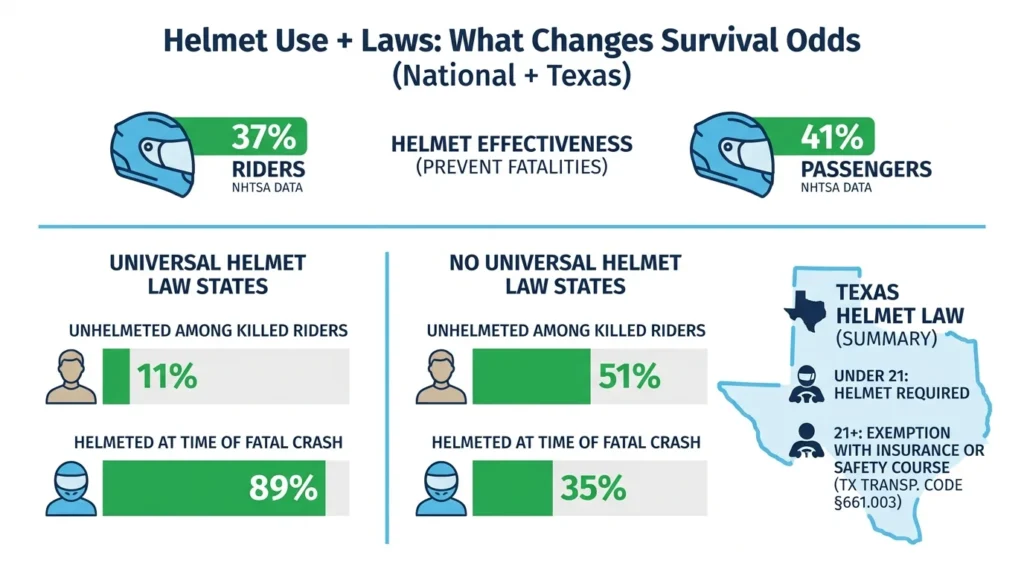
The usage gap is just as wide. In universal-law states, 89% of riders were helmeted at the time of a fatal crash. In states with no helmet law, only 35% were.
Texas Helmet Law & Its Scope
Texas requires riders under 21 to wear a helmet at all times. Riders 21 and older may legally ride without one if they carry health insurance covering motorcycle injuries or have finished an approved safety course, under Texas Transportation Code § 661.003.
Because Texas is not a universal-helmet-law state, the IIHS pattern likely applies here. Helmet use is lower than in universal-law states, and unhelmeted riders make up a larger share of fatalities. Families who lose a rider in a crash may want to understand their options under wrongful death laws.
Talk to an Attorney About Your Case
Statistics tell you the size of the risk, but they don’t tell you what to do after a serious crash injures or kills a rider you love. Angel Reyes & Associates handles Texas motorcycle accident claims and has represented injured riders and their families across the state for decades. Past results do not guarantee future outcomes.
We offer free consultations and work on contingency, meaning no fee unless we win. Learn more about our attorneys or contact us today to talk through your situation.
Motorcycle Accident FAQs
Can a motorcycle passenger's family file a wrongful death claim separately from the rider's family in Texas?
Yes. In Texas, each wrongful death claim belongs to the eligible family members of the person who died, so a passenger’s family and a rider’s family can each pursue separate claims arising from the same crash.
Does motorcycle type affect fatal crash risk?
Yes. NHTSA data shows that supersport motorcycles have a disproportionately high fatality rate compared to standard or cruiser models, largely because riders travel at higher speeds. Touring and cruiser-style bikes tend to show lower fatality rates per registered vehicle.
Are motorcycle fatalities more likely to happen in urban or rural areas?
Nationally, about 60% of motorcycle fatalities occur on urban roads, though rural crashes tend to be more severe per incident because of higher speeds and longer emergency response times.
Do most fatal motorcycle crashes involve another vehicle, or are single-vehicle crashes more common?
About half of fatal motorcycle crashes are single-vehicle incidents, meaning no other car or truck was involved. The other half involve a collision with at least one other vehicle; a left-turning car hitting a rider is a common scenario.
Is a motorcycle rider's estate entitled to a survival claim in Texas even if the rider died at the scene?
Yes. Under Texas Civil Practice and Remedies Code Chapter 71, a survival claim allows the estate to recover for damages the rider suffered before death, such as conscious pain, separate from what eligible family members may recover through a wrongful death claim.
About the Authors

Alex Ivanov
Writer
Alex Ivanov is a personal injury attorney at Angel Reyes & Associates, focused on car, truck, and motorcycle accident cases. Licensed in Texas and multiple federal districts, Alex brings international legal experience and a global education to his practice. He earned his LL.M. from Texas A&M University School of Law after graduating from Belarussian State University in 2016. Alex is fluent in Russian, English, Ukrainian, and Belarussian, and is recognized by multiple national trial lawyer associations for his results and leadership under 40.

Kyle Nicolas
Editor
Kyle Nicolas is the Web Content & SEO Manager at Angel Reyes & Associates. He has more than 10 years of experience as a marketing co...

Angel Reyes
Reviewer
Angel L. Reyes, III is the Founder and Managing Partner of Angel Reyes & Associates. A nationally recognized trial attorney and business...