Common Motorcycle Accident Injuries in Texas


Every article on this site is researched by our internal team, reviewed for legal accuracy against current Texas law, and held to State Bar of Texas advertising standards before publication. We do not publish content that overstates outcomes or makes promises about results.
Learn more about our
editorial standards .
Key Takeaways
- Texas riders have two years from the crash date to file a motorcycle injury claim under CPRC § 16.003.
- Riders found 51% or more at fault for a motorcycle crash recover nothing under Texas law.
- Lower extremity fractures, TBI, and spinal cord injuries lead motorcycle crash injury frequency rankings.
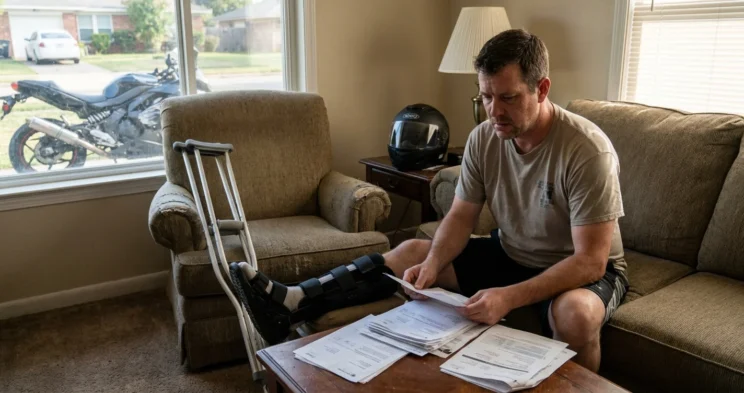
You were heading west on I-30 toward Arlington when a driver drifted into your lane and clipped your handlebars. The next thing you remember is the pavement, the sound of traffic, and a pain in your leg you cannot yet name. Now that you are home, the diagnosis is starting to come into focus, and the bills are not waiting.
In 2025 alone, more than 2,500 riders suffered suspected serious injuries as a result of a motorcycle crash. Eighty-six percent of all crashes resulted in some level of an injury, so understanding the most common ones can give you some insight into what to expect with your claim.
How Motorcycle Crashes Produce Serious Injuries
Motorcyclists absorb crash forces directly. There are no crumple zones, no airbags, and no seatbelts between the rider and the road. According to NHTSA motorcycle safety data, riders are far more likely to sustain fatal or incapacitating injuries per mile traveled than people in passenger cars.
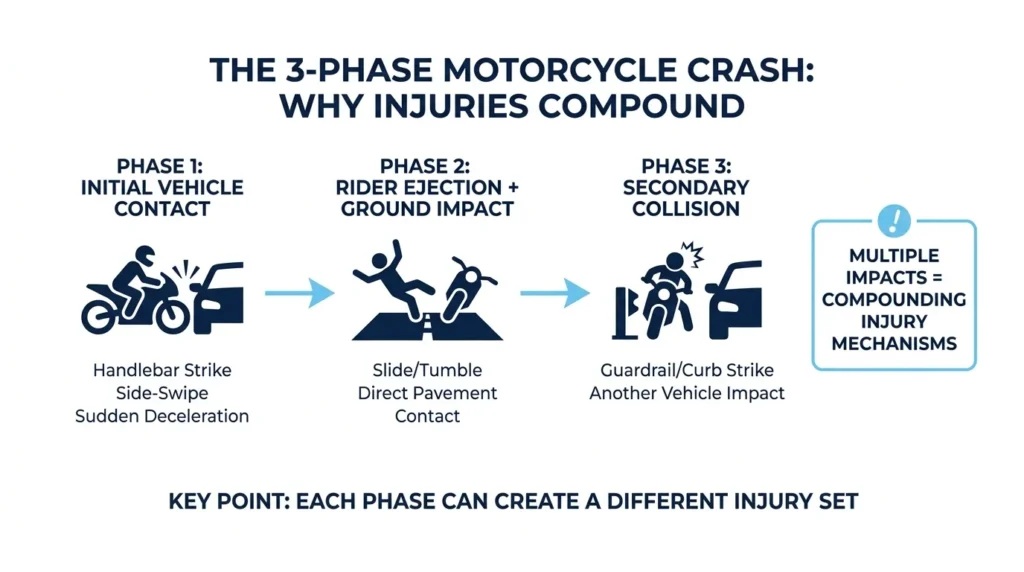
The impact rarely happens in one stage. A rider is thrown forward, hits the ground, and may then collide with a guardrail or another vehicle. Each phase produces its own pattern of motorcycle crash injuries that Texas riders see in emergency rooms.
Lower extremity injuries lead the frequency tables, followed by upper extremity and head injuries. That ranking is consistent across NHTSA crash injury research and trauma literature. The sections below walk through ten injury categories and how each connects to a Texas claim.
The Most Common Motorcycle Accident Injuries
Ten injury categories cover most motorcycle crash diagnoses. Each one carries different treatment timelines, different documentation needs, and different weights in a claim. Identifying where your injury fits is the starting point for understanding what damages you may recover and what records you need to preserve.
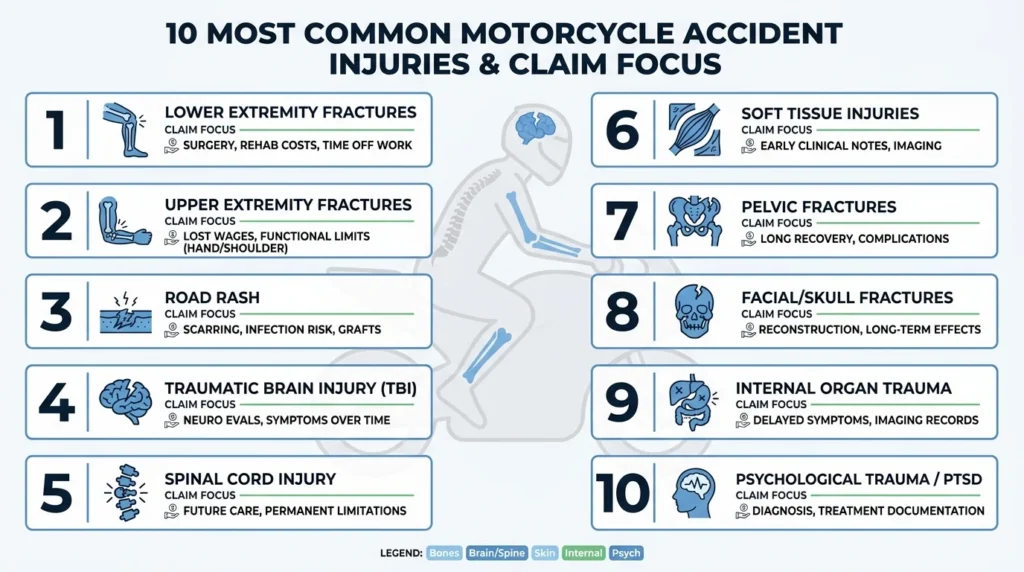
- Lower extremity fractures. Tibia, fibula, and femur fractures top the frequency lists. These injuries often need surgery and months of rehabilitation, and they document well as economic damages. Peer-reviewed trauma research on lower extremity injuries confirms these as the leading injury category by body region.
- Upper extremity fractures. When riders brace for impact, fractures to the clavicle, radius, and ulna follow. A motorcycle accident claim involving broken bones typically includes lost wages, since the injuries often affect the dominant hand or shoulder.
- Road rash. Pavement contact strips skin in layers. A road rash injury claim can range from minor abrasion treatment to skin grafts, scarring, and a risk of infection. Severity tracks closely with speed and what the rider was wearing.
- Traumatic brain injury (TBI). TBIs run from concussion to diffuse axonal injury. Helmet use affects both the medical picture and the legal one.
- Spinal cord injury. Cervical and thoracic damage can produce permanent neurological loss. Even incomplete spinal cord injuries from motorcycle accidents often result in chronic pain and lasting limits on both work and daily life. These claims tend to be high value because the future care costs are large.
- Soft tissue injuries. Whiplash, sprains, and strains are real injuries that insurers frequently undervalue. Document them early with imaging and clinical notes.
- Pelvic fractures. High-energy impacts produce pelvic ring and acetabular (the socket portion of the hip joint) fractures. Internal bleeding is a known complication, and recovery is long.
- Facial and skull fractures. Orbital, mandible, and skull fractures appear in unhelmeted riders and in helmeted riders who took an impact beyond the helmet’s protection zone.
- Internal organ trauma. Blunt abdominal force can damage the spleen, liver, or kidneys without immediate symptoms. Delayed diagnosis is common and is important for treatment records.
- Psychological trauma and Post-Traumatic Stress Disorder (PTSD). TBI caused by a motorcycle accident can leave cognitive symptoms long after the bones heal, and many riders also develop PTSD, anxiety, or depression. These are recognized diagnoses and are compensable as non-economic damages when supported by treatment records.
If your injury appears on this list, the next question is how Texas law applies, and a Texas motorcycle accident claim attorney can map your diagnosis to the damages categories that fit.
Texas Helmet Law & Comparative Fault
Two Texas rules shape almost every motorcycle injury claim: the helmet requirement and the proportionate responsibility framework. These are different rules with different consequences, and riders often confuse them. Helmet status alone does not decide your case, but it can affect how fault is allocated and how much you recover.
Texas Helmet Requirements
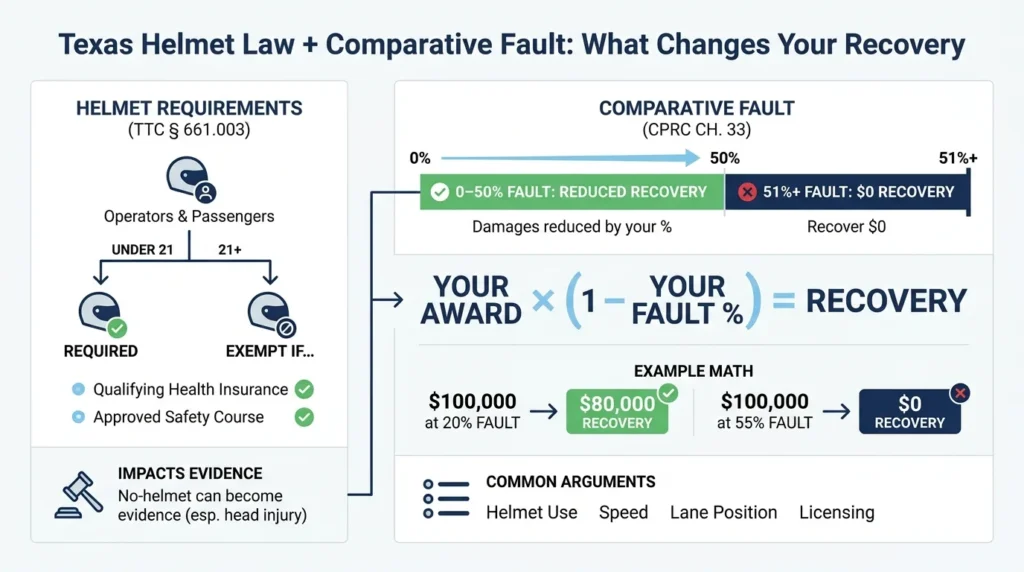
The Texas Transportation Code § 661.003 requires helmets for all motorcycle operators and passengers. Riders 21 or older are exempt if they carry qualifying health insurance or have completed an approved motorcycle safety course.
Riding without a helmet when § 661.003 requires one gives the other side a factual basis to argue comparative fault. It does not block a TBI claim, but it does mean helmet condition, type, and use at the time of the crash become evidence.
How Comparative Fault Affects Your Recovery
Texas uses a modified comparative fault rule under the Texas Civil Practice and Remedies Code (CPRC) Chapter 33. If you are found 51% or more responsible for the crash, you recover nothing. At 50% or below, your damages are reduced by your assigned percentage.
That math is critical in Texas motorcycle crash cases, as an unhelmeted rider with a head injury may face an argument that they share responsibility for the harm. The same analysis applies to factors like speed, lane position, and licensing status at the time of the crash. Other lane-related issues, including whether driving beside a motorcycle is illegal in Texas, can also factor into how fault is divided.
Texas does not cap damages on standard motorcycle injury claims outside the medical malpractice context. Full economic and non-economic damages remain on the table.
Filing a Motorcycle Injury Claim in Texas
You have two years from the date of the crash to file a personal injury lawsuit under Texas Civil Practice and Remedies Code § 16.003. Miss it, and the claim is gone, regardless of how serious the injury is. That deadline applies to every motorcycle injury settlement Texas riders pursue, from a broken wrist to a catastrophic spinal injury.
Medical documentation drives claim value. The chain matters: emergency visit, imaging, surgery records, specialist follow-up, physical therapy, and any ongoing care. Each link supports a damages category, from treatment costs to lost wages to future care.
Psychological injury claims need the same rigor as medical claims, since self-reported symptoms are not enough on their own. PTSD and anxiety claims rarely survive insurer review without diagnosis and treatment records from a licensed mental health provider.
Internal organ injuries and other delayed-onset diagnoses are a strong reason not to settle quickly. An adjuster’s offer that arrives in the first week after the accident often does not reflect injuries that have not yet shown up on imaging.
When a crash is fatal, surviving family members may pursue a Texas wrongful death claim under a separate statutory framework. The deadlines and damages categories there work differently from a personal injury suit.
Speaking with an attorney early helps you understand both the deadline and the documentation, and our motorcycle accident case results show how the type of injury and the quality of evidence shape outcomes.
Talk to a Texas Motorcycle Accident Attorney
With over 30 years of experience and $1 billion recovered, Angel Reyes & Associates features a team of more than 600 dedicated professionals available 24/7 across more than 20 offices statewide to handle motorcycle accident injury claims in both English and Spanish.
Our trial-ready Texas attorneys can review your medical records, assess fault, and handle most of your case remotely. We work on contingency, meaning no fee unless we win, and free consultations are available 24/7; contact us today to talk through your claim.
Past results do not guarantee future outcomes.
Motorcycle Injury FAQs
Can a passenger on a motorcycle file a separate injury claim in Texas?
Yes. A motorcycle passenger injured in a crash can file their own personal injury claim against any at-fault party, including the motorcycle’s operator if that person was negligent. The same two-year filing deadline and proportionate responsibility rules apply to the passenger’s claim.
Does Texas require motorcycle riders to carry uninsured motorist coverage?
Texas law does not require motorcyclists to carry uninsured or underinsured motorist coverage, though insurers must offer it. If an at-fault driver has no insurance or too little coverage, a rider without this optional coverage may have limited options for collecting damages.
What happens to a motorcycle injury claim if the at-fault driver was texting?
Distracted driving evidence, including phone records showing active use at the time of the crash, can support a finding that the other driver bears a high percentage of fault. In some cases, especially reckless conduct, distracted driving evidence may also open the door to exemplary damages under the Texas Civil Practice and Remedies Code Chapter 41.
Can a rider recover damages for a motorcycle that was totaled in the crash?
Yes. Property damage to the motorcycle is a separate recoverable economic loss from the personal injury claim, and both can be pursued against the at-fault party. Repairs, total loss value, and the cost of substitute transportation during the repair period can all be documented and claimed.
How does a pre-existing injury affect a motorcycle accident claim in Texas?
About the Authors

Alex Ivanov
Writer
Alex Ivanov is a personal injury attorney at Angel Reyes & Associates, focused on car, truck, and motorcycle accident cases. Licensed in Texas and multiple federal districts, Alex brings international legal experience and a global education to his practice. He earned his LL.M. from Texas A&M University School of Law after graduating from Belarussian State University in 2016. Alex is fluent in Russian, English, Ukrainian, and Belarussian, and is recognized by multiple national trial lawyer associations for his results and leadership under 40.

Kyle Nicolas
Editor
Kyle Nicolas is the Web Content & SEO Manager at Angel Reyes & Associates. He has more than 10 years of experience as a marketing co...

Angel Reyes
Reviewer
Angel L. Reyes, III is the Founder and Managing Partner of Angel Reyes & Associates. A nationally recognized trial attorney and business...