Motorcycle vs. Truck Accident in Texas: Liability, Evidence & Your Rights


Every article on this site is researched by our internal team, reviewed for legal accuracy against current Texas law, and held to State Bar of Texas advertising standards before publication. We do not publish content that overstates outcomes or makes promises about results.
Learn more about our
editorial standards .
Key Takeaways
- Trucking companies can be held liable alongside the driver under Texas respondeat superior law.
- Black box data in commercial trucks may be overwritten within 30 days if not legally preserved.
- Texas gives motorcycle crash victims two years to file, but evidence disappears far sooner.
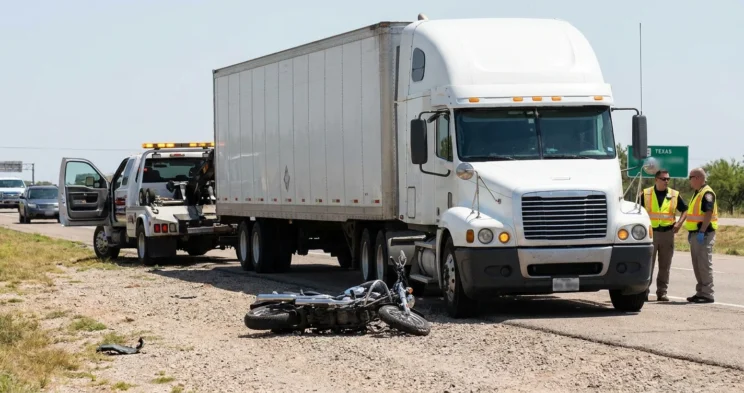
You were heading out toward Katy on I-10 when an 18-wheeler drifted into your lane without warning. The driver never saw you. What followed happened in seconds, but the questions it left behind will take months to answer.
Who is responsible? Is it just the driver, or does the company behind that truck share the blame? And what happens to the evidence sitting inside that truck’s computer right now?
A motorcycle crash involving a commercial truck or semi-trailer is not handled the same way as a collision between two cars. The rules are different, the evidence is different, and the number of parties who can be held liable is often different too.
Why Motorcycle Truck Crashes Are Different
A fully loaded commercial truck can weigh up to 80,000 pounds under federal law. A standard motorcycle weighs 300 to 500 pounds. That gap in mass creates a severity difference that is difficult to overstate.
Commercial trucks operated in interstate commerce are governed by federal regulations from the Federal Motor Carrier Safety Administration (FMCSA). Those regulations create evidence sources and liability standards that simply do not exist in everyday crashes. Under 49 CFR Part 387, trucking companies must carry a minimum of $750,000 in liability insurance for general freight.
That is more than 25 times Texas’s minimum for passenger vehicles. When a crash causes serious injuries, those policy limits matter enormously.
The combination of higher insurance coverage and multi-party liability is why motorcycle-truck cases often carry significantly higher value than crashes involving only private passenger vehicles and motorcycles.
Who Can Be Held Liable in a Texas Truck Crash
The driver who hit you may not be the only party responsible. Commercial truck crashes regularly involve multiple defendants, and each may carry separate insurance coverage.
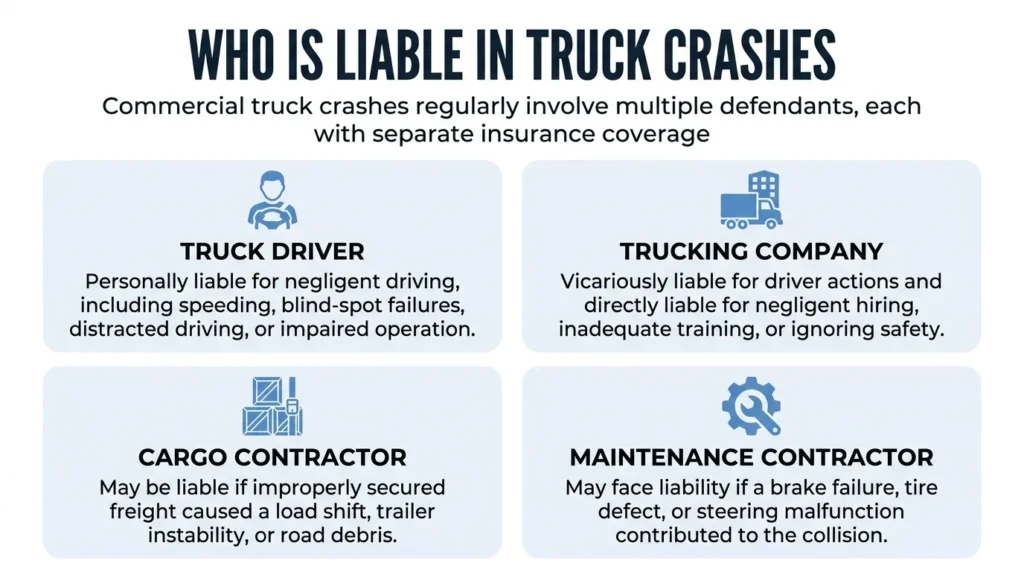
The truck driver faces personal liability for negligence: speeding, distracted driving, failure to check mirrors and blind spots before a lane change, or driving in an impaired state. But the driver’s employer may face liability too.
A trucking company is vicariously liable for a driver’s negligence when the driver was acting within the scope of employment at the time of the crash. Texas law also allows direct claims against the company for negligent hiring, inadequate driver training, or ignoring known safety violations.
If the company knew a driver had a history of hours-of-service violations and kept them on the road anyway, liability follows.
Beyond the driver and the company, a cargo loading contractor may be independently liable if improperly secured freight caused a load shift, trailer instability, or debris. A maintenance contractor may face liability if a brake failure, tire defect, or steering malfunction contributed to the crash.
Each of these parties carries its own insurance, and each is subject to Texas’s proportionate responsibility framework under Texas Civil Practice and Remedies Code Chapter 33. A claimant can recover damages unless their own share of fault exceeds 50%.
Federal Evidence That Only Exists in Truck Cases
Commercial trucks carry a layer of evidence that passenger cars do not. Knowing it exists — and knowing it disappears fast — can change the outcome of your case.
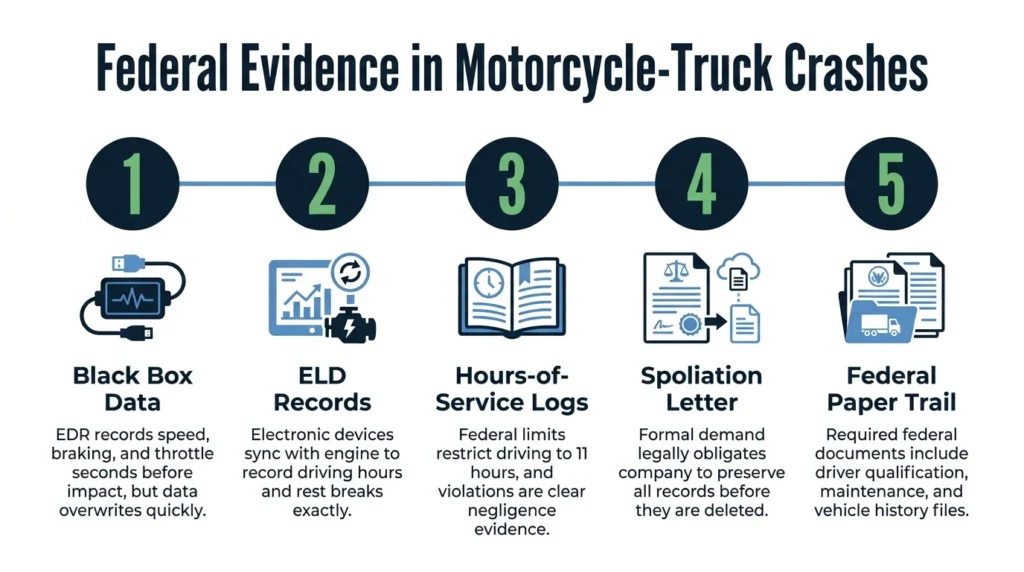
Step 1: Secure the black box data. Most commercial trucks are equipped with an Event Data Recorder (EDR), sometimes called the black box or ECM. It records speed, braking input, throttle position, and engine activity in the seconds before a crash. This data can be overwritten, or deleted, in as few as 30 days.
See how black box evidence works in Texas truck cases for a full breakdown of what the device captures and how attorneys use it.
Step 2: Request the Electronic Logging Device records. Since December 2017, the FMCSA has required most commercial drivers to use Electronic Logging Devices (ELDs). These devices sync with the truck’s engine and automatically record every change in duty status, every hour driven, and every rest break. The ELD data is a precise, timestamped record of exactly how long that driver had been on the road before the crash.
Step 3: Analyze the Hours-of-Service logs. Under 49 CFR Part 395, property-carrying truck drivers are limited to 11 hours of driving within a 14-hour on-duty window, after taking 10 consecutive hours off duty.
A driver who exceeded those limits has committed a documented federal violation. That violation is objective evidence of negligence. It does not require an expert to interpret. It is a line in a log that either complies or it does not.
Step 4: Send a spoliation letter, or a formal letter that legally obligates the company to preserve all digital and physical records. Without it, the company is under no obligation to protect data that has not yet been overwritten.
Step 5: Pull the full federal paper trail. Driver qualification files, pre-trip inspection reports, maintenance records, and vehicle inspection histories are all part of a commercial trucker’s required documentation. None of this exists in a standard car crash claim.
Texas Filing Deadline & What It Means for Your Case
Texas gives you two years from the date of the crash to file a personal injury lawsuit under the Texas Civil Practice and Remedies Code (CPRC) Section 16.003. Miss that window and your right to sue is almost certainly gone, regardless of how strong the case is.
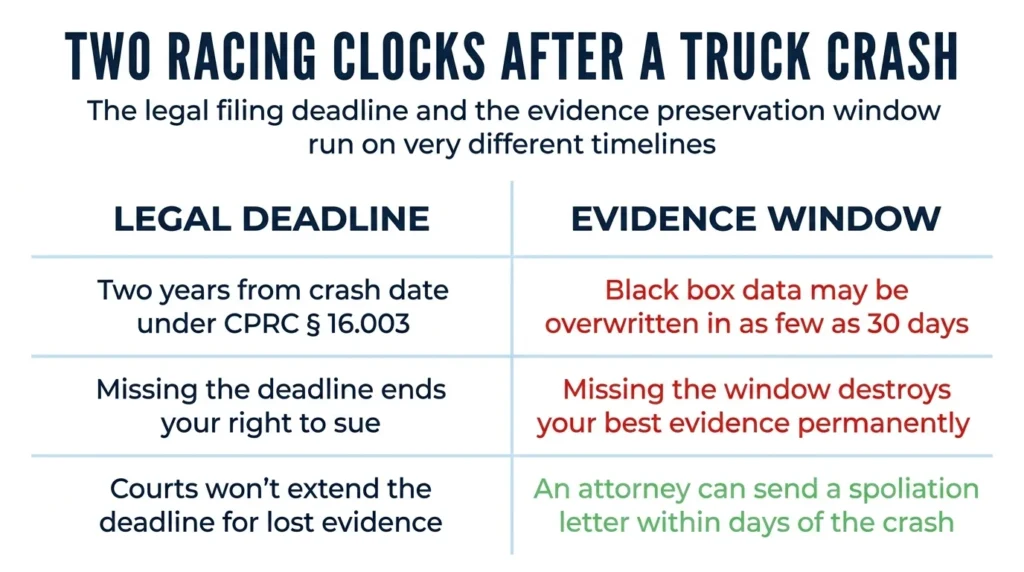
The statute of limitations and the evidence preservation timeline are two different races. The legal deadline is two years. The black box data window may be 30 days. Those timelines do not align, and the shorter one is the one that determines whether you walk into court with your best evidence.
Courts will not grant extensions because evidence was lost. An attorney can begin the preservation process within days of a crash. Understanding how a Texas truck accident claim moves from the initial crash through resolution helps you make informed decisions at each stage.
Talk to an Attorney About Your Motorcycle Crash
A crash with a commercial truck puts you up against a company with experienced claims handlers, legal teams, and an interest in settling your case for as little as possible. You do not have to handle that alone.
Angel Reyes & Associates has handled commercial truck crash cases for injured Texans for over 30 years. We work on contingency, meaning you pay nothing unless we win. Our team can send spoliation letters immediately, identify every potentially liable defendant, and deal with the trucking company’s insurance team so you can focus on your recovery.
We have more than 20 office locations across Texas and can handle most, if not all, of your case remotely. Our experienced attorneys bring the resources that these cases demand. Contact us today for a free consultation.
Past results do not guarantee future outcomes.
Motorcycle Truck Accident FAQs
Can I still sue the trucking company if the driver was listed as an independent contractor?
Possibly. Texas courts look at whether the company controlled the driver’s schedule, routes, and compliance requirements, not just the label on the contract. If the company exercised significant control, vicarious liability may still attach even without an employment relationship.
What types of damages can I recover after a motorcycle truck accident in Texas?
You can pursue economic damages for medical bills, lost wages, and future treatment costs, as well as non-economic damages for pain, emotional distress, and loss of enjoyment of life. Punitive damages may be available in cases involving reckless or willful conduct, but only if the case goes to trial.
How long does it typically take to settle an 18-wheeler crash claim in Texas?
Most commercial truck accident claims settle between six months and two years, depending on injury severity, the number of liable parties, and how cooperatively the insurer handles negotiations. Cases with multiple defendants or disputed liability tend to take longer.
Does not wearing a helmet affect my right to compensation in Texas?
Riders over 21 who completed a safety course or carry adequate insurance are not required by Texas law to wear a helmet. If you were not legally required to wear one and chose not to, that alone does not bar your claim, though insurers may argue it contributed to the severity of your head injuries under Texas’s comparative fault rules.
What is a DOT number and why does it matter after a truck crash?
A DOT number is a unique identifier assigned by the FMCSA to commercial motor carriers operating in interstate commerce. Collecting it from the truck’s door at the scene gives your attorney a direct path to the carrier’s federal safety records, inspection history, and insurance filings, all of which may be relevant to your claim.
About the Authors

Alex Ivanov
Writer
Alex Ivanov is a personal injury attorney at Angel Reyes & Associates, focused on car, truck, and motorcycle accident cases. Licensed in Texas and multiple federal districts, Alex brings international legal experience and a global education to his practice. He earned his LL.M. from Texas A&M University School of Law after graduating from Belarussian State University in 2016. Alex is fluent in Russian, English, Ukrainian, and Belarussian, and is recognized by multiple national trial lawyer associations for his results and leadership under 40.

Kyle Nicolas
Editor
Kyle Nicolas is the Web Content & SEO Manager at Angel Reyes & Associates. He has more than 10 years of experience as a marketing co...

Alex Ivanov
Reviewer
Alex Ivanov is a personal injury attorney at Angel Reyes & Associates, focused on car, truck, and motorcycle accident cases. Licensed in...