Can You Ride an E-Bike on the Sidewalk in Texas?


Every article on this site is researched by our internal team, reviewed for legal accuracy against current Texas law, and held to State Bar of Texas advertising standards before publication. We do not publish content that overstates outcomes or makes promises about results.
Learn more about our
editorial standards .
Key Takeaways
- Class 1 and Class 2 e-bikes may operate on Texas sidewalks under state law unless a local ordinance prohibits them. Class 3 e-bikes face additional path restrictions.
- Dallas prohibits sidewalk riding in its CBD; Houston prohibits it in business districts; San Antonio has restrictions under its municipal code.
- Riding in a sidewalk-prohibited zone at the time of an accident can be raised as a comparative fault argument under the Texas proportionate responsibility law.

The answer depends on two things: the class of your e-bike and the city you are riding in. Texas law generally allows Class 1 and Class 2 e-bikes on sidewalks unless a local ordinance prohibits it. Class 3 e-bikes face additional restrictions under state law.
Texas Rules for Riding E-Bikes on Sidewalks
Texas Transportation Code Chapter 664 classifies electric bicycles into three classes and generally gives them the same rights and responsibilities as traditional bicycles.
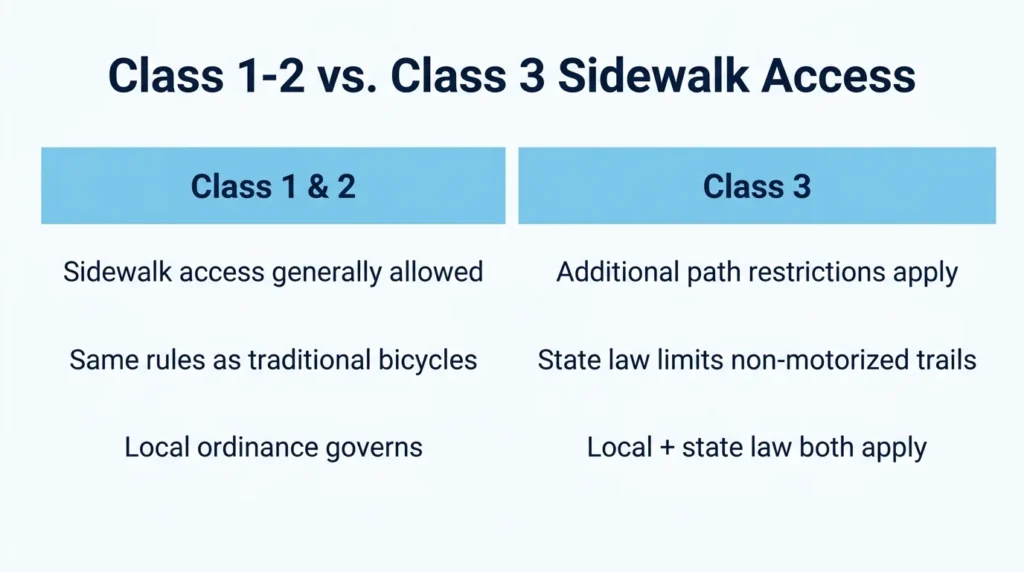
- Class 1 and Class 2 e-bikes may usually operate anywhere traditional bicycles are allowed under Texas law, including sidewalks, unless a local ordinance prohibits it. Cities may still impose additional restrictions.
- Class 3 e-bikes face additional limits under Texas law. Texas Transportation Code § 664.012 prohibits Class 3 e-bikes from operating on bicycle paths or trails designated exclusively for non-motorized traffic unless a local authority allows it.
Because Class 3 e-bikes can reach speeds up to 28 mph, access to pedestrian-shared spaces is more restricted. Class 1 and Class 2 riders should still check local city rules before riding on sidewalks. Class 3 riders need to understand both local sidewalk rules and the additional state restrictions that apply to higher-speed e-bikes.
City-by-City Sidewalk Rules for E-Bikes
Sidewalk rules vary across Texas cities. Checking your city’s current ordinance before riding is the safest approach.
Austin
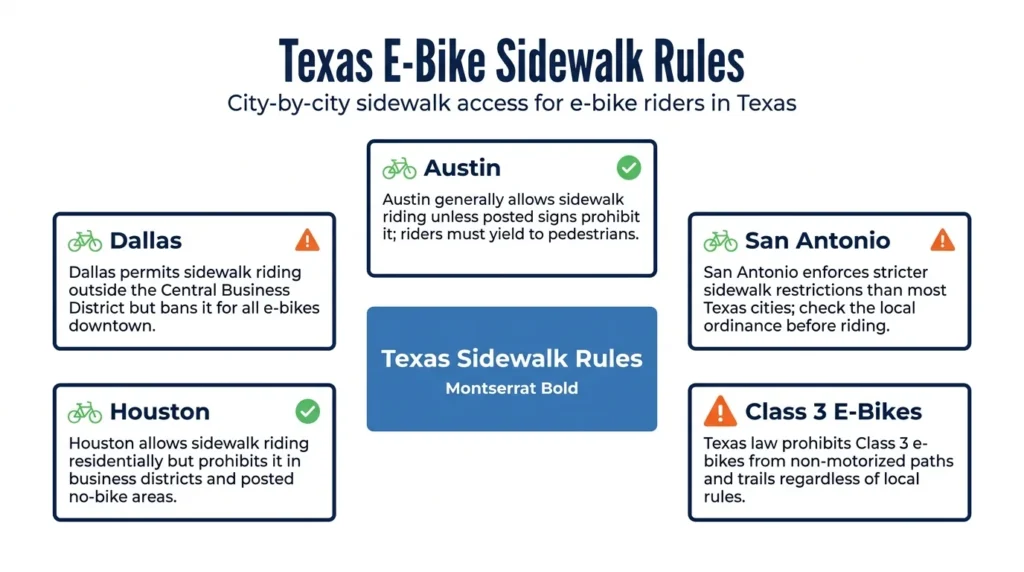
Austin generally allows sidewalk riding unless posted signs prohibit it in a specific area. If you ride in Austin, you must yield to pedestrians and ride carefully around foot traffic. If you have a Class 3 e-bike, you should also check whether certain trails or shared-use paths carry additional local restrictions.
Dallas
Dallas permits sidewalk riding outside the Central Business District. Riding on sidewalks in downtown Dallas is prohibited for all e-bike classes. If you are riding in or near the CBD, you need to know the boundaries of that restriction.
Houston
Houston generally allows sidewalk riding in residential areas. However, riding is prohibited in business districts and anywhere “no bikes” signs are posted. If you ride in Houston, you should pay close attention to posted signs when moving between residential and commercial areas.
San Antonio
San Antonio has historically enforced stricter sidewalk riding rules than many other Texas cities. Before you ride on a sidewalk in San Antonio, you should check the current local rules to confirm whether sidewalk access is allowed in your area.
How Sidewalk Status Affects Your Liability After an Accident
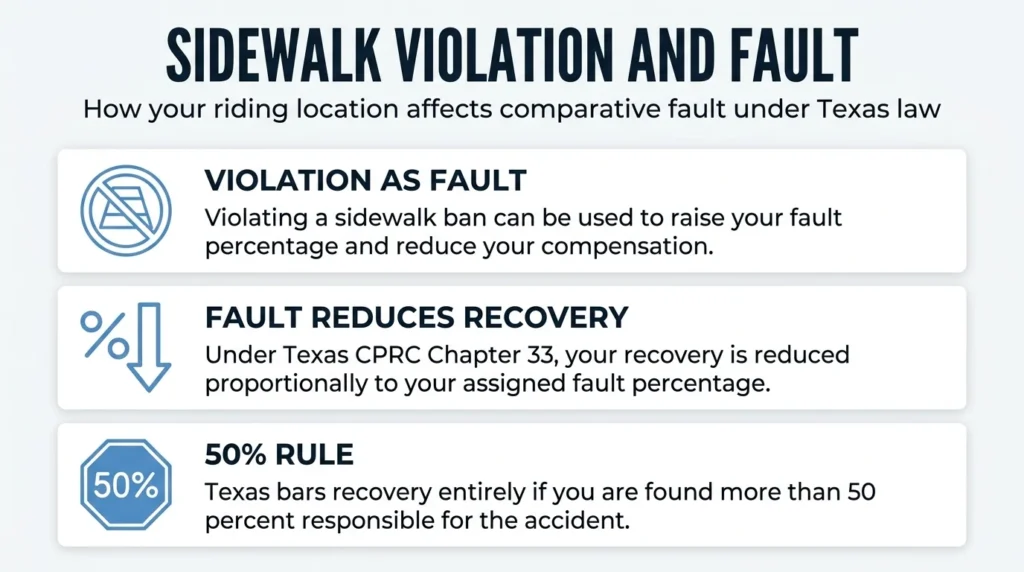
Where you were riding at the time of the accident can affect your injury claim. If you were riding in an area where sidewalk riding was prohibited, the other side may argue that you contributed to the accident. Texas proportionate responsibility governs the outcome under CPRC Chapter 33. Your assigned fault percentage reduces your recovery. If you are found more than 50 percent responsible, recovery is barred entirely.
If you were riding on a sidewalk that local law allowed you to use, the other side may have a harder time blaming you for the accident. If you were riding in a prohibited area, that violation could reduce your compensation or prevent recovery entirely. If another driver caused your crash, understanding how fault works in bicycle accident claims may also help you understand what to expect during the insurance process.
An attorney can evaluate how strong the sidewalk-violation argument is in your specific situation. That includes whether the restriction applied to your class of e-bike, whether the ordinance was clearly posted or in effect, and what other evidence may affect fault after the accident.
Talk to an Attorney About an E-Bike Accident
E-bike accident claims often turn on details like where you were riding, what class of e-bike was involved, and whether local ordinances applied. Learning how fault works after an e-bike accident in Texas can also help you see how fault may affect your compensation. We can help you assess the facts and explain how Texas e-bike laws may apply to your situation.
Angel Reyes & Associates has represented injury victims across Texas for more than 30 years. We have recovered more than $1 billion for our clients. We offer free initial consultations and work on a no-fee-unless-you-win basis. You can review outcomes from past cases we have handled to understand how we approach these claims. To discuss your situation, contact us for a free consultation.
Past results do not guarantee future outcomes.
Texas E-Bike Sidewalk FAQs
Does riding on the sidewalk affect my injury claim?
Yes. If you were riding in an area where sidewalk riding was prohibited, the other side may argue that you contributed to the accident. Texas uses proportionate responsibility rules under CPRC Chapter 33, which means your percentage of fault may reduce your compensation.
What is the difference between Class 1, 2, and 3 e-bikes for sidewalk purposes?
Class 1 and Class 2 e-bikes generally follow the same sidewalk rules as traditional bicycles under Texas law unless a local ordinance says otherwise. Class 3 e-bikes face additional restrictions because they can reach higher speeds. Some shared-use paths and non-motorized trails may prohibit Class 3 e-bikes even when lower-speed e-bikes are allowed.
Can police ticket you for riding an e-bike on the sidewalk in Texas?
Possibly. Some Texas cities restrict sidewalk riding in business districts, downtown areas, or posted zones. Riders who violate local ordinances may receive citations depending on local enforcement practices.
Are sidewalk riding rules different for Class 3 e-bikes?
Yes. Class 3 e-bikes face additional restrictions under Texas law because they can reach higher speeds than Class 1 and Class 2 e-bikes. Some shared-use paths and non-motorized trails may prohibit Class 3 e-bikes even when lower-speed e-bikes are allowed.
Can local sidewalk rules change between Texas cities?
Yes. Texas state law allows cities to create their own sidewalk riding restrictions for e-bikes and bicycles. A sidewalk that is legal to ride on in one Texas city may be restricted in another, especially in downtown areas, business districts, or shared pedestrian zones.
About the Authors

Angel Reyes
Writer
Angel L. Reyes, III is the Founder and Managing Partner of Angel Reyes & Associates. A nationally recognized trial attorney and business leader, Angel has helped over 70,000 injury victims recover more than $1 billion since founding the firm in 1993. Named to the Texas Super Lawyers list annually since 2008, Angel brings Wall Street experience, Ivy League education, and a deep commitment to client advocacy. He is a frequent legal commentator and published author with extensive contributions to legal scholarship, trial strategy, and consumer protection.

Kyle Nicolas
Editor
Kyle Nicolas is the Web Content & SEO Manager at Angel Reyes & Associates. He has more than 10 years of experience as a marketing co...

Angel Reyes
Reviewer
Angel L. Reyes, III is the Founder and Managing Partner of Angel Reyes & Associates. A nationally recognized trial attorney and business...