How Long Does a Motorcycle Accident Lawsuit Take in Texas?


Every article on this site is researched by our internal team, reviewed for legal accuracy against current Texas law, and held to State Bar of Texas advertising standards before publication. We do not publish content that overstates outcomes or makes promises about results.
Learn more about our
editorial standards .
Key Takeaways
- Most Texas motorcycle accident lawsuits resolve within 12 to 24 months after filing, while complex cases can take 36 months.
- Texas law gives you two years from the crash date to file a personal injury lawsuit under CPRC § 16.003.
- Mediation is required before most Texas personal injury trials and is where most motorcycle accident lawsuits settle.
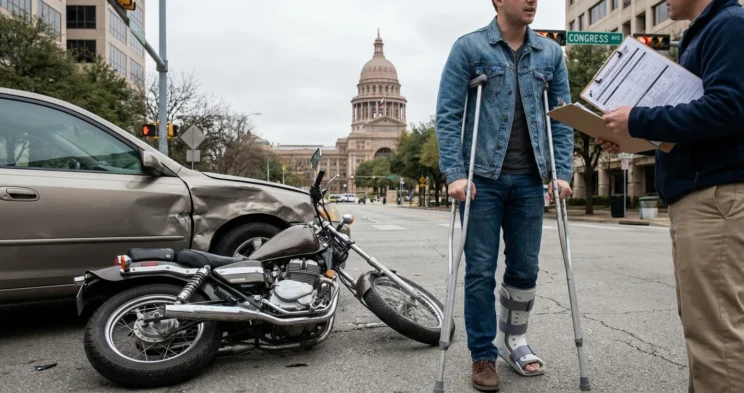
You were heading home through Stone Oak one evening when a driver ran a red light on Blanco Road and knocked you off your bike. Your injuries are serious, and the insurance company is offering far less than your claim is worth. You’ve decided to file a lawsuit, and now you’re wondering how long this is going to take.
Texas Motorcycle Lawsuits: The Realistic Timeline
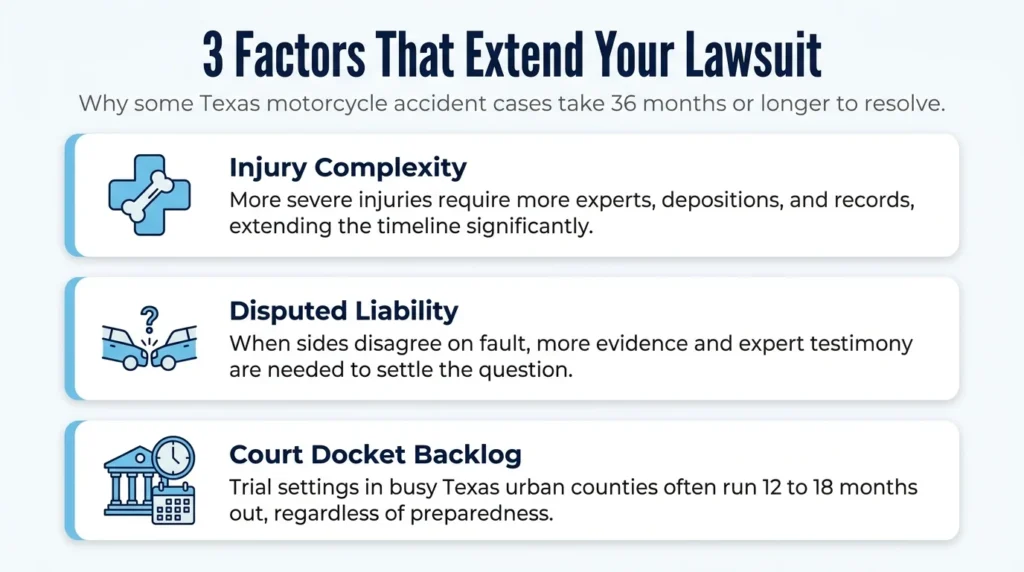
Most motorcycle accident lawsuits resolve within 12 to 24 months after filing. Cases involving catastrophic injuries, multiple defendants, or a defendant who refuses to negotiate can push that to 36 months or longer.
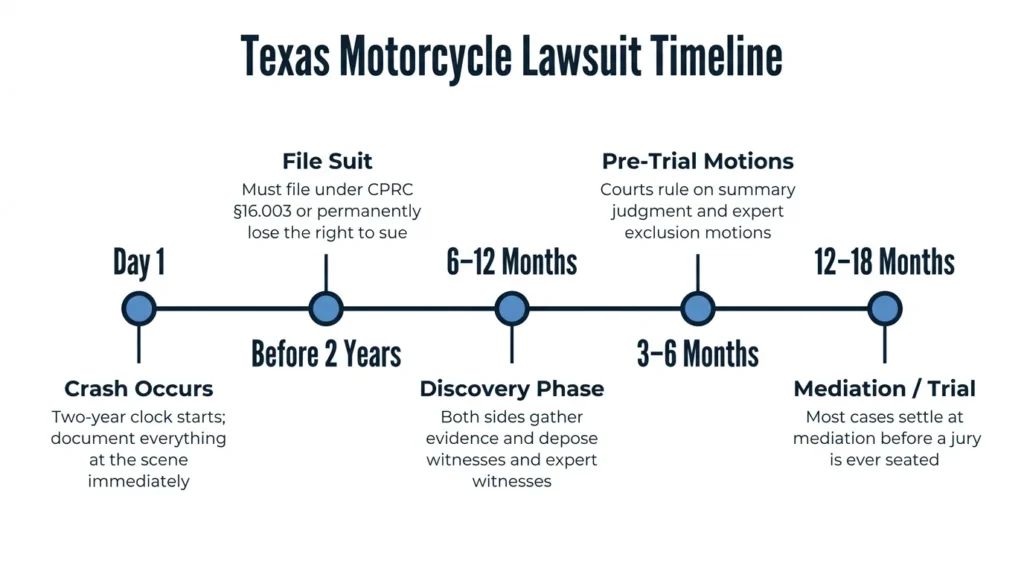
The severity of your injuries and whether liability is disputed drive the timeline more than anything else. Both affect how much evidence must be gathered, how many experts become involved, and how willing the other side is to settle.
The Texas Civil Practice and Remedies Code (CPRC) § 16.003 gives you two years from the date of the crash to file a personal injury lawsuit. Missing that deadline can permanently bar your claim, regardless of how strong the underlying case may be. That deadline stands whether or not you wait until you heal to file a claim.
Some riders wait until they reach maximum medical improvement (MMI) before demanding a settlement because the full extent of their injuries may not be clear earlier in the recovery process. If MMI takes time, that pre-suit period runs down your two-year clock. Plan accordingly.
Discovery Phase: 6-12 Months
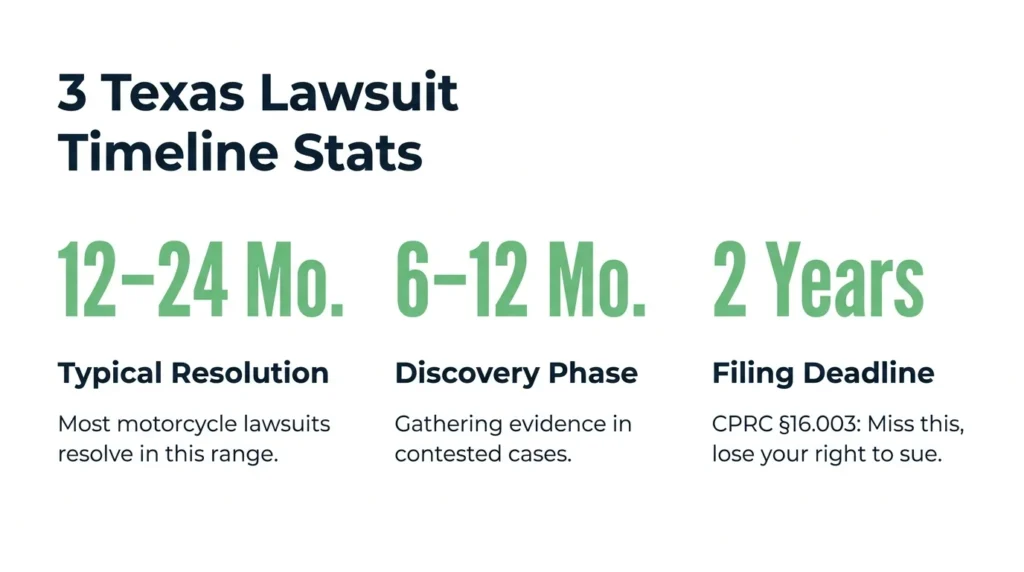
Discovery is the phase where both sides gather evidence. How long discovery takes in a personal injury case usually depends on whether liability is disputed, the complexity of the medical issues, and the amount of evidence involved. In general, it runs 6 to 12 months in most contested motorcycle accident cases.
During discovery, your attorney and the defendant’s attorney exchange documents, submit written questions called interrogatories, and take sworn depositions from witnesses, experts, and the parties themselves. Under Texas Rules of Civil Procedure, Level 2 discovery, the most common track for larger personal injury claims, runs until 9 months after initial disclosures are due or 30 days before trial.
Cases involving disputed liability, multiple at-fault parties, or catastrophic injuries often take longer. Depositions of accident reconstructionists, treating physicians, vocational experts, and other specialists require additional scheduling and preparation.
Pre-Trial Motions: 3-6 Months
After discovery closes, both sides file pre-trial motions. This phase typically runs 3 to 6 months.
Common motions include summary judgment (asking the court to rule in one side’s favor without a trial), motions to exclude expert testimony, and motions in limine to control what evidence the jury sees. Courts often schedule hearings on significant motions, which can add weeks or months to the timeline, depending on the judge’s calendar.
A successful summary judgment motion can resolve part of the lawsuit or, in some cases, end it entirely before trial. More often, these rulings narrow the issues in dispute and give both sides a clearer picture of how the case may play out before a jury. That clarity often leads to more serious settlement discussions.
Trial Settings: 12-18 Months from Filing
Getting a trial date in Texas usually means waiting 12 to 18 months from the date you file suit. In busy urban counties, that window stretches toward the longer end.
Courts issue scheduling orders that establish every major deadline in the case, including discovery cutoffs, expert designation dates, dispositive motion deadlines, and the trial date itself. The scheduling order serves as the roadmap for the lawsuit. Missing a deadline can limit the evidence you can present or, in some situations, jeopardize your case entirely.
Many of the same scheduling pressures that affect motorcycle accident lawsuits also appear in other complex injury cases, including commercial truck accident claims. As discovery closes and trial approaches, both sides gain a clearer understanding of the strengths and weaknesses of their positions, which often drives settlement negotiations.
The trial date also functions as a forcing mechanism. As it approaches, the costs and risks of proceeding to trial become more concrete for both sides. Most cases settle before the first juror is seated.
Mediation: Where Most Lawsuits Settle
Most motorcycle accident lawsuits never reach trial. They end at mediation, and Texas courts require it before most personal injury cases go to a jury.
Mediation is a structured negotiation session led by a neutral third party called a mediator. Unlike a judge or jury, the mediator does not decide the case. Their role is to help both sides negotiate toward a resolution.
Mediation usually takes place several months before trial, often after discovery is complete and the major evidence has been exchanged. By that stage, both sides have a much clearer understanding of the strengths and weaknesses of the case, which is one reason so many lawsuits settle during mediation.
Reaching a settlement at mediation is not a sign of a weak case. For many riders, it provides compensation sooner and avoids the cost, delay, and uncertainty that come with a trial. Factors such as liability, injury severity, future medical treatment, and available insurance coverage all affect the value of a motorcycle accident settlement and often become the focus of mediation discussions.
Work with an Attorney
A motorcycle accident lawsuit is a long process. Understanding the timeline helps set realistic expectations, but having an attorney who can manage deadlines, evidence, experts, and settlement negotiations can make the process much easier to navigate.
Angel Reyes & Associates has handled motorcycle accident claims across Texas for over 30 years. We work on a contingency basis, so there is no fee unless we win. Free consultations are available 24/7, and we can handle most cases remotely. To review your options and understand what your case may involve, contact us today.
You can also review our case results to see the kinds of claims we’ve handled for injured Texans.
Past results do not guarantee future outcomes.
Motorcycle Lawsuit Timeline FAQs
Can an appeal extend the timeline after a jury verdict?
Yes. Either party can appeal a jury verdict in Texas, adding months or years to the final resolution. Most cases settle before a verdict, but when a trial does conclude and one side challenges the outcome, the appellate process runs on its own separate schedule.
Can I speed up a motorcycle accident lawsuit in Texas?
There is no guaranteed way to accelerate a lawsuit, but responding quickly to document requests, attending scheduled depositions, following your treatment plan, and providing information to your attorney promptly can help prevent unnecessary delays.
What documents does the other side typically request during discovery?
In motorcycle accident cases, the defense typically requests your medical records, the accident report, photos from the scene, repair estimates for your bike, and records related to lost wages or employment. Your attorney will also request documents from the other side, including insurance policies, driver records, and any evidence the defendant has related to the crash.
Can the lawsuit settle after mediation fails but before trial?
Yes. If mediation does not produce a settlement, negotiations can continue through to and during trial. Many cases that survive mediation still settle when the parties see how the evidence lands before a jury during the early stages of trial.
What happens if the defendant asks to postpone the trial?
Either side can ask the court for a continuance, which is a request to move a scheduled deadline or trial date. Courts do not automatically grant these requests, but they may do so when additional discovery is needed, a key witness is unavailable, or another legitimate issue affects the case schedule. A continuance can add weeks or months to the overall timeline.
About the Authors

Angel Reyes
Writer
Angel L. Reyes, III is the Founder and Managing Partner of Angel Reyes & Associates. A nationally recognized trial attorney and business leader, Angel has helped over 55,000 injury victims recover more than $1 billion since founding the firm in 1993. Named to the Texas Super Lawyers list annually since 2008, Angel brings Wall Street experience, Ivy League education, and a deep commitment to client advocacy. He is a frequent legal commentator and published author with extensive contributions to legal scholarship, trial strategy, and consumer protection.

Kyle Nicolas
Editor
Kyle Nicolas is the Web Content & SEO Manager at Angel Reyes & Associates. He has more than 10 years of experience as a marketing co...

Angel Reyes
Reviewer
Angel L. Reyes, III is the Founder and Managing Partner of Angel Reyes & Associates. A nationally recognized trial attorney and business...