Failure to Yield Motorcycle Accidents in Texas


Every article on this site is researched by our internal team, reviewed for legal accuracy against current Texas law, and held to State Bar of Texas advertising standards before publication. We do not publish content that overstates outcomes or makes promises about results.
Learn more about our
editorial standards .
Key Takeaways
- Violating Texas Transportation Code §§545.151-153 can establish negligence per se in a motorcycle accident claim.
- Texas comparative fault bars recovery if the rider is found more than 50% responsible for the crash.
- Traffic camera footage is often overwritten within days, so securing evidence quickly protects your claim.
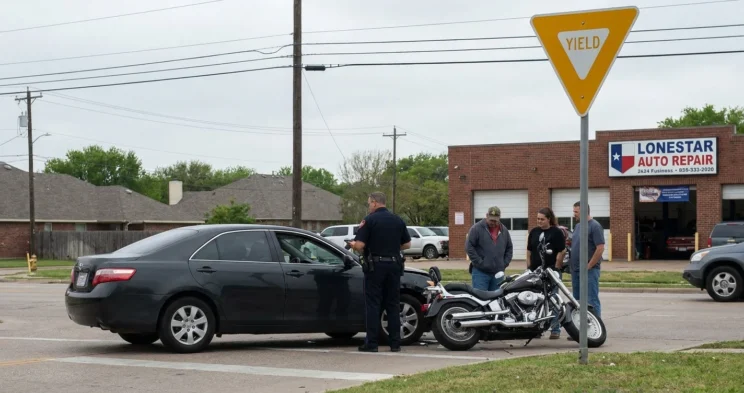
You were riding through an intersection on US-290 outside of Austin when a car turned left directly into your path. The driver never slowed down. You had the right of way, and the driver simply did not yield.
Now you are dealing with a broken collarbone, a totaled bike, and an insurance adjuster who is already calling to ask whether you were speeding. What you need to know is whether that driver’s failure to yield changes your legal position, and what you can do to protect your claim.
Texas Right-of-Way Laws for Motorcyclists
Texas law is specific about when drivers must yield, and those rules apply the same way to a motorcycle as they do to any other vehicle on the road.
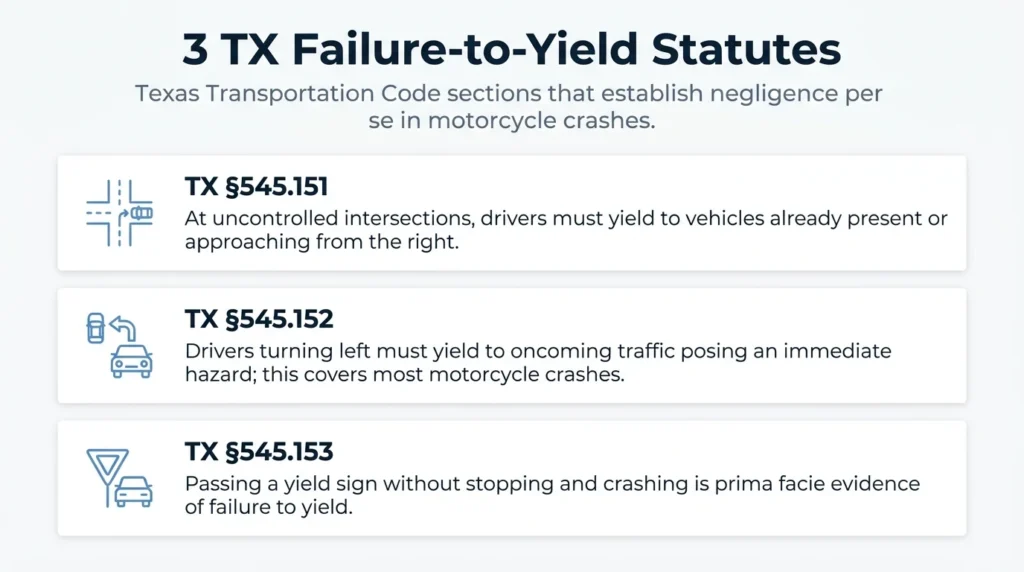
Texas Transportation Codes §§ 545.151-545.153 cover the three most common failure-to-yield scenarios:
- Section 545.151 applies at uncontrolled intersections, where a driver must yield to any vehicle that has already entered the intersection or is approaching from the right in a way that creates a hazard.
- Section 545.152 requires any driver turning left to yield to oncoming traffic that poses an immediate hazard, which covers the majority of failure-to-yield motorcycle crashes.
- Section 545.153 addresses stop and yield sign intersections. Under that section, if a driver passes a yield sign without stopping and then crashes into another vehicle, that collision is prima facie evidence that the driver failed to yield.
The word “prima facie” means the facts, on their face, are sufficient to support the claim, shifting the burden to the other driver to explain why the collision occurred despite the posted sign.
These are not vague standards. They are codified duties with specific conditions. When a driver violates one of them and hits a motorcyclist, the legal consequences are meaningful.
What Negligence Per Se Means for Your Claim
A violation of the right-of-way statutes does more than show the other driver made a mistake. It can establish negligence per se in your civil claim.
Negligence per se means the statutory violation itself satisfies the breach-of-duty element of a negligence case. In a standard negligence claim, you have to prove four things: duty, breach, causation, and damages. Normally, proving breach requires showing that the other driver failed to act as a reasonably careful person would.
When a driver violates a specific traffic statute designed to protect other road users, the breach element is satisfied by the violation itself.
You still have to prove causation and damages; the violation does not automatically win the case. It removes one difficult type of proof and gives your claim a serious foundation.
A traffic citation issued to the other driver at the scene is strong evidence, but it is not the only path. Witness statements, camera footage, and physical evidence can all establish the violation independently.
Riders who understand how negligence per se works are better positioned to protect their motorcycle accident claims from the start of the process.
Evidence That Proves a Failure-to-Yield Crash
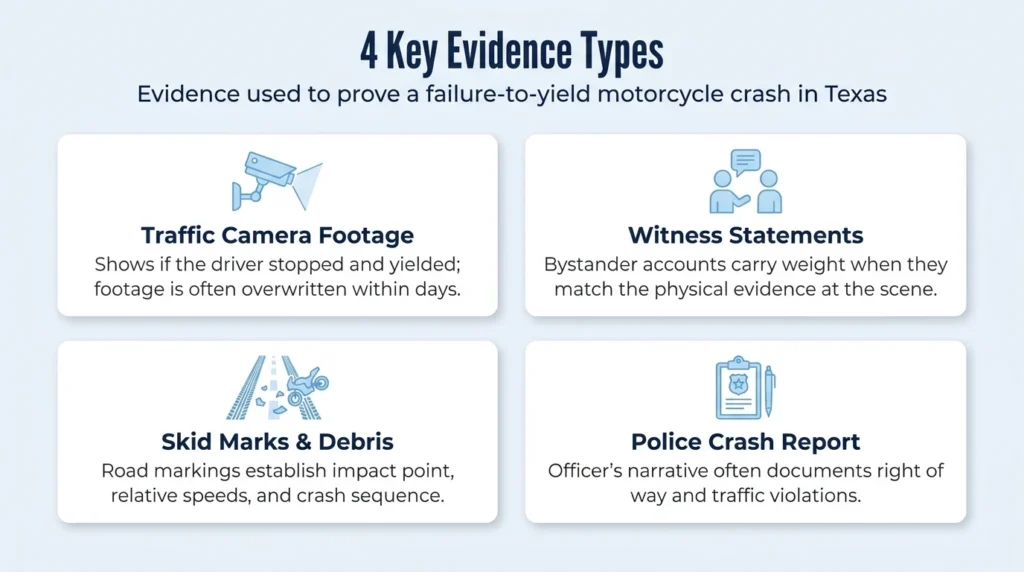
The strength of your claim depends on the evidence you can gather. In failure-to-yield cases, four evidence types are most effective:
- Traffic camera footage is often the most powerful. Cameras at city intersections, highway on-ramps, and private businesses capture the moments before and during the collision. That footage can show clearly whether the other driver stopped, checked, and yielded, or simply drove through. Time is a factor: footage is often overwritten within days, and sometimes sooner at privately owned cameras.
- Witness statements from bystanders or other drivers can confirm what they observed. A witness who saw the other driver fail to stop or look before turning carries real weight, especially when their account is consistent with the physical evidence.
- Skid marks and debris patterns on the road tell a story that accident reconstruction specialists can read. The position of skid marks, the direction of debris scatter, and the final resting positions of both vehicles establish the point of impact, relative speeds, and the likely sequence of events. This kind of physical evidence supports the witness accounts and the camera footage, or fills in gaps when neither is available.
- The police crash report includes the responding officer’s observations, vehicle positions, and any citations issued. Even when no citation is written, the officer’s narrative often includes observations about who had the right of way or which driver appeared to violate a traffic control device.
You can review typical motorcycle accident evidence and how each of these evidence types is gathered and preserved.
How Comparative Fault Affects Your Recovery
Proving the other driver violated a right-of-way statute is important, but it does not automatically mean you recover everything you are owed. Texas uses a modified comparative fault system under Texas Civil Practice and Remedies Code Chapter 33.
Under that system, if you are found more than 50% at fault for the crash, you recover nothing. If you are found 30% at fault in a $100,000 claim, your financial recovery is reduced to $70,000.
Insurance adjusters in failure-to-yield cases often try to push the rider’s fault percentage up. They may argue you were speeding, riding in a way that reduced your visibility, or that you had time to avoid the crash. The goal is to move the fault number toward or past the 50% threshold.
A documented statutory violation by the other driver works against that strategy. It anchors the primary cause of the crash to the other driver’s conduct and makes it harder to argue that a rider doing nothing wrong was somehow responsible for more than half the collision.
For a detailed breakdown of how Texas fault percentages are calculated in motorcycle cases, review how comparative fault works in Texas motorcycle accident cases.
Filing Deadlines & Steps After the Crash
Texas gives you two years from the date of the crash to file a personal injury lawsuit under Texas Civil Practice and Remedies Code §16.003. Missing that deadline ends your right to pursue compensation in court, regardless of how strong the underlying claim is.
The two-year window sounds long, but evidence disappears quickly. Camera footage is overwritten. Witnesses move or forget details. Skid marks fade. The earlier you act, the better the evidence pool you have to work with.
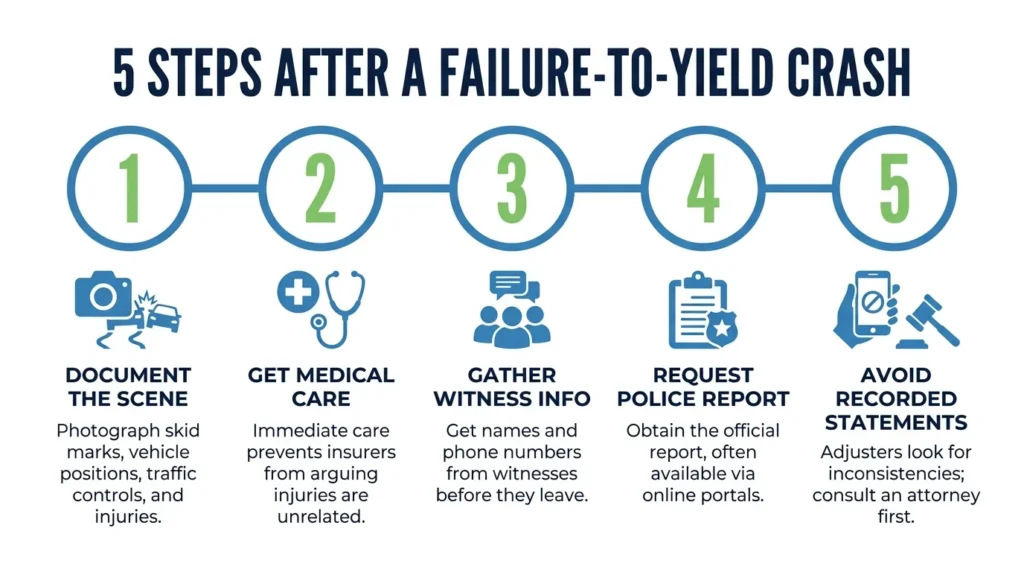
In the days after the crash, focus on these steps:
- Step 1: Document the scene. Take photos of road conditions, skid marks, vehicle positions, traffic control devices, and your injuries before anything is moved or cleaned up.
- Step 2: Get medical care immediately. A gap in treatment gives insurers grounds to argue your injuries were not serious or were not caused by the crash.
- Step 3: Gather witness information. Get names, phone numbers, and a brief description of what each witness saw before they leave the scene.
- Step 4: Request the police crash report. The report is typically available within a few days through the department’s records portal.
- Step 5: Avoid giving recorded statements to the other driver’s insurer. Adjusters use recorded statements to find inconsistencies. Speak with an attorney before agreeing to a recorded call.
Talk to an Attorney About Your Claim
An attorney can send preservation letters to city transportation agencies and private businesses to secure camera footage before it is deleted and provide other post-crash guidance. When a driver runs a stop sign or turns left without yielding and hits a motorcycle, the consequences for the rider are severe. You deserve a clear assessment of your legal options.
Angel Reyes & Associates has spent over 30 years helping injured Texans work through personal injury claims, including motorcycle accidents caused by failure-to-yield violations. We work on contingency, which means no upfront costs and no fee unless we win.
Get a free consultation to review your situation and understand your options.
Past results do not guarantee future outcomes.
Failure to Yield Motorcycle Accident FAQs
What if the driver who failed to yield does not have insurance?
You may still be able to recover through your own uninsured motorist (UM) coverage if your policy includes it. You can also file a civil lawsuit directly against the uninsured driver, though collecting a judgment can be more difficult if they lack assets.
Does the other driver have to receive a ticket for me to win my claim?
No. A traffic citation is helpful evidence, but it is not required. Witness statements, video footage, skid marks, and the crash report narrative can all establish that the other driver violated the right-of-way statutes even without a citation.
What damages can I recover after a failure-to-yield motorcycle crash in Texas?
Texas allows you to seek medical expenses, lost wages, property damage to your motorcycle, pain and suffering, and in serious cases, future medical costs and loss of earning capacity. The final amount depends on injury severity, available insurance coverage, and your share of fault.
Does it help my case if the crash happened at a yield sign specifically?
Yes. Under Texas Transportation Code §545.153, a collision that occurs after a driver passes a yield sign without stopping is treated as prima facie evidence of failure to yield. That shifts the burden to the other driver to explain why the crash happened despite the posted sign.
Can I still file a claim if I was not wearing a helmet at the time of the crash?
Texas does not require helmets for riders 21 and older who carry the required medical coverage. Not wearing a helmet may become a factor in calculating damages if an insurer argues it contributed to the severity of your head injuries, but it does not prevent you from filing a claim or recovering compensation for other injuries.
About the Authors

Angel Reyes
Writer
Angel L. Reyes, III is the Founder and Managing Partner of Angel Reyes & Associates. A nationally recognized trial attorney and business leader, Angel has helped over 70,000 injury victims recover more than $1 billion since founding the firm in 1993. Named to the Texas Super Lawyers list annually since 2008, Angel brings Wall Street experience, Ivy League education, and a deep commitment to client advocacy. He is a frequent legal commentator and published author with extensive contributions to legal scholarship, trial strategy, and consumer protection.

Kyle Nicolas
Editor
Kyle Nicolas is the Web Content & SEO Manager at Angel Reyes & Associates. He has more than 10 years of experience as a marketing co...

Angel Reyes
Reviewer
Angel L. Reyes, III is the Founder and Managing Partner of Angel Reyes & Associates. A nationally recognized trial attorney and business...