What to Expect at a Motorcycle Accident Deposition in Texas


Every article on this site is researched by our internal team, reviewed for legal accuracy against current Texas law, and held to State Bar of Texas advertising standards before publication. We do not publish content that overstates outcomes or makes promises about results.
Learn more about our
editorial standards .
Key Takeaways
- A Texas deposition is sworn testimony given outside of court under oath.
- Defense attorneys ask about gear, experience, and prior crashes to build a fault argument.
- Review your records with your attorney before the deposition to avoid costly mistakes.
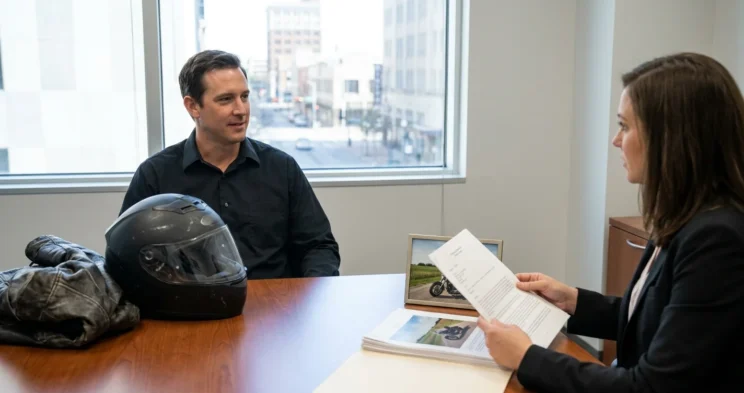
You were riding home on I-35 outside of San Antonio when another driver crossed into your lane and hit you. The crash wasn’t your fault. You filed a claim, your case moved forward, and now your attorney has told you a deposition is coming.
The word alone can feel threatening. It doesn’t have to. Understanding what a deposition is, what questions you will face, and how to show up prepared can take most of the fear out of the room.
What Is a Deposition?
A deposition is sworn testimony given outside of court during the discovery phase of a lawsuit, or when both parties gather evidence and exchange information. A court reporter is present to transcribe everything. No judge is in the room.
The opposing attorney asks questions, and your attorney sits beside you.
In Texas, oral depositions are generally limited to six hours unless both parties agree to extend that time. Most personal injury depositions run far shorter. The purpose is to lock in your account of what happened, evaluate your credibility, and give both sides a clear picture before settlement or trial.
Understanding how the injury claim process works before the deposition helps put the whole timeline in context.
Questions You Will Face in a Motorcycle Deposition
The opposing attorney follows a predictable structure. Knowing the categories in advance takes away their ability to surprise you.
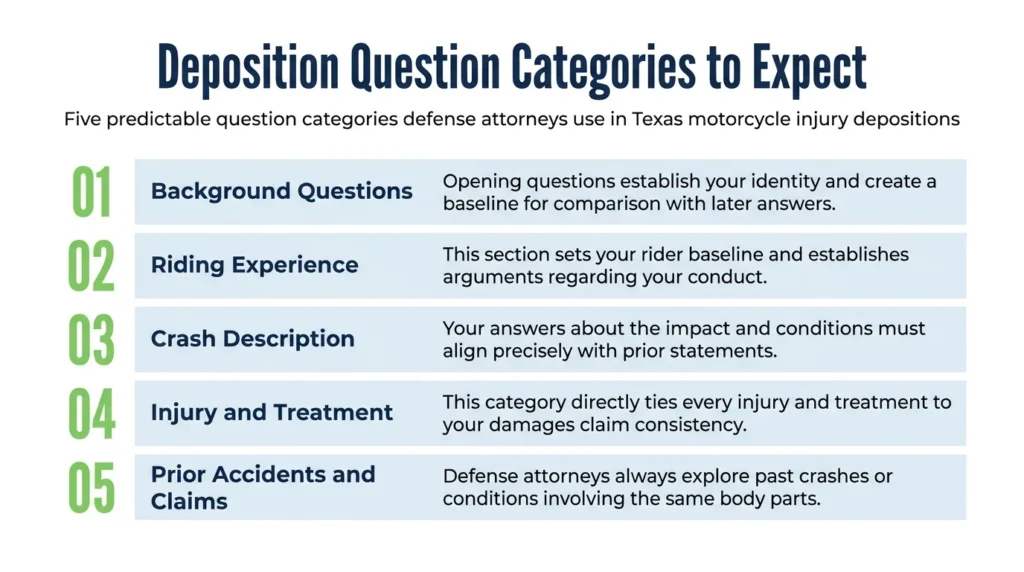
The deposition typically opens with background questions about your name, address, employment history, and general health history. From there, it moves into categories specific to your case.
Riding experience questions come early in motorcycle cases. The opposing attorney will ask how long you have been riding, what type of bike you own, whether you completed any safety courses, and how often you ride. These questions establish your baseline as a rider.
Accident description questions follow. You will describe what you saw before the crash, your speed, road and weather conditions, and what happened right after impact. Be specific about what you know and honest about what you do not.
Injury and medical treatment questions cover every injury you sustained, every provider you saw, every treatment you received, and your current condition. These questions connect directly to the damages you are claiming.
Prior accident and prior claim questions almost always come up. The opposing attorney will ask about earlier crashes, prior injury claims, and prior injuries to the same body parts. Answer accurately. Downplaying prior history is one of the most damaging mistakes you can make.
How Defense Attorneys Use Your Answers
Defense attorneys in motorcycle cases are doing more than collecting facts. They are often building a comparative fault argument designed to reduce what you can recover.
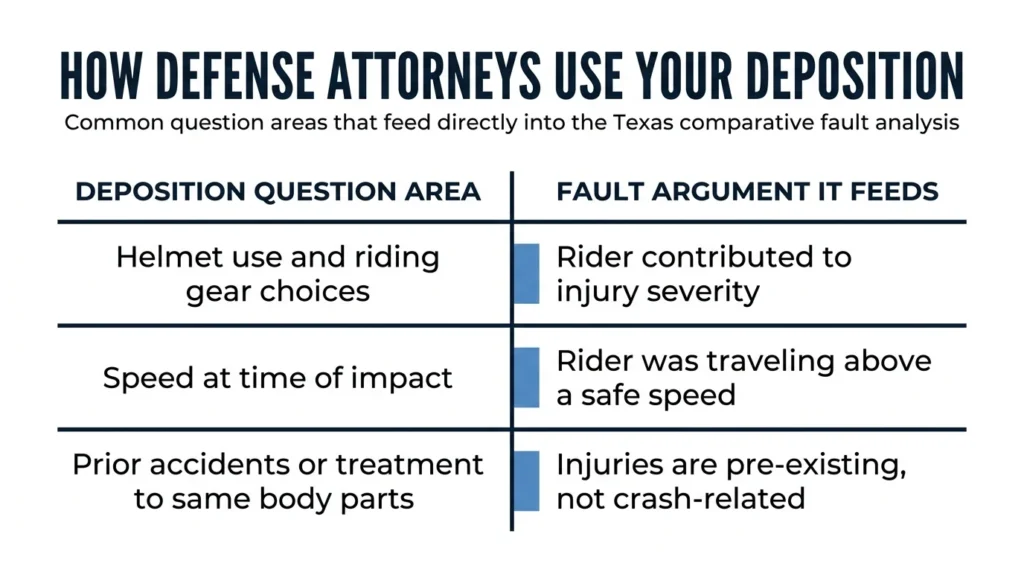
Texas uses a modified comparative fault system under the Texas Civil Practice and Remedies Code (CPRC) Chapter 33. A rider found 51 percent or more at fault recovers nothing. Below that threshold, your compensation is reduced by your share of fault.
Questions about helmet use, gear, and riding speed often try to establish that you contributed to your own injuries. Questions about prior accidents attempt to argue that your current injuries predate the crash. Every answer you give is evaluated against that framework.
The court reporter records every word. Inconsistencies between what you say in the deposition and what you say at trial will be used to challenge your credibility.
Reviewing how motorcycle accident settlements work in Texas gives you a clearer picture of how deposition performance connects to what you ultimately recover.
How to Prepare for Your Deposition
Preparation is key to winning or losing the deposition. If you show up knowing your case backwards and forwards, you will be harder to rattle.
Step 1: Review your records. Go through your accident report, your medical records, and any prior statements you have made about the crash. Your answers in the deposition will be compared against all of these documents.
Step 2: Meet with your attorney. Your attorney will walk you through the likely question categories and practice answering them with you. A mock deposition session reduces anxiety and exposes any inconsistencies in your account before they surface under questioning.
Step 3: Know your timeline. Be clear on when the crash happened, what your symptoms were, which providers you saw, and when. Vague answers to timeline questions look like evasion, even when they are not.
Step 4: Prepare for the day itself. Dress in business casual clothing and arrive early. Listen to each question fully before answering, and take all the time you need. There is no clock on how long you can pause to think.
Mistakes That Can Hurt Your Case
Most deposition mistakes come from the same impulse: trying to be helpful or trying to appear credible. Both backfire.
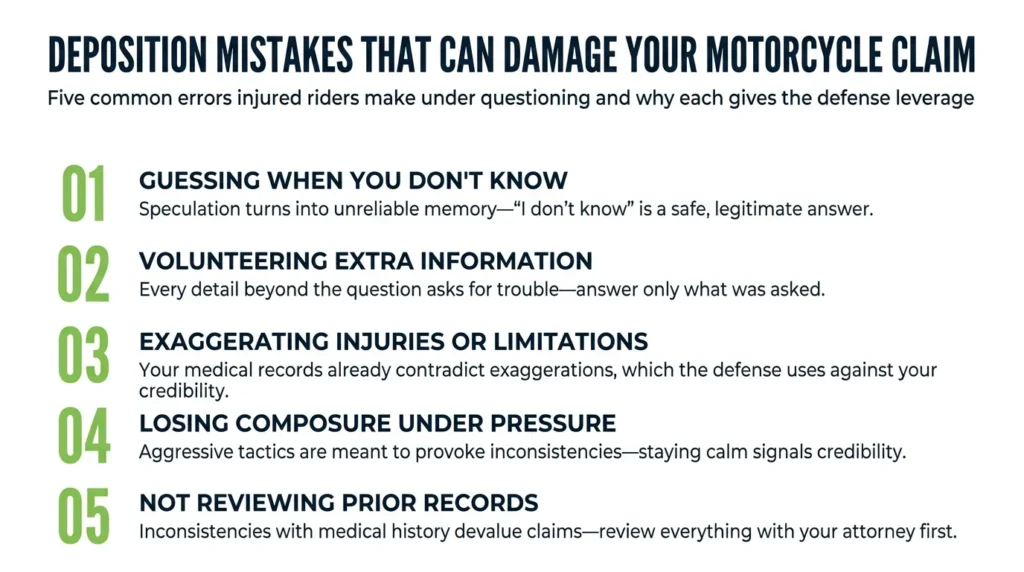
Guessing when you don’t know. If you speculate and get it wrong, the opposing attorney will argue you were being deceptive or that your memory is unreliable. “I don’t know” and “I don’t recall” are legitimate answers when they are true.
Volunteering extra information. Answer what was asked. Nothing more. Every detail you offer beyond the question is a potential opening for the other side to probe further.
Exaggerating injuries or limitations. The defense already has your medical records. If your testimony describes limitations that your records do not support, that inconsistency becomes a weapon against you.
Losing composure under pressure. The opposing attorney may ask the same question multiple ways, push back on your answers, or use an aggressive tone. Staying calm signals credibility. Getting frustrated signals weakness.
Failing to review your prior records. Inconsistencies between your deposition and your medical history are one of the most common ways motorcycle claims lose value. Your attorney can explain how long you have to file an injury lawsuit in Texas so you understand the full timeline before testifying.
A deposition is one of the most consequential steps in a Texas motorcycle injury claim, so showing up prepared makes a real difference in the outcome.
Talk to an Attorney Before Your Deposition
An attorney who handles motorcycle accident cases regularly can walk you through the specific questions most likely to come up in your case before the deposition begins.
Angel Reyes & Associates has guided injured Texans through every stage of the personal injury process for over 30 years. We offer free initial consultations and work on contingency, so there is no fee unless we win. Contact us today to discuss your case and what to expect at your deposition.
You can also review our case results to see how we have handled personal injury claims for injured Texans.
Past results do not guarantee future outcomes.
Motorcycle Accident Deposition FAQs
How long does a motorcycle accident deposition typically last in Texas?
Texas law limits oral depositions to six hours unless both parties agree to extend, but most personal injury depositions run between two and four hours. The actual length depends on how complex your case is and how thoroughly the opposing attorney wants to question you.
Can my attorney object to questions during my deposition?
Yes, your attorney can object to improper questions, but the objection is recorded for the court to rule on later. In most cases, you still need to answer unless your attorney instructs you not to in order to preserve a privilege.
Does not wearing a helmet affect my motorcycle injury claim in Texas?
Riders over 21 who completed an approved safety course or carry qualifying health insurance are not required to wear a helmet under Texas law. Defense attorneys may still argue that not wearing a helmet worsened head or facial injuries, which can factor into the comparative fault calculation.
What happens after my deposition is finished?
The court reporter produces a written transcript that both sides review, and settlement talks typically intensify once each side has a clearer picture of the case. Most Texas personal injury cases settle within weeks to several months after depositions conclude.
Can I reschedule my deposition if I need more time to prepare?
Depositions can be rescheduled by agreement between the attorneys, and your attorney can file a motion for protective order if there is a genuine scheduling conflict. Asking for more time to prepare is a legitimate reason, but the process should go through your attorney rather than approaching the opposing side directly.
About the Authors

Angel Reyes
Writer
Angel L. Reyes, III is the Founder and Managing Partner of Angel Reyes & Associates. A nationally recognized trial attorney and business leader, Angel has helped over 70,000 injury victims recover more than $1 billion since founding the firm in 1993. Named to the Texas Super Lawyers list annually since 2008, Angel brings Wall Street experience, Ivy League education, and a deep commitment to client advocacy. He is a frequent legal commentator and published author with extensive contributions to legal scholarship, trial strategy, and consumer protection.

Kyle Nicolas
Editor
Kyle Nicolas is the Web Content & SEO Manager at Angel Reyes & Associates. He has more than 10 years of experience as a marketing co...

Angel Reyes
Reviewer
Angel L. Reyes, III is the Founder and Managing Partner of Angel Reyes & Associates. A nationally recognized trial attorney and business...