Were You Hit by an E-Moto as a Pedestrian?


Every article on this site is researched by our internal team, reviewed for legal accuracy against current Texas law, and held to State Bar of Texas advertising standards before publication. We do not publish content that overstates outcomes or makes promises about results.
Learn more about our
editorial standards .
Key Takeaways
- E-bikes and e-motos cause more serious injuries than pedal bikes due to greater speed and weight.
- Texas gives pedestrians two years from the collision date to file a personal injury lawsuit.
- Liability can extend to the rider, a parent, a manufacturer, or a property owner based on the facts.
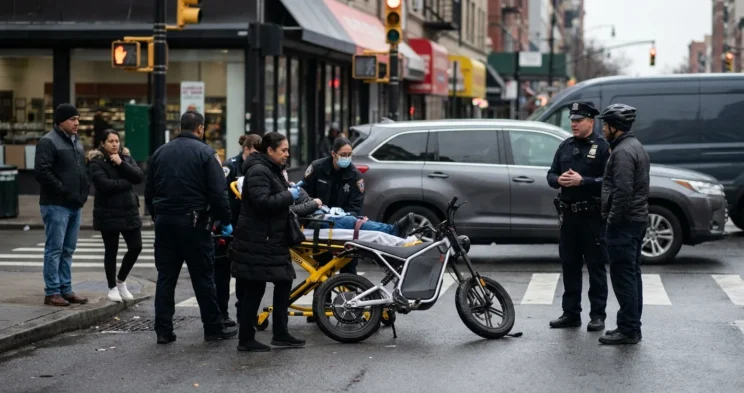
You were walking along a shared path near Montrose in Houston when a Sur-Ron-style e-moto came out of nowhere and knocked you off your feet. The rider may have stopped, or they may have kept going. Either way, you are dealing with pain, medical bills, and a set of questions you have never had to answer before.
Being struck by an electric bike or e-moto is not the same as being bumped by a standard pedal bike. You have legal options, and they may be broader than you expect.
Why E-Bike & E-Moto Collisions Are Different
E-bikes and electric moto-style vehicles weigh far more than traditional bicycles and reach speeds that no pedal bike can match. When one of those vehicles strikes a pedestrian, the person on foot absorbs all of that force. The result is frequently bone fractures, traumatic brain injury, spinal trauma, and soft-tissue damage that does not resolve quickly.
The legal classification of the vehicle also matters. Texas Transportation Code Chapter 664 defines three classes of electric bicycle based on motor wattage and top assisted speed. Any vehicle that exceeds 750 watts or a top speed of 28 mph does not qualify as an e-bike under Texas law. Sur-Ron-style vehicles and similar e-motos commonly exceed those thresholds and are treated as motor vehicles, which means registration and insurance obligations apply to the rider.
These vehicles are also showing up where pedestrians have always felt safe: sidewalks, greenways, shared-use trails, and parking garage paths. That is where most e-bike pedestrian accidents happen, and it is why your rights as a pedestrian injured by one of these vehicles deserve a close look.
Who Can Be Held Liable After a Pedestrian E-Bike Accident
Multiple parties can bear responsibility when an e-bike or e-moto strikes a pedestrian. The rider is the most direct defendant, but the list does not stop there.
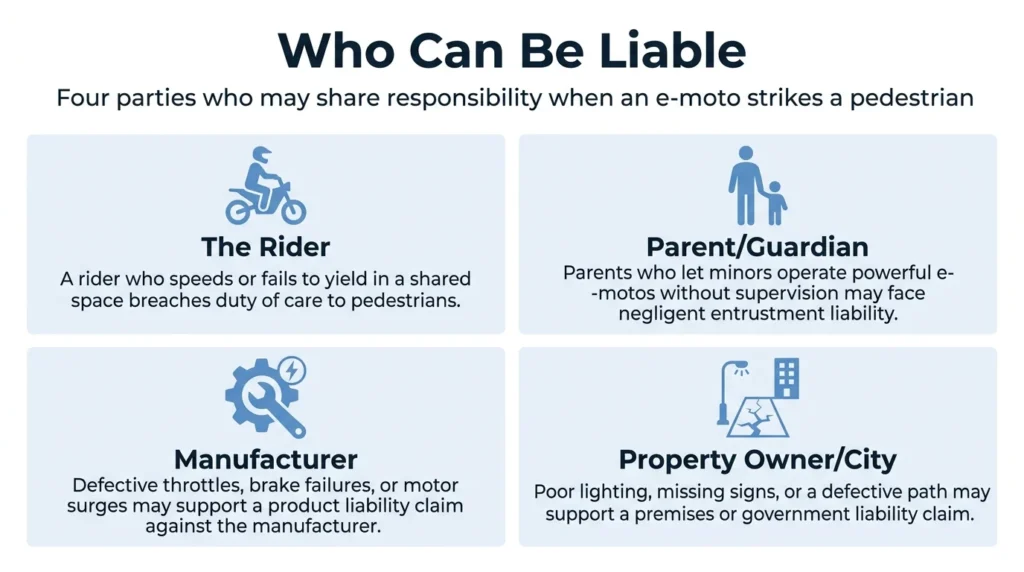
The Rider
The rider of any vehicle in a shared space owes a duty of care to every pedestrian present. Speeding on a sidewalk, failing to yield at a crossing, riding while distracted, or operating an e-moto in a pedestrian-only zone each represent a breach of that duty. When that breach causes your injury, you have a negligence claim against the rider.
If the vehicle qualifies as a motor vehicle under Texas law, the rider may also be required to carry auto insurance, giving you a potential insurance source to access your compensation.
A Parent or Guardian of a Minor Rider
When the rider was a minor, you may be able to bring a claim against the parents. Texas Family Code Chapter 41 establishes statutory parental liability for a child’s property damage. For personal injury claims, the stronger path is common-law negligent entrustment: a parent who gave a minor access to a powerful e-moto without adequate supervision can be held liable for what that minor did with it.
You do not need to prove the parent intended harm. You need to show they provided access to a dangerous vehicle and knew, or should have known, the child was likely to operate it carelessly.
A Manufacturer in a Defect Case
If the e-bike or e-moto had a defect that caused the rider to lose control, the manufacturer may be liable under Texas product liability law. A throttle that stuck, brakes that failed, or a motor that surged without input can support a product liability claim entirely separate from whether the rider was negligent.
An attorney can help determine whether a product defect contributed to the crash and whether the manufacturer is a proper defendant in your case.
A Property Owner or Municipality
Property owners and municipalities that allow e-bikes and e-motos on their pathways owe pedestrians a duty to keep those spaces reasonably safe. If poor lighting, missing warning signs, or a deteriorated surface played a role in the collision, a premises liability claim against the owner or city may be available alongside your claim against the rider.
How to Identify a Rider Who Fled the Scene
Most standard e-bikes in Texas do not require registration, and riders of Class 1, 2, or 3 bikes do not need a driver’s license. After a hit-and-run, that can feel like a dead end. It is not.
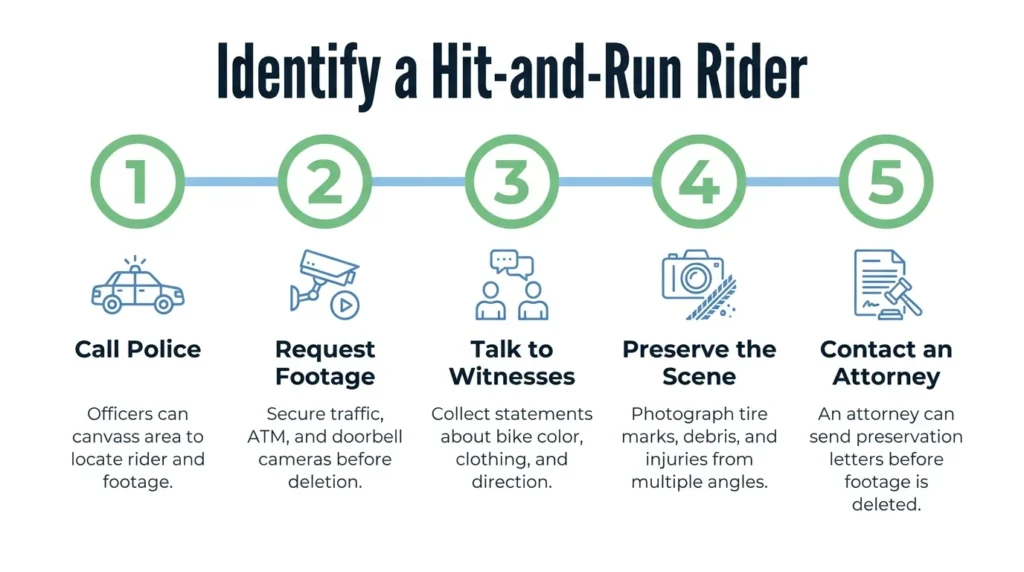
These steps can help identify the person who hit you:
- Call police immediately. Officers can canvass the area, look for the rider nearby, and coordinate with nearby businesses for footage. A police report also creates an official record of the incident.
- Request surveillance footage from every camera nearby. Traffic cameras, business security systems, ATM cameras, and residential doorbell cameras within a block of the collision may have captured the rider’s face, the vehicle, or both. Act quickly.
- Talk to witnesses before they leave. Anyone who saw the color of the bike, any markings on it, the rider’s clothing, or the direction of travel can help investigators narrow the search.
- Preserve the scene. Photograph the area, tire marks, any parts or debris the e-bike left behind, and your injuries from multiple angles.
- Contact an attorney. A lawyer can send evidence preservation letters to businesses and local government agencies before surveillance footage is deleted, which typically happens within 30 to 60 days. Your options for finding the pedestrian accident claim widen significantly when footage is preserved early.
What Evidence Preserves Your Claim
The strength of a pedestrian injury claim often comes down to what was saved in the hours and days after the crash.
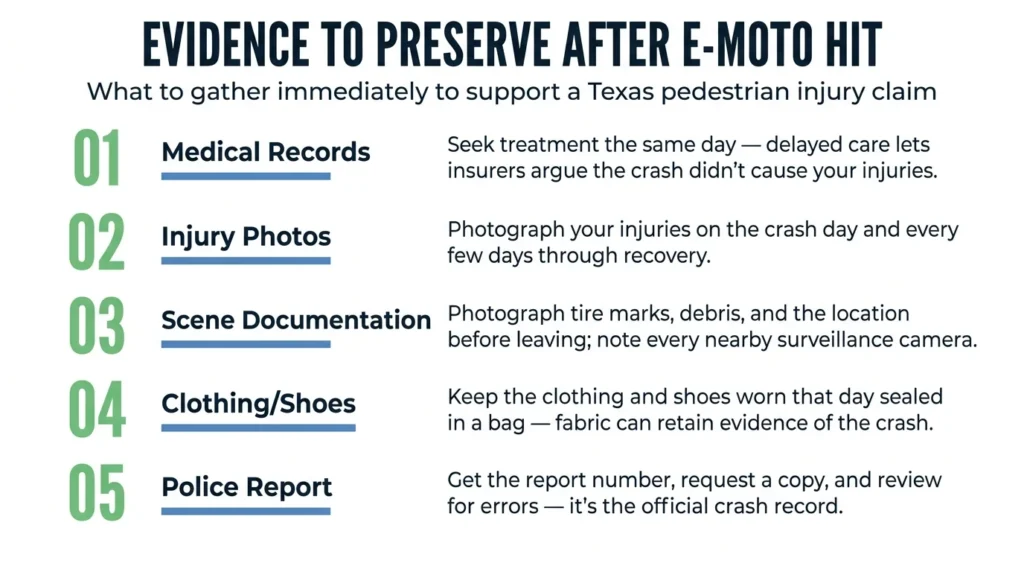
Seek medical treatment the same day, even if your pain feels manageable at first. Delayed treatment gives an insurer or opposing lawyer room to argue the collision did not actually cause your injuries. Your diagnosis, treatment records, and any imaging create the medical foundation for your claim.
Beyond medical records, gather photographs of your injuries from the day of the accident and every few days during recovery. Document the scene before you leave if you are able to. Keep the clothing and shoes you wore that day in a sealed bag because fabric can retain physical evidence. Get the police report number and request a full copy, then review it for errors.
Understanding how courts and insurers evaluate pedestrian right-of-way in Texas helps you frame your own account of the collision and anticipate arguments about shared fault.
What a Texas Pedestrian Injury Claim Looks Like
Texas gives you two years from the date of the collision to file a personal injury lawsuit. The deadline is set by the Texas Civil Practice and Remedies Code (CPRC) section 16.003. Missing it almost always ends the right to sue, regardless of how strong the underlying case is.
Texas uses a proportionate responsibility system under CPRC Chapter 33. If a jury finds you more than 50% responsible for the collision, you cannot recover damages. If your share of fault is 50% or less, your compensation is reduced by that percentage. Insurance companies often argue that a pedestrian was distracted or in the wrong place. Solid evidence and prompt legal help counter those arguments early.
Recoverable damages can include past and future medical expenses, lost wages, reduced earning capacity, pain and suffering, and emotional distress. If the vehicle was an e-moto that qualifies as a motor vehicle, the rider’s auto insurance may be accessible. For standard e-bikes, a rider’s homeowners or renters insurance personal liability coverage often applies to off-premises injuries. Your own auto policy’s uninsured motorist coverage may apply if the e-moto qualified as a motor vehicle under Texas law; if the vehicle was a standard e-bike, other coverage sources take priority.
The Texas e-scooter liability framework shares many of the same legal principles as e-bike pedestrian claims and is worth understanding as context for how Texas courts approach micro-mobility collisions.
Get Help After an E-Bike Pedestrian Accident
If an electric bike or e-moto hit you, the path to compensation involves identifying every responsible party, preserving evidence before it disappears, and acting within Texas’s two-year window.
Angel Reyes & Associates has guided injured Texans through pedestrian injury claims for over 30 years. We offer free consultations, work on contingency so there is no fee unless we win, and are available around the clock. Contact us today to review your options and understand what your claim may be worth.
You can also review our experience handling injury claims to understand how we approach cases like yours.
Past results do not guarantee future outcomes.
FAQs
Does the rider's homeowners insurance cover me if an e-bike hit me?
It depends on the policy and the type of e-bike. Standard homeowners and renters policies include personal liability coverage that can pay for injuries the policyholder causes away from home, but many policies exclude motorized vehicles, which can include Class 2 and Class 3 e-bikes. Checking the exact policy language is the only way to know for certain.
Can I use my own auto insurance if the e-bike rider had no insurance?
Generally no, unless the e-bike or e-moto qualifies as a motor vehicle under Texas law. Standard uninsured motorist coverage on an auto policy applies when the at-fault party is operating a motor vehicle, and most e-bikes do not meet that definition. If the vehicle exceeded the 750-watt or 28-mph threshold and qualified as a motor vehicle, coverage may be available.
How do I file a claim against a city if a poorly maintained path caused the accident?
Claims against Texas government entities require formal written notice within a specific window, which can be as short as 45 to 90 days depending on the city. Missing that deadline typically bars the claim entirely, so contacting an attorney quickly is the right move if a city or municipality may share responsibility.
What if my injuries did not seem serious right away?
Some injuries from e-bike collisions, including soft-tissue damage and traumatic brain injury, do not produce full symptoms until hours or days after the impact. Seeking medical evaluation the same day preserves the connection between the crash and your injuries; waiting gives insurers room to dispute causation.
Can I still file a claim if I did not get a police report?
Yes, but the absence of a report makes building your case harder. You can still document the incident through photographs, witness statements, medical records, and surveillance footage. Filing a late police report is also possible in Texas if you contact the relevant law enforcement agency promptly after the accident.
About the Authors

Angel Reyes
Writer
Angel L. Reyes, III is the Founder and Managing Partner of Angel Reyes & Associates. A nationally recognized trial attorney and business leader, Angel has helped over 70,000 injury victims recover more than $1 billion since founding the firm in 1993. Named to the Texas Super Lawyers list annually since 2008, Angel brings Wall Street experience, Ivy League education, and a deep commitment to client advocacy. He is a frequent legal commentator and published author with extensive contributions to legal scholarship, trial strategy, and consumer protection.

Graham Griffin
Editor
Graham Griffin is the Web & Content Manager at Angel Reyes & Associates, where he oversees content strategy, AI-powered workflows, a...

Angel Reyes
Reviewer
Angel L. Reyes, III is the Founder and Managing Partner of Angel Reyes & Associates. A nationally recognized trial attorney and business...