How Often Do Robotaxis Hit Pedestrians and Cyclists?


Every article on this site is researched by our internal team, reviewed for legal accuracy against current Texas law, and held to State Bar of Texas advertising standards before publication. We do not publish content that overstates outcomes or makes promises about results.
Learn more about our
editorial standards .
Key Takeaways
- 40 of 1,538 reported ADS crashes involved motorcycles or non-motorists.
- Company reports provide crash counts, not per-mile rates or final fault findings.
- Save evidence at the scene and ask promptly about preserving video footage and sensor data.
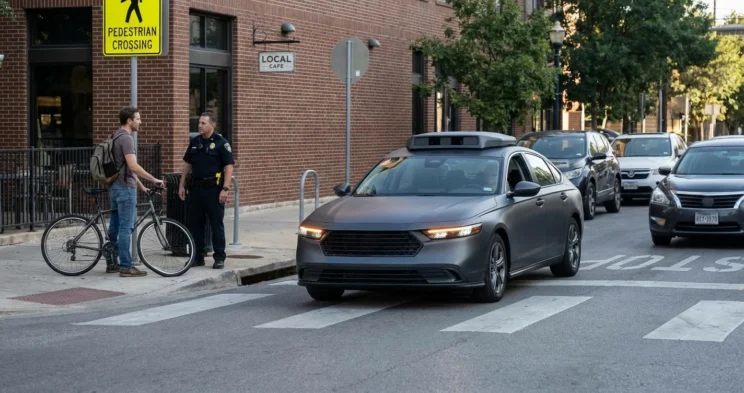
Automated vehicle crashes involving pedestrians, cyclists, motorcyclists and other road users raise important safety questions, but reported crash counts cannot establish how likely someone is to be hit or which company operates the safest vehicles.
An analysis of NHTSA’s Standing General Order crash reports identified 40 of 1,538 unique automated driving system crashes (under 3%) that involved a motorcycle or another person outside a vehicle. The analysis covers crashes from June 2025 through August 2026. One qualifying property damage crash from April 2025 is included as an exception. September 2026 crashes are excluded.
The scenarios described below are based on company reports unless otherwise stated. These figures count reported crashes, not crashes per mile driven.
What the 40 Automated Vehicle Crashes Reveal
The 40 crashes involved different road users. Not all involved a moving automated vehicle striking a pedestrian or cyclist.
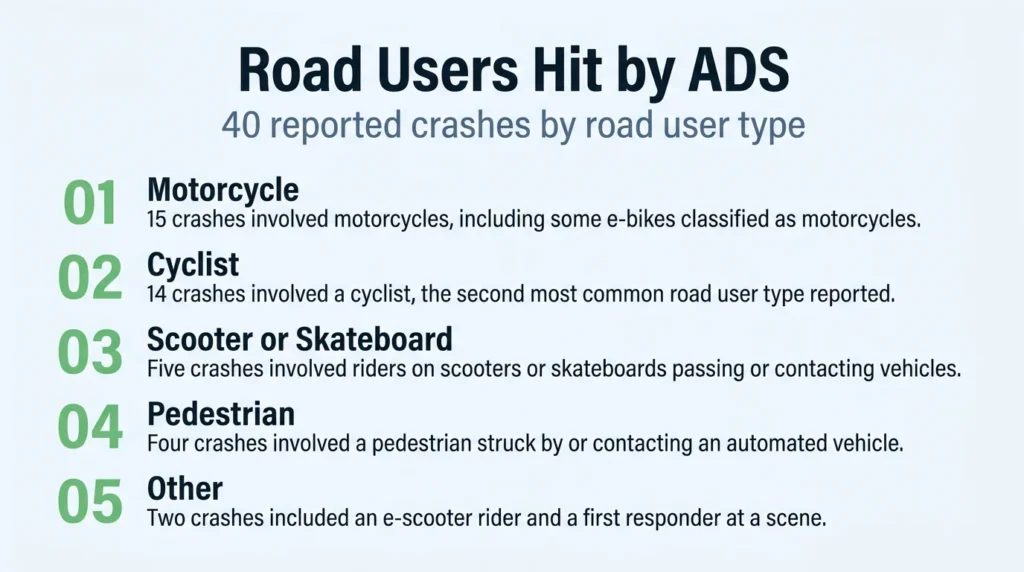
The first table shows how the reports categorized the road users involved:
| Type of Road User | Crashes |
|---|---|
| Motorcycle | 15 |
| Cyclist | 14 |
| Scooter or skateboard | 5 |
| Pedestrian | 4 |
| Other | 2 |
| Total | 40 |
Some e-bikes were also classified as motorcycles. The “Other” category included an e-scooter rider in Miami and a first responder in Las Vegas.
The reports also show which companies were associated with these 40 crashes:
| Company | Crashes |
|---|---|
| Waymo | 29 |
| Zoox | 6 |
| Avride | 3 |
| Nuro | 1 |
| Tesla | 1 |
| Total | 40 |
The geographic breakdown shows where the reported crashes occurred by state:
| State | Crashes |
|---|---|
| California | 26 |
| Texas | 5 |
| Florida | 3 |
| Georgia | 2 |
| Nevada | 2 |
| Arizona | 2 |
| Total | 40 |
These counts do not consider differences in miles driven, so they cannot show which company or state had the highest crash rate.
The reports also identify the cities where the crashes occurred:
| City | Crashes |
|---|---|
| San Francisco | 18 |
| Los Angeles | 5 |
| Austin | 3 |
| Atlanta | 2 |
| Dallas | 2 |
| Miami | 2 |
| Santa Clara | 1 |
| Winchester | 1 |
| Palo Alto | 1 |
| Santa Monica | 1 |
| Miami Beach | 1 |
| Las Vegas | 1 |
| Scottsdale | 1 |
| Tempe | 1 |
| Total | 40 |
The reports also provide information about the reported severity of injuries in these crashes. Eighteen of the 40 crashes were coded as involving an injury or fatality, including two fatal crashes. These 18 crashes make up 18 of the full dataset’s 154 injury-or-fatality-coded crashes, and they account for both reported deaths.
The subset included:
- One serious injury requiring hospital treatment
- Three moderate injuries
- 12 minor injuries
Hospital treatment was reported in one moderate injury and four minor injuries.
Another 18 crashes were coded as having “no reported injury,” while four had “unknown injury severity.”
These are reported severity codes, not confirmed diagnoses or counts of people injured.
NHTSA’s definitions include emergency treatment as hospitalization. Some cases marked “unknown” also describe hospital transportation.
The reports also recorded what the automated vehicles were doing when the crashes occurred:
| Vehicle movement | Crashes |
|---|---|
| Stopped | 15 |
| Parked | 3 |
| Traveling straight | 18 |
| Turning right | 4 |
| Total | 40 |
A separate speed field listed 0 mph in 21 crashes. A stopped vehicle is not automatically free from fault. Its position and the actions of everyone involved are still important when determining fault.
Six Scenarios Described in Automated Vehicle Crash Reports
Company reports describe six broad scenarios, and these accounts are not independent findings of fault:
- Riders or pedestrians entering the path of a stopped or slowing vehicle: About 26 crashes.
- Doors opening into traffic: Four crashes involved passengers opening ADS vehicle doors into passing riders.
- Another vehicle triggering a collision: Four crashes involved a third vehicle.
- Passengers exiting moving vehicles: Two crashes involved passengers exiting before the vehicle stopped.
- Moving vehicles striking people: Three crashes involved a moving ADS vehicle striking a person.
- Intentional contact: One report described a firefighter striking an ADS vehicle with a hand tool at an active fire scene.
These descriptions summarize company reports and do not establish legal fault.
Texas Automated Vehicle Crash Reports and Case Details
In September 2025 in Tempe, Arizona, Waymo reported at about 1:21 a.m. that its vehicle was slowing to turn right into a parking lot and yielding to a pedestrian when a motorcycle struck the vehicle’s rear left side. The report states that the rider was then struck by a second vehicle, which left the scene. Waymo reported that its vehicle was traveling about 8 mph.
On August 7, 2026, around 11:30 p.m. on Maple Avenue in Dallas, Waymo reported that an opposing SUV hit a pedestrian, who then made contact with the rear-left side of Waymo’s slowing vehicle. FOX 4’s initial report, citing Dallas police, stated that both vehicles stopped, and the Waymo was unoccupied. Initial reports described an ongoing police investigation, but a final outcome was not verified.
The reporting companies described the five Texas cases as follows:
| City | Date | Company | Reported Details | Reported Injuries |
|---|---|---|---|---|
| Austin | September 2025 | Tesla | A pedicab struck the vehicle’s mirror while it was stopped at a red light. | No injuries reported. |
| Dallas | April 2026 | Avride | A cyclist passed a trailing SUV, ran a stop sign, and made contact with the vehicle as it began turning right. | No injuries reported. |
| Austin | July 2026 | Avride | An e-bike rider traveling in the wrong direction lost control on a curve and slid into the side of the vehicle. | A minor injury was reported. |
| Austin | July 2026 | Avride | A scooter rider entered against the pedestrian signal and made contact with the side of the vehicle. | A minor injury was reported. |
| Dallas | August 2026 | Waymo | An SUV struck a pedestrian before the pedestrian made contact with Waymo’s vehicle. | A fatal injury was reported. |
Texas Traffic Laws That Apply to Automated Vehicle Crashes
Texas Transportation Code § 552.008 requires drivers to use due care to avoid hitting pedestrians. It also addresses horn use and precautions around children and people who appear to be confused or incapacitated.
Texas Transportation Code § 545.418 prohibits opening a traffic-side door unless it is reasonably safe and will not interfere with traffic. The door may remain open only as long as it is required to load or unload. This Texas law does not govern the San Francisco examples.
Under current Texas Transportation Code § 545.454, an engaged automated driving system is treated as the operator for traffic law compliance. This rule does not, by itself, determine who must pay damages.
What to Do After a Crash Involving an Automated Vehicle
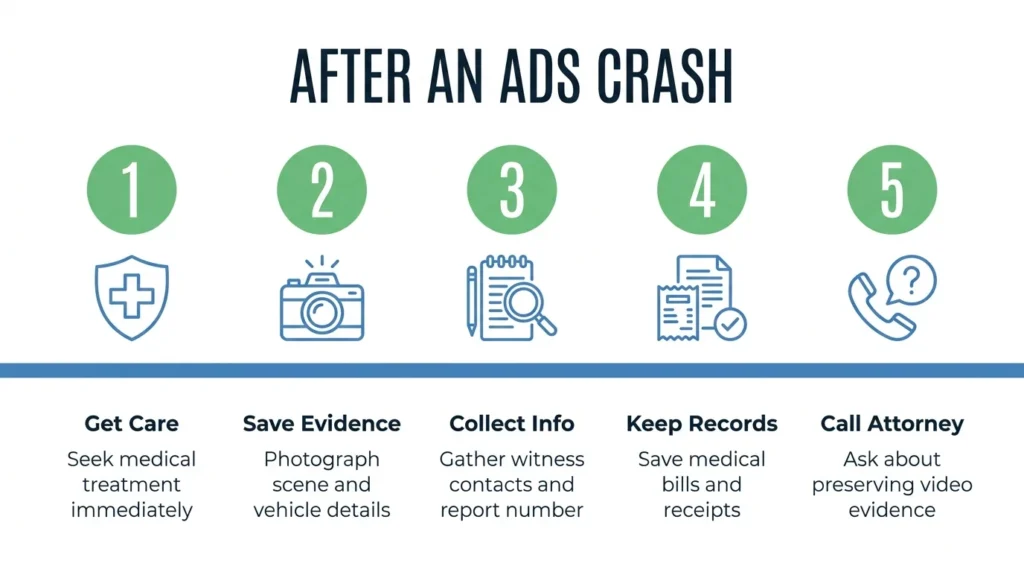
After a crash, take these steps:
- Get medical care for your injuries.
- Save evidence, including scene photos, video footage, vehicle identifiers, door positions, and traffic-signal details.
- Collect witness contact information and the police incident number.
- Keep all medical records, bills, and receipts.
- Ask an attorney promptly about preserving ADS video footage, sensor records, and evidence from other vehicles.
These records can help support a Texas car accident claim, including one involving a driverless vehicle.
Talk to Angel Reyes & Associates About Your Automated Vehicle Crash in Texas
Determining responsibility after a Texas crash involving autonomous vehicle technology can be complicated. Angel Reyes & Associates has been helping injured Texans through this process for over 30 years, and we have recovered more than $1 billion for our clients. We work on contingency, which means you pay no fees unless we win your case.
Contact Angel Reyes & Associates today for a free consultation to discuss your accident, understand your legal options, and learn what steps you can take to protect your claim.
Past results do not guarantee future outcomes.
Automated Driving System Vehicle FAQs
Can I sue an ADS vehicle company if its vehicle causes a crash?
Potentially. If an ADS vehicle’s actions or a technology problem contributed to a crash, the operating company or another responsible party may be responsible. The evidence and applicable law will determine whether a claim is viable.
Who is responsible when a self-driving car causes an accident?
Responsibility depends on the cause of the crash. Potentially responsible parties may include the operator, manufacturer, technology developer, maintenance provider, or another driver. Investigators must examine the evidence to determine fault.
How long do I have to file an ADS vehicle injury lawsuit in Texas?
Texas generally allows two years to file a personal injury lawsuit, but exceptions apply. Government claims and other special circumstances may have different deadlines, so check the deadline for your specific case.
About the Authors

Angel Reyes
Writer
Angel L. Reyes, III is the Founder and Managing Partner of Angel Reyes & Associates. A nationally recognized trial attorney and business leader, Angel has helped over 70,000 injury victims recover more than $1 billion since founding the firm in 1993. Named to the Texas Super Lawyers list annually since 2008, Angel brings Wall Street experience, Ivy League education, and a deep commitment to client advocacy. He is a frequent legal commentator and published author with extensive contributions to legal scholarship, trial strategy, and consumer protection.

Kyle Nicolas
Editor
Kyle Nicolas is the Web Content & SEO Manager at Angel Reyes & Associates. He has more than 10 years of experience as a marketing co...

Angel Reyes
Reviewer
Angel L. Reyes, III is the Founder and Managing Partner of Angel Reyes & Associates. A nationally recognized trial attorney and business...