Do You Need Insurance for an E-Bike in Texas?


Every article on this site is researched by our internal team, reviewed for legal accuracy against current Texas law, and held to State Bar of Texas advertising standards before publication. We do not publish content that overstates outcomes or makes promises about results.
Learn more about our
editorial standards .
Key Takeaways
- Texas does not require insurance, registration, or license plates for classified e-bikes; a non-conforming e-bike that exceeds 750W or 28 mph is treated as a motor vehicle and must be insured.
- Homeowner's and renter's policies may partially cover e-bikes as bicycles, but liability coverage for injuries you cause to others is generally unreliable; standalone e-bike insurance fills that gap.
- An injured e-bike rider without insurance can still pursue the at-fault party's insurance, their own UM/UIM coverage, or TTCA claims if infrastructure contributed.
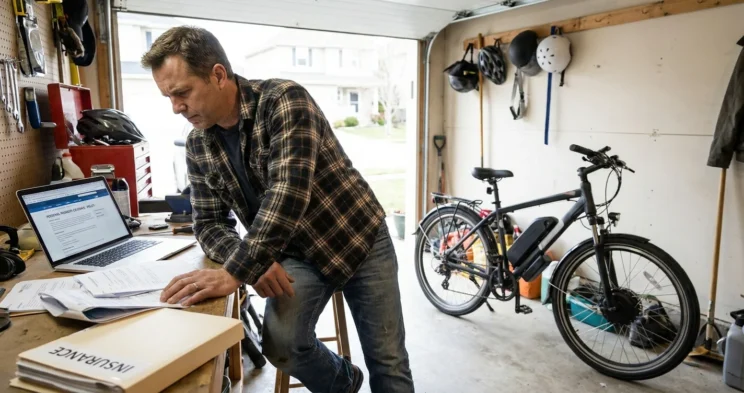
The short answer is no, Texas law doesn’t require insurance coverage, registration, or license plates for most e-bikes like it does for cars and trucks. But optional insurance for e-bikes is becoming increasingly common, and it’s worth considering for several reasons.
If you cause an accident on your e-bike, you can be held personally responsible for any injuries and damages that result. Even if you are insured, your policy may have significant gaps in coverage that could put you in a tight spot after an accident.
Texas Does Not Require E-Bike Insurance
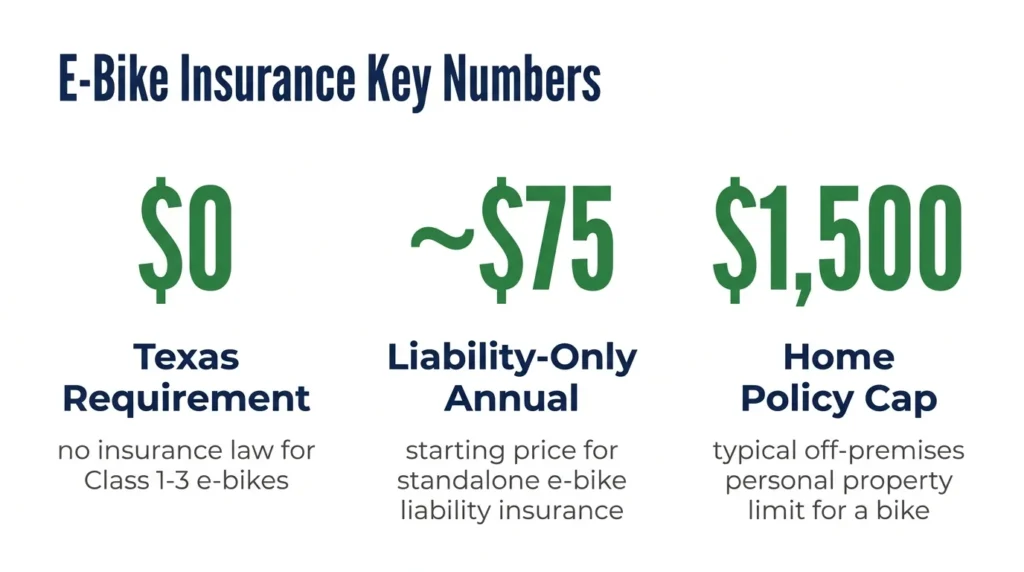
Texas classifies electric bicycles under Transportation Code Chapter 664. Their classification — electric bicycle, not motor vehicle — means the mandatory insurance requirements that apply to cars and trucks doesn’t apply to Class 1, 2, and 3 e-bikes.
There are a few exceptions you should know about. A bike that exceeds 750 watts, reaches assisted speeds above 28 mph, or lacks fully operable pedals is considered a motor vehicle under Texas law and must be insured.
However, even if coverage isn’t legally required, riding an uninsured e-bike creates real financial risk. If you cause a crash that injures a pedestrian or damages a vehicle, you are just as liable in the eyes of the law whether you’re insured or not.
Policies That May Cover Your E-Bike
Personal Auto Insurance
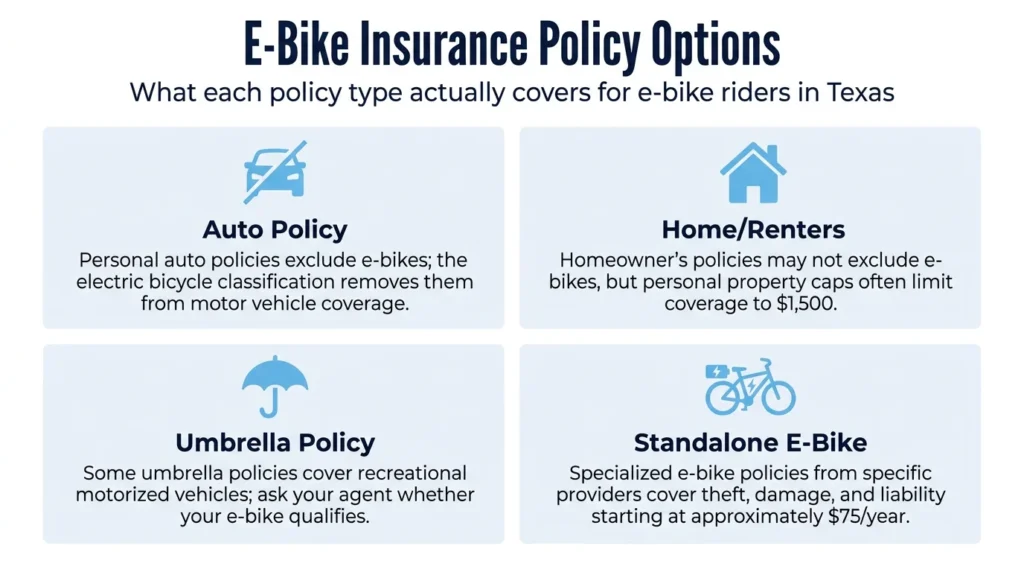
Your auto policy will generally not cover your e-bike. Those policies are designed for motor vehicles, and e-bikes are not motor vehicles under Texas law. A Texas auto insurer will typically deny a liability claim arising from an e-bike accident.
Homeowner’s & Renter’s Insurance
Because Texas classifies e-bikes as electric bicycles rather than motorized vehicles, a homeowner policy’s standard “motorized vehicle” exclusion may not apply to an e-bike. That means some coverage may be available. In practice, there are two important limitations.
First, personal property coverage for items damaged or stolen away from home is often capped at $500 to $1,500—a fraction of what most e-bikes cost. Second, liability coverage for injuries you cause to others while riding is generally not provided by standard homeowner’s or renter’s policies.
Whether coverage applies will depend on the language of your specific policy. Check directly with your insurance provider before assuming you are covered.
Umbrella Policies
Some umbrella policies extend to recreational vehicles, and may cover e-bike use. This varies by insurance company. Ask your insurance whether your umbrella policy covers motorized recreational vehicles used on public roads.
Standalone E-Bike Insurance
This is the most reliable option for e-bike riders who want meaningful protection. Specialized e-bike insurance policies are available from well-known carriers like Progressive, Markel, GEICO, and USAA. These policies typically cover theft, damage to the bike, liability for injuries caused to others and, in some cases, even medical payments and uninsured motorist protection. Liability-only e-bike coverage starts at roughly $75 to $100 per year; full coverage is higher and varies by insurer.
The Gap Between Your Injuries & Liability Coverage
These are two different areas of coverage, and it’s important that you understand the distinction.
Your Own Injuries
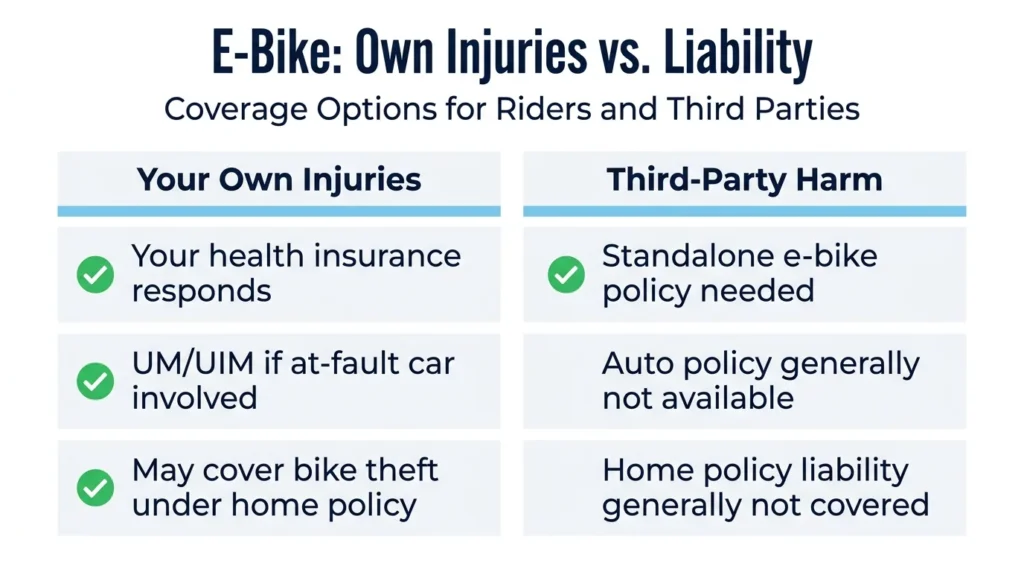
Your health insurance covers your medical expenses if you are hurt in a crash, regardless of who caused it. Health insurance doesn’t cover property damage to your bike or liability for others’ injuries.
Third-Party Liability
If you injure a pedestrian, cyclist, or motorist while riding, you are responsible for their damages. Riding without liability coverage means you are personally on the hook for anyone you harm. This is where standalone e-bike insurance can protect you.
What Injured E-Bike Riders Can Pursue Without Insurance
Even without insurance, you still have options if you’re injured in an e-bike accident caused by someone else.
A Negligence Claim Against the At-Fault Party
If a driver’s negligence caused your injury, you can pursue a claim against that driver’s auto insurance. In that situation, an e-bike rider injured in a crash caused by a motor vehicle is treated similarly to a bicyclist.
Uninsured Motorist Coverage
If you carry a personal auto policy with uninsured motorist (UM) or underinsured motorist (UIM) coverage, that coverage may apply to injuries caused by an uninsured driver — even if you were on an e-bike rather than in your car. Whether it applies will depend on your specific policy.
Product Liability
If a defective e-bike component caused or contributed to the crash, a product liability claim against the manufacturer or seller may be an option.
Texas proportionate responsibility rules under Texas Civil Practice and Remedies Code Chapter 33 apply here. It’s important to note that the statute of limitations for personal injury claims is two years, so don’t delay to take action.
Texas Tort Claims Act
If a road defect, broken pavement, or inadequate infrastructure contributed to your accident, a claim against the municipality is available under CPRC Chapter 101. Again, timeliness is an important factor. Cities require written notice within 90 days of the incident; counties require 180 days’ notice. Damages against municipalities are capped at $250,000 per person and $500,000 per occurrence.
Work with a Personal Injury Attorney
If you were injured in an e-bike accident, an attorney can identify all available coverage, evaluate the other party’s fault, and pursue the full range of claims available to you under Texas law.
Angel Reyes & Associates has represented injury victims across Texas for more than 30 years and recovered more than $1 billion on their behalf. We offer free initial consultations and work on a no-fee-unless-you-win basis.
To discuss your situation, contact us for a free consultation.
Past results do not guarantee future outcomes.
E-Bike Insurance FAQs
Does homeowners insurance cover an e-bike?
Sometimes partially. Because Texas classifies e-bikes as electric bicycles rather than motorized vehicles, some homeowner’s policies do not apply a blanket motorized vehicle exclusion. Personal property coverage may apply, but it is often capped at $500 to $1,500 for items away from home — far less than most e-bikes cost. Liability coverage for injuries you cause to others while riding is generally not reliably provided. Check your specific policy language with your insurer.
What if I am injured by someone else while riding my e-bike?
You can pursue a personal injury claim against the at-fault party regardless of your own insurance status. If a driver caused your injury, their auto insurance should respond. If the at-fault driver is uninsured or underinsured, your own auto policy’s UM/UIM coverage may apply depending on your policy language.
What is the difference between coverage for my own injuries and liability coverage?
Your own injuries are covered by your health insurance regardless of fault. Health insurance does not pay for harm you cause to others. Third-party liability coverage pays for injuries and property damage you cause while riding. These are separate types of insurance. Most e-bike riders who rely on homeowner’s policies have personal property coverage but lack adequate liability coverage — those are different needs requiring different solutions.
About the Authors

Angel Reyes
Writer
Angel L. Reyes, III is the Founder and Managing Partner of Angel Reyes & Associates. A nationally recognized trial attorney and business leader, Angel has helped over 70,000 injury victims recover more than $1 billion since founding the firm in 1993. Named to the Texas Super Lawyers list annually since 2008, Angel brings Wall Street experience, Ivy League education, and a deep commitment to client advocacy. He is a frequent legal commentator and published author with extensive contributions to legal scholarship, trial strategy, and consumer protection.

Kyle Nicolas
Editor
Kyle Nicolas is the Web Content & SEO Manager at Angel Reyes & Associates. He has more than 10 years of experience as a marketing co...

Angel Reyes
Reviewer
Angel L. Reyes, III is the Founder and Managing Partner of Angel Reyes & Associates. A nationally recognized trial attorney and business...