The $5 Million Insurance Requirement for Charter Buses


Every article on this site is researched by our internal team, reviewed for legal accuracy against current Texas law, and held to State Bar of Texas advertising standards before publication. We do not publish content that overstates outcomes or makes promises about results.
Learn more about our
editorial standards .
Key Takeaways
- Federal law requires for-hire charter buses with 16+ seats to carry $5 million in coverage.
- The $5 million limit is a per-crash pool shared by every injured passenger, not $5 million per person.
- Texas gives injured bus passengers two years from the crash date to file a claim.
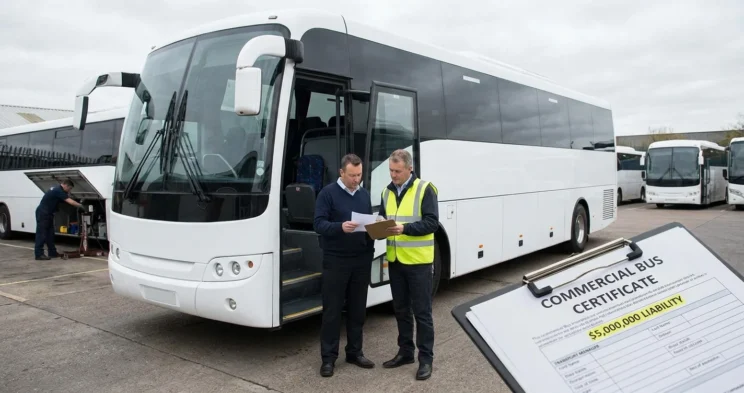
You boarded a charter bus in downtown Austin for what should have been a routine trip up I-35. Then the bus rear-ended a stopped truck, and now you are dealing with a hospital bill and a bus company you have never heard of. Who pays for your injuries, and is there enough insurance to cover your losses?
Federal Insurance Rules for Charter Buses
A charter bus that carries passengers-for-hire must carry at least $5 million in liability coverage under federal law. This applies to any bus built to seat 16 or more passengers. Smaller for-hire vehicles must carry at least $1.5 million.
These charter bus insurance requirements come from the Federal Motor Carrier Safety Administration, which is the agency that regulates commercial passenger vehicles. These rules are found in federal motor carrier financial responsibility regulations and apply to companies who transport passengers for money.
The dollar amounts are listed in 49 CFR § 387.33. Congress gave the Secretary of Transportation the power to set these minimums under 49 U.S.C. § 31138, which is the statute that specifically governs the minimum financial responsibility for passenger carriers. Together, they set the minimum insurance coverage that buses are required to carry according to the FMCSA.
These insurance rules apply if the company is considered to be “for-hire.” A company that buses its own employees to a job site is a private carrier and is not subject to these minimums, but a company that sells you a seat on their bus is considered to be a “for-hire carrier,” and therefore, they must carry the required coverage. If you were injured on a commercial charter bus, then you are likely dealing with a carrier that must abide by these insurance requirements.
The FMCSA also publishes official guidance on passenger carrier insurance that confirm the most current thresholds.
Interstate vs. Intrastate Charter Bus Coverage
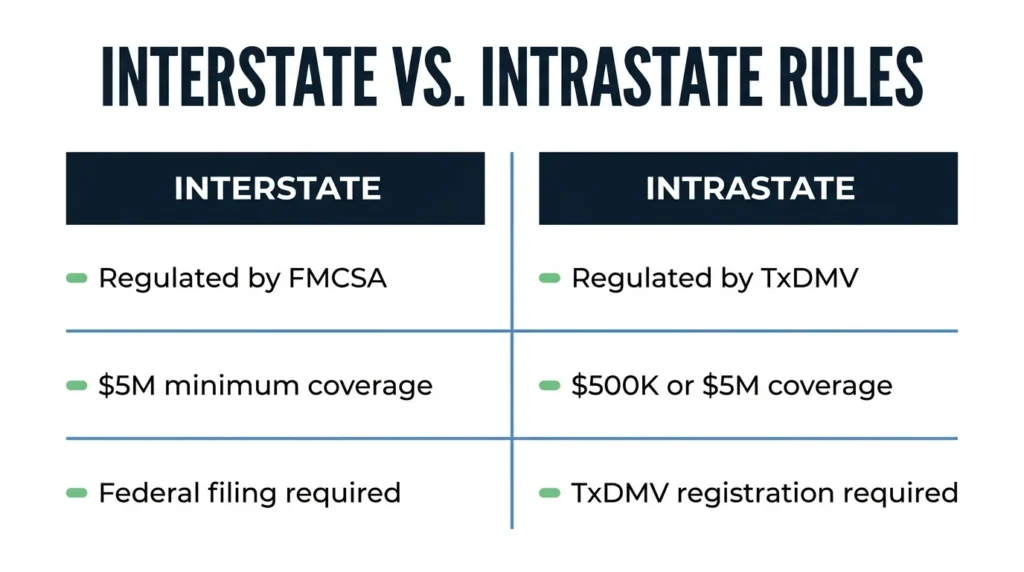
The coverage that a carrier is required to have depends on whether it crosses state lines or stays inside Texas. Interstate carriers must follow federal FMCSA rules. Carriers that operate only within Texas must follow state-specific rules instead.
Interstate Charter Bus Carriers
A bus that crosses state lines falls under the FMCSA directly, and its minimum coverage is set only by federal regulation. The $5 million policy applies to any for-hire bus with 16 or more seats operating across state lines.
These carriers must file proof of financial responsibility with the FMCSA. They have to keep their coverage active for as long as they are allowed to operate.
The FMCSA offers tips for chartering a bus safely that explain what these FMCSA insurance requirements mean for travelers.
Intrastate Charter Bus Carriers
A Texas-only carrier answers to the Texas Department of Motor Vehicles, not the FMCSA. State rules under the Texas Transportation Code Chapter 643 require these carriers to register with TxDMV and file proof of insurance to operate.
The actual dollar amounts come from a TxDMV administrative rule, 43 TAC § 218.16. Under that rule, a Texas intrastate bus carrying 26 or fewer passengers must carry at least $500,000 in liability coverage. A bus carrying 27 or more passengers must carry at least $5 million in liability coverage.
So, the first step after a crash is to figure out where the bus operated: across state lines or only within Texas. This will determine which dollar amount applies.
What the $5 Million Minimum Means for Injured Passengers
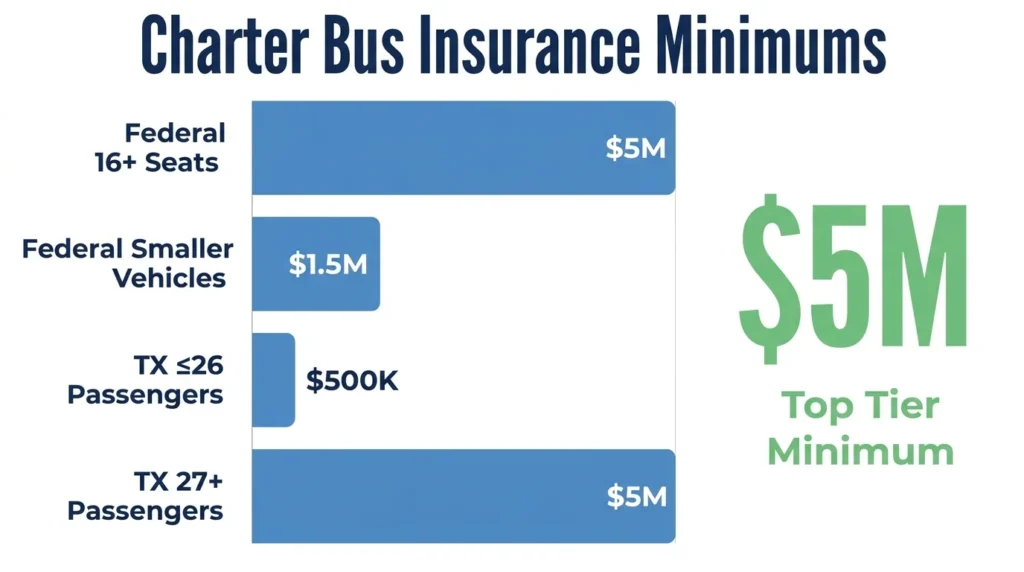
The $5 million minimum is a per-crash pool, not a guaranteed amount for each passenger. When a crash injures many people, every injured party draws from that same pool. There are no separate per-person limits stacked on top of it.
When injuries are severe, and several passengers are injured, the total recovery per person can be far below $5 million. Knowing this early shapes how you build and pursue your claim.
For a clearer picture of how these cases resolve in practice, our coverage of average bus accident settlements in Texas walks you through the factors that determine the final figure.
Additionally, the policy limit is not paid out automatically. Insurers for large carriers defend these claims hard, and injured passengers usually have to go through a legal process before any payment is made. If you are trying to figure out how much coverage may be available to you, start by learning how Texas bus accident claims work.
Federal data explains why these insurance minimums are set. The FMCSA publishes large truck and bus crash facts that document how many serious injuries result from large bus crashes nationwide.
How to Verify a Charter Bus Carrier’s Insurance
You can confirm a carrier’s insurance and registration at any time. The FMCSA offers a free public lookup, and Texas keeps its own records for intrastate carriers. A few details captured at the scene will make the search far easier.
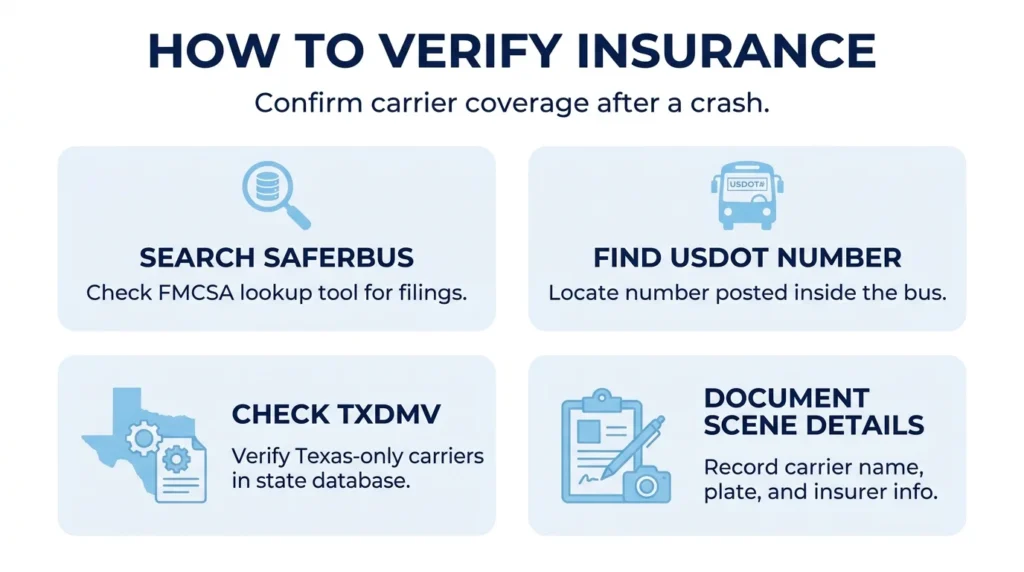
Step 1: Search the carrier on the FMCSA SaferBus tool. The free FMCSA public lookup tool allows anyone to search a carrier name or USDOT number to check active insurance filings and safety ratings. This is the fastest way to confirm whether charter bus accident liability coverage exists.
Step 2: Find the carrier’s USDOT number. This number is usually posted inside the bus and appears on FMCSA registration records. It is the key to pulling insurance verification after a crash.
Step 3: Check TxDMV for Texas-only carriers. A carrier that stays inside Texas may not register with the FMCSA. For those operators, verification is done through the TxDMV carrier database instead.
Step 4: Document the details at the scene. Record the carrier name, USDOT number (if visible), license plate, and any insurer information. Capturing this information early preserves your ability to file a bus accident claim in Texas.
If you are unsure who actually bears responsibility, our guide to who is liable in a bus accident breaks down the parties involved.
How an Attorney Can Help with Your Bus Accident Claim in Texas
An attorney can figure out which rules govern your crash and confirm whether the carrier actually carries the coverage it is required to have. An attorney knows which rules apply, how to verify insurance coverage, how to protect evidence against a large carrier, all of which requires knowledge of federal regulations and Texas injury law.
These cases are often complicated, as charter bus companies often have corporate legal teams and insurers who start investigating within hours of a crash. Early legal action protects your ability to recover the full insurance coverage available to you.
These cases are similar to other commercial vehicle claims. Our overview of commercial truck insurance requirements shows how similar federal minimum insurance rules work.
Remember, time is working against you. Texas gives you two years from the date of the crash to file a personal injury claim. Every month that you delay cuts into the time available to build your case against the carrier and its insurer.
Talk to an Attorney About Your Bus Accident in Texas
A charter bus crash leaves you dealing with a corporate carrier, federal regulations, and an insurer that wants to pay you less than your claim is worth. Fortunately, you do not have to figure it out alone.
Angel Reyes & Associates has spent more than 30 years helping injured Texans understand their options and pursue what they are owed. We handle bus accident cases on a contingency basis, which means you pay no fee unless we win, and we have recovered more than $1 billion for clients across the entire state of Texas.
Reach out to us for a free consultation to talk through what happened and what your claim may be worth.
Past results do not guarantee future outcomes.
Charter Bus Insurance FAQs
Does the $5 million insurance requirement apply to charter buses rented for a wedding or private event?
Yes. Any carrier that transports passengers for compensation is a for-hire carrier under federal rules, regardless of the occasion. A company that rents a bus for a wedding, concert, or corporate outing is still operating for hire and must meet the same $5 million coverage policy.
What types of damages can an injured charter bus passenger recover in Texas?
An injured passenger can recover economic damages (such as medical bills, lost wages, and reduced earning capacity) and non-economic damages (such as pain and suffering, mental anguish, and physical impairment). In cases involving gross negligence or malice, Texas law also allows punitive damages against a private carrier.
If another driver caused the crash, can a bus passenger still file a claim?
Yes. A passenger injured in a crash caused by a third-party driver can file a claim directly against that driver’s insurance for all provable damages. However, the bus carrier’s $5 million policy only applies when the carrier is legally responsible, and it does not cover crashes caused entirely by outside parties.
Can an injured passenger file a claim against the bus driver personally, in addition to the company?
Yes. In Texas, both the driver and the company can be named in the same lawsuit. The company is typically liable under the legal principle that employers are responsible for their employees’ negligence on the job, but the driver can also be held personally liable for their own negligent acts.
What happens if the charter bus company does not carry the required insurance?
A bus company that fails to maintain the required coverage can still be sued directly, and a court can order payment from the company’s assets. Injured passengers may also be able to file a claim under their own uninsured or underinsured motorist coverage if their personal auto policy includes those protections.
About the Authors

Angel Reyes
Writer
Angel L. Reyes, III is the Founder and Managing Partner of Angel Reyes & Associates. A nationally recognized trial attorney and business leader, Angel has helped over 70,000 injury victims recover more than $1 billion since founding the firm in 1993. Named to the Texas Super Lawyers list annually since 2008, Angel brings Wall Street experience, Ivy League education, and a deep commitment to client advocacy. He is a frequent legal commentator and published author with extensive contributions to legal scholarship, trial strategy, and consumer protection.

Kyle Nicolas
Editor
Kyle Nicolas is the Web Content & SEO Manager at Angel Reyes & Associates. He has more than 10 years of experience as a marketing co...

Angel Reyes
Reviewer
Angel L. Reyes, III is the Founder and Managing Partner of Angel Reyes & Associates. A nationally recognized trial attorney and business...