Who Is Liable in a Bus Accident in Texas?


Every article on this site is researched by our internal team, reviewed for legal accuracy against current Texas law, and held to State Bar of Texas advertising standards before publication. We do not publish content that overstates outcomes or makes promises about results.
Learn more about our
editorial standards .
Key Takeaways
- Texas bus crash claims can involve drivers, operators, contractors, manufacturers, and other motorists.
- Claims against public transit authorities require written notice within six months of the incident.
- Bus accident claims and lawsuits can be incredibly difficult to navigate, making legal guidance crucial.
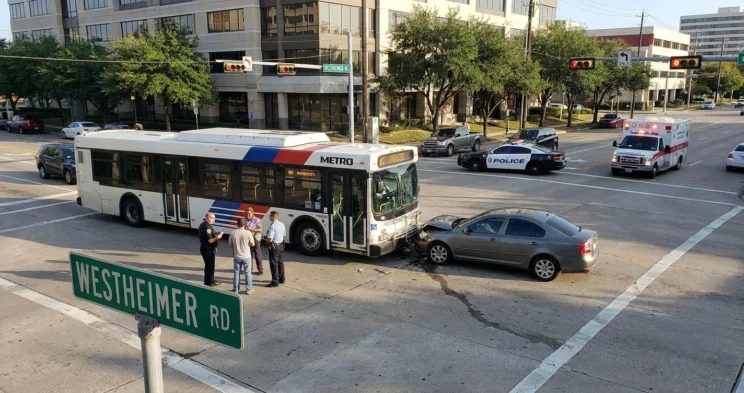
You were riding the bus home from work along Westheimer Road when the driver braked hard, and you slammed into the seat in front of you. Now your back is in spasm, the medical bills are piling up, and the transit company is treating you like a number on a claim form.
So, who is liable in a bus accident in Texas? Figuring it out can be difficult without the right assistance.
Multiple Parties Can Share Liability
A Texas bus crash usually involves more than one responsible party. The driver, the operating company, a maintenance contractor, the bus manufacturer, or another motorist may each share fault.
In Texas, you can hold multiple parties responsible for the same accident. Because a jury assigns a percentage of fault to each person or company involved, it is critical to identify every potential “target” immediately.
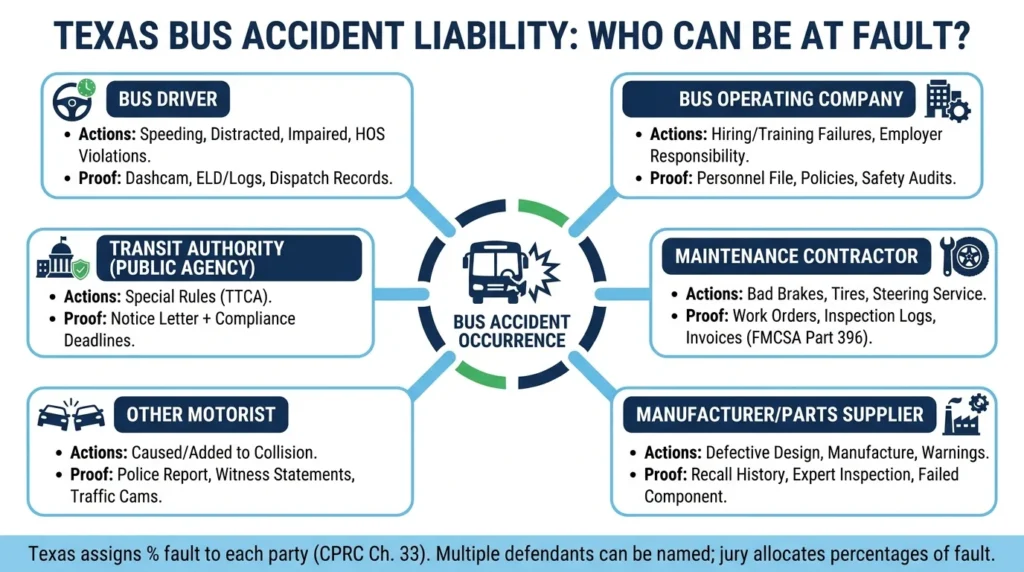
A bus accident is much more complicated than a typical two-car crash. Instead of just dealing with another driver, you are often dealing with a web of organizations, including the bus company, the government agency that hired them, and the contractors who maintain the vehicles. Each of these layers has its own legal team and insurance policy.
Under the proportionate responsibility rules found in Texas Civil Practice and Remedies Code (CPRC) Chapter 33, juries assign a fault percentage to every party in the case. That means a strong claim often names multiple defendants together, with each paying in proportion to their share.
Bus Driver & Operating Company
If you’re hurt in a bus crash, your claim will likely name the bus driver and the bus company as the parties responsible for the accident. They are often sued together because, in Texas, an employer is legally responsible for the actions of their employees while they are on the clock. The driver may face direct negligence claims, while the company may face both vicarious liability for the driver’s actions and its own claims for hiring and oversight failures.
Bus Driver Negligence
Federal rules set by the FMCSA’s passenger carrier safety program establish qualification and conduct standards for commercial bus drivers. A violation of those rules is considered evidence of negligence in Texas.
Examples of bus driver negligence include speeding, distracted driving, impaired driving, failure to yield, or violating federal hours-of-service limits. Each of these examples can be proven through dispatch records, dashcam footage, and electronic logs.
If the driver was off the clock or doing something unrelated to their job, the bus company might argue they aren’t responsible, leaving the driver to face the lawsuit alone.
Maintenance Contractors & Vehicle Manufacturers
There are two additional individuals or entities that may be found at fault for your accident: the contractor who serviced the bus and the company that built it or its parts. Both can be named alongside the driver and operator when the facts support it.
Third-Party Maintenance Contractors
Many bus companies outsource maintenance. When a brake failure, tire blowout, or steering defect traces back to bad service work, the contractor can be sued directly.
FMCSA Part 396 sets the inspection, repair, and maintenance guidelines for commercial buses, and failing to meet these requirements can be used as evidence of negligence in court.
Maintenance records, inspection logs, and service invoices are types of evidence that can demonstrate negligence in these cases. They must be preserved quickly, because contractors can overwrite or discard records.
Vehicle Manufacturers
When a defective component causes a crash, the manufacturer of the bus or part may be strictly liable under Texas products liability law. Strict liability means you do not have to prove the manufacturer was careless, only that the product was defective and that the defect caused your injury.
Defects fall into three categories:
- Design defects make the bus model itself unsafe.
- Manufacturing defects affect a single unit that left the factory in dangerous condition.
- Marketing defects involve missing or inadequate warnings about known hazards.
Bus body manufacturers, engine makers, brake suppliers, and tire makers can all be found at fault depending on what failed.
How a Bus Company Can Be Held Responsible
A bus company can be held liable in two different ways. Think of these as two separate paths to a successful claim.
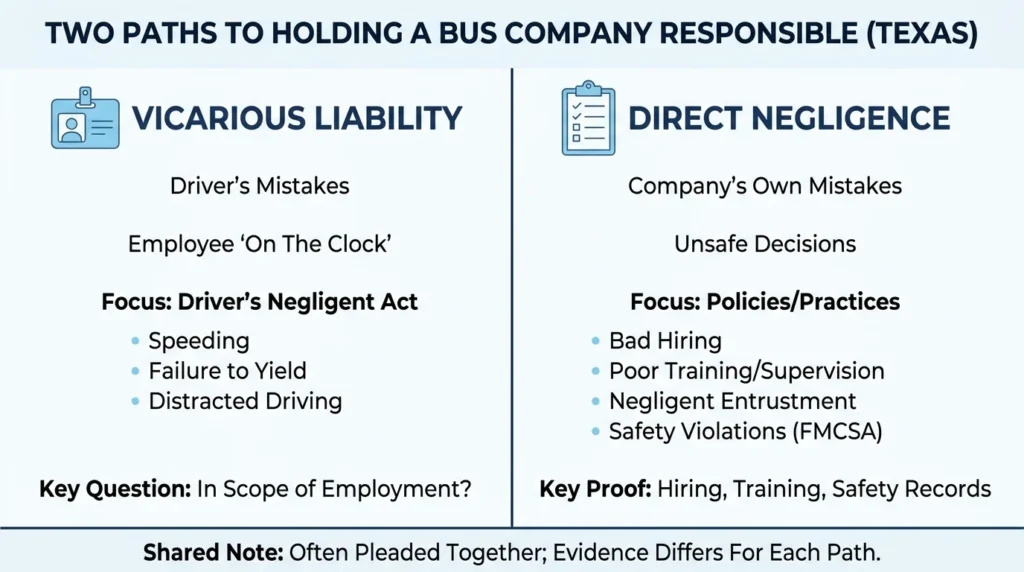
Responsibility for the Driver’s Mistakes
Under a rule called “vicarious liability,” a company is automatically responsible for its driver’s actions while they are on the job. Even if the company followed every safety rule, they are still on the hook if their employee’s negligence caused your crash.
Responsibility for the Company’s Own Mistakes
The company can also be sued for its own poor decisions.
This is known as “direct negligence,” and it usually involves three things:
- Bad Hiring: Failing to check a driver’s background or driving record.
- Poor Training or Supervision: Not making sure drivers are safe and alert.
- Negligent Entrustment: Giving the keys to someone they knew—or should have known—was unfit to drive.
Private bus companies and contractors must follow strict federal safety rules (FMCSA standards) regarding vehicle inspections and driver qualifications. If a company ignores these rules, it provides powerful evidence that they were negligent, making your case much stronger.
Texas Transit Authority Liability
Public bus systems—like METRO, DART, and VIA—have a special legal shield called “sovereign immunity.” This means you generally cannot sue them unless a specific law gives you permission.
The Texas Tort Claims Act is the law that grants this permission for crashes caused by a government employee’s driving. However, this permission comes with two major “traps” that can ruin a case if you aren’t careful.
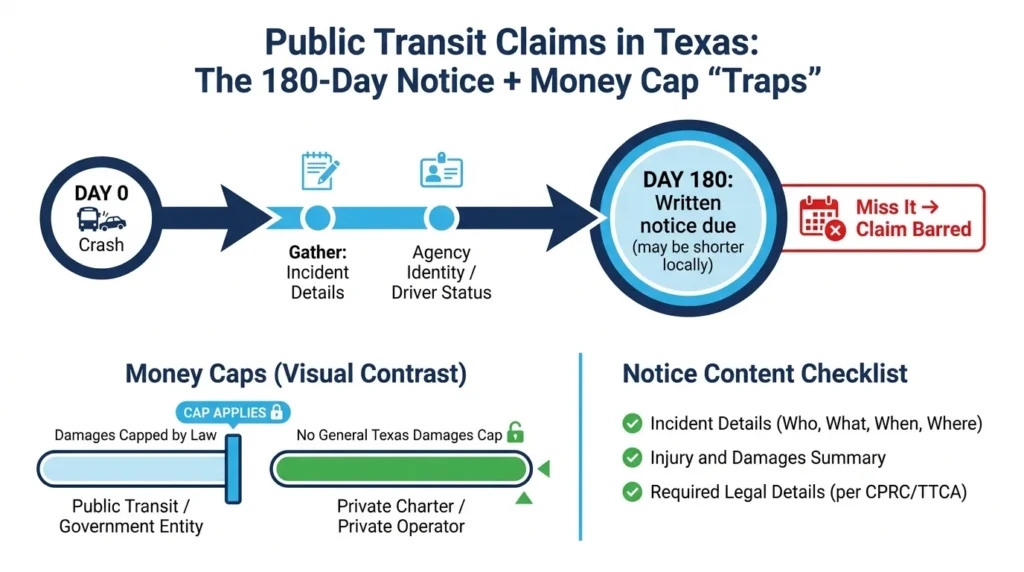
The 180-Day Notice Trap
In a normal car accident, you usually have two years to file a lawsuit. With a government-run bus (including school district buses), you must provide the agency with a formal written notice within six months (180 days) of the crash. Some cities have even shorter deadlines. If you miss this window, you may lose your right to sue forever.
Money Caps
Texas law places a “cap” (a maximum limit) on how much money a government entity has to pay for injuries. These limits are often much lower than what you could recover from a private charter bus or a commercial trucking company.
Why You Should Seek Legal Guidance
Because the rules for suing a public entity are so strict, an attorney is essential for:
- Meeting Deadlines: Identifying the exact notice deadline before it’s too late.
- Following the Rules: Ensuring the written notice contains the specific legal details required by the Texas Civil Practice and Remedies Code.
- Finding the Right Target: Determining if the driver was a government employee or a private contractor, which changes which rules apply.
Talk to a Bus Accident Attorney Today
Bus accident claims often involve drivers, companies, contractors, manufacturers, and sometimes a government agency, each with its own rules and deadlines.
`Angel Reyes & Associates handles bus accident claims, including public transit, school buses, and private carriers, with more than 30 years of experience and more than $1 billion recovered for clients. We work on a contingency basis, so there is no fee unless we win.
You can review our case results to see the kinds of outcomes we pursue. If a loved one was killed in a bus crash, we handle wrongful death claims as well. Contact us today for a free consultation.
Bus Accident FAQs
Can a passenger injured on a city bus recover damages if the driver was partly at fault, but the bus company was also negligent?
Yes. Texas law allows a claimant to pursue both the driver and the operating company in the same case under separate legal theories. The jury then assigns a fault percentage to each defendant, and each pays its proportionate share of the damages.
Does Texas cap the total damages a bus accident victim can recover from a private charter company?
Texas does not impose a general damages cap on claims against private bus operators or charter companies. Caps apply specifically to government entities, not to private carriers.
What physical evidence from the bus itself is most useful in a Texas accident claim?
Event data recorders, sometimes called black boxes, store speed, braking, and throttle data in the seconds before a crash. Dashcam footage, driver log books, and pre-trip inspection reports from the day of the incident are also commonly used to build or challenge liability.
Can a third-party driver who caused a bus crash be sued alongside the bus company in Texas?
Yes. If another motorist’s negligence contributed to the crash, that driver can be named as a defendant in the same lawsuit. The jury allocates fault among all parties, including the third-party driver, the bus company, and any other responsible parties.
Does Texas workers' compensation affect a bus accident claim if the injury happened while commuting?
Workers’ compensation typically does not cover injuries during an ordinary commute because the going-and-coming rule excludes travel to and from work. However, if the injured person was traveling for a work-required purpose, coverage may apply and could affect how a third-party claim against the bus operator proceeds.
About the Authors

Alex Ivanov
Writer
Alex Ivanov is a personal injury attorney at Angel Reyes & Associates, focused on car, truck, and motorcycle accident cases. Licensed in Texas and multiple federal districts, Alex brings international legal experience and a global education to his practice. He earned his LL.M. from Texas A&M University School of Law after graduating from Belarussian State University in 2016. Alex is fluent in Russian, English, Ukrainian, and Belarussian, and is recognized by multiple national trial lawyer associations for his results and leadership under 40.

Kyle Nicolas
Editor
Kyle Nicolas is the Web Content & SEO Manager at Angel Reyes & Associates. He has more than 10 years of experience as a marketing co...

Angel Reyes
Reviewer
Angel L. Reyes, III is the Founder and Managing Partner of Angel Reyes & Associates. A nationally recognized trial attorney and business...