What Is Unique About Bus Accident Lawsuits in Texas?


Every article on this site is researched by our internal team, reviewed for legal accuracy against current Texas law, and held to State Bar of Texas advertising standards before publication. We do not publish content that overstates outcomes or makes promises about results.
Learn more about our
editorial standards .
Key Takeaways
- Government bus claims in Texas require written notice within six months, sometimes only 90 days.
- Recovery against a public transit authority is capped under Texas Tort Claims Act § 101.023 limits.
- Private bus injury lawsuits follow the standard two-year filing deadline under CPRC § 16.003.
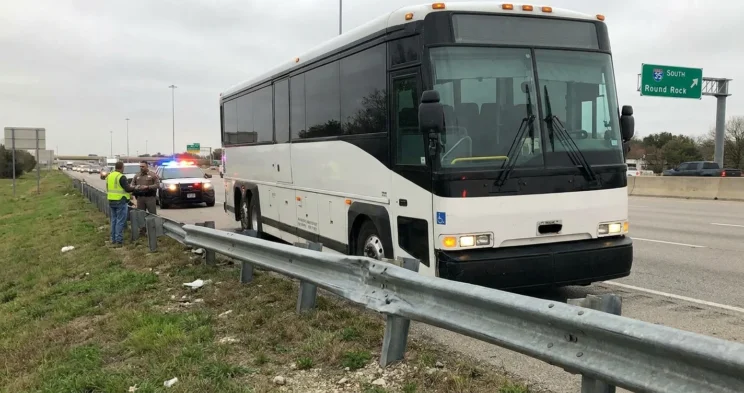
You were riding a charter bus back from a weekend trip when the driver drifted across I-35 near the Round Rock exit and clipped a guardrail. Now you’re home from the hospital with a stack of medical bills, a lost paycheck, and an insurance adjuster offering a quick check that feels too small. Should you take it, or is there a real case here?
Sue or Settle After a Texas Bus Crash?
Early settlement offers from transit authorities and bus carriers usually arrive before doctors know the full extent of your injuries. Accepting the offer closes the case for good. Holding out means a longer process but often a fairer recovery, especially when your injuries are severe, liability is disputed, or several passengers are competing for the same limited insurance pool.
Accepting a reasonable settlement offer may make sense when liability is clear, your injuries are healing on a predictable schedule, and you have documented wage loss that needs replacing now. Litigation makes more sense when you’re still evaluating possible permanent injuries, when the bus company is denying fault, or when a government entity is involved and statutory caps put pressure on early resolution.
Bus case values depend heavily on who operated the bus. A public transit authority, a charter company, a school district, and an interstate motorcoach carrier all sit in different legal frameworks. Knowing which one applies changes both the recovery ceiling and the procedural path. For a sense of what these claims tend to be worth, knowing average bus accident settlement amounts in Texas can help you make an informed decision.
Texas Tort Claims Act & Government Bus Claims
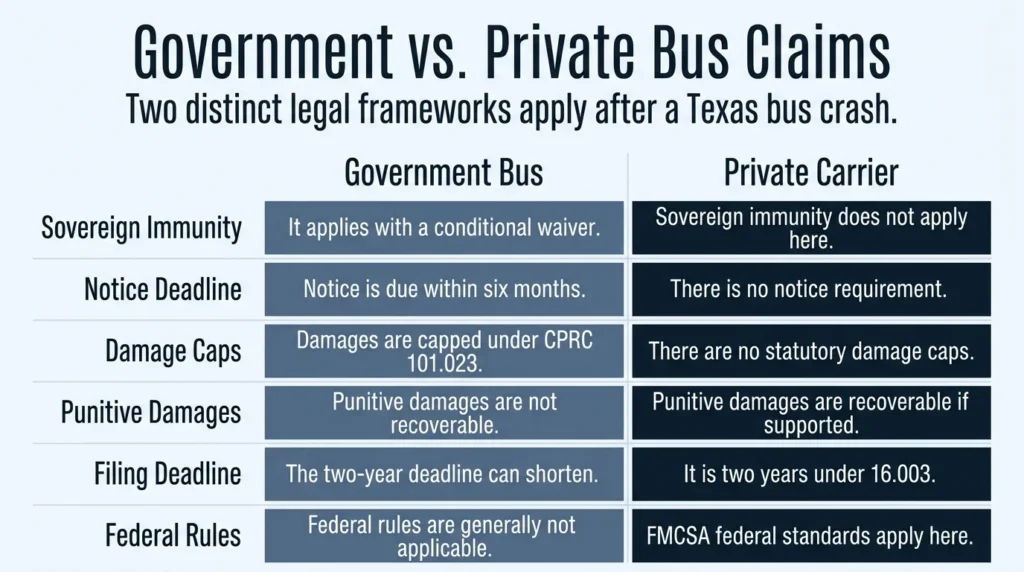
When the bus belongs to a city, transit district, or school district, you’re suing a government entity. Texas shields these entities from suit unless a specific law waives that protection. The Texas Tort Claims Act provides that waiver for crashes involving government vehicles, but only if you follow strict procedural rules first.
Sovereign Immunity & the Notice Requirement
The waiver is conditional. You must give written notice to the governmental unit within six months of the crash, describing the damage or injury you sustained, the time and place of the incident, and the incident itself—the three elements required under the statute. This rule comes from Texas Civil Practice and Remedies Code (CPRC) § 101.101.
Some Texas cities have adopted shorter local windows by ordinance, sometimes as short as 90 days. You have to verify the rule for the specific transit authority involved. Missing the notice deadline almost always ends the case, no matter how strong the underlying facts are.
Damages Caps Against Government Defendants
If you’re filing a claim against a unit of local government, your recovery is capped by statute. The per-person and per-occurrence limits under CPRC § 101.023 apply to total damages, including both medical bills and pain and suffering. However, the specific cap amounts differ depending on whether the defendant is a municipality or another unit of local government.
When one crash injures many passengers, every claimant is fighting for a slice of the same capped fund. Contacting a lawyer promptly and suing public transportation in Texas early affect your position in that line. Thorough documentation of medical costs, lost wages, and future care becomes even more important when the ceiling is fixed.
Private & Charter Bus Claims in Texas
Privately operated buses sit in a different legal world. Charter carriers, motorcoach companies, and private school bus contractors do not get sovereign immunity. There is no six-month notice requirement, and statutory damage caps do not apply.
Personal injury claims against private bus operators run on the standard two-year deadline under Texas CPRC § 16.003. That two-year window is the default, but remember that government bus claims have a much shorter notice deadline that effectively shrinks the filing window.
Interstate bus and motorcoach carriers must follow federal rules covering driver qualifications, hours of service, and vehicle maintenance. The FMCSA passenger carrier safety standards lay out those obligations, and a violation can serve as direct evidence of negligence. School bus contractors hired by a district add another wrinkle: The district may be a government entity, while the contractor is not, which can put two defendants under two different sets of rules in the same lawsuit.
If you are not sure whether the bus involved was public or private, an attorney can sort that out before a notice deadline becomes a problem.
Discovery Challenges in Bus Accident Cases
Bus accident cases generate far more evidence than ordinary car accident claims. The most important categories include the bus’s electronic control module (black box) data, electronic logging device records, driver qualification files, GPS and dispatch logs, maintenance records, onboard video, and post-crash inspection reports.
Government transit agencies routinely resist disclosure. Attorneys often have to invoke the Texas Public Information Act or serve formal subpoenas to force production. That fight adds months to the case but is usually unavoidable.
Federal carriers must keep certain records for set retention periods under the FMCSA passenger carrier regulations. Once the retention window closes, the company can legally destroy records. That timing makes early action important.
If you were involved in a bus accident, sending preservation letters, sometimes called spoliation letters, as soon as possible is important. They put the operator on notice that evidence cannot be destroyed. If a carrier ignores that warning, a court can instruct the jury to assume the missing evidence would have hurt the carrier’s defense.
Fatal bus crashes add more layers: driver toxicology, vehicle certification history, and route safety audits. These cases overlap with wrongful death claims after a fatal commercial vehicle crash, which follow a similar evidence path. Knowing which records exist and how fast they can vanish is one reason many bus crash victims talk to an attorney before doing anything else.
How Long Does a Bus Accident Lawsuit Take?
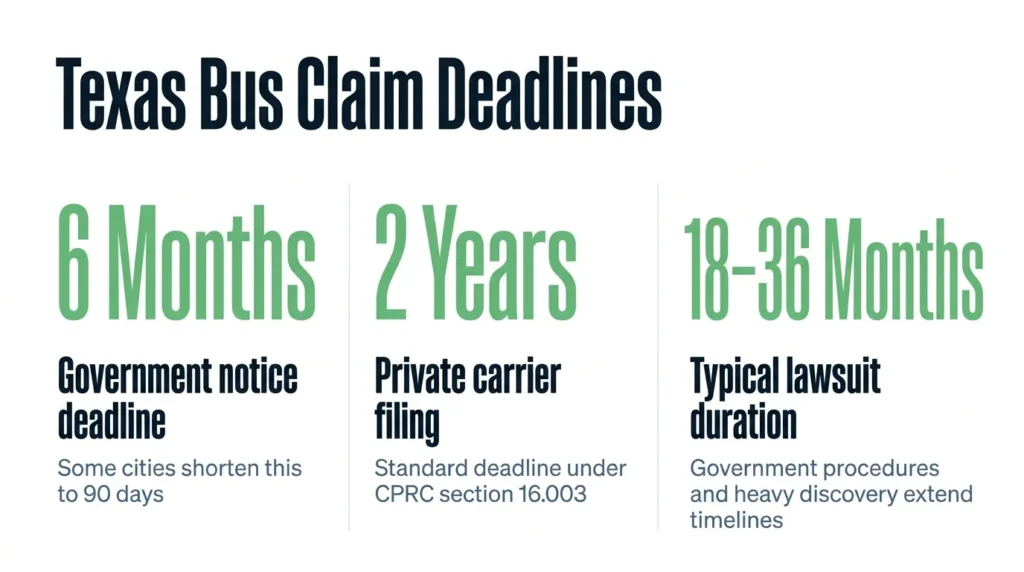
Bus accident lawsuits routinely run 18 to 36 months or longer because of government procedures, heavy discovery, and multiple defendants, though timelines vary widely depending on injury severity, the number of parties, and whether the case goes to trial.
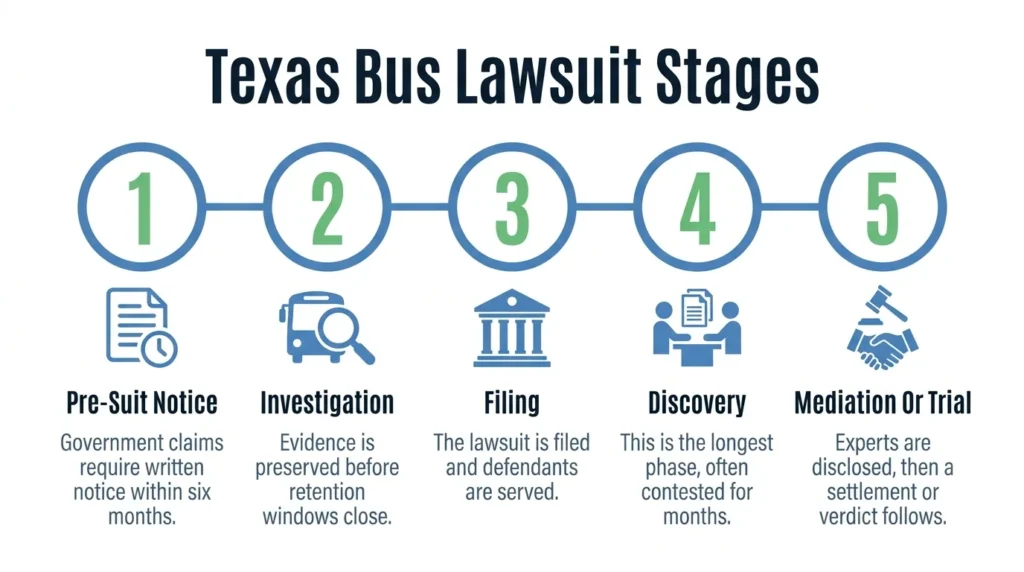
The stages are predictable. First comes pre-suit notice and the waiting period for government cases. Then investigation, evidence preservation, filing, and service. Discovery is the longest phase. After that comes expert disclosures, mediation, and trial if no settlement is reached.
Several factors stretch bus cases beyond the average. Government entities use every procedural tool available. Catastrophic injuries need a long-term prognosis before damages can be valued accurately. Multiple plaintiffs from one crash add coordination delays. Government defendants also have broader appeal rights than private companies.
Wrongful death claims from fatal bus crashes follow the same general timeline but bring estate and beneficiary issues governed by Texas CPRC Chapter 71. Eligible family members can recover for lost financial support, lost companionship, and mental anguish. Understanding fatal car accidents and wrongful death claims in Texas helps you see how those damages are calculated.
Discuss Your Claim with a Bus Accident Attorney
Bus accident cases in Texas are not ordinary car wreck claims. Notice deadlines, damage caps, federal regulations, and aggressive defense counsel all sit between you and a fair recovery. You should not have to handle that alone.
Angel Reyes & Associates has over 30 years of experience helping Texas crash victims and more than $1 billion recovered for clients. Past results do not guarantee future outcomes. We work on contingency, meaning no fee unless we win, and offer free consultations 24/7 in English and Spanish.
Learn more about our firm and our Texas personal injury attorneys, or contact us today to talk through your options.
Past results do not guarantee future outcomes.
Bus Accident Lawsuit FAQs
Can a passenger who was injured on a bus sue both the driver and the bus company at the same time?
Yes. In Texas, an injured passenger can bring claims against both the individual driver and the operating company in the same lawsuit under a legal theory called respondeat superior, which holds employers liable for negligent acts their employees commit on the job. A third party, such as a bus manufacturer or a negligent vehicle maintenance contractor, can also be added as a defendant if the facts support it.
Does Texas require a bus passenger to prove they were wearing a seatbelt to recover damages?
Texas law does not bar you from recovering damages simply because you weren’t wearing a seatbelt on a bus, but you may argue the absence of a seatbelt contributed to the severity of your injuries. A jury could reduce your recovery under Texas proportionate responsibility rules if it finds you partly responsible for your own harm.
What types of damages are not recoverable under the Texas Tort Claims Act when suing a government bus operator?
Punitive or exemplary damages are not available against a governmental unit under the Texas Tort Claims Act, regardless of how reckless the conduct was. Recovery is limited to actual damages such as medical expenses, lost wages, and pain and suffering, all subject to the statutory caps in CPRC Section 101.023.
Can a non-citizen or undocumented person file a bus accident lawsuit in Texas?
Texas courts don’t require plaintiffs to be citizens or lawful residents to file a personal injury lawsuit, and immigration status does not affect the right to seek compensation for injuries caused by another party’s negligence. However, immigration status can complicate the calculation of certain economic damages, such as future lost earnings, which courts assess based on the individual’s documented work history and circumstances.
If a bus crash happens on a trip that crosses state lines, does Texas law still apply?
Not necessarily. When a crash happens in another state, that state’s laws on liability, damages, and deadlines typically govern the claim. Texas law may still apply to certain aspects of the case, but jurisdiction and choice-of-law questions in interstate bus crashes can be complex and depend on where the crash occurred, where the carrier is based, and where the lawsuit is filed.
About the Authors

Angel Reyes
Writer
Angel L. Reyes, III is the Founder and Managing Partner of Angel Reyes & Associates. A nationally recognized trial attorney and business leader, Angel has helped over 70,000 injury victims recover more than $1 billion since founding the firm in 1993. Named to the Texas Super Lawyers list annually since 2008, Angel brings Wall Street experience, Ivy League education, and a deep commitment to client advocacy. He is a frequent legal commentator and published author with extensive contributions to legal scholarship, trial strategy, and consumer protection.

Kyle Nicolas
Editor
Kyle Nicolas is the Web Content & SEO Manager at Angel Reyes & Associates. He has more than 10 years of experience as a marketing co...

Spencer Browne
Reviewer
Spencer Browne is a partner at Angel Reyes & Associates and a Board Certified personal injury trial lawyer with nearly 100 jury trials a...