Do Bus Drivers Get Fired for Accidents?


Every article on this site is researched by our internal team, reviewed for legal accuracy against current Texas law, and held to State Bar of Texas advertising standards before publication. We do not publish content that overstates outcomes or makes promises about results.
Learn more about our
editorial standards .
Key Takeaways
- Firing a bus driver after a crash is not automatic; severity and record decide.
- A company that keeps a dangerous driver working can face a negligent retention claim.
- Texas lets you name both the driver and the bus company and split the fault.
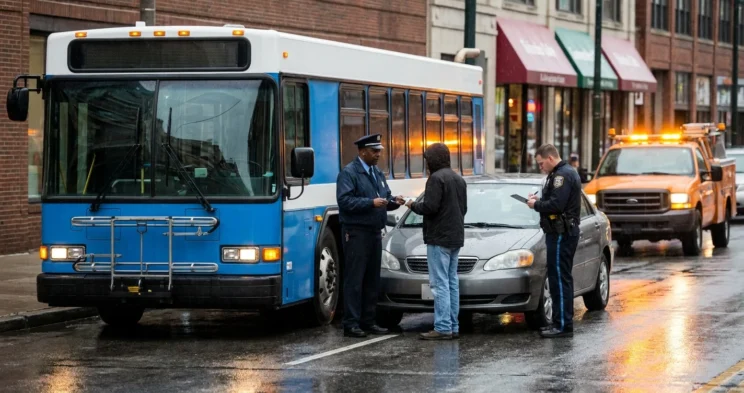
You were heading home down Westheimer Road near the Galleria when a city bus drifted into your lane and slammed your driver’s side door. Now you are dealing with an emergency room bill and a car you cannot drive. Then a neighbor mentions that the same bus line has had complaints about that driver before.
You start to wonder what happens to a driver after a crash like this, and whether it changes anything for you.
The Seriousness of the Crash
Getting fired after a crash is not automatic for a bus driver. It depends on how serious the crash was, the driver’s record, and whether they broke a company rule.
A minor crash with no injuries might lead to retraining or a warning. A serious crash where the driver was clearly at fault is far more likely to get fired.
If you were riding the bus, the first steps after a bus accident can protect both your health and your legal claim.
Keep one thing separate in your mind: Whether the driver keeps or loses the job is a different question from whether the company owes you money.
You can have a strong claim against the bus company even if the driver was never disciplined at all.
Bus Driver Termination Factors After a Crash
When a bus company decides whether to keep or fire a driver, a few factors carry the most weight. Some are about the crash itself, and some are about what the company already knew:
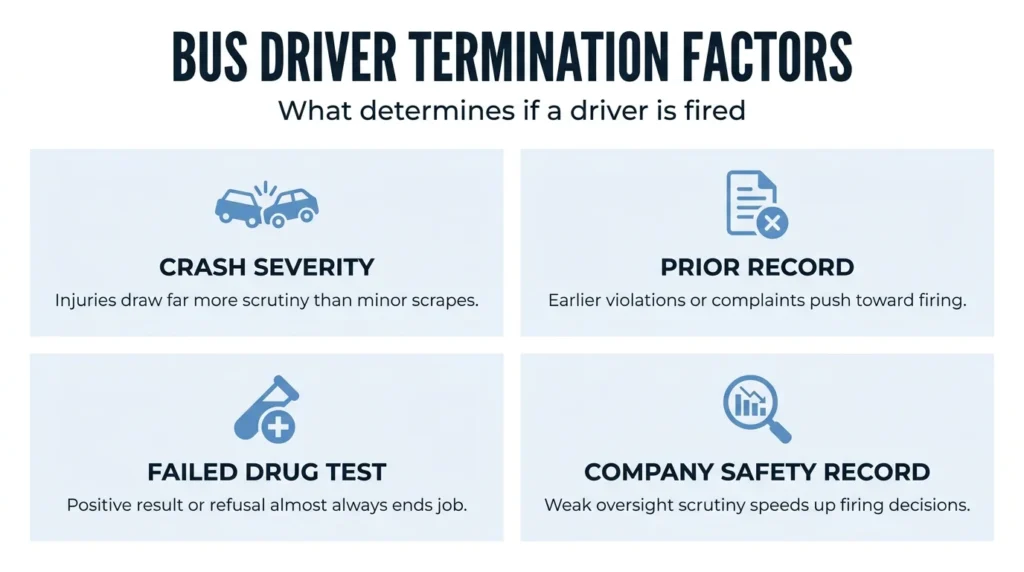
- How serious the crash was: A crash with injuries draws far more scrutiny than a parking lot scrape. A driver at fault in a serious wreck is the most likely to lose the job.
- The driver’s prior record: Earlier violations or a pattern of complaints already in the file push toward firing. A clean record can save a driver’s job after a single mistake.
- A failed drug or alcohol test: Federal rules under 49 CFR § 382.303 require testing after certain serious crashes. A positive result or a refusal almost always ends the job.
- The company’s own safety record: Bus companies must meet federal passenger carrier safety standards. A company already under scrutiny for weak oversight may act faster to fire a driver.
The consequences a bus driver faces after an accident are not the same in every case. For you, these same factors also shape who can be held responsible, which is why bus accident claims often reach beyond the driver alone.
Negligent Retention of a Bus Driver
Negligent retention is a legal claim against the bus company itself, not the driver. It applies when a company keeps a driver on the road after it knew, or should have known, that the driver was a danger.
The company’s fault lies in its choice to keep a risky driver working, which is the core of employer liability for an employee’s crash.
Federal law does not treat driver screening as a one-time box to check. Under 49 CFR Part 391, a carrier must keep confirming that each driver stays qualified to drive.
Part of that duty is an annual review of every driver’s motor vehicle record, required by 49 CFR § 391.25. That yearly check is often where a company first sees the warning signs it later ignores. If a company’s own files show it knew about a driver’s record before your crash, those records can become the center of your case.
Rideshare cases follow the same logic. Suing Uber after a Texas accident often turns on whether the platform kept a driver active despite known complaints.
These federal qualification rules apply to other commercial carriers too, including large trucks.
Bus Company Liability for a Driver’s Record
A driver’s disciplinary record can support a claim against the bus company itself. When the company ignores prior accidents and complaints, that choice becomes its own fault, separate from the crash.
Ask yourself whether the driver who hit you was someone the company should have taken off the road long before your crash.
Texas lets you name both the driver and the company in the same claim. Under Texas Civil Practice and Remedies Code (CPRC) Chapter 33, a jury can split the fault between them by percentage.
The company’s share of the blame can stand on its own, even if the driver was mostly at fault. As long as you are not mostly to blame for the crash, that division works in your favor.
Proving what a company knows takes digging into hiring files, complaint logs, and safety records. Additionally, bus crashes can involve more responsible parties than just the driver and the company.
Work with an Experienced Attorney
If you suspect the bus company knew about a driver’s history, the sooner someone gathers those records, the better. Angel Reyes & Associates has spent more than 30 years handling bus accident claims for injured Texans across the state. Your first consultation is free, and we work on contingency, so there is no fee unless we win your case.
Our record includes more than $1 billion recovered for clients, and we would be glad to review what happened to you. When you are ready, reach out for a free consultation.
Past results do not guarantee future outcomes.
Bus Accident Claim FAQs
Does it matter if the bus that hit me was run by a city transit agency instead of a private company?
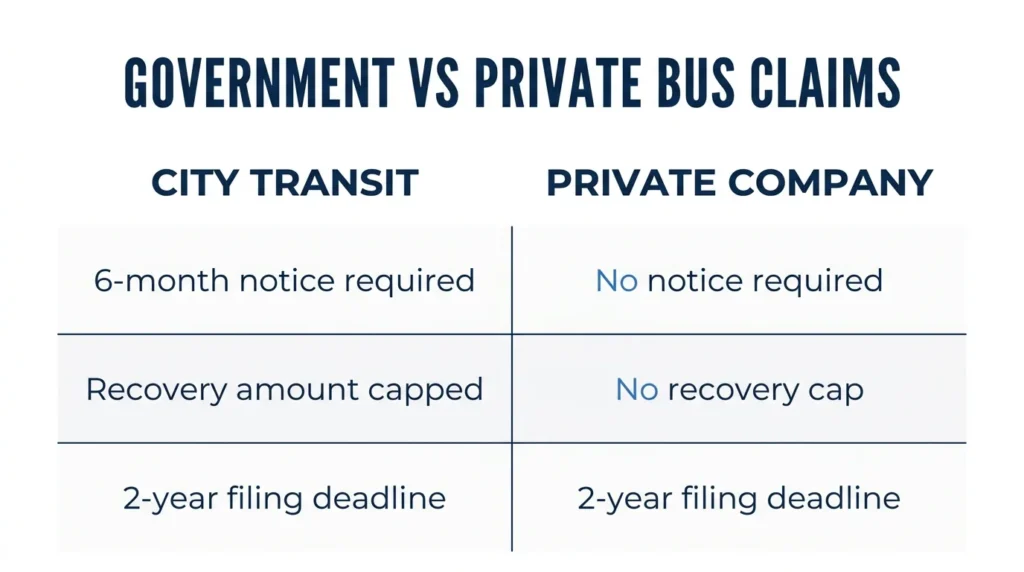
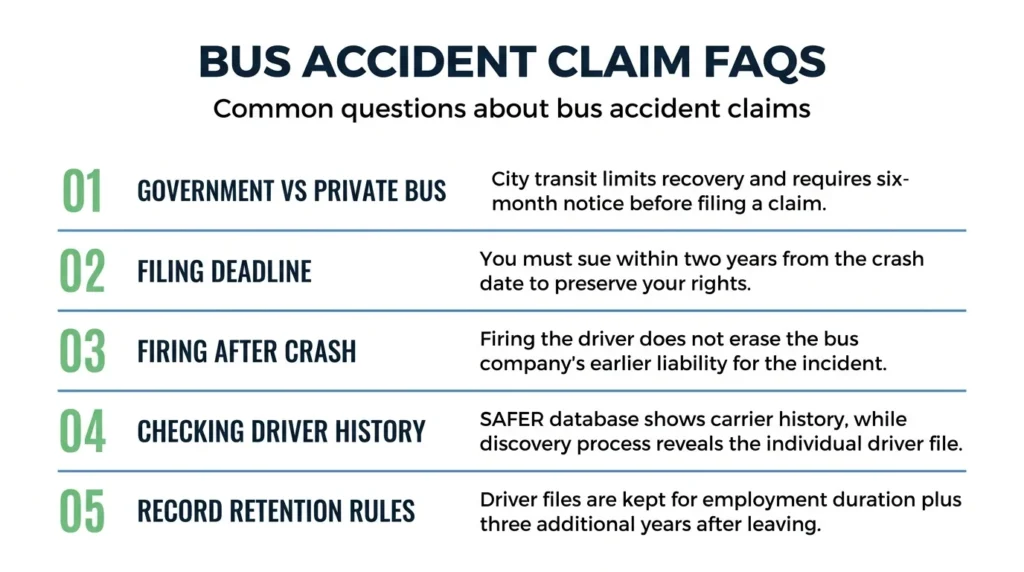
Yes. Texas law limits how much you can recover from a government-run transit system and requires written notice of your claim within six months of the crash.
How long do I have to file a lawsuit after a bus accident in Texas?
In most cases, Texas law gives you two years from the crash date to file a personal injury lawsuit. Missing that window generally prevents you from suing over the crash at all.
Does firing a driver after a crash change the bus company's liability for what happened?
Firing a driver after your crash does not undo the company’s earlier decision to keep a risky driver on the road. Courts also generally do not treat that firing as proof the company was at fault for the crash.
How can I find out if a bus driver had prior accidents or complaints on their record?
A carrier’s overall crash and inspection history is public through the federal SAFER database. A specific driver’s personnel file and complaint records usually come out only through the formal record-gathering process in a lawsuit, called discovery.
How long are bus companies required to keep a driver's safety and disciplinary records?
Federal rules require a motor carrier to keep a driver’s qualification file for as long as that driver works there, plus three more years after they leave. That paperwork can become important evidence in a negligent retention case.
About the Authors

Angel Reyes
Writer
Angel L. Reyes, III is the Founder and Managing Partner of Angel Reyes & Associates. A nationally recognized trial attorney and business leader, Angel has helped over 70,000 injury victims recover more than $1 billion since founding the firm in 1993. Named to the Texas Super Lawyers list annually since 2008, Angel brings Wall Street experience, Ivy League education, and a deep commitment to client advocacy. He is a frequent legal commentator and published author with extensive contributions to legal scholarship, trial strategy, and consumer protection.

Graham Griffin
Editor
Graham Griffin is the Web & Content Manager at Angel Reyes & Associates, where he oversees content strategy, AI-powered workflows, a...

Angel Reyes
Reviewer
Angel L. Reyes, III is the Founder and Managing Partner of Angel Reyes & Associates. A nationally recognized trial attorney and business...