Rideshare Accidents and Wrongful Death Claims in Texas


Every article on this site is researched by our internal team, reviewed for legal accuracy against current Texas law, and held to State Bar of Texas advertising standards before publication. We do not publish content that overstates outcomes or makes promises about results.
Learn more about our
editorial standards .
Key Takeaways
- Only a surviving spouse, child, or parent can file a Texas wrongful death claim.
- Uber and Lyft carry a $1 million policy once the driver accepts a ride request.
- Texas gives families two years from the date of death to file the claim.
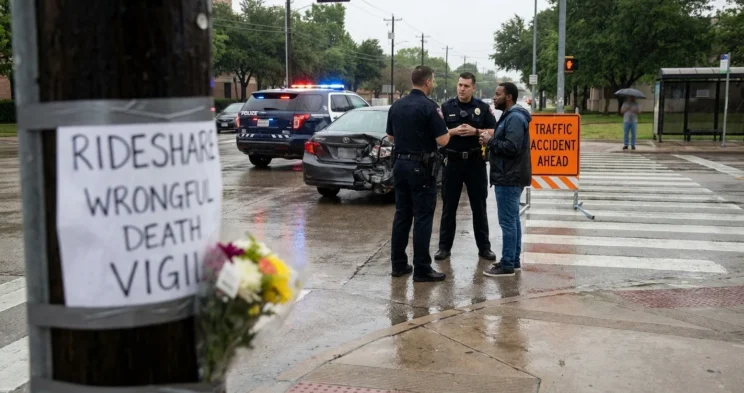
The call came late on a weeknight, after your husband left a friend’s place near Midtown and climbed into an Uber for the ride home down Westheimer. The driver ran a light, another car came through, and the person you built a life with did not make it.
Now the bills are arriving, the house feels too quiet, and you have no idea where to even start.
Who Can File a Wrongful Death Claim in Texas?
Texas law limits who may bring a wrongful death claim to the surviving spouse, children, and parents of the person who passed. No other relatives have legal standing, no matter how close they were.
That rule comes from the Texas Civil Practice and Remedies Code (CPRC) § 71.004. Siblings, grandparents, and cousins cannot file, though an eligible family member can file on behalf of everyone.
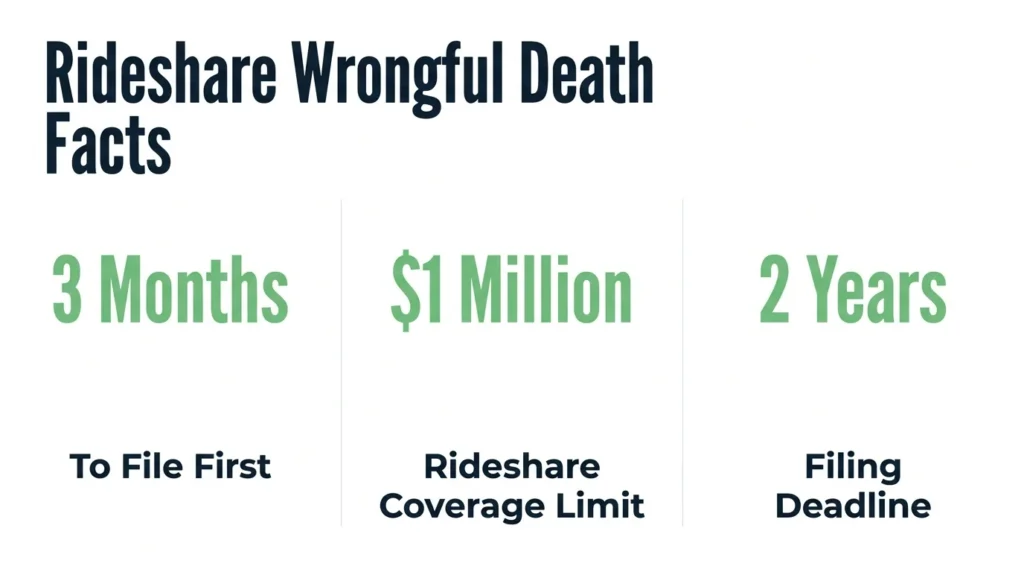
You have a window to act on this yourself. Eligible family members have three calendar months from the date of death to file before the personal representative of the estate may bring the action for them, unless all entitled family members request that the representative not file.
That window matters in a practical way for a grieving family. It gives you first say in how the claim proceeds, before the estate steps in to file on your behalf.
The claim itself belongs to you and the other surviving family members, not to the estate. The estate can pursue its own separate claim at the same time.
A rideshare crash does not change any of this. Whether an Uber driver, a Lyft driver, or a third party caused the death, the same family members hold the right to file under Texas law.
If you are sorting out who in your family can step forward, you can review how Texas wrongful death claims work.
Wrongful Death Claims vs. Survival Actions
Two separate claims can come out of the same fatal rideshare crash. Families often confuse them because both name the same defendant and the same crash.
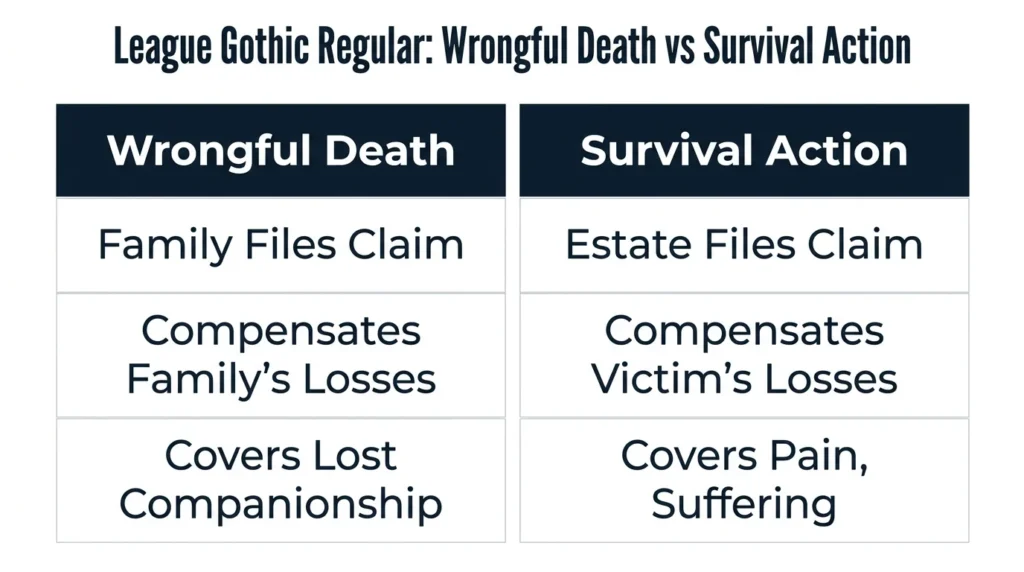
One claim covers your family’s losses. The other covers what your loved one suffered before death. Filing both captures the full scope of what was taken from you.
Wrongful Death Claim
The wrongful death claim under CPRC § 71.002 compensates you and the other surviving family members for your own losses. That includes lost companionship, mental anguish, lost financial support, and the household help your loved one provided.
These damages belong to you personally as a surviving spouse, child, or parent. The measure of the claim is what your family lost when the death occurred. Recoverable losses run from pecuniary support to loss of inheritance, along with the harder-to-measure loss of love and society.
Survival Action
The survival action under § 71.021 preserves the claims your loved one could have brought had they lived. That covers the pain and suffering before death, medical bills incurred before death, and lost earning capacity.
These damages belong to the estate, and the personal representative or executor files them. The measure here is your loved one’s own losses, not your family’s.
A survival action does not reduce or offset the wrongful death claim. In a fatal rideshare case, your family should pursue both at once to capture every dollar of loss.
Uber & Lyft Coverage Tiers Explained
Texas requires rideshare companies to carry insurance that shifts depending on what the driver was doing when the crash happened. The Texas Insurance Code Chapter 1954 sets a floor for each phase of the app.
When the app is off, the driver’s personal auto policy applies. When the app is on but no ride has been accepted, contingent coverage of $50,000 per person, $100,000 per crash, and $25,000 for property kicks in.
The full $1 million combined single-limit policy activates the moment the driver accepts a ride request. It stays in force through passenger drop-off.
Most fatal rideshare crashes fall inside that final phase. That is the coverage tier you will most often be dealing with after a death.
The $1 million figure sounds like a lot. In a death claim, it can fall short, especially when a high earner is gone, several family members have claims, or the conduct supports punitive damages.
Whether that limit is enough for your family’s loss takes a real evaluation.
Uber and Lyft also carry excess and umbrella policies above the required floor. An attorney can investigate whether those extra layers apply to your case and explain how the coverage period works.
Damages, Defendants & the Filing Deadline
A rideshare wrongful death case can recover both economic and non-economic losses. Economic losses cover medical bills, funeral costs, lost income, and the value of household services.
Non-economic losses cover mental anguish and the loss of your loved one’s companionship.
Punitive damages may also be on the table. Under the Texas Civil Practice and Remedies Code Chapter 41, these apply when the claimant proves by clear and convincing evidence that the driver acted with gross negligence or malice, a standard that drunk or reckless driving can meet.
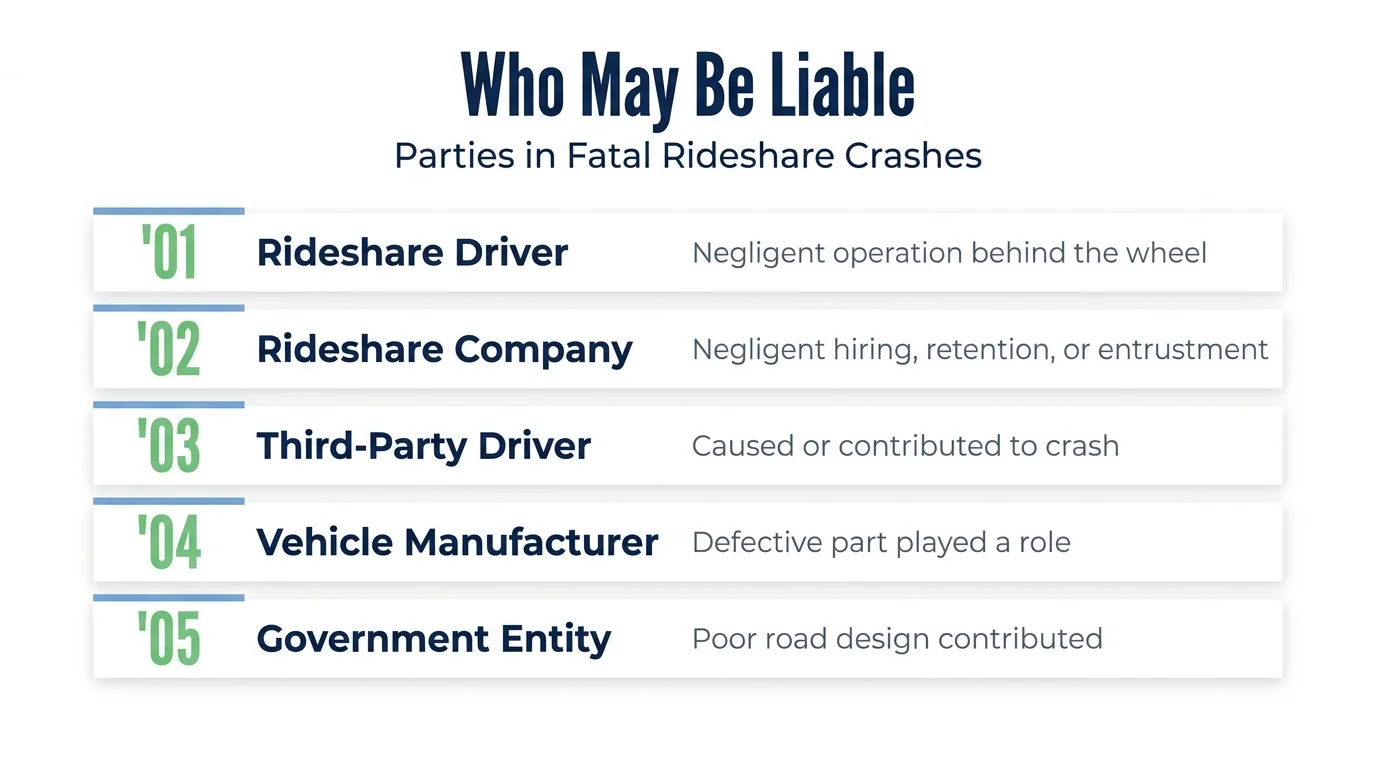
More than one party may share the blame for a fatal rideshare crash. Identifying every responsible party widens the pool of money available to your family.
- The rideshare driver: liability for negligent operation behind the wheel.
- Uber or Lyft: liability in the right case for negligent hiring, retention, or entrustment.
- A third-party driver: liability when another motorist caused or contributed to the crash.
- A vehicle manufacturer: liability when a defective part played a role.
- A government entity: liability when poor road design contributed to the death.
Every claim carries a clock. The Texas Civil Practice and Remedies Code § 16.003 gives you two years from the date of death to file both the wrongful death and survival action claims. Wait too long and the right to recover is gone, no matter how clear the fault.
Evidence matters as much as the deadline. The Texas Department of Licensing and Regulation oversees rideshare operations, and its records on driver history can become real proof in a wrongful death investigation.
When several parties may share fault, the analysis gets layered fast.
Speak with an Experienced Attorney Today
Losing someone in a rideshare crash leaves you carrying grief and financial weight at the same time. Angel Reyes & Associates has spent over 30 years guiding Texas families through serious injury and wrongful death cases, and we have recovered more than $1 billion for clients across the state.
We offer free initial consultations, and we work on a contingency basis, so there is no fee unless we win. You can learn about the people who would handle your case on our attorney profiles.
When you are ready, reach out to us for a free consultation. We will review what happened, explain your options, and handle the legal side so you can focus on your family.
Past results do not guarantee future outcomes.
Rideshare-Related Wrongful Death Claim FAQs
If multiple family members are eligible to file, how are the damages divided?
Texas does not set a fixed formula for splitting wrongful death proceeds among a spouse, children, and parents. If the case settles, eligible family members can agree on a division; if it goes to a jury, the jury allocates damages based on each person’s individual loss.
Is a wrongful death settlement from a rideshare crash taxable?
Compensation for physical injury and death is generally not taxable as income under federal law. Punitive damages and any interest that accrues on a judgment or settlement are taxable, so those portions are treated differently.
Does Uber or Lyft's classification of drivers as independent contractors affect a wrongful death claim?
That classification limits the company’s automatic liability under standard employer-employee rules, but families can still pursue direct claims against Uber or Lyft for negligent hiring, retention, or entrustment when the facts support it. The statutory insurance coverage requirement under Texas Insurance Code Chapter 1954 applies regardless of how the driver is classified.
What digital evidence is most important to preserve in a rideshare wrongful death case?
The rideshare app’s trip data, GPS logs, and driver history records are time-sensitive because companies retain them for limited periods. Sending a formal preservation notice quickly can prevent that data from being deleted before it can be used in the case.
Can UM/UIM coverage help when the at-fault driver in a rideshare crash was uninsured?
Yes. If the driver who caused the crash carried no insurance or too little insurance, uninsured and underinsured motorist coverage from either the family’s own policy or Uber’s policy can apply to a wrongful death claim. Uber carries $1 million in UM/UIM coverage for passengers when an uninsured or underinsured driver causes the crash during an active trip.
About the Authors

Angel Reyes
Writer
Angel L. Reyes, III is the Founder and Managing Partner of Angel Reyes & Associates. A nationally recognized trial attorney and business leader, Angel has helped over 70,000 injury victims recover more than $1 billion since founding the firm in 1993. Named to the Texas Super Lawyers list annually since 2008, Angel brings Wall Street experience, Ivy League education, and a deep commitment to client advocacy. He is a frequent legal commentator and published author with extensive contributions to legal scholarship, trial strategy, and consumer protection.

Graham Griffin
Editor
Graham Griffin is the Web & Content Manager at Angel Reyes & Associates, where he oversees content strategy, AI-powered workflows, a...

Angel Reyes
Reviewer
Angel L. Reyes, III is the Founder and Managing Partner of Angel Reyes & Associates. A nationally recognized trial attorney and business...