Delivery App Accident Claims in Texas


Every article on this site is researched by our internal team, reviewed for legal accuracy against current Texas law, and held to State Bar of Texas advertising standards before publication. We do not publish content that overstates outcomes or makes promises about results.
Learn more about our
editorial standards .
Key Takeaways
- Delivery drivers are contractors, so personal auto insurance is usually the first line of coverage.
- DoorDash and Amazon Flex pay only in active delivery phases; Phase 1 leaves a coverage gap.
- Texas gives you two years from the crash date to file a delivery accident injury claim.
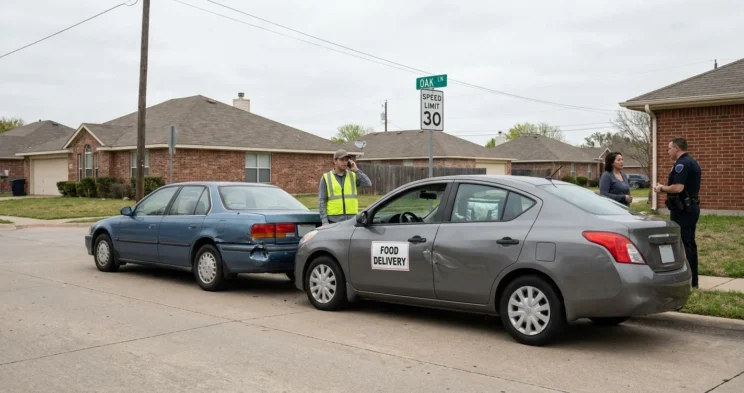
You were stopped at a light on Westheimer Road when a car rushed through and clipped your bumper. The driver hops out apologizing, a hot bag of food still on the passenger seat. They hand you a personal insurance card, but they were clearly working when they hit you. So whose insurance actually pays for this?
Why Delivery App Drivers Are Different
Delivery platforms treat their drivers as independent contractors, not employees. That single classification shapes who you can hold responsible and whose insurance pays your medical bills.
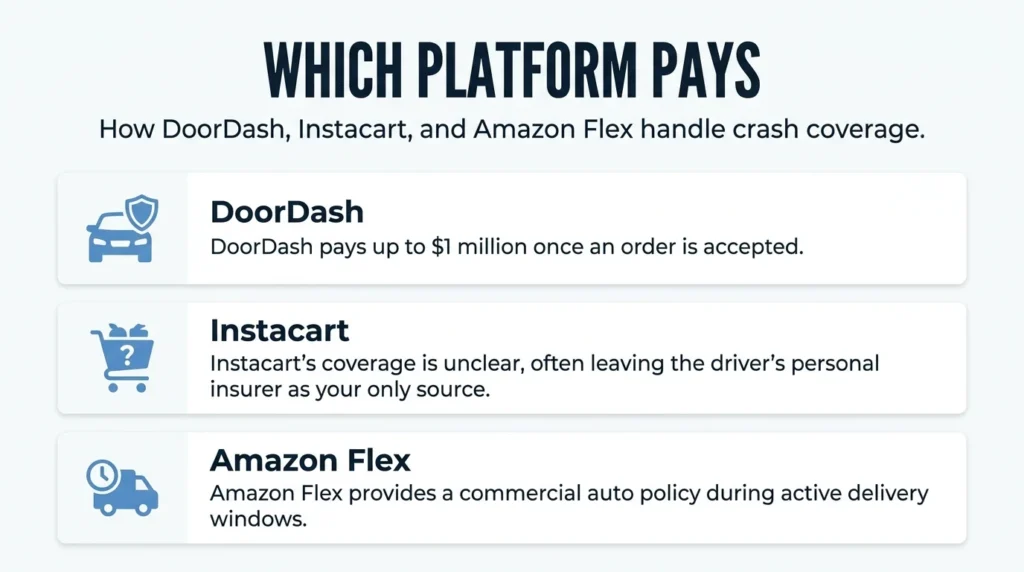
DoorDash, Instacart, and Amazon Flex all use this contractor model. It limits what the platform owes when one of its drivers hurts someone. Because the driver is not an employee, the platform tries to keep itself out of your claim entirely.
That pushes your claim toward the driver’s personal auto insurance first. Here is the problem. Most personal auto policies contain a commercial-use exclusion that can cancel coverage when the driver was being paid to deliver.
The commercial-use exclusion is the most common reason a personal insurer denies a delivery crash claim. The Texas Department of Insurance warns that standard personal policies often will not cover you while you drive for pay. Knowing this before you call anyone protects your position.
Texas historically required ride-hailing companies to carry phased liability coverage while delivery-only platforms faced no equivalent mandate. That changed in 2025: Texas House Bill 4215, effective September 1, 2025, brought delivery network companies under the same TDLR licensing framework that governs ride-hailing under Texas Occupations Code Chapter 2402, with insurance requirements governed by Texas Insurance Code Chapter 1954.
How the new insurance requirements apply to each delivery phase is still being clarified in practice, which is one more reason the coverage picture for delivery crashes can be complicated.
Texas does require every driver to carry minimum liability coverage under the Texas Transportation Code § 601.072. Those minimum limits often fall far short of what a serious injury really costs. A driver who meets the state minimum may still leave you with bills no one wants to pay.
Coverage Phases: When Platform Insurance Applies
Whether a platform’s insurance applies usually comes down to what the driver was doing the moment they hit you. Each platform splits its coverage into phases, and the phase decides whether a commercial policy was active or whether you are left with the driver’s personal insurer.
Three ideas get tangled together here: what the platform covers, what the driver’s own policy covers, and what happens when neither one does. The breakdown below sorts out each platform.
DoorDash Coverage by Phase
DoorDash runs a three-period model. Phase 1, when the app is on but no order is accepted, is the most dangerous gap for you, because DoorDash provides no backup liability coverage in Texas during that window.
The phase that was active at the moment of your crash decides everything:
- Phase 1 (app on, waiting for an order): The driver’s personal policy is the only coverage in play. DoorDash provides no supplemental liability in Texas during this period.
- Phase 2 (order accepted, driving to pickup): DoorDash’s commercial policy turns on, with up to $1 million in third-party liability coverage.
- Phase 3 (food in hand, driving to you): The same $1 million DoorDash commercial policy applies.
This is why your first question after a DoorDash crash is what the driver was doing when they hit you. The answer can be the difference between a $1 million policy and a voided personal one. Cases involving app-based drivers often turn on these same coverage timing questions, much like ride-hailing claims do.
Instacart Coverage by Phase
Instacart’s platform insurance is far less transparent than DoorDash’s. Some sources indicate Instacart maintains liability coverage during active delivery batches, but the company’s independent contractor agreement places primary insurance responsibility on the driver. In practice, injured third parties often find themselves dealing primarily with the driver’s personal insurer. When that insurer invokes a commercial-use exclusion, the path to recovery through any platform policy is far from clear.
When that insurer invokes a commercial-use exclusion, no Instacart policy steps in to fill the gap. You can be left staring at a coverage void with no obvious source of payment. That gap is exactly what makes these claims harder than a standard fender bender.
Instacart does offer occupational accident coverage, but that protects its own drivers’ injuries. It does nothing for you as the person they hit. If you cannot get a straight answer from an insurer about whether any coverage applies, it helps to understand your options before you make a statement, and a walkthrough of the steps after a rideshare or delivery crash can orient you.
Amazon Flex Coverage by Phase
Amazon provides a commercial auto policy that turns on during active delivery windows. The structure differs from DoorDash, and the Phase 1 gap exists here too.
When the app is on but no delivery is active, Amazon’s commercial coverage does not apply, and the driver’s personal policy is your only target. Once the delivery window is active, Amazon’s commercial auto policy provides liability coverage. You should confirm the limits and conditions at the time of your claim, because Amazon has revised its policy terms since earlier published guides.
Amazon’s size opens a second door. Injured Texans have raised negligent-hiring and direct-negligence theories against Amazon in court. These can become an alternate path when coverage limits fall short, similar to how serious commercial vehicle claims develop against large carriers.
When Both Policies Deny Your Claim
When the driver’s personal insurer denies under a commercial-use exclusion and no platform policy applies, you still have options. This gap shows up most often with Instacart, and with DoorDash drivers stuck in Phase 1.
Your own auto policy may carry the answer. Uninsured and underinsured motorist coverage, called UM/UIM, can act as a backstop. It kicks in when the at-fault driver is effectively uninsured because their policy was voided, and a closer look at how UM/UIM claims work can show you what to expect.
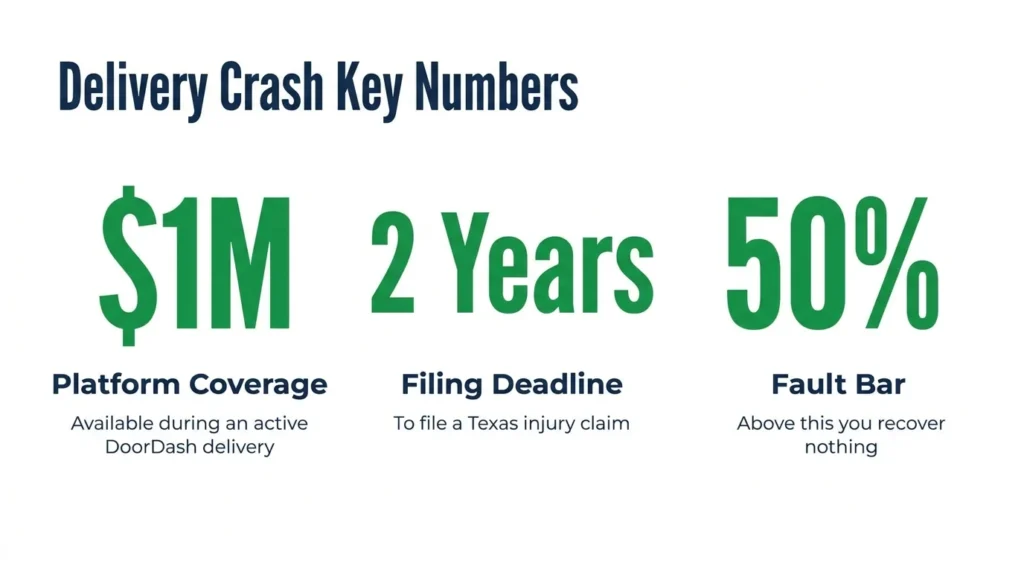
Texas comparative fault rules can also shift what you recover. If you are found partly at fault, your recovery drops by your share of the blame. Under Texas law, if you are more than 50% responsible, you recover nothing.
Timing decides whether any of this is even possible. The Texas Civil Practice and Remedies Code § 16.003 gives you two years from the date of the crash to file a personal injury claim. Texas also applies its proportionate responsibility rules through the Texas Civil Practice and Remedies Code § 33.001, which is what reduces a partly-at-fault recovery. If an insurer has already denied or disputed coverage, an attorney can identify whether a platform policy, your UM/UIM coverage, or a direct claim against the platform still offers a path to recovery.
Steps to Take After a Delivery Driver Crash
What you do in the first hours after a delivery crash can decide whether your claim survives. Move through these steps as soon as you are safe.
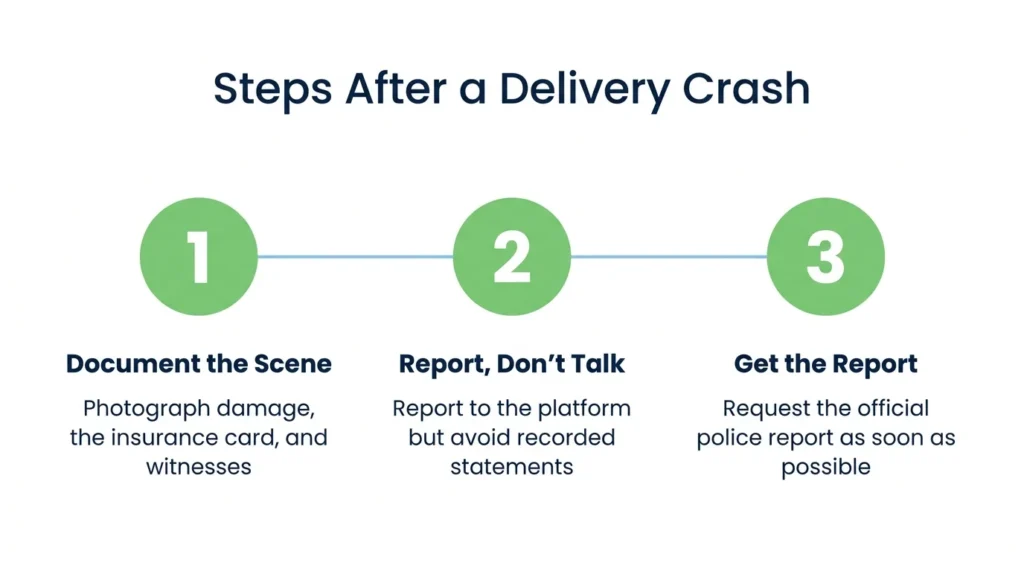
Step 1: Document everything at the scene. Photograph the vehicle damage and the driver’s insurance card. If you safely can, capture the delivery app status showing on the driver’s phone, and collect the names of any witnesses.
Step 2: Report the crash to the platform. Use the app’s in-app or online reporting tool. The report creates a record of the delivery status at the time of the crash, which becomes critical in any coverage dispute.
Step 3: Do not give a recorded statement. Say nothing on the record to any insurer, the driver’s or the platform’s, until you speak with an attorney. Insurers routinely use early statements to limit or deny claims.
Step 4: Request the police report. Get a copy as soon as it is available. These reports often note whether a commercial endorsement or platform coverage applies to the driver’s policy, which can decide your claim. The same documentation habits protect you in any Texas car crash, not only delivery cases.
Get Help with Your Delivery Accident Claim
Delivery crashes hide their hardest problem in the insurance, not the impact. Sorting out which policy applies, and forcing it to pay, is rarely something you should face alone.
Angel Reyes & Associates has spent more than 30 years helping injured Texans across the state untangle exactly these kinds of claims. We work on contingency, so there is no fee unless we win, with more than $1 billion recovered for clients. If a delivery driver hurt you and the insurance answers are not adding up, reach out to us for a free consultation. You can learn more about our team and our approach to accident cases on our About Us page.
Past results do not guarantee future outcomes.
Frequently Asked Questions
Can I sue DoorDash or Instacart directly if one of their drivers causes a crash?
The independent-contractor label makes vicarious liability hard to prove, but you may still have a claim based on negligent hiring or inadequate safety practices. These platform-liability theories depend on the specific facts of the crash and are evaluated case by case.
What if the delivery driver hits me and leaves the scene?
Report the crash to police right away and notify your own insurer as soon as possible. Texas uninsured motorist coverage generally requires proof of physical contact in a hit-and-run before your policy will pay, so documenting the scene matters even if the driver is gone.
Can I use my health insurance to cover medical bills while the liability dispute is being sorted out?
Yes, health insurance can pay for your treatment in the short term while the auto liability and platform coverage questions get resolved. Keep all medical records and bills, since you may be able to recover those costs from the at-fault party’s insurer once liability is established.
Does it matter if I was a pedestrian instead of a driver when a delivery vehicle hit me?
Your right to file a claim against the at-fault driver and any applicable platform policy is the same whether you were on foot or in a car. The same coverage phase analysis applies, and the same two-year statute of limitations runs from the date of your injury.
What if the delivery driver was using a borrowed or rented vehicle?
Coverage generally follows the vehicle first, meaning the vehicle owner’s auto policy applies as primary coverage. The delivery driver’s own policy, and any active platform policy, can layer on top depending on what delivery phase was active at the time of the crash.
About the Authors

Angel Reyes
Writer
Angel L. Reyes, III is the Founder and Managing Partner of Angel Reyes & Associates. A nationally recognized trial attorney and business leader, Angel has helped over 70,000 injury victims recover more than $1 billion since founding the firm in 1993. Named to the Texas Super Lawyers list annually since 2008, Angel brings Wall Street experience, Ivy League education, and a deep commitment to client advocacy. He is a frequent legal commentator and published author with extensive contributions to legal scholarship, trial strategy, and consumer protection.

Graham Griffin
Editor
Graham Griffin is the Web & Content Manager at Angel Reyes & Associates, where he oversees content strategy, AI-powered workflows, a...

Angel Reyes
Reviewer
Angel L. Reyes, III is the Founder and Managing Partner of Angel Reyes & Associates. A nationally recognized trial attorney and business...