What to Do After a Rideshare Accident in Texas


Every article on this site is researched by our internal team, reviewed for legal accuracy against current Texas law, and held to State Bar of Texas advertising standards before publication. We do not publish content that overstates outcomes or makes promises about results.
Learn more about our
editorial standards .
Key Takeaways
- Screenshot the Uber or Lyft app at the scene to document driver, trip, and coverage period data.
- TNC commercial coverage of $1 million applies once a ride is accepted under Texas law.
- Rideshare passengers involved in accidents have two years from the crash date to file a suit.
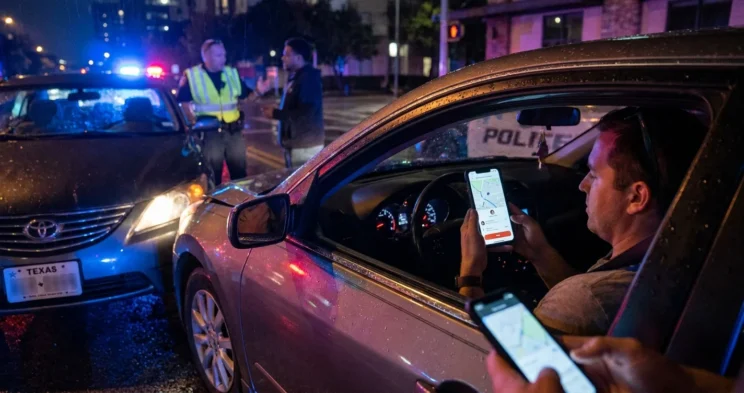
You were heading home from a late shift, riding in an Uber down I-35 through Austin, when another driver ran a light at an intersection near downtown and slammed into the side of your ride. Your shoulder hurts. The Uber driver is on his phone, and you are not sure whether he is calling 911 or his dispatcher. The next 30 minutes will shape your ability to recover compensation for medical bills, pain and suffering, missed work, etc.
Your First Steps at the Scene
The first thing you should do after a rideshare accident is document proof of what happened and who was driving. Before you leave the scene, you need to capture app data, get an independent police report started, and file a report through the rideshare platform itself. Each step protects a different part of your future claim.
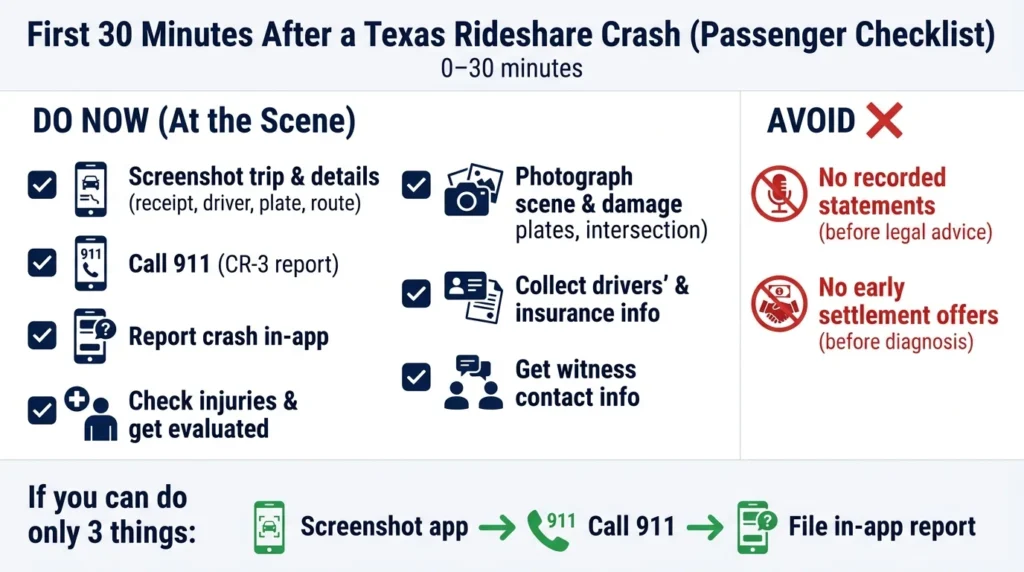
After your accident, you should:
- Take a screenshot of the Uber or Lyft app right away. Capture the trip receipt, the driver’s profile, the vehicle plate, and the route map. This timestamped record proves which coverage period was active at the moment of impact.
- Call 911 yourself. Do not wait for the driver or assume the platform will dispatch police. A Texas CR-3 crash report creates an official record. Passengers who skip this step often face disputes later on about whether the crash even happened the way they describe.
- File a report through the in-app Help section. This is separate from the police call. The in-app report opens a file with the company and starts its internal claims process.
- Check yourself and any other passengers for injuries. Adrenaline hides pain, so it is important to get evaluated even if you feel okay. Photograph any visible injuries ASAP and throughout the recovery process.
- Gather names, license numbers, insurance details, and plate numbers from every driver involved. You should also record witness statements and get their contact information before they leave.
- Do not give a recorded statement before talking to a lawyer. Do not accept an early settlement before you know the full extent of your injuries.
Evidence to Preserve Before It Disappears
Rideshare companies do not keep GPS logs, driver records, or in-app messages forever. The Texas Department of Licensing and Regulation TNC Operations Guide requires these companies to collect certain data, but they often delete it after a short amount of time.
A preservation demand sent to Uber or Lyft soon after the crash is often the only way to stop that data from being purged. An attorney can send a formal preservation demand to the platform before key trip data is overwritten.
Filing Your Rideshare Injury Claim in Texas
The Texas Civil Practice and Remedies Code (CPRC) § 16.003 gives you two years from the crash date to file a personal injury lawsuit. Miss it, and your claim is almost always barred for good.
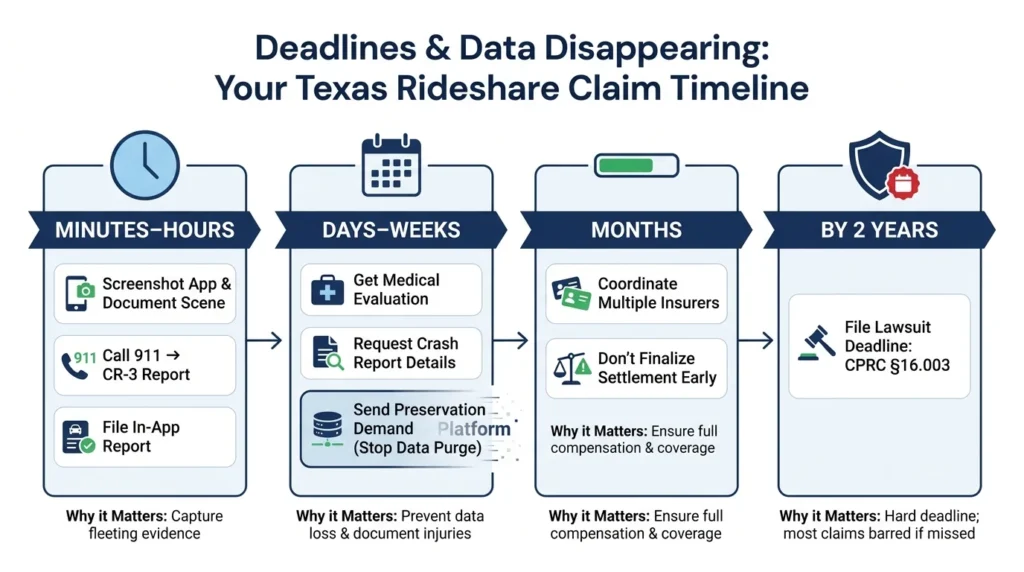
Rideshare claims often involve coordinating with more than one insurer: the driver’s personal carrier and the TNC’s commercial carrier. Because you need to work with multiple adjusters, bringing in counsel early on can make a big difference in your case. Our breakdown of the average settlement for a Lyft accident in Texas gives a sense of typical outcomes.
What to Do When the Crash Causes Serious or Fatal Injuries
Severe injuries and wrongful death cases are eligible for more compensation. The $1 million TNC policy is the ceiling for standard liability, but bad-faith claims and direct TNC liability for negligent driver background checks can lead to additional recovery.
Wrongful death claims for a passenger killed in a rideshare crash fall under CPRC Chapter 71. Surviving spouses, children, and parents may file the claim within two years of the accident. Our guide on fatal car accidents and wrongful death claims walks through who can file and what damages are available.
Texas TNC Insurance Coverage Periods
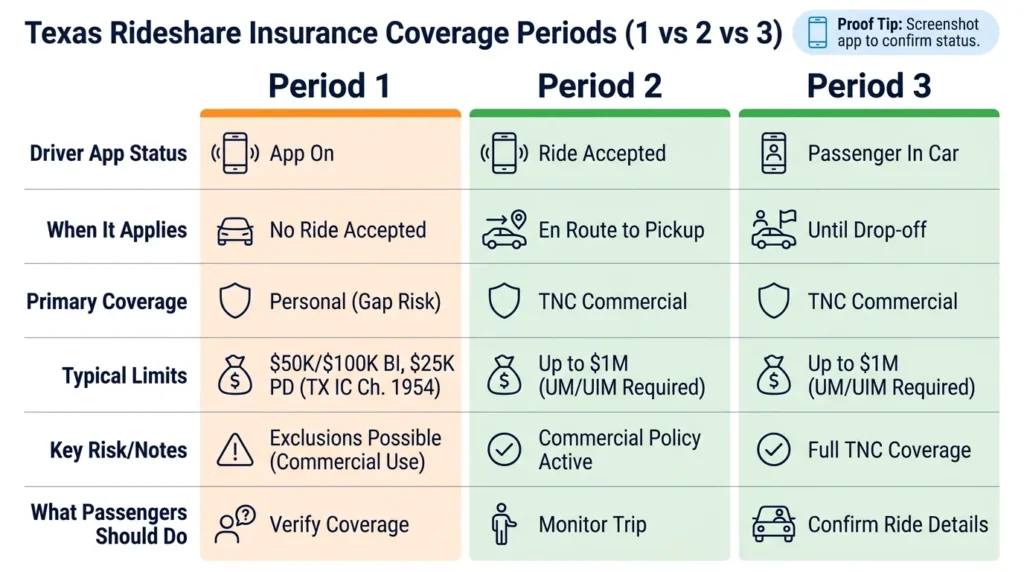
Which insurance applies to your crash depends entirely on what the driver was doing in the app at the moment of impact. This is where the screenshot you took of the app at the scene really comes into play. Texas law sorts rideshare coverage into three periods with different compensation limits.
Period 1 Coverage (App On, No Ride Accepted)
Period 1 coverage applies from the time the driver turns on the app to when they accept a ride. During this window, Texas Insurance Code (IC) Chapter 1954 requires primary coverage of at least $50,000 per person and $100,000 per accident for bodily injury, plus $25,000 for property damage.
Many personal auto policies exclude commercial driving activity, and Texas law expressly permits insurers to include such exclusions under IC §1954.151. That means that passengers injured during this period often face a coverage gap. Accidents that take place during this period often result in a settlement that is far less than what your injuries are actually worth.
Periods 2 & 3 Coverage (Ride Accepted Through Drop-Off)
Period 2 starts after the driver accepts the trip request. Period 3 starts when you, the passenger, get in the car. Both periods are covered by the Transportation Network Company’s (TNC) $1 million commercial liability policy. This is the coverage most injured passengers will rely on.
IC Chapter 1954 also requires TNCs to carry uninsured and underinsured motorist coverage during Periods 2 and 3. That coverage protects you if the at-fault driver has no insurance or not enough insurance to pay your damages.
Speak with a Texas Rideshare Injury Attorney Today
Rideshare injury claims involve overlapping policies, strict deadlines, and adjusters who are not on your side.
Angel Reyes & Associates has over three decades of experience handling injury claims and has recovered more than $1 billion for clients across Texas. We work on a contingency basis, so there are no fees unless we win.
Contact us today to schedule a free consultation and start discussing your case.
Rideshare Accident FAQs
Can I use my own health insurance or PIP coverage after a rideshare crash in Texas?
Yes, your personal health insurance can pay for treatment regardless of which TNC coverage period applies. Texas does not require personal auto policies to include personal injury protection (PIP), but if you have it, it can cover medical costs and lost wages while the liability claim is still being resolved.
What if the rideshare driver had a suspended or invalid license at the time of the crash?
The TNC’s commercial liability policy may still apply during an active trip even if the driver had a license issue, but the platform may dispute coverage by arguing it was unaware of the problem. A separate bad-faith or negligent hiring claim against the TNC is sometimes possible in those situations.
Does Texas law require Uber or Lyft to run background checks on their drivers?
Yes, Texas Occupations Code Chapter 2402 requires TNCs to conduct criminal background checks on drivers before allowing them to operate on the platform. If a platform approves a driver with a disqualifying history, that failure can become part of a negligent retention or hiring claim.
Can a rideshare passenger recover damages if the at-fault driver fled the scene?
Yes, the uninsured motorist coverage that Texas law requires TNCs to carry during Periods 2 and 3 is designed to apply in hit-and-run situations. Your claim would run through that UM coverage rather than the at-fault driver’s liability policy.
What happens to a rideshare injury claim if the passenger was traveling across state lines when the crash occurred?
If the crash happened in Texas, Texas law generally governs the claim even if the trip originated in another state. The TNC’s commercial policy follows the vehicle, so the same $1 million liability coverage would typically apply as long as the driver was on an active trip at the time of impact.
About the Authors

Angel Reyes
Writer
Angel L. Reyes, III is the Founder and Managing Partner of Angel Reyes & Associates. A nationally recognized trial attorney and business leader, Angel has helped over 70,000 injury victims recover more than $1 billion since founding the firm in 1993. Named to the Texas Super Lawyers list annually since 2008, Angel brings Wall Street experience, Ivy League education, and a deep commitment to client advocacy. He is a frequent legal commentator and published author with extensive contributions to legal scholarship, trial strategy, and consumer protection.

Kyle Nicolas
Editor
Kyle Nicolas is the Web Content & SEO Manager at Angel Reyes & Associates. He has more than 10 years of experience as a marketing co...

Angel Reyes
Reviewer
Angel L. Reyes, III is the Founder and Managing Partner of Angel Reyes & Associates. A nationally recognized trial attorney and business...