Rideshare Accident Compensation in Texas


Every article on this site is researched by our internal team, reviewed for legal accuracy against current Texas law, and held to State Bar of Texas advertising standards before publication. We do not publish content that overstates outcomes or makes promises about results.
Learn more about our
editorial standards .
Key Takeaways
- Texas lets you recover economic, non-economic, and property damages in one rideshare claim.
- You have two years from the crash date to file a Texas personal injury lawsuit.
- Being more than 50 percent at fault bars any recovery under Texas fault rules.
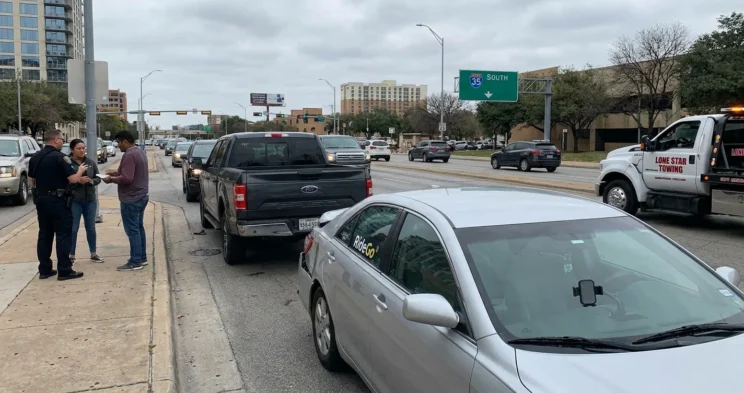
You were in the back of an Uber heading home through Uptown when another driver ran the light and slammed into your door. Now your back hurts, you have missed work, and the insurance company is already calling with an offer. How do you know whether that number actually covers everything you have lost?
What Texas Rideshare Accident Victims Can Recover
Texas law allows you to pursue three main categories of compensation in rideshare accident cases. They are economic damages, non-economic damages, and property damage. You can seek all of these damages in a single claim.
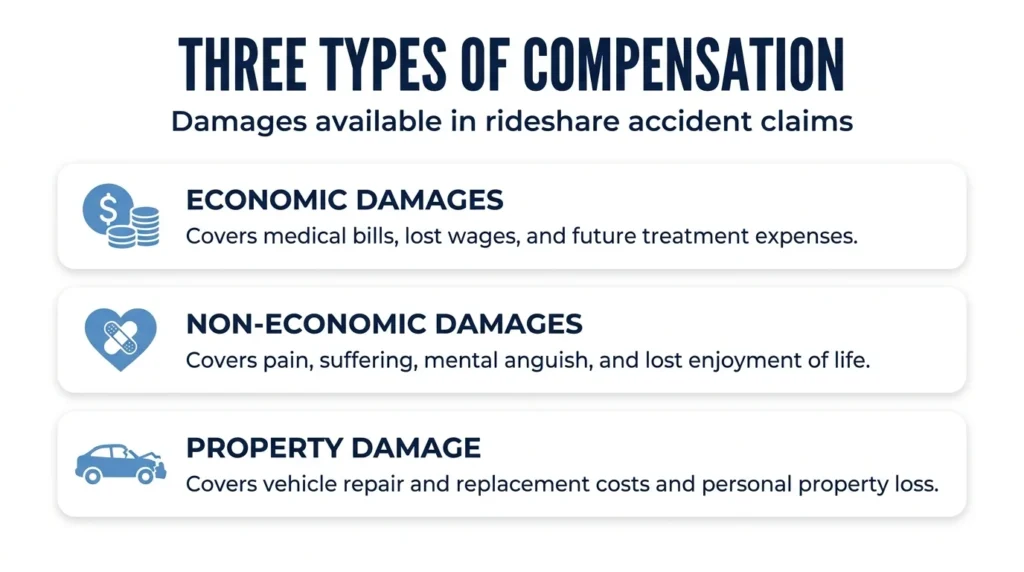
Economic damages cover measurable financial losses like medical bills, lost wages, future medical treatment, and reduced earning capacity. Non-economic damages compensate you for losses that are harder to measure, including pain and suffering, mental anguish, and loss of enjoyment of life. Property damage covers repairs or replacement of your vehicle and personal belongings damaged in the crash.
The insurance coverage available after a rideshare accident depends on the driver’s status in the app at the time of the collision. Still, the coverage period does not change the types of damages you can pursue. Whether the claim involves Uber’s policy, Lyft’s policy, or another driver’s insurance, the same categories of compensation remain available.
Some claims involve additional forms of recovery. In fatal rideshare accidents, surviving family members may have the right to pursue wrongful death damages. In rare cases involving especially reckless conduct, a court may also award exemplary damages.
Economic Damages in Rideshare Claims
Economic damages are the financial losses you can document with a receipt, a bill, or a pay stub. They cover what the crash has already cost you and what it will cost you going forward.
Medical expenses are usually the largest piece. That includes emergency care, your hospital stay, surgery, rehabilitation, prescriptions, and any ongoing treatment your injuries require. Save every bill and record, even the small ones. There are also out-of-pocket costs. Rides to medical appointments, in-home care, and assistive devices like a wheelchair or a walker all belong in your claim.
Lost wages cover the income you missed while recovering. You can prove this with pay stubs, a statement from your employer, or your tax records. Average settlements for rideshare accidents vary widely depending on the severity of the injury, the cost of treatment, and the amount of available insurance coverage.
Lost Wages vs. Loss of Earning Capacity
These two get mixed up constantly because both involve money you would have earned from work. They cover different time periods and use different math.
Lost wages cover the gap from your crash date through your recovery or settlement. The number is concrete because the work already happened or clearly would have.
Future earning capacity matters when your injuries keep you from your old job. If you cannot return to the work you did before, or you can only do less of it, that lost income counts too.
Loss of earning capacity looks forward. It covers the income you can no longer earn because a permanent or long-term disability has changed the kind of work you can do.
Non-Economic Damages After a Rideshare Accident
Non-economic damages compensate you for losses that do not come with bills, receipts, or other direct financial records. Texas law treats your pain, your distress, and your lost quality of life as real, compensable losses, even though no invoice exists.
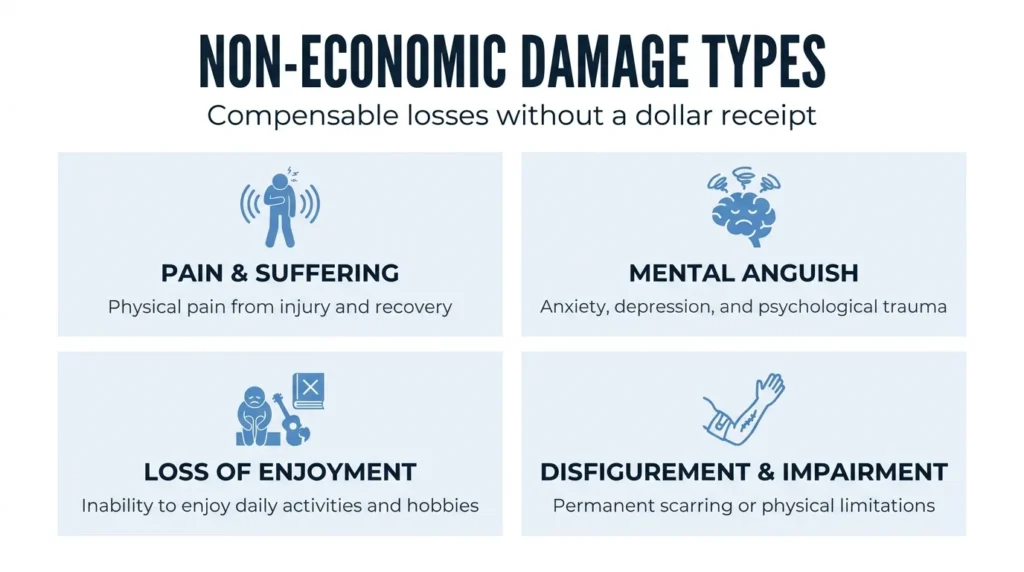
Pain and suffering cover the physical pain from the injury itself. That includes the pain at the moment of the crash and everything you endure during recovery.
Mental anguish covers the emotional side. Anxiety, depression, trouble sleeping, and the psychological trauma that follows a serious crash all fall here.
Loss of enjoyment of life covers what the injury took from your daily routine. If you can no longer coach your kid’s team, garden, or simply get through a workday without pain, that loss counts.
Disfigurement and physical impairment apply when the injury leaves lasting marks or limits how your body works. Scarring and a permanent limp are both compensable.
Comparative Fault & How It Affects Your Compensation
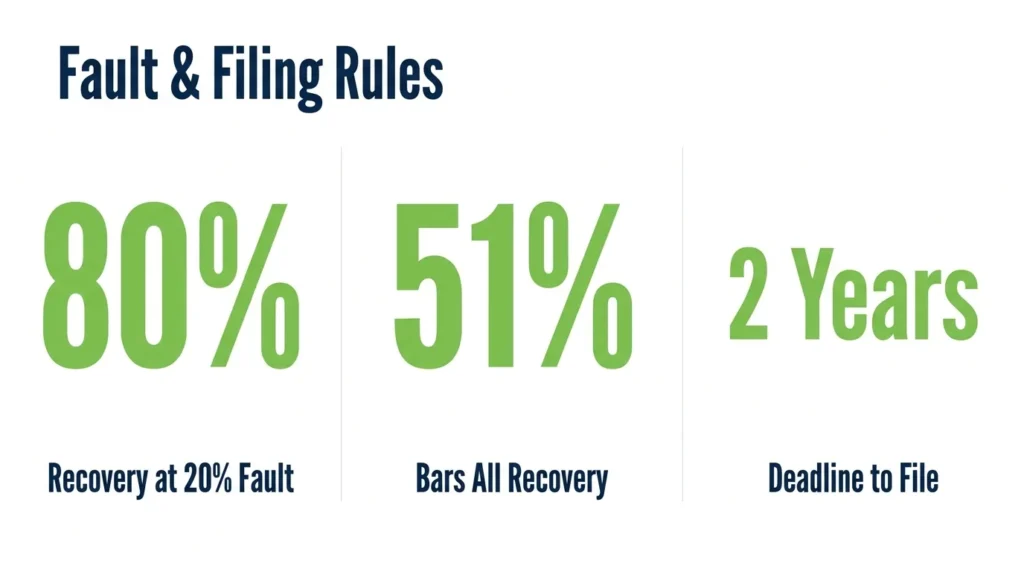
Texas uses a fault-sharing system that can reduce what you recover. Your damages drop by your share of the blame, so if you are found 20 percent at fault, you collect 80 percent of your damages. This rule comes from the Texas Civil Practice and Remedies Code § 33.001, often referred to as proportionate responsibility.
If you are found more than 50 percent at fault, you recover nothing at all. That is the 51 percent rule, and it ends a claim entirely. As a passenger, this rarely works against you. You were not driving, so you almost never carry fault for the crash, which puts you in a strong position.
Fault gets decided from evidence. Police reports, witness statements, dashcam video, and the rideshare company’s trip data all help establish who did what.
If you want to pursue a case, Texas gives you two years from the date of the crash to file a personal injury lawsuit under CPRC § 16.003. Miss that window and your right to recover is almost certainly gone, no matter how strong your case is.
Wrongful Death & Exemplary Damages in Rideshare Cases
The most serious cases open up two more categories of recovery. Surviving family members can bring a wrongful death claim, and a court can order exemplary damages when the conduct was especially reckless.
Wrongful Death Damages
A wrongful death claim belongs to the surviving family, not the estate. It compensates the people left behind for their own losses. The surviving spouse, children, and parents of the person who died may file under the Texas Civil Practice and Remedies Code Chapter 71.
The recoverable losses often include lost financial support, lost companionship and society, mental anguish, and funeral and burial costs. A separate survival claim, brought by the estate, can run alongside the wrongful death case. It covers what your loved one endured before passing.
Exemplary Damages
Exemplary damages punish extreme conduct and require a much higher level of proof. You need clear and convincing evidence of gross negligence, malice, or fraud under Texas Civil Practice and Remedies Code Chapter 41.
In a rideshare case, this might apply when a company kept a driver with a known dangerous record on the road. It could also apply if a company disabled a safety feature while knowing the risk.
Chapter 41 also caps these awards. The cap is the greater of two times your economic damages plus up to $750,000 in non-economic damages, or a flat $200,000.
Talk to an Accident Attorney
A rideshare crash can leave you facing bills you never planned for, and figuring out the full value of your claim alone is hard. Angel Reyes & Associates has guided injured Texans through situations like this for over 30 years.
We serve the entire state of Texas from more than 20 office locations, and we can handle most, if not all, of your case remotely. We work on a no-fee-unless-we-win basis. Reviewing our client reviews and testimonials can give you a sense of how we handle and present these cases.
We have more than $1 billion recovered for clients across the kinds of cases that change lives. Take the first step and contact us for a free consultation so you understand everything you are owed.
Past results do not guarantee future outcomes.
Rideshare Compensation FAQs
Does Texas cap non-economic damages in a rideshare accident case?
No cap applies to non-economic damages in Texas personal injury cases, except in medical malpractice. For a rideshare crash claim, there is no legal ceiling on what you can recover for pain and suffering, mental anguish, or loss of enjoyment of life.
What if the rideshare driver's app was turned off when the crash happened?
When a driver is logged out of the Uber or Lyft app, neither company’s commercial policy applies. Your claim would go against the driver’s personal auto insurance only, which may have lower limits than the TNC’s commercial coverage.
Can a pedestrian or cyclist file a rideshare accident claim in Texas?
Yes. You do not have to be a passenger to have a claim. Pedestrians and cyclists hit by an Uber or Lyft vehicle can pursue compensation for their injuries, and the same coverage period rules determine which insurance policy applies.
What records help prove non-economic damages like pain and suffering?
A daily journal tracking pain levels, sleep problems, and activities you can no longer do is one of the strongest forms of evidence. Mental health treatment records, statements from people who know you, and medical notes documenting your functional limitations all support the value of these damages.
Is the deadline to file a wrongful death claim the same as for a personal injury claim?
Both carry a two-year deadline under Texas law, but the clock on a wrongful death claim starts from the date of death, not the date of the crash. If the two dates differ, surviving family members need to track the correct deadline for their specific claim.
About the Authors

Angel Reyes
Writer
Angel L. Reyes, III is the Founder and Managing Partner of Angel Reyes & Associates. A nationally recognized trial attorney and business leader, Angel has helped over 70,000 injury victims recover more than $1 billion since founding the firm in 1993. Named to the Texas Super Lawyers list annually since 2008, Angel brings Wall Street experience, Ivy League education, and a deep commitment to client advocacy. He is a frequent legal commentator and published author with extensive contributions to legal scholarship, trial strategy, and consumer protection.

Kyle Nicolas
Editor
Kyle Nicolas is the Web Content & SEO Manager at Angel Reyes & Associates. He has more than 10 years of experience as a marketing co...

Angel Reyes
Reviewer
Angel L. Reyes, III is the Founder and Managing Partner of Angel Reyes & Associates. A nationally recognized trial attorney and business...