Can Federal Safety Standards Block Your Defect Claim?


Every article on this site is researched by our internal team, reviewed for legal accuracy against current Texas law, and held to State Bar of Texas advertising standards before publication. We do not publish content that overstates outcomes or makes promises about results.
Learn more about our
editorial standards .
Key Takeaways
- Federal safety standards are minimums, so compliance alone does not bar a defect claim.
- Preemption needs proof the agency wanted a mix of designs, not merely a choice.
- Texas gives compliant makers a rebuttable presumption that defect proof alone cannot rebut.
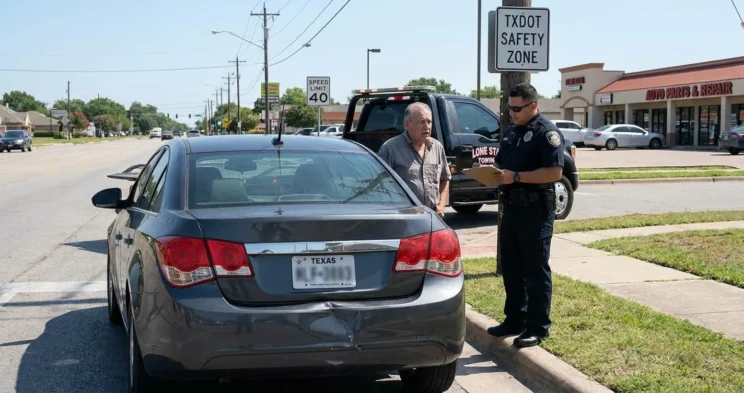
A defense lawyer tells you the vehicle met every applicable federal safety standard, so your case is finished. Compliance may strengthen the manufacturer’s defense, but it does not automatically bar a Texas product liability claim.
Two separate rules can affect the case. Federal preemption may end a claim in narrow circumstances. A Texas statutory presumption can shift the burden to you while leaving the claim open.
How Federal Compliance Affects Liability
Under 49 U.S.C. 30102(a)(10), a motor vehicle safety standard is a minimum standard for performance.
The savings clause at 49 U.S.C. 30103(e) then states that compliance “does not exempt a person from liability at common law.” Manufacturers also certify their own compliance under 49 U.S.C. 30115(a).
Most defect claims follow an ordinary Texas crash, where compliance raises the separate risks of a narrow federal preemption defense and the Texas compliance presumption. Only the federal defense can end the claim.
How Conflict Preemption Applies
A Federal Motor Vehicle Safety Standards (FMVSS) preemption defense is narrower than it sounds. Express preemption does not apply to common-law lawsuits.
In Geier v. American Honda Motor Co., 529 U.S. 861 (2000), the Supreme Court read the savings clause as narrowing the express preemption clause so that it does not cover common-law suits. A broader reading would leave few, if any, state tort actions for the savings clause to save.
The savings clause does not prevent conflict preemption. A claim may still be preempted if enforcing state law would interfere with a federal objective. This is known as implied conflict preemption or obstacle preemption.
Texas courts read it the same way. In MCI Sales & Service, Inc. v. Hinton (Tex. 2010), obstacle preemption was the only preemption theory advanced.
A federal standard that deliberately allows manufacturers to choose among designated options may preempt a state claim that would effectively require one option. The same analysis governs heavy vehicle defect claims.
The Dividing Line Between a Deliberate Mix & a Plain Floor
Obstacle preemption applies in a narrow situation. A federal agency deliberately gave manufacturers several options because it wanted a mix of systems on the road, and the state-law claim would effectively require every manufacturer to choose one.
Deliberate Variety in Geier
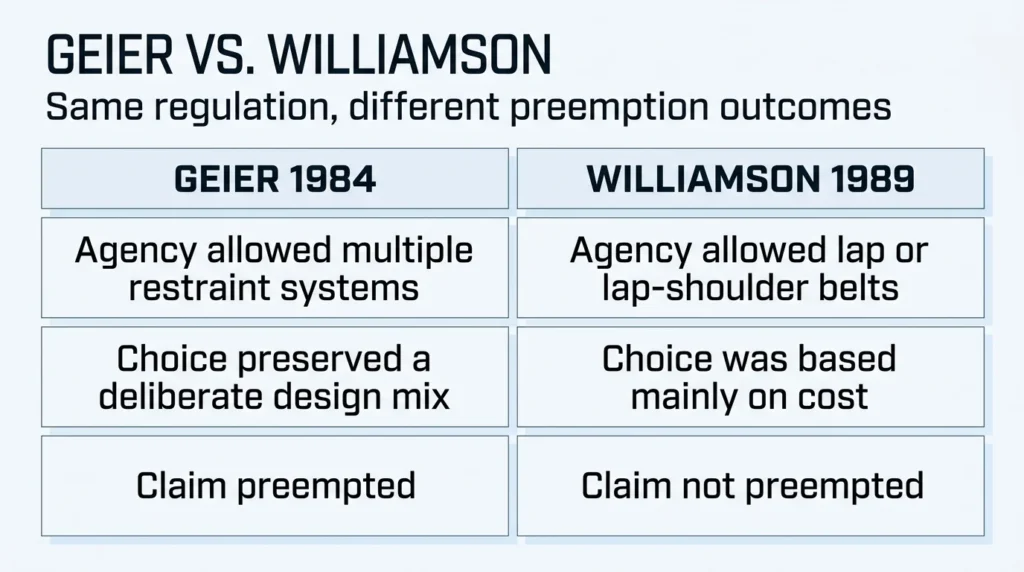
The 1984 version of 49 C.F.R. 571.208 let manufacturers choose among passive restraint systems and phased it in gradually. The agency wanted manufacturers to use different systems while it evaluated costs, safety risks, and comparative data.
A state-law duty requiring airbags would have pushed every similar vehicle toward one device and interfered with that federal objective. The Court therefore held that the claim was preempted.
Regulatory Choice in Williamson
Williamson v. Mazda Motor of America, Inc., 562 U.S. 323 (2011) involved the same standard and a similar choice. The 1989 version let manufacturers install either a lap belt or a lap and shoulder belt at rear inner seats. The Court held the suit was not preempted because providing that seatbelt choice was not a significant objective of the regulation.
By 1989, the agency was not trying to maintain a mix of restraint systems and believed the lap-and-shoulder belt offered greater safety. Its decision to permit lap belts was based primarily on cost.
Justice Sotomayor summarized the distinction in her concurrence. Giving manufacturers a choice is not enough. The agency must have intended that choice to advance a federal objective.
The lap-only option for rear seats is no longer available in vehicles manufactured on or after September 1, 2007. FMVSS 208 now generally requires lap-and-shoulder belts in rear seats. When an alleged defect contributes to a fatal crash, the same analysis may affect a wrongful death claim.
How the Texas Compliance Presumption Works
Federal preemption can end a claim. Texas law creates a separate compliance presumption that shifts the burden to the claimant but can still be overcome.
What the Presumption Requires
Tex. Civ. Prac. & Rem. Code 82.008 creates a rebuttable presumption that a manufacturer is not liable when the formulation, labeling, or design complied with a mandatory federal standard.
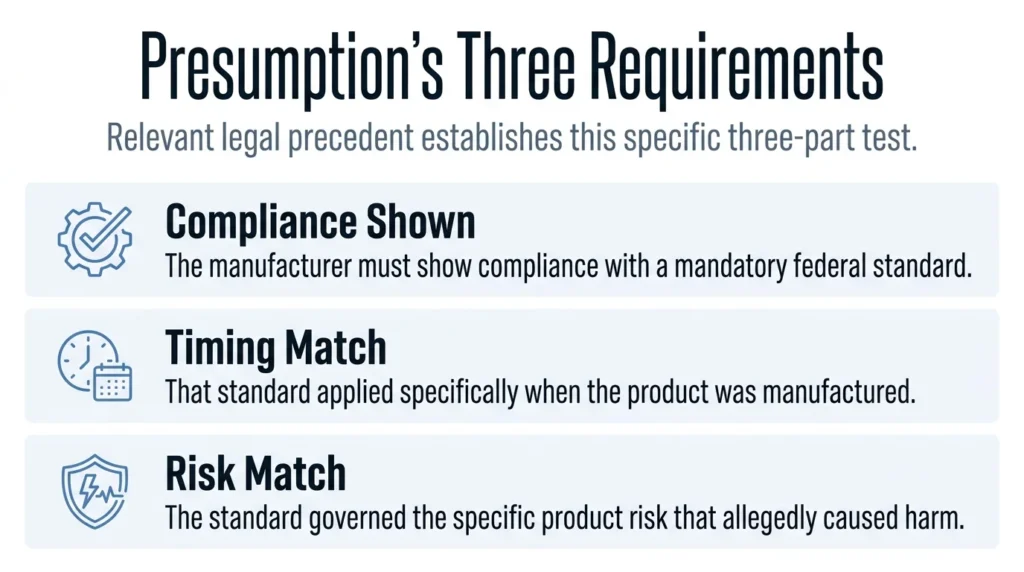
Kia Motors Corp. v. Ruiz (Tex. 2014) identifies three requirements. The manufacturer must show compliance with a mandatory federal standard, that the standard applied when the product was manufactured, and that the standard governed the product risk that allegedly caused the harm.
The third requirement limits when the presumption applies. In Kia Motors, the presumption did not apply because the crash-test requirements did not address the alleged risk of an airbag failing to deploy reliably.
Section 82.008 provides two ways to overcome the presumption. The claimant may show that the federal standards did not adequately protect the public from unreasonable risks or that the manufacturer withheld or misrepresented information relevant to the agency’s decision. The presumption does not cover manufacturing defects, even when the company followed federally mandated quality-control procedures.
The Milburn Limit on Rebuttal
American Honda Motor Co. v. Milburn, No. 21-1097 (Tex. June 28, 2024) shows how heavy that burden is. A third-row passenger used only the shoulder portion of a ceiling-mounted seat belt and suffered catastrophic injuries when the vehicle rolled. FMVSS 208 expressly permitted the design.
The Texas Supreme Court held that the presumption applied and that the evidence did not overcome it. The Court reversed the lower judgment and ruled for Honda.
Whether a design is defective and whether the standard it met is inadequate are distinct inquiries. Rebuttal takes more than a risk-benefit conclusion about the design at issue.
The Court said relevant evidence could include problems with the agency’s decision-making process or later developments such as new technology or new risk data. It did not define the full limits of that second route.
The Court did not address Honda’s preemption argument, so Milburn concerns the Texas compliance presumption rather than federal preemption.
Building a Defect Claim Around the Standard’s Limits
The claim’s strength depends on how closely the federal standard matches the alleged defect.
Reviewing What the Standard Requires
Start by identifying what the standard requires and what it merely permits. Then review the rulemaking record to determine whether the agency intended to preserve a mix of designs or establish a minimum requirement. When the standard establishes a minimum, the savings clause may allow a claim that the manufacturer should have provided greater protection.
The standard may not address whether the chosen system performed correctly or whether the product had manufacturing, assembly, testing, or warning defects. Milburn shows the limit. The claimant challenged the usability of a design expressly permitted by the regulation and failed to overcome the Texas compliance presumption. When the compliant design itself is challenged, the evidence must show why the federal standard provided inadequate protection.
The Evidence That Decides These Cases
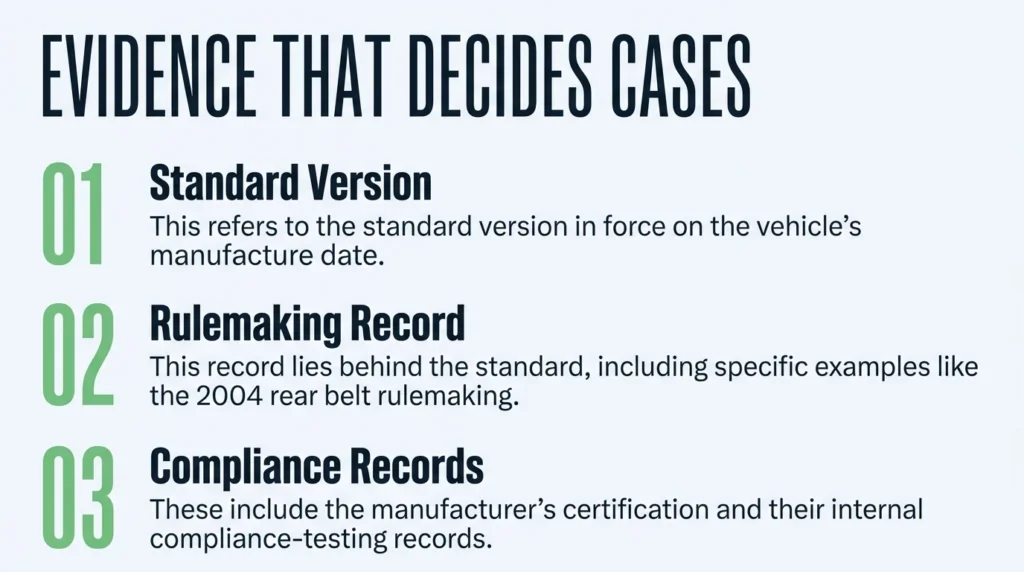
- The version of the standard in force on the vehicle’s date of manufacture.
- The rulemaking record behind it, including the 2004 rear belt rulemaking.
- The manufacturer’s certification and internal compliance-testing records.
Talk to a Vehicle Defect Lawyer
Federal compliance can strengthen the manufacturer’s defense, so review the applicable standard and rulemaking history early.
Angel Reyes & Associates has guided injured Texans for more than 30 years. Contact us for a free consultation to talk through your options.
Every case is different, and past results do not guarantee future outcomes.
Vehicle Defect Claim FAQs
Can a vehicle manufacturer face liability for a safety feature that exceeds federal requirements?
Yes. Federal motor vehicle safety standards often set minimum requirements, and compliance does not, by itself, prevent a Texas product liability claim alleging that additional reasonable safety measures were necessary.
Does a vehicle recall prove that the vehicle was defective in a Texas product liability case?
Not automatically. A recall may provide relevant evidence about a safety issue, but liability still depends on the particular defect alleged, the applicable legal requirements, and whether that defect caused the injury.
Can changes to federal vehicle safety standards affect an older vehicle defect claim?
Potentially, but the standard in effect when the vehicle was manufactured is generally the one relevant to the Texas compliance presumption. Later regulatory changes or new safety information may still be relevant when evaluating whether an earlier standard adequately protected the public from unreasonable risks.
Does FMVSS compliance protect a manufacturer from a vehicle manufacturing defect claim in Texas?
The presumption in Texas Civil Practice and Remedies Code 82.008 applies to injuries caused by aspects of a product’s formulation, labeling, or design that meet the statute’s requirements. It does not extend that presumption to manufacturing defects merely because the manufacturer complied with federal standards.
What is the difference between a vehicle design defect and a manufacturing defect?
A design defect challenges the safety of the product’s intended design, while a manufacturing defect generally alleges that a particular product deviated from its specifications or planned output. That distinction can matter when a manufacturer relies on federal regulatory compliance as a defense.
About the Authors

Angel Reyes
Writer
Angel L. Reyes, III is the Founder and Managing Partner of Angel Reyes & Associates. A nationally recognized trial attorney and business leader, Angel has helped over 70,000 injury victims recover more than $1 billion since founding the firm in 1993. Named to the Texas Super Lawyers list annually since 2008, Angel brings Wall Street experience, Ivy League education, and a deep commitment to client advocacy. He is a frequent legal commentator and published author with extensive contributions to legal scholarship, trial strategy, and consumer protection.

Kyle Nicolas
Editor
Kyle Nicolas is the Web Content & SEO Manager at Angel Reyes & Associates. He has more than 10 years of experience as a marketing co...

Spencer Browne
Reviewer
Spencer Browne is a partner at Angel Reyes & Associates and a Board Certified personal injury trial lawyer with nearly 100 jury trials a...