What’s the Difference Between a Concussion and a TBI?


Every article on this site is researched by our internal team, reviewed for legal accuracy against current Texas law, and held to State Bar of Texas advertising standards before publication. We do not publish content that overstates outcomes or makes promises about results.
Learn more about our
editorial standards .
Key Takeaways
- A concussion is a traumatic brain injury at the mild end of the severity spectrum
- Doctors grade TBI severity by Glasgow Coma Scale score, unconsciousness, and amnesia
- Most concussions happen with no loss of consciousness, and scans can look normal
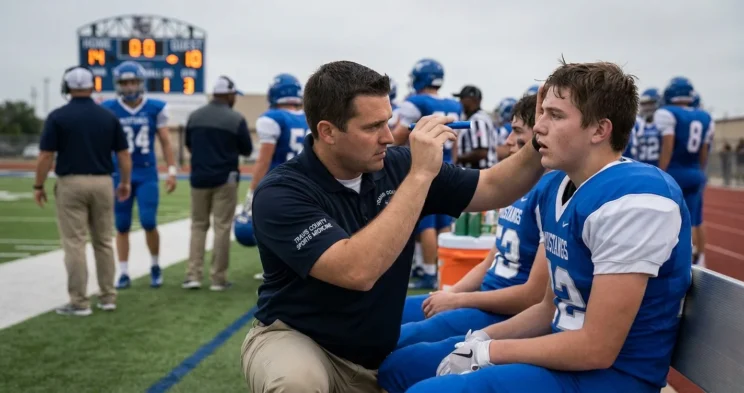
Your discharge papers say concussion. Weeks later you still can’t hold a thought through a work meeting, and the adjuster keeps talking about your injury as if it were a bad headache that should have cleared up by now.
A concussion is a traumatic brain injury. The two terms are not describing two different injuries. Concussion is the everyday word for a TBI at the mild end of the severity spectrum.
What changes from case to case is where the injury falls on that spectrum, and doctors measure that with objective criteria. Knowing those criteria, and knowing which parts of your medical record capture them, is how a real brain injury avoids being treated as nothing.
Is a Concussion Really a Traumatic Brain Injury?
Yes. The CDC’s HEADS UP concussion education program states it plainly: a concussion is a type of traumatic brain injury “caused by a bump, blow, or jolt to the head or by a hit to the body that causes the head and brain to move rapidly back and forth.”
Nothing has to strike your head. A rear-end collision that snaps your head forward and back can cause the same injury as a direct impact.
Mayo Clinic Sports Medicine describes a concussion the same way, as a traumatic brain injury that affects how your brain functions. The effects are usually temporary, and they can include headaches along with problems in concentration, memory, balance, and coordination.
Clinicians treat the terms as interchangeable at that point on the spectrum. A clinical reference published through the NIH’s National Library of Medicine refers to “a mild TBI (otherwise known as a concussion).”
So the concussion vs. TBI question is really a question about severity, not about two separate diagnoses.
How Doctors Classify Mild, Moderate, & Severe TBI
Severity is set by three objective clinical measures, not by how serious the injury sounds. Those measures are the Glasgow Coma Scale (GCS) score, the duration of loss of consciousness, and the duration of post-traumatic amnesia, meaning the period of memory loss after the injury.
The NIH clinical reference groups the GCS scores this way:
- Mild TBI, commonly called a concussion: GCS score of 13 to 15
- Moderate TBI: GCS score of 9 to 12
- Severe TBI: GCS score of 3 to 8
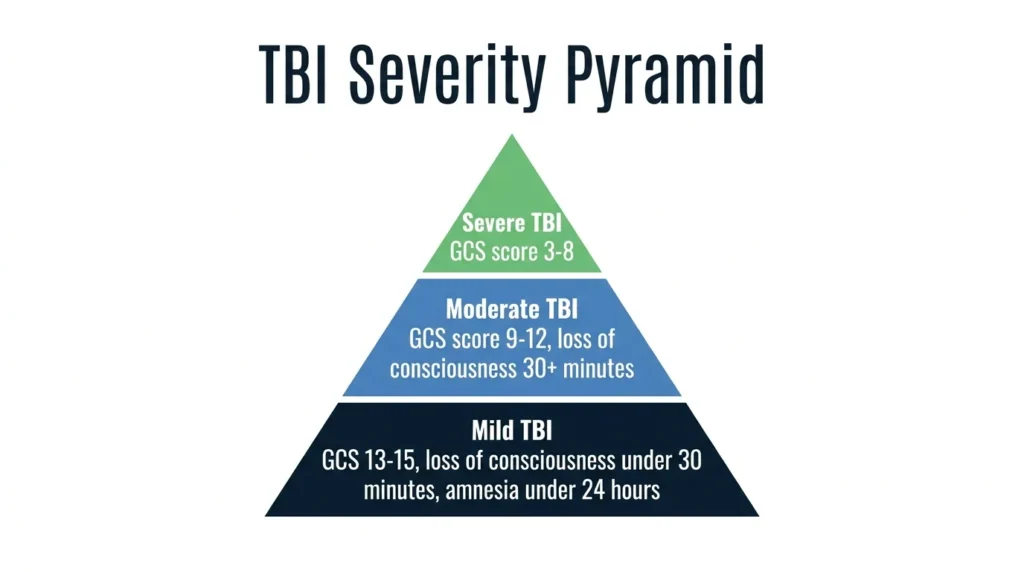
The duration criteria follow the same pattern. Mild TBI involves loss of consciousness under 30 minutes and post-traumatic amnesia under 24 hours, or any alteration of consciousness. Moderate and severe TBI involve loss of consciousness of 30 minutes or longer, up to prolonged coma, with amnesia lasting 24 hours or longer.
One point gets missed constantly. You do not have to lose consciousness to have a concussion. A 2025 peer-reviewed review of mild traumatic brain injury reports that the vast majority of concussions happen without any loss of consciousness at all, which is why so many go unrecognized.
At the other end of the range, the CDC notes that moderate and severe TBI can follow a bump, blow, or jolt to the head or a penetrating head injury, and that survivors may face long-term or lifelong health problems.
The injury mechanisms behind both ends of that spectrum are ordinary Texas events. A collision on I-35 and a fall on an unlit stairwell can each produce the same closed head injury, which is why these questions come up so often in car accident claims and in premises liability claims.
Why the Word “Concussion” Can Work Against Your Claim
Your GCS score, your loss of consciousness, and your memory gaps do not change based on which word gets written next to them. The connotations of the words do change, and that gap is worth understanding before you talk to anyone about your claim.
The CDC explains the reasoning behind the label directly on its page about mild TBI and concussion: providers may describe these injuries as mild “because they are usually not life-threatening.” Mild describes the risk to your life. It does not describe how much the injury is affecting your days.
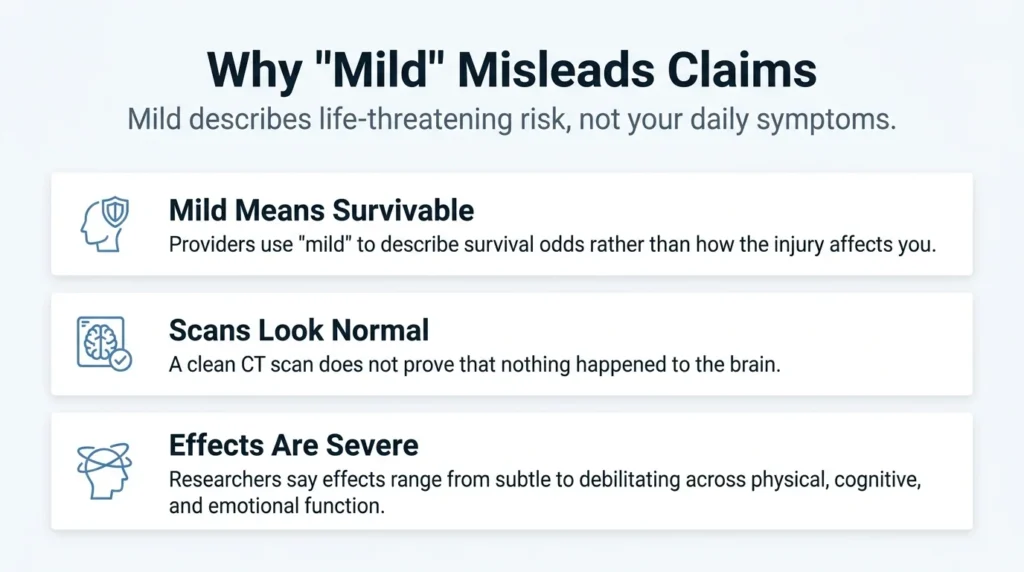
The same CDC page addresses another common misunderstanding. A brain scan such as a CT is not needed to spot a mild TBI or concussion. A clean scan is not proof that nothing happened to your brain.
Medical researchers have raised the same concern about the label. The 2025 review notes that despite its “seemingly benign classification,” the consequences of mild TBI can reach physical, cognitive, emotional, and social functioning, with effects “ranging from subtle to debilitating.” The authors conclude that the traditional mild designation “may inadequately capture the complexity and heterogeneity of these injuries.”
None of that is a legal rule, and no study proves that one word on a chart changes what a claim is worth. It is a plain mismatch between what the word suggests and what the medical record may actually show. The adjuster’s job is to close your claim for as little as possible, and a label that sounds minor makes that job easier.
The Evidence That Documents a Real Brain Injury
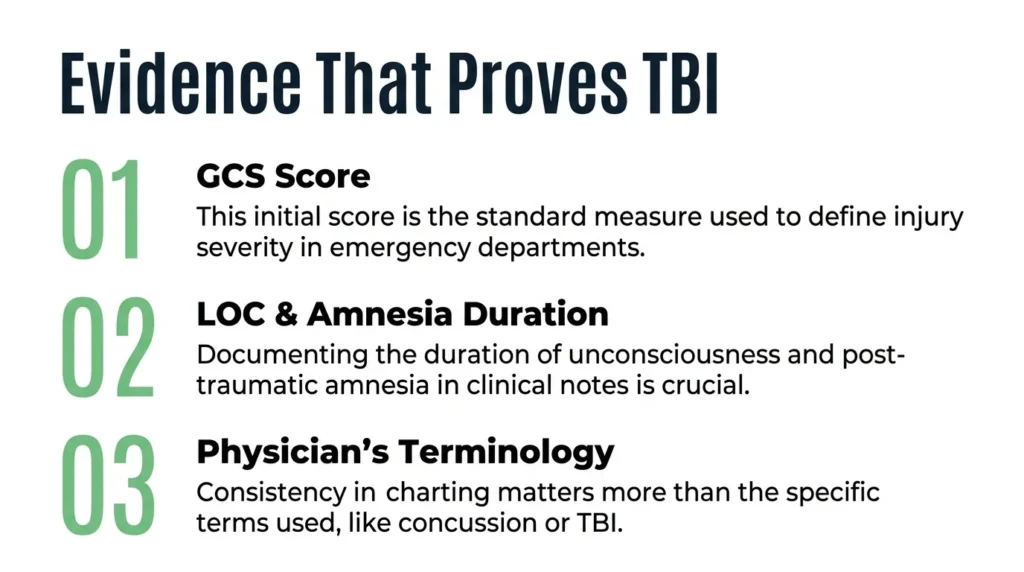
Your claim is built on documented clinical facts, not on adjectives. Three records carry most of the weight, and each one should be preserved from the day of the injury forward:
- The Glasgow Coma Scale score from the emergency department. GCS is the standard point-of-care assessment, and it is the same metric used to define mild, moderate, and severe TBI.
- The documented duration of lost consciousness and post-traumatic amnesia. These are the other two criteria that classify severity, and they belong in the emergency department chart and in follow-up notes.
- The treating physician’s own terminology. Whether your chart reads concussion, mild TBI, or traumatic brain injury, that wording sits in the same record as your GCS score and your amnesia findings.
Consistency across those records is what makes an injury difficult to dismiss. Keep every follow-up appointment, describe your symptoms specifically rather than saying you feel fine, and ask that ongoing problems with memory, sleep, mood, or concentration be written down.
Talk to a Lawyer About Your Concussion or TBI Claim
Timing matters in Texas. Under Texas Civil Practice and Remedies Code § 16.003(a), a person must generally bring suit for personal injury “not later than two years after the day the cause of action accrues.” How that deadline applies depends on the facts of your situation, which is a reason to get answers early rather than late.
Angel Reyes & Associates has guided injured Texans through the legal process for over 30 years, and the team can be reached 24/7. If a crash or a fall left you with a head injury that the paperwork calls mild, contact Angel Reyes & Associates for a free consultation and a clear read on your options.
Past results do not guarantee future outcomes.
Concussion Claim FAQs
What are the treatment options for a concussion?
Cognitive and physical rest are the best treatments. Treatment for symptoms that linger for longer than 10 days typically include manual neck therapy, visual rehabilitation, and more.
What share of traumatic brain injuries are classified as mild concussions?
The large majority. CDC data reported in its MMWR publication finds that approximately 75 percent of traumatic brain injuries are mild, often called concussions. Most people carrying a concussion label still have a documented traumatic brain injury.
Why does the Glasgow Coma Scale matter for a claim?
The Glasgow Coma Scale, or GCS, is the standard emergency department test for grading a head injury’s severity. A score of 13 to 15 is mild, 9 to 12 is moderate, and 3 to 8 is severe. Recorded early by a treating physician, it becomes one of the clearest pieces of documentation behind a brain injury claim.
About the Authors

Angel Reyes
Writer
Angel L. Reyes, III is the Founder and Managing Partner of Angel Reyes & Associates. A nationally recognized trial attorney and business leader, Angel has helped over 70,000 injury victims recover more than $1 billion since founding the firm in 1993. Named to the Texas Super Lawyers list annually since 2008, Angel brings Wall Street experience, Ivy League education, and a deep commitment to client advocacy. He is a frequent legal commentator and published author with extensive contributions to legal scholarship, trial strategy, and consumer protection.

Kyle Nicolas
Editor
Kyle Nicolas is the Web Content & SEO Manager at Angel Reyes & Associates. He has more than 10 years of experience as a marketing co...

Angel Reyes
Reviewer
Angel L. Reyes, III is the Founder and Managing Partner of Angel Reyes & Associates. A nationally recognized trial attorney and business...