What Happens When a Texas Injury Case Moves to Federal Court?


Every article on this site is researched by our internal team, reviewed for legal accuracy against current Texas law, and held to State Bar of Texas advertising standards before publication. We do not publish content that overstates outcomes or makes promises about results.
Learn more about our
editorial standards .
Key Takeaways
- Only a defendant can remove a Texas injury case, generally within 30 days after service.
- Diversity-based removal generally requires complete diversity between the parties and more than $75,000 in controversy.
- Moving to federal court can mean a jury pool will be drawn from a broader geographic area and stricter, firmer deadlines for expert reports.
You filed your personal injury lawsuit in a Texas state courthouse, and you expected the case to stay there. Then a notice arrived telling you that a federal judge in a different courthouse would oversee your case. You did not choose to move your case, and you may be wondering why it happened, and whether it means something has gone wrong.
Your case may have moved to federal court because a defendant filed a notice of removal. Removal allows a defendant to transfer certain lawsuits from state court to federal district court, and personal injury cases often reach federal court through diversity jurisdiction.
The move does not necessarily mean your claim is weaker, or you filed in the wrong court. In some circumstances, you may also be able to ask the federal court to send the case back to state court through a process called “remand.”
How Removal From State Court to Federal Court Works
Removal works in only one direction. A defendant can remove a case from state court to federal court, but a plaintiff cannot. The case generally moves to the federal district court serving the area where the state case was pending.
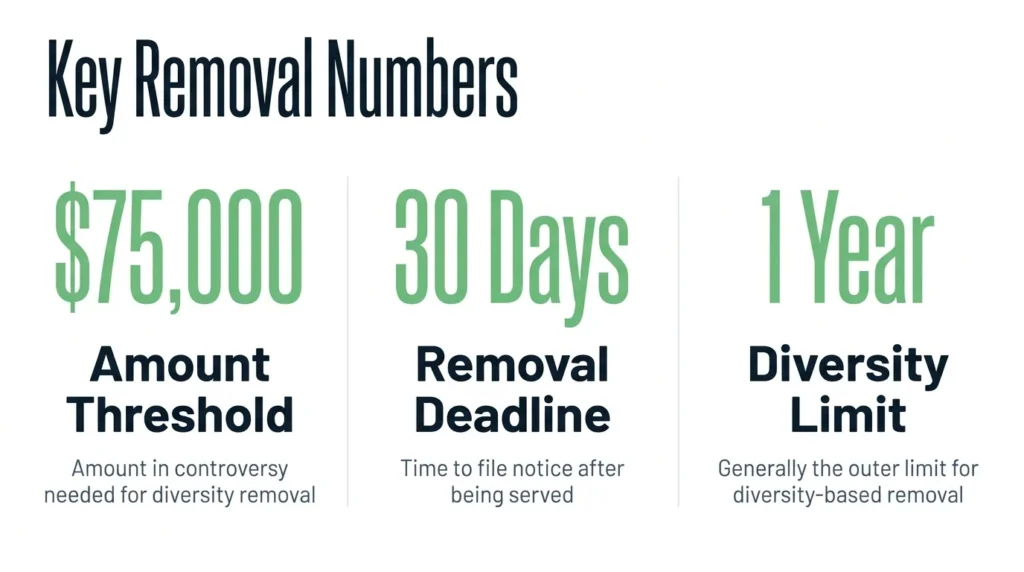
For a personal injury case, removal usually depends on diversity jurisdiction. A federal court can hear the case only if no plaintiff is a citizen of the same state as any defendant, and the amount in controversy is more than $75,000 (not including interest and court costs).
The first requirement is called “complete diversity,” and the rule is strict. If even one plaintiff and one defendant are citizens of the same state, then diversity jurisdiction generally does not support removal.
A corporation is a citizen of every state where it is incorporated and the state where it has its principal place of business. A properly joined and served defendant who is a citizen of the state where the lawsuit was filed can also prevent diversity removal under the forum defendant rule.
What Evidence Shows a Case Is Worth More Than $75,000?
Texas petitions rarely state how much a case is worth. As a result, a defendant who is seeking removal usually must use evidence outside the petition to show that the amount in controversy is more than $75,000.
Fifth Circuit law provides the rule when the petition does not state a specific amount. The defendant seeking removal must show, by a preponderance of the evidence, that the amount in controversy is more than $75,000.
The defendant may rely on the injuries described in your petition or provide evidence, such as medical bills, discovery responses, or a demand letter. That last example can catch you off guard. A detailed pre-suit demand letter that lists your medical bills and other damages can become evidence used by the defendant to show that your case belongs in federal court.
The 30-Day Deadline for Removing a Case

A defendant generally has 30 days after being served to remove a case to federal court. If the defendant misses that deadline, then the removal may be improper and subject to challenge.
Who the parties are and when each party was served can determine whether the removal was valid in the first place. The 30-day period generally begins when the defendant is served with the initial pleading. If the case later becomes removable, then a new 30-day period may begin when the defendant receives the document showing that the case has become removable.
Diversity removal usually has a one-year limit. A defendant generally cannot remove a case based on diversity jurisdiction more than one year after the lawsuit begins in state court. An exception may apply if the court finds that the plaintiff acted in bad faith to prevent removal.
Each properly joined and served defendant generally must join in or consent to the removal, and each defendant generally has its own 30-day removal period.
What to Expect After Your Case Moves to Federal Court
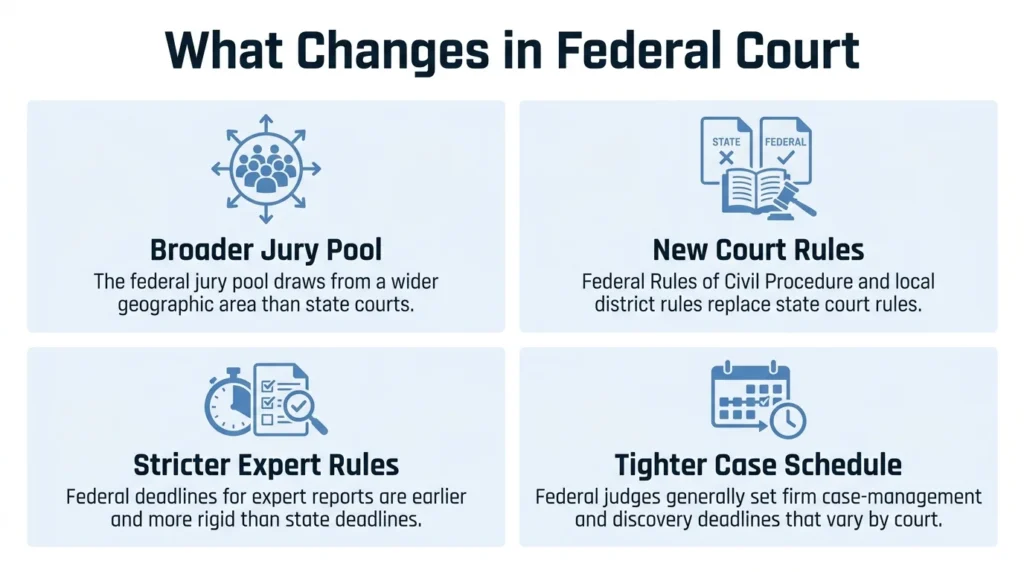
Several things can change when your case moves to federal court:
- Your jury pool can widen: A federal jury pool can draw from a broader geographic area than a state-court jury pool, depending on the federal district and division handling the case.
- Different rules apply: Once your case moves to federal court, it follows the Federal Rules of Civil Procedure, along with the local rules and standing orders of that federal district. The Texas Rules of Civil Procedure no longer control your case. This can change how the court handles scheduling under Rule 16, summary judgment motions, and other routine motions.
- Expert requirements can be stricter: Federal rules generally require retained experts to provide detailed written reports, and the disclosure deadlines can be earlier and more rigid than those used in Texas state court. Missing a federal expert deadline can result in the expert being excluded from testifying.
- The schedule can be tighter. Federal judges generally set firm case-management and discovery deadlines. The schedule varies by court and case.
How a Motion to Remand Works
A removed case can return to state court through a motion to remand.
The deadline for filing the motion depends on the reason the removal was improper:
- Procedural defects have a 30-day deadline: If the removal was procedurally improper, then you generally must raise the objection within 30 days after the notice of removal is filed. Otherwise, the objection is usually waived.
- Jurisdictional defects do not have the same deadline: If the federal court lacks subject matter jurisdiction, then the case generally must be remanded at any time before final judgment.
Talk to Angel Reyes & Associates About Your Federal Court Case
A case moving to federal court does not necessarily change the strength of your underlying claim, but it does put the case under federal procedures and deadlines that can differ from state court. Issues involving citizenship, service, damages, and expert disclosures may require careful attention because federal rules and deadlines can affect your case.
Angel Reyes & Associates has guided injured Texans through the legal process for over 30 years, and we have recovered more than $1 billion for our clients. Our team includes board-certified personal injury attorneys and investigators who can help evaluate your case.
Schedule a free consultation with Angel Reyes & Associates today to discuss where your case stands and what deadlines may apply.
Past results do not guarantee future outcomes.
Federal Court Case FAQs
Does moving to federal court mean I am being sued by the federal government?
No. A personal injury case moved to federal court is still a lawsuit between the parties involved in the accident or injury. The federal court is simply the court handling the case.
Will a federal judge handle my case after it is removed?
Yes. A case removed from state court will generally be assigned to a federal district judge. The federal judge will then handle the case under federal court procedures.
Will my case take longer because it moved to federal court?
Not necessarily. The length of a personal injury case depends on many factors, including the complexity of the injuries, amount of evidence, discovery, motions, settlement discussions, and the court’s schedule. Moving to federal court does not automatically mean the case will take longer.
Can the federal court decide that my case should be moved back to state court?
Yes. A federal court can review whether it has the authority to hear the case. If the requirements for federal jurisdiction or removal are not met, the case may be sent back to state court.
About the Authors

Angel Reyes
Writer
Angel L. Reyes, III is the Founder and Managing Partner of Angel Reyes & Associates. A nationally recognized trial attorney and business leader, Angel has helped over 70,000 injury victims recover more than $1 billion since founding the firm in 1993. Named to the Texas Super Lawyers list annually since 2008, Angel brings Wall Street experience, Ivy League education, and a deep commitment to client advocacy. He is a frequent legal commentator and published author with extensive contributions to legal scholarship, trial strategy, and consumer protection.

Kyle Nicolas
Editor
Kyle Nicolas is the Web Content & SEO Manager at Angel Reyes & Associates. He has more than 10 years of experience as a marketing co...

Angel Reyes
Reviewer
Angel L. Reyes, III is the Founder and Managing Partner of Angel Reyes & Associates. A nationally recognized trial attorney and business...