Was the Driver on the Clock at the Time of Your Crash?


Every article on this site is researched by our internal team, reviewed for legal accuracy against current Texas law, and held to State Bar of Texas advertising standards before publication. We do not publish content that overstates outcomes or makes promises about results.
Learn more about our
editorial standards .
Key Takeaways
- Being on the clock is evidence of course and scope, not the test itself.
- The going and coming rule keeps most ordinary Texas commutes outside employment.
- A company vehicle raises a presumption that vanishes on contrary evidence.
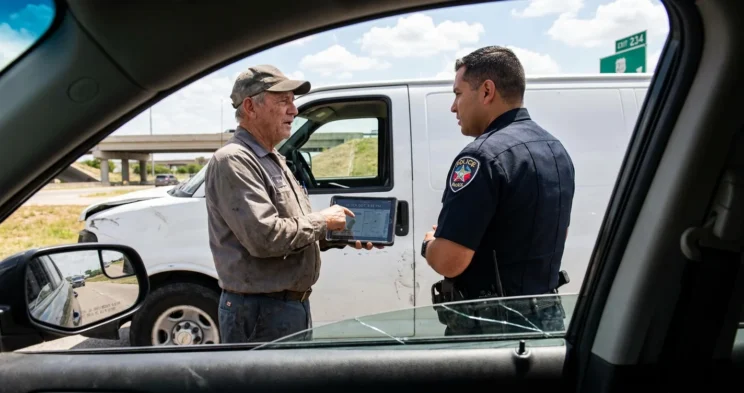
Someone hit you, and you have learned that the driver was working. Being on the clock can support your claim, but Texas law focuses on whether the trip itself was a job task the employer assigned and benefited from at the time of the crash.
The Texas Course & Scope Test for Employer Liability
An employer may be responsible for an employee’s crash only when the driver was acting within the course and scope of employment at the time. This rule is called respondeat superior, which allows an employer to be held liable for negligence an employee commits while performing assigned work.
Two Elements, Measured at the Moment of the Crash
- The driver was an employee.
- The driver was acting in the course and scope of employment.
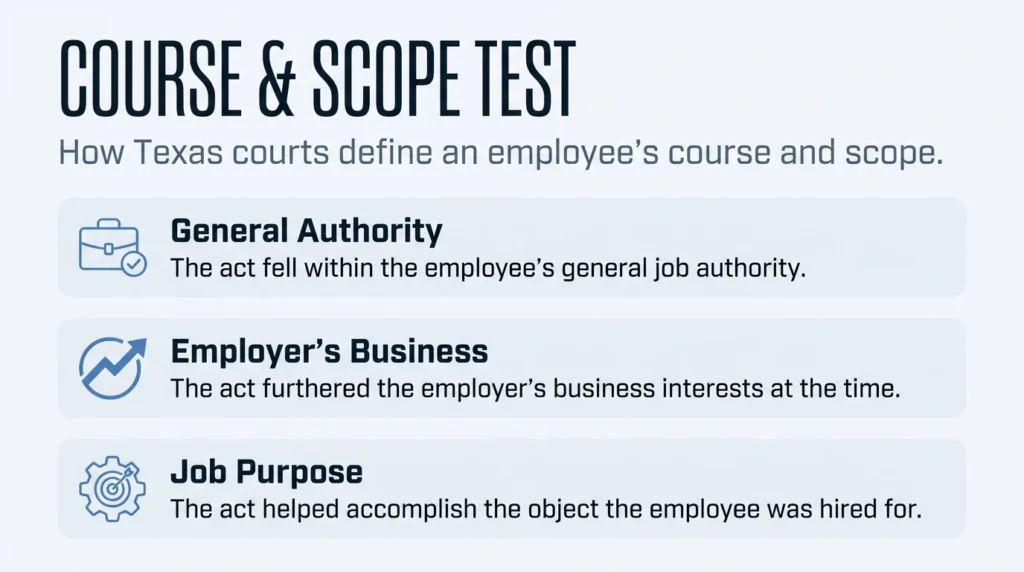
Course and scope means the act fell within the employee’s general authority, in furtherance of the employer’s business, and to accomplish the object for which the employee was hired. Goodyear Tire & Rubber Co. v. Mayes, 236 S.W.3d 754 (Tex. 2007). Courts evaluate both elements based on what was happening when the negligent conduct occurred.
Painter v. Amerimex Drilling I, Ltd., 561 S.W.3d 125 (Tex. 2018) settled step one. Once employment is undisputed, the employer concedes the right to control, so courts do not rerun it task by task. Step two asks objectively whether the employee was doing his job. Amerimex argued that it controlled neither the route nor the vehicle, but the court still allowed the course-and-scope issue to proceed.
An employee who departs from his duties for his own purposes takes the employer off the hook, even if it allowed the personal use.
A genuine independent contractor generally does not make the hiring party responsible under this rule. In cases involving rideshare accident liability in Texas, the analysis may depend on who controls the details and methods of the work.
How the Going & Coming Rule Applies
Under the going and coming rule, an employee is generally not acting within the scope of employment while traveling to or from work. The employer is usually not liable for an ordinary commute crash. Many Texas car accident claims stop there. Painter confirmed the rule applies to vicarious liability, and Texas courts write it as the coming and going rule.
Why the Commute Usually Falls Outside Employment
Traveling to and from work generally serves the employee, not the employer. In Pilgrim, a federal appeals court applying Texas law explained that a commute remains outside the scope of employment unless the travel provides the employer with a special benefit beyond making the employee available for work.
Distance alone does not provide that benefit. The worker in Pilgrim drove roughly six hours on top of a twelve-hour shift, and the rule applied.
The Workers’ Compensation Test
Texas has a separate course-and-scope definition for workers’ compensation claims. The workers’ compensation definition in the Texas Labor Code governs an injured employee’s own benefit claim and carries transportation exceptions that do not control a tort claim.
Goodyear draws that line. Evidence that an employee received workers’ compensation benefits is not competent evidence of tort course and scope.
Four Situations That Can Put the Drive Back Inside Employment
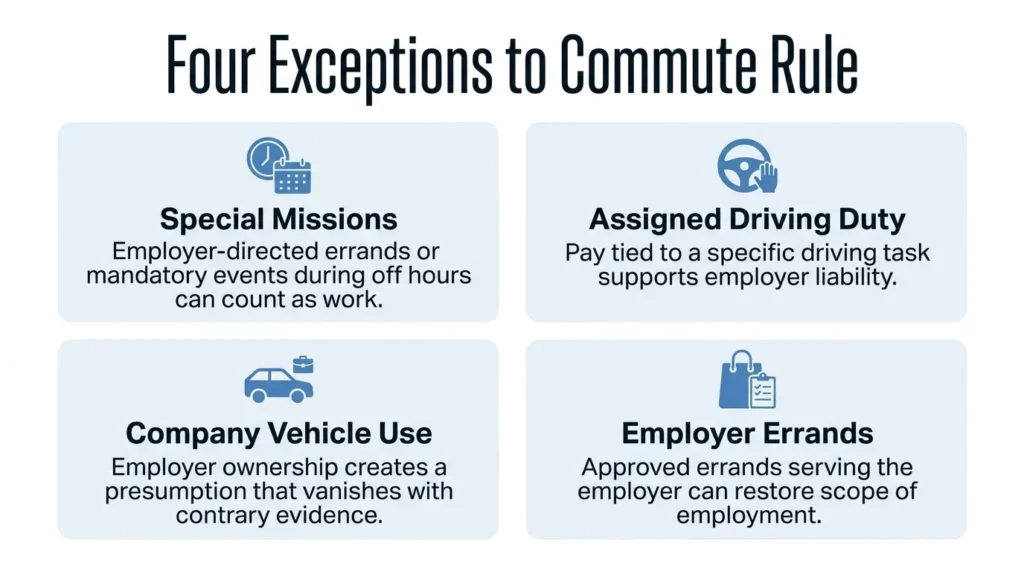
Four situations can bring a commute within the scope of employment, although none does so automatically. Each depends on whether the travel was a regular or specifically assigned duty that benefited the employer.
Special Missions & Assigned Errands
The exception reaches an employee on a special mission at the employer’s direction, or performing a service for the employer’s business with express or implied approval.
Chevron v. Lee calls it travel from home or back on a special errand, as part of regular duties or at the employer’s specific order. A mandatory seminar on a day off, with mileage paid, met that standard. The jury found course and scope, and the appellate court affirmed.
Driving as an Assigned Job Duty With Pay Tied to the Task
Painter involved a drilling contractor that paid a driller a daily bonus to drive the crew to and from a well site. The court found enough evidence for a jury to decide whether the driller was acting within the scope of employment when he crashed while driving the crew back.
The driller was performing an assigned duty that made the entire crew available to the employer. A travel allowance alone does not establish the same connection.
In Pilgrim, the employer paid a daily allowance that crew members rotated among themselves. The employer did not provide transportation or pay employees for their travel time. The court found no special mission.
Payment supports employer liability when it is tied to assigned driving duties that benefit the employer. Mileage reimbursement or a per diem alone may not be enough.
Company Vehicles & the Rebuttable Presumption
Using a company vehicle does not automatically make a commute part of the job. Under the rule discussed in Painter, an employee may still fall outside the scope of employment while traveling to or from work in an employer-owned vehicle.
Employer ownership and an employee driver can initially create a presumption that the employee was acting within the scope of employment. Robertson Tank Lines, Inc. v. Van Cleave, 468 S.W.2d 354 (Tex. 1971). That presumption disappears when the employer presents evidence showing that the employee was on a personal trip.
Goodyear illustrates the limit. The employee was driving a company truck carrying company products and had a delivery scheduled, but he was on a personal errand when the crash happened. The company vehicle alone did not make the employer responsible.
Vehicle ownership is only a starting point when evaluating company vehicle crash settlements.
Errands for the Employer & Personal Detours
A personal detour can take an employee outside the scope of employment. An approved errand that serves the employer may bring the employee within it.
Painter recognized that a meal stop or personal errand could change the analysis. Once the employee returns to the assigned work trip, the employer may become responsible again.
Proving What the Driver Was Doing
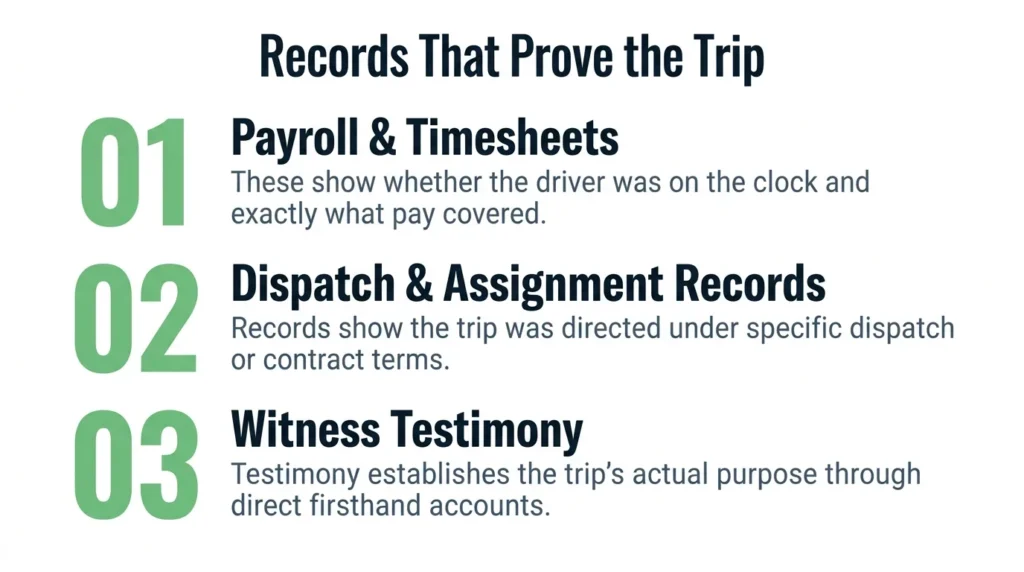
Because the test asks what the driver was doing and why, these cases often depend on employer records and witness testimony.
Three Records That Help Prove the Trip
- Payroll and timesheets showing whether the driver was on the clock and what the pay covered.
- Dispatch, assignment, and contract records showing the trip was directed.
- Testimony establishing the trip’s actual purpose.
Federal rules require a regulated motor carrier to keep drivers’ records of duty status for at least six months, and drivers must carry records covering the previous seven days. Because those records may eventually be destroyed, an early preservation letter can direct the company to retain them after a Texas truck accident.
When Course & Scope Fails
A separate negligent entrustment claim may apply when an employer gives a vehicle to an unlicensed, incompetent, or reckless driver and knew or should have known about the risk.
Goodyear shows that limited driving-history evidence may not be enough. A few old citations, a speeding ticket, and knowledge of long commutes and shifts did not create a sufficient factual dispute in that case.
Talk to a Lawyer About Who Was Responsible
Determining whether the driver was working often requires employer records. Angel Reyes & Associates can identify the employer, request the preservation of payroll, dispatch, and duty-status records, and document the purpose of the trip.
Contact Angel Reyes & Associates for a free consultation.
Past results do not guarantee future outcomes.
Employer Liability FAQs
Can an employer be liable if an employee causes a crash while working from home or between job sites?
Potentially. Under Texas law, liability can depend on whether the employee’s travel was undertaken to perform an assigned work duty or otherwise further the employer’s business at the time of the crash.
What happens if an employee combines a work trip with a personal errand?
A mixed-purpose trip requires a fact-specific analysis of what the employee was doing when the crash occurred. A substantial personal departure may fall outside the scope of employment, while resuming the employer’s assigned task may bring the employee back within it.
Can more than one company be responsible for a working driver's accident in Texas?
Potentially, particularly when staffing companies, contractors, or other businesses are involved. Determining responsibility can require examining the employment relationships and which entity had the relevant right of control.
Does an employer's commercial auto insurance cover an employee who causes an accident?
Coverage depends on the specific insurance policy and circumstances of the trip, so employer liability and insurance coverage are separate questions. A policy may contain provisions addressing covered vehicles, permitted drivers, and business versus personal use.
How long do I have to sue an employer after a work-related car accident in Texas?
Texas generally provides a two-year limitations period for personal injury claims, although exceptions can affect the deadline. Identifying a potentially responsible employer early can also help preserve evidence relevant to the driver’s work assignment.
About the Authors

Angel Reyes
Writer
Angel L. Reyes, III is the Founder and Managing Partner of Angel Reyes & Associates. A nationally recognized trial attorney and business leader, Angel founded the firm in 1993, which has gone on to help over 70,000 injury victims recover more than $1 billion. Named to the Texas Super Lawyers list annually since 2008, Angel brings Wall Street experience, Ivy League education, and a deep commitment to client advocacy. He is a frequent legal commentator and published author with extensive contributions to legal scholarship, trial strategy, and consumer protection.

Kyle Nicolas
Editor
Kyle Nicolas is the Web Content & SEO Manager at Angel Reyes & Associates. He has more than 10 years of experience as a marketing co...

Angel Reyes
Reviewer
Angel L. Reyes, III is the Founder and Managing Partner of Angel Reyes & Associates. A nationally recognized trial attorney and business...