Who Is Liable in a Rideshare Accident in Texas?


Every article on this site is researched by our internal team, reviewed for legal accuracy against current Texas law, and held to State Bar of Texas advertising standards before publication. We do not publish content that overstates outcomes or makes promises about results.
Learn more about our
editorial standards .
Key Takeaways
- Texas rideshare liability depends on the driver's app status at the exact moment of the crash.
- Period 3 unlocks a $1 million commercial policy from the rideshare company for injured riders.
- Texas gives crash victims two years under CPRC § 16.003 to file a rideshare injury lawsuit.
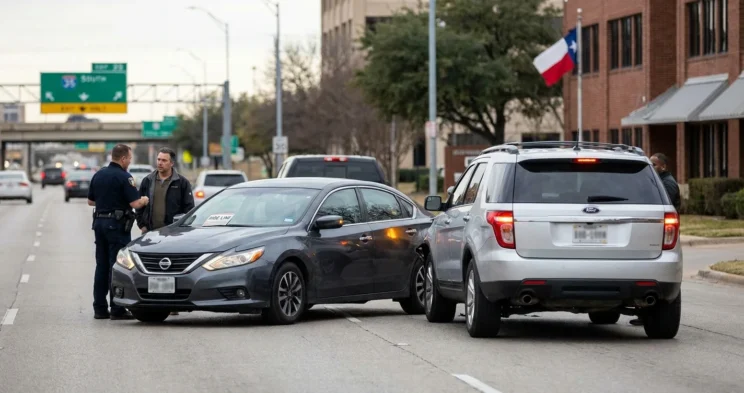
You were heading home from a late dinner in Deep Ellum when your Uber driver glanced at the app and drifted into the next lane on Commerce Street. The other driver swerved, but the impact still threw your head against the window. Now the hospital bills are stacking up, and you have no idea whose insurance is supposed to pay. Is it the driver? Uber? The other car’s policy? Your own?
How App Status Controls Rideshare Liability in Texas
The driver’s status in the app at the moment of the crash decides which insurance applies. Texas law creates three coverage periods: app off, app on but waiting for a ride request, and ride accepted through drop-off. Each period triggers a different insurance layer, and that layer often determines how much money is actually available for your injuries.
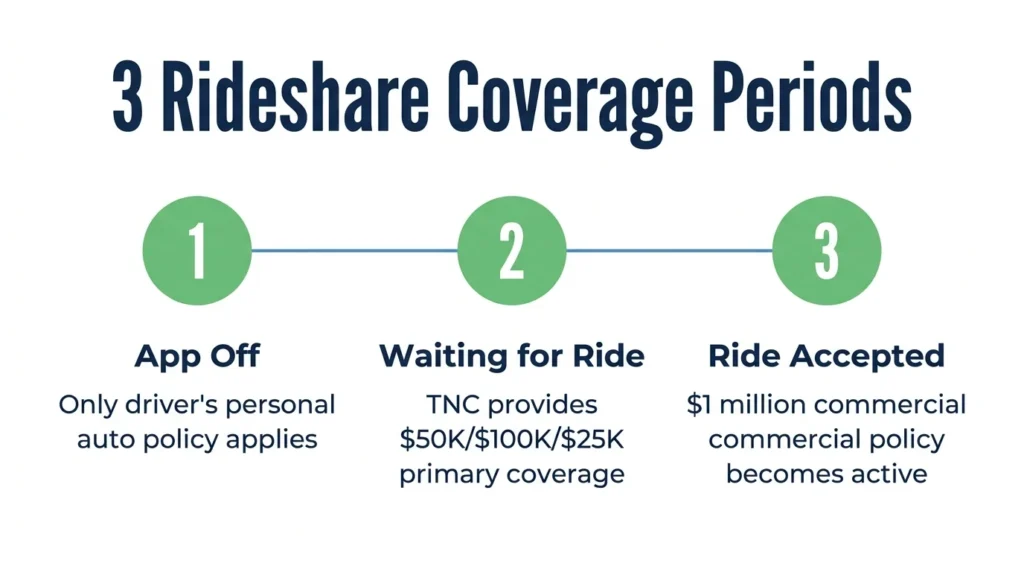
Period 1 is the simplest. The driver’s app is off, the driver is using the car for personal reasons, and only the driver’s personal auto policy applies. No Uber or Lyft coverage activates.
Period 2 begins when the driver logs in and waits for a ride request. Under the Texas Insurance Code Chapter 1954, the rideshare company or its driver must carry primary automobile liability coverage during this period, with minimum limits of $50,000 per person, $100,000 per accident, and $25,000 for property damage.
Period 3 is the most favorable for injured passengers and third parties. Once a ride is accepted and through passenger drop-off, the rideshare company’s $1 million commercial liability policy is active.
Proving which period applied at the moment of impact is its own challenge. App logs, GPS timestamps, and ride-acceptance records carry the answer, and getting them often requires formal legal process through a Texas rideshare accident claim.
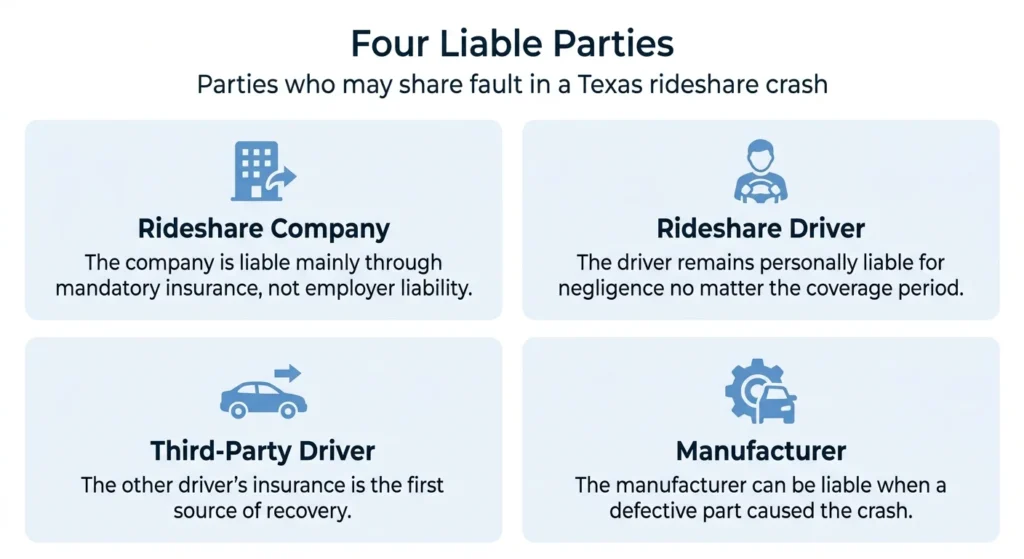
The Rideshare Driver’s Personal Liability
Rideshare drivers owe the same duty of care as every other driver on Texas roads. When they speed, run lights, or stare at the app instead of the road, they can be held personally liable for negligence regardless of which coverage period was active. The insurance layer changes; the driver’s underlying duty does not.
Texas uses a proportionate responsibility rule under the Texas Civil Practice and Remedies Code (CPRC) Chapter 33. Your recovery is reduced by your share of fault. If you are found more than 50 percent at fault, you recover nothing.
When the driver was in Period 1 and carries only minimum-limit personal coverage, that policy may run out fast. Underinsured motorist coverage on your own auto policy can help close the gap.
Distracted driving is a recurring factor in rideshare crashes. In-app navigation, ride requests, and message notifications pull the driver’s attention from the road. The driver’s in-app activity records can directly support a negligence claim, which is why steps to take after a rideshare accident in Texas include preserving that digital trail.
Can You Sue Uber or Lyft Directly in Texas?
Sometimes, but the path is narrow. The Texas Occupations Code Chapter 2402 classifies rideshare drivers as independent contractors, not employees. That classification blocks the standard employer-liability theory most plaintiffs would use. But two direct claims against the company remain viable, and the commercial insurance is still accessible during Periods 2 and 3.
The first direct theory is negligent hiring or retention. If the company failed to run a real background check or kept a driver after learning of disqualifying conduct, that decision can support a claim against the company itself.
The second is direct negligence in the company’s own operations. Decisions about driver vetting, app design, and safety policies belong to the company, not the driver.
Here is the practical part: you do not need to defeat the contractor defense to reach the commercial policy during Period 3. The $1 million layer exists by statute. Negligent hiring is a separate, higher bar, and it is worth pursuing when background screening failures are documented. For platform-specific patterns, see this Uber accident settlement and insurance guide and this overview of average Lyft accident settlement amounts.
When Third Parties & Manufacturers Bear Liability
Not every rideshare crash is the rideshare driver’s fault. Other drivers cause many of these wrecks, and defective vehicle components cause others. Both create separate recovery paths that run alongside any claim against the driver or the rideshare company. Identifying every liable party early is often what separates a fully paid claim from a partial one.
Third-Party Driver Fault
When another driver caused or contributed to the crash, that driver’s personal liability policy is the first recovery source against them. Under CPRC Chapter 33, fault can be allocated across multiple defendants in the same case. A third-party driver and the rideshare driver can each be assigned a share.
If the third-party driver is uninsured or underinsured, the rideshare driver’s policy or the company’s contingent coverage may step in, depending on app status. Passengers can also tap their own uninsured motorist coverage.
Product Liability Against a Manufacturer
A brake failure, tire blowout, airbag defect, or unfixed recall can cause or worsen injuries in a rideshare crash. When that happens, the vehicle or parts manufacturer may be liable under strict liability, negligence, or warranty theories.
Product liability claims do not require proof that any driver was at fault. They run on a separate track and can add real value when mechanical failure played a role, as some of our recent case results show.
Texas Filing Deadlines for Rideshare Injury Claims
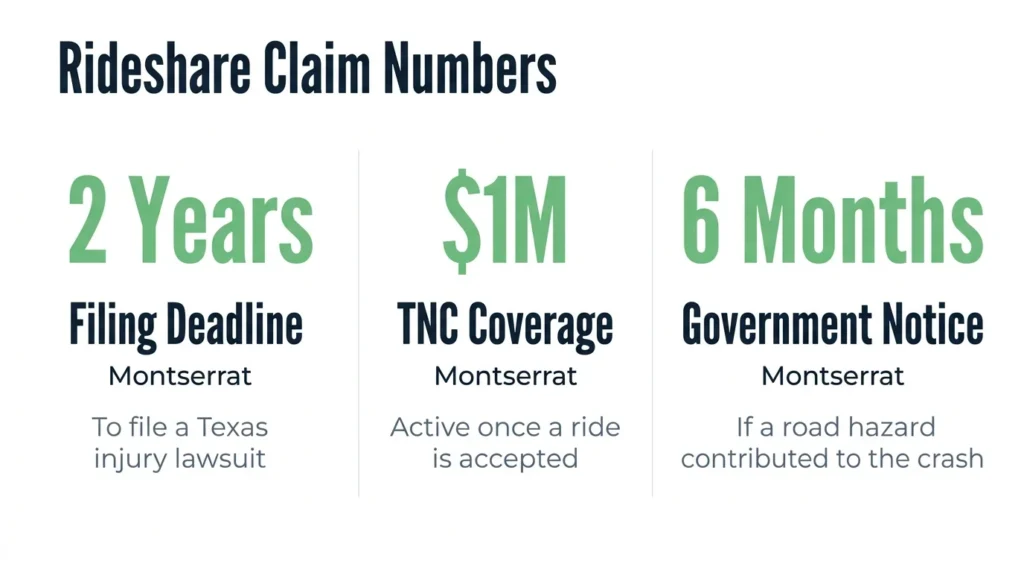
Texas gives you two years from the crash date to file a personal injury lawsuit under CPRC § 16.003. Miss it and the claim is gone, no matter how strong it would have been. Rideshare cases involve more moving parts than a typical crash, and that two-year window closes faster than most people expect.
If a government entity contributed to the crash through a road hazard or signage issue, the deadline is much shorter. Written notice to the agency is generally required within six months under CPRC Chapter 101.
App-status evidence is the other clock to watch. Ride logs, GPS data, and acceptance records sit on rideshare company servers and are subject to retention schedules. Once overwritten, they are gone.
Sending preservation demands and legal holds early protects the digital evidence your case will need. Coverage disputes, multiple defendants, and product investigations all benefit from the involvement of experienced Texas injury attorneys before deadlines tighten.
Talk to a Texas Rideshare Accident Attorney
Rideshare claims involve overlapping insurance layers, contractor defenses, and tight evidence windows that most injured passengers should not handle alone. Angel Reyes & Associates has decades of experience handling Texas injury claims and has recovered significant compensation for clients across a wide range of cases.
We work on contingency, meaning no fee unless we win, and offer free consultations in English and Spanish. Contact us today to talk through what happened and what your claim is worth.
Past results do not guarantee future outcomes.
FAQs
Does Texas require rideshare companies to carry uninsured motorist coverage for passengers?
Texas Insurance Code Chapter 1954 does not require TNCs to provide uninsured motorist coverage as part of their Period 2 or Period 3 policies. Injured passengers who want that protection typically need to carry their own uninsured motorist coverage through a personal auto policy.
Can a rideshare passenger be found partially at fault for their injuries in Texas?
Yes. Texas proportionate responsibility rules apply to all parties in a crash, including passengers. A passenger who contributed to their own injuries, such as by interfering with the driver, could see their recovery reduced by their assigned percentage of fault.
Does health insurance have to be paid back if it covers a Texas rideshare injury?
If your health insurer pays your medical bills after a rideshare crash, it may have a subrogation right to seek repayment from any settlement or judgment you receive. The specific rules depend on your plan type, and some federal plans have stronger subrogation rights than private Texas plans.
What happens to a rideshare injury claim if the at-fault driver dies after the crash?
The claim does not disappear. Under Texas law, a personal injury claim can be pursued against the deceased driver’s estate. If the estate has limited assets, the available insurance policies become the main recovery source.
Can a minor who is injured as a rideshare passenger file a claim in Texas?
Yes, but the two-year statute of limitations is paused until the minor turns 18 under Texas Civil Practice and Remedies Code Section 16.001. A parent or guardian can also file a claim on the child’s behalf before that point.
About the Authors

Angel Reyes
Writer
Angel L. Reyes, III is the Founder and Managing Partner of Angel Reyes & Associates. A nationally recognized trial attorney and business leader, Angel has helped over 70,000 injury victims recover more than $1 billion since founding the firm in 1993. Named to the Texas Super Lawyers list annually since 2008, Angel brings Wall Street experience, Ivy League education, and a deep commitment to client advocacy. He is a frequent legal commentator and published author with extensive contributions to legal scholarship, trial strategy, and consumer protection.

Kyle Nicolas
Editor
Kyle Nicolas is the Web Content & SEO Manager at Angel Reyes & Associates. He has more than 10 years of experience as a marketing co...

Angel Reyes
Reviewer
Angel L. Reyes, III is the Founder and Managing Partner of Angel Reyes & Associates. A nationally recognized trial attorney and business...