What If the Driver Who Hit You Fled the Scene?


Every article on this site is researched by our internal team, reviewed for legal accuracy against current Texas law, and held to State Bar of Texas advertising standards before publication. We do not publish content that overstates outcomes or makes promises about results.
Learn more about our
editorial standards .
Key Takeaways
- Texas law treats an unidentified hit-and-run driver as an uninsured motorist.
- UM coverage requires a police report and actual contact with the fleeing vehicle.
- Notify your carrier promptly in writing; Texas gives you two years to file suit.
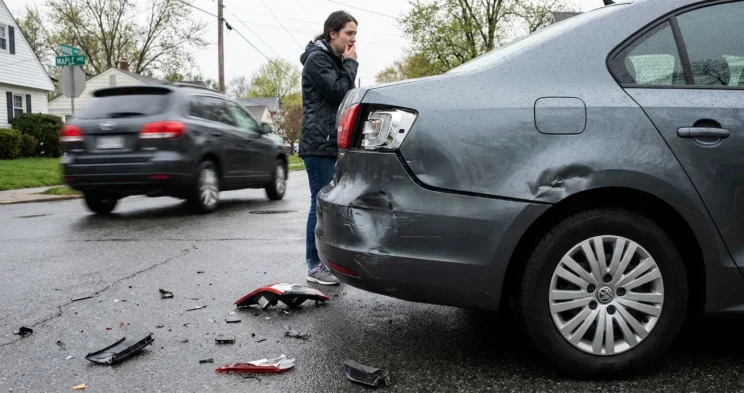
In Texas, a driver who leaves a crash that injures someone has committed a crime.
When the driver is never identified, Texas law treats that driver as uninsured, and your own uninsured/underinsured motorist coverage becomes the realistic path to payment.
Two clocks start running the moment the other car pulls away. One is the police investigation window, while the vehicle can still be identified. The other is the notice condition inside your own policy.
Leaving the Scene Is a Crime in Texas, & the Criminal Case Still Will Not Pay Your Bills
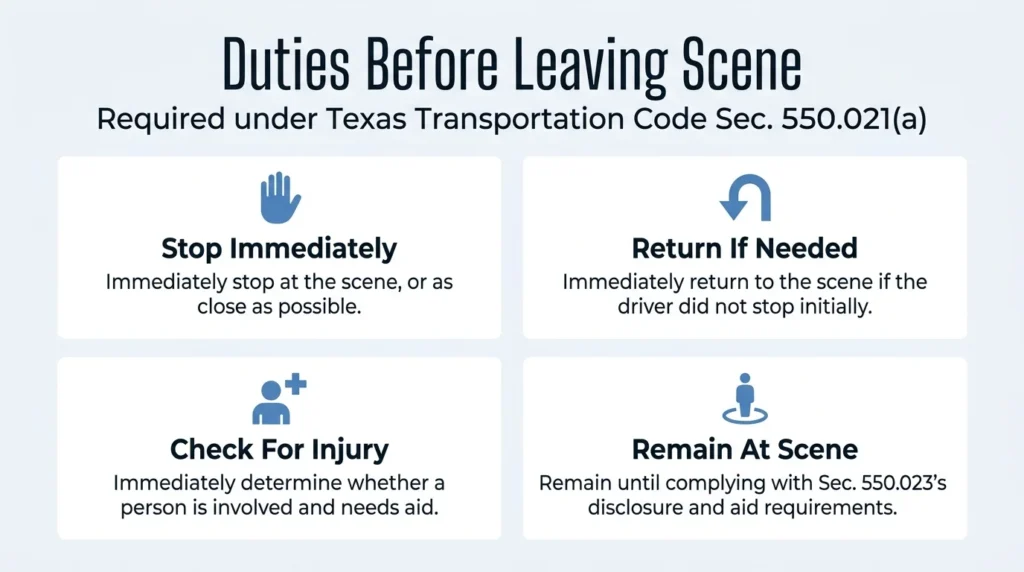
A driver who leaves a crash that causes or is reasonably likely to cause injury or death commits a criminal offense under Texas Transportation Code Sec. 550.021, titled “Collision Involving Personal Injury or Death.”
Sec. 550.023 explains what a driver must do before leaving the scene. The driver must provide their name, address, vehicle registration number, and insurance information. They must also show their driver’s license if requested and arrange transportation for medical care when necessary or requested.
The state can prosecute the driver who fled. The state does not write you a check. Recovery after a hit-and-run accident in Texas runs through insurance rather than the criminal docket, which is where a car accident claim begins.
When the Driver Is Never Found, Your Own Uninsured Motorist Coverage Is the Path to Payment
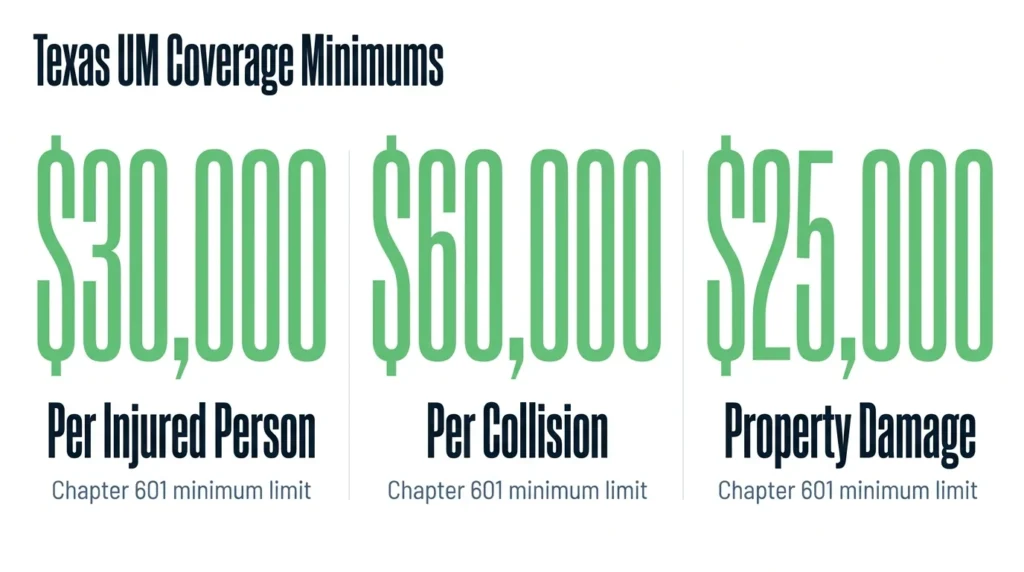
If the driver is never identified, Texas law generally treats them as an uninsured motorist. You may then be able to seek payment based on how UM/UIM coverage applies in hit-and-run accidents.
Under Insurance Code Sec. 1952.101, Texas insurers must offer UM/UIM coverage with an auto liability policy. A named insured may reject the coverage in writing, so you can check your declarations page or policy documents to see whether you have it.
Two conditions are especially important in a hit-and-run claim. You must report the crash to the police, and the unknown driver’s vehicle must have made physical contact with you or your property.
The Texas Department of Insurance states that UM/UIM pays in a hit-and-run accident. It also states that your uninsured motorist coverage “won’t pay for a hit-and-run accident if you didn’t report it to police.” The physical-contact condition comes from Insurance Code Sec. 1952.104, which requires three provisions in every UM/UIM policy:
- For a claim involving an unknown motorist, actual physical contact must have occurred between the vehicle owned or operated by the unknown person and the person or property of the insured.
- An aggregate-limits provision capping total liability to any one person at the stated policy limit.
- An exclusion for damages arising from the insured’s own intentional acts.
The physical-contact requirement applies alongside the police-report condition. It may cover a crash in which the other vehicle struck you and drove away. However, it can prevent coverage when a “phantom vehicle” forces you off the road without making contact.
Clock 1: The Police Investigation Window
Police have the best chance of identifying the vehicle shortly after the crash. If you are able, call them before leaving the scene.
Sec. 550.026 requires an involved operator to report the collision immediately by the quickest means of communication, and the Texas Department of Insurance conditions UM payment on that police report. Reporting is one of the two conditions a hit-and-run UM claim rests on, alongside the actual physical contact required by Sec. 1952.104(3).
Under Transportation Code Sec. 550.062, a peace officer investigating a collision in the regular course of duty must make a written report when it resulted in injury to or the death of a person, or damage to the property of any one person to the apparent extent of $1,000 or more.
Nearby businesses, homes, doorbell cameras, and traffic cameras may have recorded the vehicle, but those systems overwrite on their own schedules, and nobody in your claim controls them. A canvass run in the first days finds footage that a canvass run weeks later does not.
Then there is the physical evidence sitting on your own car. Paint transfer, broken trim, and debris at the scene can point investigators toward a manufacturer and a range of makes, models, and years. It disappears the moment the vehicle is washed or repaired, so photograph everything before you authorize any work.
Knowing what to do after a hit-and-run accident in Texas can help you preserve evidence before footage is erased or your vehicle is repaired.
Clock 2: The Notice Deadline in Your Own Policy
No Texas statute sets an hour count for telling your own insurer about a hit-and-run. The duty comes from your policy, which requires prompt notice in language that varies from carrier to carrier.
Give that notice promptly and in writing. Two different deadlines may apply:
- Your policy’s notice condition. Contractual, worded by your carrier, with no fixed statutory hour count behind it.
- The statutory suit deadline. Fixed by law at two years from the day the cause of action accrues under Civil Practice and Remedies Code Sec. 16.003(a).
If you have already waited to provide notice, you may still have a claim. However, delays can make it harder to identify the fleeing vehicle and preserve evidence.
Once you provide notice, the insurer also has deadlines to follow. Under Insurance Code Sec. 542.055, the carrier generally has 15 days after receiving notice to acknowledge the claim, begin its investigation, and request the information it needs. An eligible surplus lines insurer has 30 business days.
Sec. 542.056 generally requires the insurer to accept or reject the claim within 15 business days after receiving all requested information. If the insurer needs more time, it must notify you within that period and then has up to 45 additional days to make its decision.
Sec. 16.003(b) also provides a two-year filing period when an injury results in death. The deadline for a wrongful death claim begins on the date the injured person dies.
What If You Have No Uninsured Motorist Coverage at All?
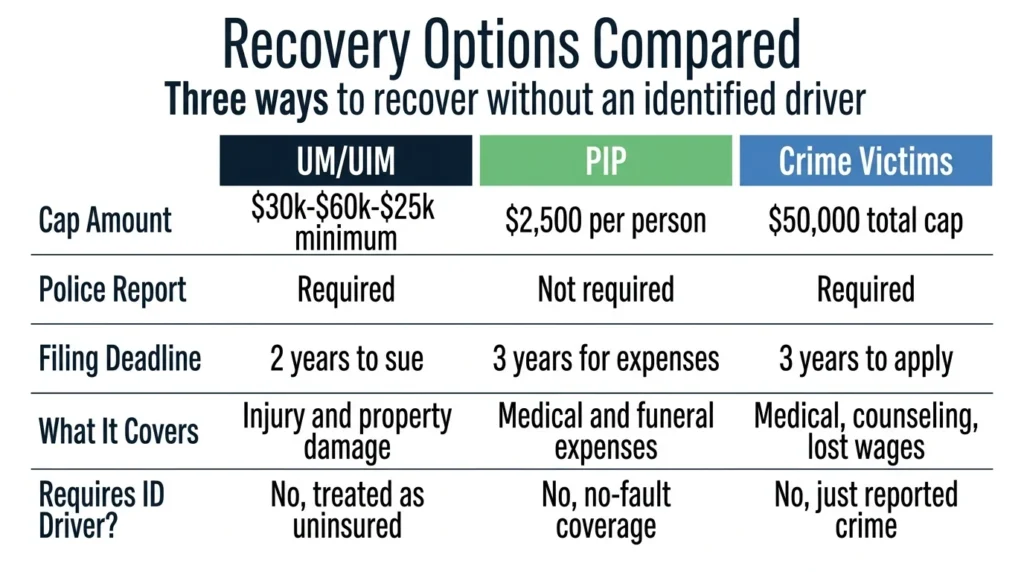
If you can’t identify the fleeing driver and you don’t have UM coverage, recovering compensation may be more difficult. Personal injury protection and the Texas Crime Victims’ Compensation program may provide limited assistance.
Personal Injury Protection on Your Own Policy
Personal injury protection (PIP) is another type of coverage Texas insurers must offer. Under Insurance Code Sec. 1952.152, an auto liability policy must include PIP unless a named insured rejects it in writing.
PIP is no-fault, so it does not depend on anyone identifying the driver who hit you. Sec. 1952.151 covers reasonable expenses arising from the accident and incurred within three years, including medical care and lost income.
Sec. 1952.153 does not require PIP coverage exceeding $2,500 for all benefits, in the aggregate, for each person. Medical expenses can quickly exceed that amount.
Texas Crime Victims’ Compensation
Hit-and-run is a listed qualifying crime under the Texas Crime Victims’ Compensation program. The crime must be reported to the appropriate law enforcement agency, and the claimant must cooperate with the investigation.
Applications generally must be filed within three years of the crime, although that period may be extended for good cause. Total compensation is capped at $50,000.
Before assuming that UM or PIP coverage is unavailable, check your declarations page and policy records to see whether either type of coverage was rejected in writing.
Talk to Angel Reyes & Associates About Your Hit-and-Run Claim
A hit-and-run claim may depend on whether the other vehicle made physical contact, whether the crash was reported to police, and how quickly you notified your insurer. Your policy records can also show whether UM or PIP coverage was rejected in writing.
Angel Reyes & Associates offers free consultations to review your policy, the available evidence, and your options for seeking compensation. Contact Angel Reyes & Associates to discuss your claim. Every case is different.
Past results do not guarantee future outcomes.
Texas Hit-and-Run FAQs
Someone hit my parked car and drove off. Is that the same offense?
No. A driver who strikes an unattended vehicle falls under a different section. Transportation Code Sec. 550.024 requires that driver to stop and either locate the owner or leave a conspicuous written notice giving the operator’s name and address and the circumstances of the collision.
When can I get the crash report, and what does it cost?
Under Transportation Code Sec. 550.062, the investigating officer’s written report must be filed electronically with the department no later than the 10th day after the date of the collision. TxDOT sells copies through its Crash Report Online Purchase System at $6 for a regular copy and $8 for a certified copy, plus a system surcharge and possible credit card processing fees. Certified copies are the ones required for legal proceedings.
Who am I supposed to report the crash to if it didn't happen in a city?
Transportation Code Sec. 550.026 routes the immediate report by location. Report to the local police department if the collision happened inside a municipality, to the local police department or the county sheriff if it happened within 100 feet of a municipality’s limits, and otherwise to the county sheriff or the nearest office of the Department.
Does a deductible apply to an uninsured motorist claim, and does the coverage reach my vehicle as well as my injuries?
Yes, regarding the deductible. The Texas Department of Insurance states that the deductible for uninsured/underinsured coverage is $250, and that a deductible applies to collision, comprehensive, and UM/UIM claims but not to a claim made against another driver’s insurance. The coverage does reach both. Insurance Code Sec. 1952.101(a) defines UM/UIM coverage as protecting insureds legally entitled to recover for bodily injury, sickness, disease, death, or property damage, so vehicle damage sits inside the same coverage as your injuries.
About the Authors

Angel Reyes
Writer
Angel L. Reyes, III is the Founder and Managing Partner of Angel Reyes & Associates. A nationally recognized trial attorney and business leader, Angel founded the firm in 1993, which has gone on to help over 70,000 injury victims recover more than $1 billion. Named to the Texas Super Lawyers list annually since 2008, Angel brings Wall Street experience, Ivy League education, and a deep commitment to client advocacy. He is a frequent legal commentator and published author with extensive contributions to legal scholarship, trial strategy, and consumer protection.

Graham Griffin
Editor
Graham Griffin is the Web & Content Manager at Angel Reyes & Associates, where he oversees content strategy, AI-powered workflows, a...

Angel Reyes
Reviewer
Angel L. Reyes, III is the Founder and Managing Partner of Angel Reyes & Associates. A nationally recognized trial attorney and business...