How Do You Request Medical Records in Texas?


Every article on this site is researched by our internal team, reviewed for legal accuracy against current Texas law, and held to State Bar of Texas advertising standards before publication. We do not publish content that overstates outcomes or makes promises about results.
Learn more about our
editorial standards .
Key Takeaways
- Send a dated written request and keep proof of delivery, fees, and every provider reply.
- Ask each provider for clinical records and existing itemized billing records by name.
- Check which deadline applies, then confirm the delivery matches the scope and format asked.
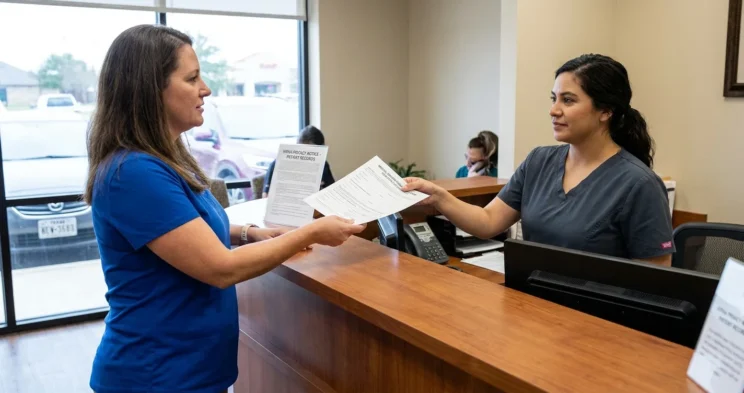
To request medical records in Texas, send each hospital, doctor’s office, and separate billing provider a clear written request for your own records. Ask for your clinical records and your itemized billing records by name, and keep every reply. Texas law, federal HIPAA rules, or both can set the timing and fees, depending on who holds the records and how they keep them.
How to Send a Texas Medical Records Request
After an injury, start with a written request to every place that treated or billed you. A hospital and the doctors who treated you there may keep separate records. The Texas Medical Board treats hospital-held records separately from physician records:
- List every record holder. Include the hospital, each treating physician’s office, and any provider that sends its own bill. Ask each one for its records or privacy contact.
- Identify yourself. Give your full name, date of birth, treatment dates, and contact details. Follow reasonable identity-verification instructions. If you are requesting someone else’s records, ask what proof of authority the provider needs.
- Describe the clinical records. Name the date range and the documents you need. These may include visit and emergency notes, discharge records, procedure reports, test results, and imaging reports. An imaging report differs from the images themselves, so ask for the image files too when you need them. Ask what the patient portal leaves out instead of assuming a download is complete.
- Ask for billing records separately. Request existing itemized statements and account ledgers showing service dates, charges, payments, adjustments, and balances where the provider keeps them. Ask whether the billing office needs a separate request. Request existing records; the provider need not create a custom report.
- Choose the format and delivery. Say whether you want paper or electronic copies and where the provider should send them.
- Ask for a fee estimate and confirmation. Request written confirmation of receipt and notice of any fee before processing. The Texas Medical Board suggests certified mail with return receipt as one way to document delivery. Keep a copy of everything you send.
Consider the following sample to help you:
“Please provide copies of my clinical records for [dates], including [items], in [format] sent to me at [destination]. Separately, please provide my existing itemized billing statements and account ledger for those dates. Please confirm receipt and advise me of any copying fee before processing.”
Which Deadline Applies to Your Request?
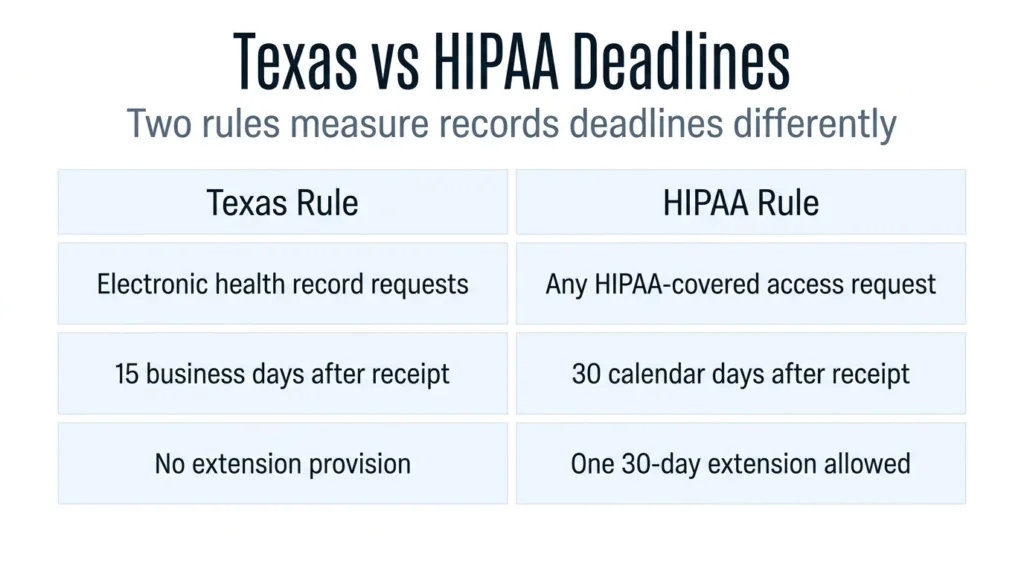
The deadline depends on who holds your records, how they store them, and what you asked for. Two rules cover many patient requests, and they measure time differently.
| Rule | What it covers | Clock |
| Texas Health and Safety Code §181.102(a) | Your written request for your own electronic health record, sent to a provider whose electronic system can fulfill it | 15th business day after receipt |
| HIPAA, 45 CFR §164.524 | An access request to a HIPAA-covered entity | 30 calendar days after receipt, with one possible extension |
Under Texas Health and Safety Code §181.102(a), the provider must deliver the record electronically unless you agree to another form. This Texas rule has a narrow scope. It does not automatically govern paper records, billing requests, or requests to send records to someone else.
Under 45 CFR §164.524, a covered entity may take one extension of up to 30 more days. It must give you written reasons and a completion date within the first 30 days. A simple “we received your request” does not satisfy the access duty.
HIPAA also protects your choice of format when the provider can readily produce it. If the provider keeps your records electronically and you ask for electronic copies, it must provide them in your requested format or an agreed readable electronic alternative. A summary instead of full records requires your advance agreement, including any fee.
According to HHS, HIPAA access covers medical and billing records held by covered providers and health plans. An unpaid treatment bill does not justify withholding your copy. Psychotherapy notes kept separately form a narrow exception. That exception does not make all mental health records off-limits.
HIPAA’s timeline works as a federal outer limit. The federal extension does not automatically extend a faster Texas electronic-record clock that applies to your request.
What Can a Provider Charge for Copies?
When you request your own records under HIPAA, the provider may charge only a reasonable, cost-based fee. Allowable costs include copying labor, eligible supplies or media, postage you request, and a summary you agreed to in advance.
A Texas fee schedule does not change that limit. HHS explains that a state schedule cannot authorize search or retrieval charges for your own access request. A state maximum is not automatically a reasonable fee. You may also see a $6.50 figure mentioned. HHS clarifies that it is one optional flat-fee method for electronic copies of electronically kept records, not a universal cap.
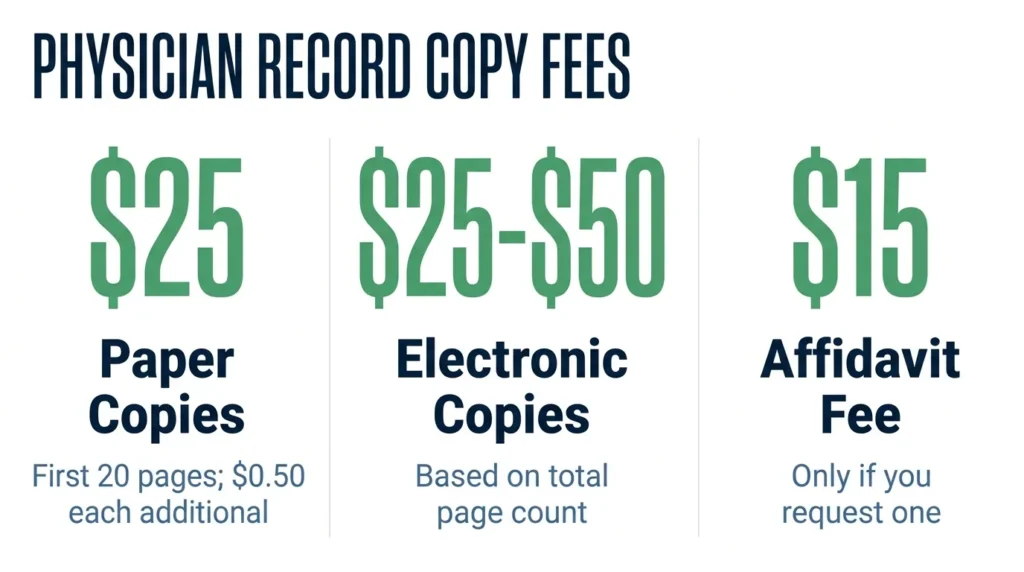
The Texas Medical Board’s published fee guidance lists these ceilings for physician records:
- Paper copies: $25 for the first 20 pages, plus $0.50 for each additional page
- Electronic copies: $25 for 500 pages or fewer, and $50 for more than 500 pages
- Requested affidavit: up to $15
Those are ceilings, not required charges. HIPAA may allow a lower fee for your own request, and an affidavit fee applies only when you ask for one.
Hospital fees follow a different framework. Ask the hospital for an itemized quote that explains the basis for each charge, and ask whether HIPAA’s patient-access rules apply.
Who receives the records matters too. HHS’s notice following the Ciox decision states that HIPAA’s patient fee limit does not apply when you direct a provider to send records straight to a third party, such as a lawyer. Your own-copy protections stay intact.
What to Do When the Request Stalls or Records Are Missing
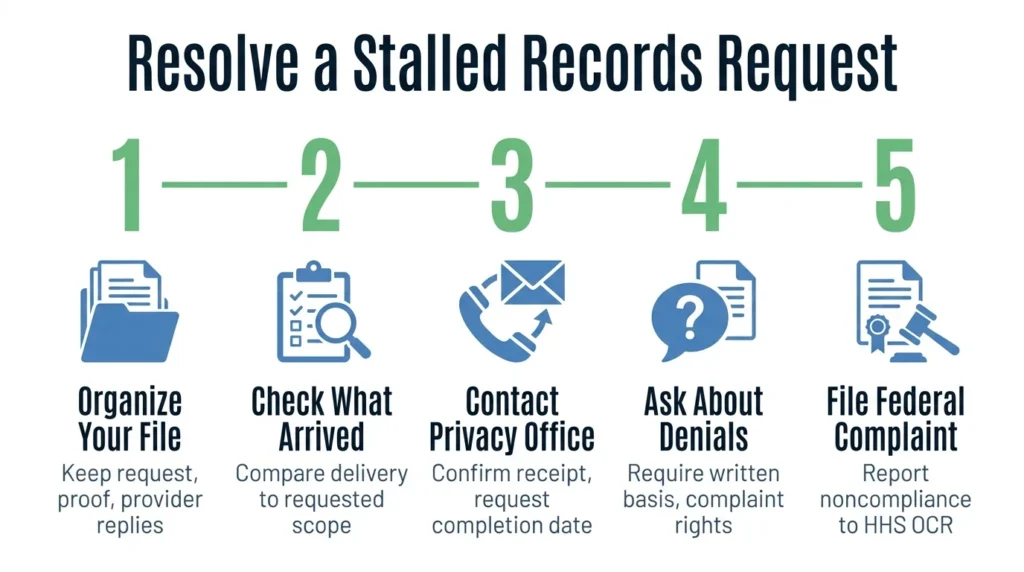
When a request stalls, follow up in writing against the rule that applies and build a dated paper trail.
Keep your written request, the provider’s response date, and the delivered records together:
- Organize your file. Keep the original request, proof of submission or delivery, any fee estimate, the provider’s response date, later letters or emails, and the files received.
- Check what arrived. Compare the delivery against the scope and format you requested. Note missing dates, images, or billing pages.
- Contact the records or privacy office. Ask them to confirm receipt, identify any missing identity or authority document, and give a specific completion date. Save each reply instead of starting over with a new undocumented request.
- Ask about any denial in writing. Under HIPAA, a denial must explain its basis and your complaint rights. Certain safety or harm denials carry review rights. The provider should still release the records the denial does not cover.
- Consider a federal complaint. If a HIPAA-covered entity fails to comply, you can file a written complaint with the HHS Office for Civil Rights. The complaint should identify the entity and what happened. You generally must file within 180 days of when you knew about the problem, though OCR may extend that period for good cause. Attach your request, delivery proof, and the provider’s correspondence.
A complaint does not guarantee a particular result or timeline. It does create a formal record of the problem.
When to Ask for a Records Custodian’s Certification
Getting copies for yourself and preparing evidence for an injury claim are two different tasks. If your records may support a claim, ask whether the provider’s records custodian can supply an appropriate business-record affidavit or declaration with the identified records.
Texas Rules of Evidence 902(10) and 803(6) provide a self-authentication route for qualifying business records. That route has its own foundation and service requirements. A generic “certified” stamp does not guarantee a court will admit the records.
The custodian’s affidavit explains how the provider made and kept the records. It does not prove the accident caused your injuries, that every charge is recoverable, or what your claim is worth. The same rules’ commentary points to separate expense-affidavit provisions in the Texas Civil Practice and Remedies Code §§18.001–18.002, which serve a different purpose.
An attorney can decide which certification fits and when to request it.
Talk With Angel Reyes & Associates About Your Records & Injury Claim
Your records and bills can shape how an injury claim is evaluated. You don’t have to sort through them alone. Angel Reyes & Associates has guided injured Texans for over 30 years and can review what you’ve gathered during a free consultation.
Bring your written requests, delivery proof, the providers’ dated responses, your clinical and billing files, and any custodian certification or denial letter. Contact Angel Reyes & Associates for a free consultation to talk through your options.
Past results do not guarantee future outcomes.
Texas Medical Record Request FAQs
Can you request medical records for a deceased family member in Texas?
Access is not automatically available simply because you are a relative; the provider may require proof that you are the personal representative or otherwise legally authorized to obtain the deceased person’s records.
Can a parent request a child's medical records in Texas?
A parent or legal guardian may generally have access to a minor’s medical records, but Texas and federal law recognize exceptions based on the minor’s treatment, the parent’s legal authority, and the type of records requested.
Can you request medical records from an urgent care clinic in Texas?
Yes. An urgent care clinic that maintains your records should be included among the providers you contact, particularly when treatment there is relevant to an injury or ongoing medical condition.
About the Authors

Angel Reyes
Writer
Angel L. Reyes, III is the Founder and Managing Partner of Angel Reyes & Associates. A nationally recognized trial attorney and business leader, Angel founded the firm in 1993, which has gone on to help over 70,000 injury victims recover more than $1 billion. Named to the Texas Super Lawyers list annually since 2008, Angel brings Wall Street experience, Ivy League education, and a deep commitment to client advocacy. He is a frequent legal commentator and published author with extensive contributions to legal scholarship, trial strategy, and consumer protection.

Graham Griffin
Editor
Graham Griffin is the Web & Content Manager at Angel Reyes & Associates, where he oversees content strategy, AI-powered workflows, a...

Angel Reyes
Reviewer
Angel L. Reyes, III is the Founder and Managing Partner of Angel Reyes & Associates. A nationally recognized trial attorney and business...