Can a Contractor Sue the Property Owner?


Every article on this site is researched by our internal team, reviewed for legal accuracy against current Texas law, and held to State Bar of Texas advertising standards before publication. We do not publish content that overstates outcomes or makes promises about results.
Learn more about our
editorial standards .
Key Takeaways
- Chapter 95 can apply when the injury comes from the same improvement you were working on.
- Under Chapter 95, prove owner control, actual knowledge, and an inadequate warning.
- Save contracts, site rules, owner messages, and hazard reports before they disappear.

Yes, a contractor, subcontractor, or their employee can sometimes sue a Texas property owner. An injury on the owner’s property is not enough on its own. Chapter 95 of the Texas Civil Practice and Remedies Code sets specific requirements for many of these claims.
When Chapter 95 applies, § 95.003 allows recovery only if the owner retained or exercised control over how the work was done and had actual knowledge of the danger and failed to warn adequately.

When Can an Injured Contractor Sue a Texas Property Owner?
Whether you can sue depends on whether Chapter 95 covers the owner, the work, and the condition that caused your injury. If it applies, you must meet its requirements. Otherwise, other negligence rules determine whether the owner is liable.
Property Owners Chapter 95 Covers
§ 95.001 defines a protected property owner as a person or entity that owns real property primarily used for commercial or business purposes. That definition does not automatically cover every private homeowner.
A residential rental project may qualify. In Los Compadres Pescadores, L.L.C. v. Valdez, the property was intended for rental apartments.
Claims Chapter 95 Covers
§ 95.002 ties the claim to the condition or use of the same improvement the contractor was constructing, repairing, renovating, or modifying. In Energen Resources Corp. v. Wallace, the Texas Supreme Court explained that an accident at a workplace location is not enough. The negligence that caused the damage must involve the condition or use of that improvement.
Courts examine how the equipment and work are connected. In Ineos USA, LLC v. Elmgren, the court treated interconnected processing equipment as a single improvement. In Energen, gas entering a water well under construction was a condition of that well, even though nearby oil drilling contributed. A danger originating elsewhere can still fall under Chapter 95.
The statute can also cover a negligent hiring claim. In Endeavor Energy Resources, L.P. v. Cuevas, Chapter 95 applied because the contractor’s negligent use of the improvement helped cause the injury.
When Chapter 95 Does Not Apply
If Chapter 95 does not apply, other negligence and Texas premises liability rules determine whether the owner is liable. A personal injury claim still requires proof of duty, breach, causation, and damages.
What Control Must the Property Owner Have Over the Work?
Chapter 95 requires proof that the owner retained or exercised control over how the relevant work was performed. Under § 95.003 and Energen, the right to start or stop work, inspect progress, or receive reports is not enough.

Contract Rights & Job-Site Directions
The owner may reserve control in the contract or exercise it through job-site directions. That control must extend to the means, methods, or details of the work that caused the injury.
Review the owner-contractor agreement alongside instructions the owner or its agent gave workers.
Safety Rules Alone May Not Prove Control
Many owners publish safety manuals, staff safety personnel, and require work permits. Those measures do not automatically prove control over the injury-causing task.
In Dow Chemical Co. v. Bright, a common-law decision cited in Energen, the court examined the instructions and how the safety rules were applied. Evidence of who enforced a rule and how it affected the crew’s work can help establish control.
How an Owner’s Directions Can Show Control
In Los Compadres, the owner’s agent directed the work sequence and instructed the contractor to continue working near an energized power line. Based on the evidence, the Texas Supreme Court upheld liability.
An instruction to keep working does not establish control on its own.
What Must the Property Owner Know About the Danger?
When Chapter 95 applies, the owner must actually know of the specific danger that caused the injury and fail to warn adequately. What the owner should have discovered through a reasonable inspection is not enough. Control alone does not prove knowledge.
Actual Knowledge of the Specific Danger
Circumstantial evidence can establish actual knowledge, but it must show the owner was aware of the specific danger before the injury.
In Ineos, the owner’s general knowledge of explosive materials at the facility, its general procedures, and another incident did not establish awareness of gas in the particular line being worked on.
Can Earlier Hazard Reports Help?
Earlier complaints or incident reports can support a claim. Their value depends on what they said, when they were made, who received them, and whether they concern the condition that hurt you.
A written report about the exact hazard shortly before the injury can provide stronger evidence than a vague complaint about another area of the plant.
Did the Worker Understand the Danger?
A generic warning may not adequately explain the risk.
In SandRidge Energy, Inc. v. Barfield, the court applied the open-and-obvious danger doctrine, finding that the worker fully appreciated the hazard of energized equipment.
In Los Compadres, seeing a power line did not establish that the worker knew it was energized. The court examined whether the worker understood the danger the visible line posed.
What Evidence Can Support Your Claim?
Contracts, instructions, hazard reports, and warnings can help show the owner’s control over the work and knowledge of the danger.
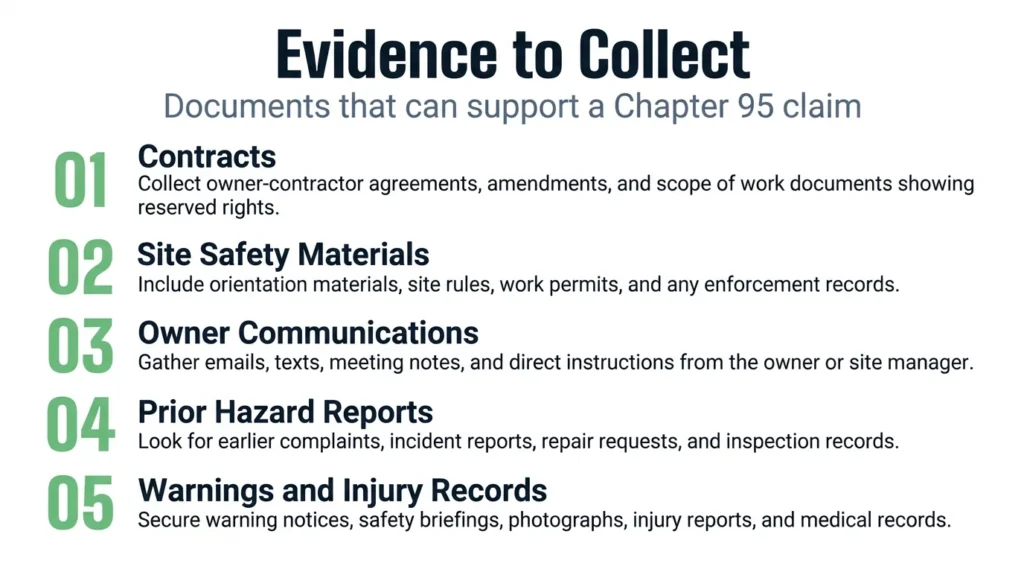
1. Collect the contracts. Find the owner-contractor agreement, amendments, scope of work, and any relevant subcontract. These show what rights the owner reserved over work methods.
2. Gather site safety materials. Keep orientation materials, site rules, work permits, and any enforcement records. These help show who applied which rule to your task.
3. Save owner communications. Preserve emails, texts, meeting notes, and direct instructions from the owner or site manager, along with witness names. These help identify who gave directions and whether that person acted for the owner rather than an independent contractor.
4. Look for prior hazard reports. Earlier complaints, incident reports, repair requests, inspection records, and messages acknowledging receipt can connect the owner’s awareness to the specific danger.
5. Document warnings and the injury. Keep warning notices, safety briefing records, photographs, the injury report, and medical records. These show what you were told, what you understood, and how the incident caused harm.
6. Preserve originals. Keep records in their existing form and avoid altering them.
Talk With Angel Reyes & Associates About Your Injury
Angel Reyes & Associates has guided injured Texans for over 30 years.
Contact Angel Reyes & Associates for a free consultation. Bring your contract, any owner directions, prior hazard reports, and warnings you received, and our team can walk you through your options.
Past results do not guarantee future outcomes.
Contractor Injury Claim FAQs
How long does an injured contractor have to sue a property owner in Texas?
Under Texas Civil Practice and Remedies Code § 16.003, most personal injury lawsuits must be filed within two years of the injury. Exceptions may apply, but missing the applicable deadline can prevent recovery.
Can a subcontractor sue both the general contractor and the property owner?
Yes, a subcontractor may pursue claims against multiple parties if each independently bears legal responsibility for the injury. The applicable liability standards depend on each party’s role, conduct, and relationship to the injured worker.
Can an injured construction worker receive workers' compensation and sue the property owner?
Yes, Texas Labor Code § 417.001 allows eligible workers to receive workers’ compensation benefits while pursuing a separate claim against a legally responsible third party. However, the workers’ compensation insurer may have a right to reimbursement from the lawsuit’s recovery.
Can a contractor sue a property owner after signing a liability waiver?
Possibly, because a liability waiver’s enforceability depends on its language, the circumstances, and applicable Texas law. A waiver does not automatically eliminate every potential injury claim.
Can a contractor's family sue a property owner for a fatal construction accident?
Under Texas law, certain surviving family members may bring a wrongful death lawsuit when a property owner’s legally actionable conduct causes a contractor’s death. Eligible claimants generally include the deceased worker’s spouse, children, and parents.
About the Authors

Angel Reyes
Writer
Angel L. Reyes, III is the Founder and Managing Partner of Angel Reyes & Associates. A nationally recognized trial attorney and business leader, Angel founded the firm in 1993, which has gone on to help over 70,000 injury victims recover more than $1 billion. Named to the Texas Super Lawyers list annually since 2008, Angel brings Wall Street experience, Ivy League education, and a deep commitment to client advocacy. He is a frequent legal commentator and published author with extensive contributions to legal scholarship, trial strategy, and consumer protection.

Kyle Nicolas
Editor
Kyle Nicolas is the Web Content & SEO Manager at Angel Reyes & Associates. He has more than 10 years of experience as a marketing co...

Angel Reyes
Reviewer
Angel L. Reyes, III is the Founder and Managing Partner of Angel Reyes & Associates. A nationally recognized trial attorney and business...