What Does a Release of All Claims Mean?


Every article on this site is researched by our internal team, reviewed for legal accuracy against current Texas law, and held to State Bar of Texas advertising standards before publication. We do not publish content that overstates outcomes or makes promises about results.
Learn more about our
editorial standards .
Key Takeaways
- Texas courts generally limit a release of all claims to the subject matter that its wording clearly covers.
- Compare every released party and claim description against the settlement you negotiated.
- Watch for indemnity, lien, and confidentiality clauses that may create obligations beyond giving up your claim.

After months of dealing with an injury claim, you finally receive the settlement release form. You may be ready to sign it, collect your settlement, and put the entire ordeal behind you, but a release can do more than confirm you received payment.
In Texas, a release of all claims generally gives up the claims covered by its language against the people or companies that it identifies in exchange for the agreed-upon settlement. It does not automatically erase every possible dispute you could ever have.
Before signing, compare the release against the settlement terms you negotiated. Pay close attention to the payment terms, the claims being released, who is protected by the release, and any obligations that will continue after the settlement.
How Texas Courts Interpret a Release of All Claims
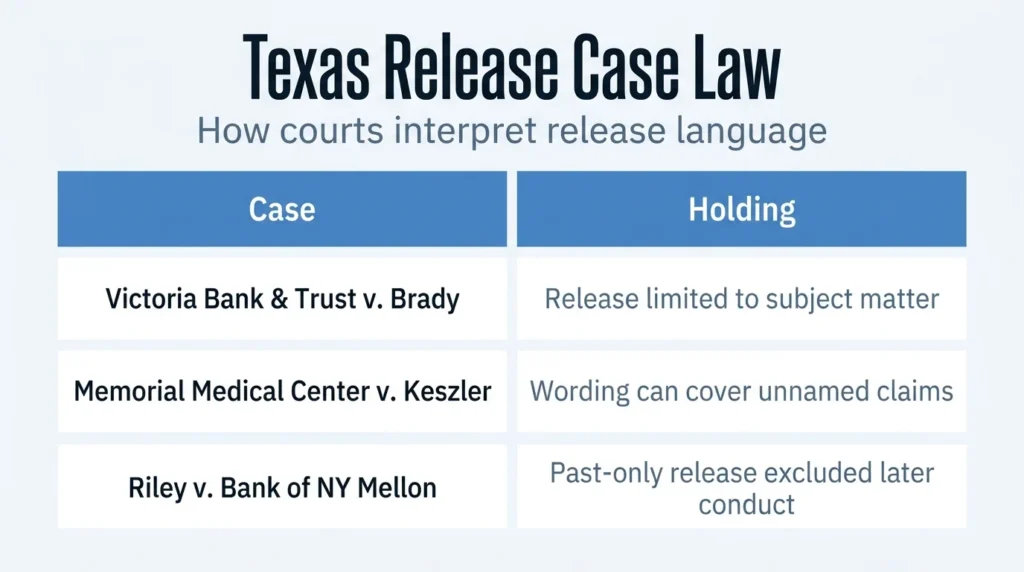
A release of all claims ends the claims that clearly fall within the subject of the agreement. The Texas Supreme Court established this rule in Victoria Bank & Trust Co. v. Brady. In Brady, the release covered a specific loan transaction, but it did not release claims involving a separate cattle transaction. In other words, “all claims” were limited to the subject matter covered by the agreement.
However, a release does not have to list every claim by name. In Memorial Medical Center of East Texas v. Keszler, the Texas Supreme Court held that a claim can be released if the wording brings it within the subject matter of the agreement.
The practical rule is simple: a claim must fall within the subject matter covered by the release, but the release can be broad enough to include claims that you did not specifically expect to give up.
Texas courts generally read the entire agreement and related settlement documents together. Looking at just one sentence can give you the wrong idea about what the release covers.
How to Review a Release of All Claims
Start with two questions:
- Who does the release protect?
- Which claims does the release cover?
Then compare both answers with the settlement you negotiated.
First, identify the signer (often called the “releasor”) and every releasee. Read the defined terms carefully, including references to employers, insurers, related companies, and anyone the agreement excludes. If the draft adds a person or company that was not part of your settlement negotiations, then address it before signing.
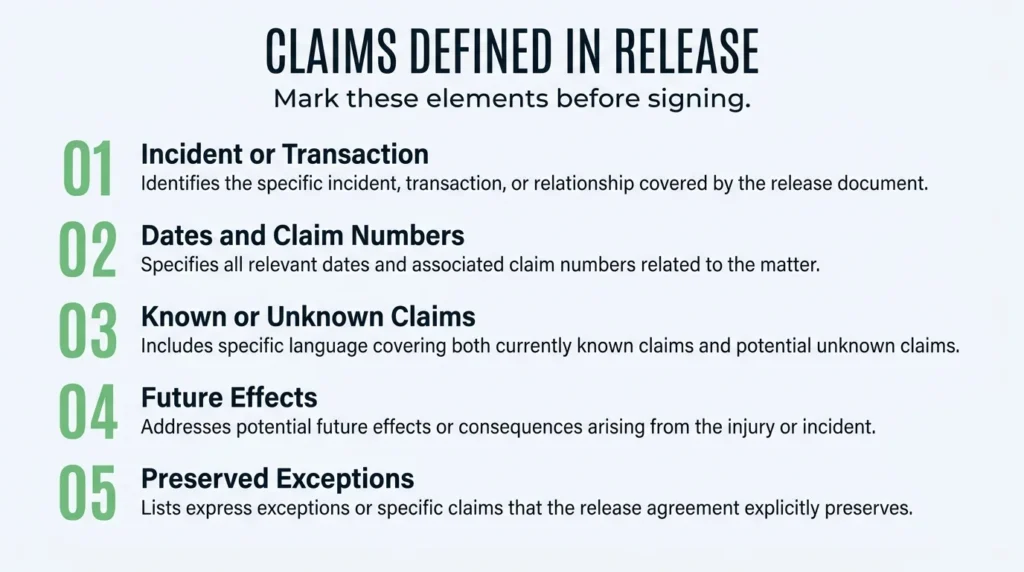
Next, mark every part of the draft that defines the claims you are giving up, including:
- The incident, transaction, or relationship covered by the release
- Relevant dates and claim numbers
- Language covering known or unknown claims
- Language addressing future effects or consequences of the injury
- Any express exceptions or claims that the release preserves
These markings show you where the release begins and ends. They can also reveal whether the draft goes beyond the settlement you agreed to.
Can You Reopen a Claim After Signing a Release?
Signing a release may prevent you from making a later claim for new symptoms or expenses related to the injury you settled for. If the release covers unknown claims or future effects of the injury, then a worsening condition may not allow you to file another claim. Review the release language before you sign, rather than assuming you can reopen the case later.
In Riley v. Bank of New York Mellon, a 2025 decision from the Beaumont Court of Appeals, the court applied Brady and held that a release covering only past and present claims did not cover alleged conduct that occurred years later. The result depended on the exact wording of that release.
What to Know About Liens, Indemnity, and Settlement Funds
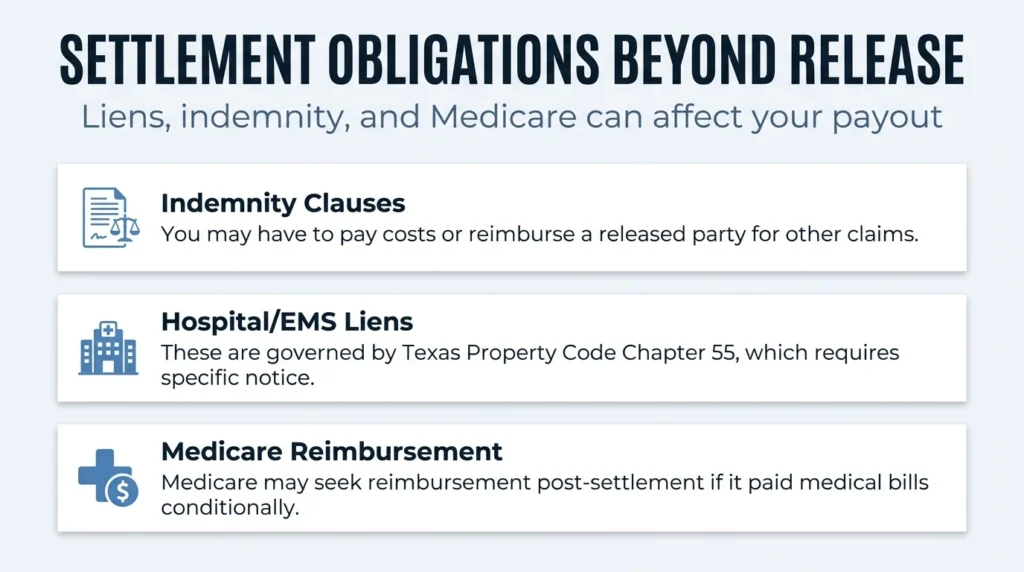
Indemnity and lien provisions can create obligations beyond giving up your own claim. They can also affect how much of your settlement you ultimately receive.
An indemnity clause may require you to pay certain costs or reimburse a released party for claims filed by someone else. This goes beyond agreeing not to sue.
In Lehmann v. Har-Con Corp., a Texas appellate court enforced an indemnity provision in a post-accident release. The case shows why you should review an indemnity clause carefully before signing.
Lien language raises a related issue. Texas hospital and EMS liens are governed by Chapter 55 of the Texas Property Code, which includes specific notice requirements. A medical bill by itself does not prove that an enforceable hospital lien exists.
Medicare follows its own rules. If Medicare paid accident-related medical bills conditionally, then CMS guidance explains that Medicare may seek reimbursement after you settle.
Hospital, EMS, and Medicare claims can create separate repayment obligations after a settlement. Before signing, determine whether any lien or repayment claim applies and who is responsible for paying it.
Signing a settlement release does not automatically eliminate a provider’s or Medicare’s separate rights.
How to Review a Confidentiality Clause Before Signing
A confidentiality clause may limit what you can say about the settlement. Identify whether it covers the settlement amount, the fact that you settled, the events involved, or only certain information. Also identify who must follow the clause, what disclosures are allowed, and what happens if someone violates it.
In Joselevitz v. Roane, a 2020 Houston appellate decision, the court reviewed a wrongful death settlement with confidentiality terms that included exceptions for health, financial, and tax purposes. The court rejected an interpretation that went beyond what the confidentiality clause explicitly said.
Your release may have different exceptions or no exceptions at all. Make sure to compare its limits and exceptions with what you explicitly agreed to.
Six Things to Check Before Signing a Release
Before you sign, confirm that these terms match the settlement you negotiated:
- Confirm that the payment amount and conditions match the settlement.
- Match the released parties, incident, and claims to what you negotiated.
- Check for provisions covering unknown claims, future consequences, and preserved claims.
- Identify who is responsible for each lien or repayment demand and any indemnity obligation.
- Compare the confidentiality terms and exceptions with what you agreed to.
- Correct inaccurate information and keep a complete copy of the signed agreement.
The legal effect of a release depends on its full wording and the specific claims involved. Resolve any flagged clauses before you sign.
Contact Angel Reyes & Associates to Discuss Your Settlement Release in Texas
Angel Reyes & Associates has guided injured Texans through this process for over 30 years, and we have recovered more than $1 billion for our clients. We work on contingency, which means you pay no fees unless we win your case.
If you have received a proposed release, contact Angel Reyes & Associates for a free consultation today to discuss the release, what it covers, and your options before you sign, so you can compare what the agreement says against what you negotiated.
Past results do not guarantee future outcomes.
Release of All Claims FAQs
Can I change a proposed release before signing it?
You may be able to ask for changes. Whether the other side agrees to those changes depends on the settlement negotiations and the terms of the agreement.
Can a release cover claims that I did not know about?
It can, depending on the wording. Some releases are written broadly enough to cover claims related to the same event that you did not know about when you signed.
Can I still sue someone who is not named in the release?
Possibly. A release generally applies to the people and claims covered by its language. If another person or company is not covered, then you may still have a claim against them, depending on the circumstances.
What happens if the release has incorrect information?
Do not assume you should sign it anyway. Ask the other side to correct mistakes before signing, especially if the document lists the wrong person, accident date, payment amount, or other important information.
Can I cancel a release after I sign it?
You should not assume that you can change your mind after signing. Whether a signed release can be challenged depends on the circumstances, such as how it was obtained and whether there was a serious legal problem with the agreement.
About the Authors

Angel Reyes
Writer
Angel L. Reyes, III is the Founder and Managing Partner of Angel Reyes & Associates. A nationally recognized trial attorney and business leader, Angel founded the firm in 1993, which has gone on to help over 70,000 injury victims recover more than $1 billion. Named to the Texas Super Lawyers list annually since 2008, Angel brings Wall Street experience, Ivy League education, and a deep commitment to client advocacy. He is a frequent legal commentator and published author with extensive contributions to legal scholarship, trial strategy, and consumer protection.

Kyle Nicolas
Editor
Kyle Nicolas is the Web Content & SEO Manager at Angel Reyes & Associates. He has more than 10 years of experience as a marketing co...

Angel Reyes
Reviewer
Angel L. Reyes, III is the Founder and Managing Partner of Angel Reyes & Associates. A nationally recognized trial attorney and business...