Whose Insurance Applies if You’re Hurt in an Uber Black?


Every article on this site is researched by our internal team, reviewed for legal accuracy against current Texas law, and held to State Bar of Texas advertising standards before publication. We do not publish content that overstates outcomes or makes promises about results.
Learn more about our
editorial standards .
Key Takeaways
- Texas rideshare insurance tiers exclude limousines and similar for-hire vehicles.
- Uber says its rideshare liability policies do not cover trips by commercial drivers.
- Registration, commercial policy, operator contract, and trip records point to who may pay.
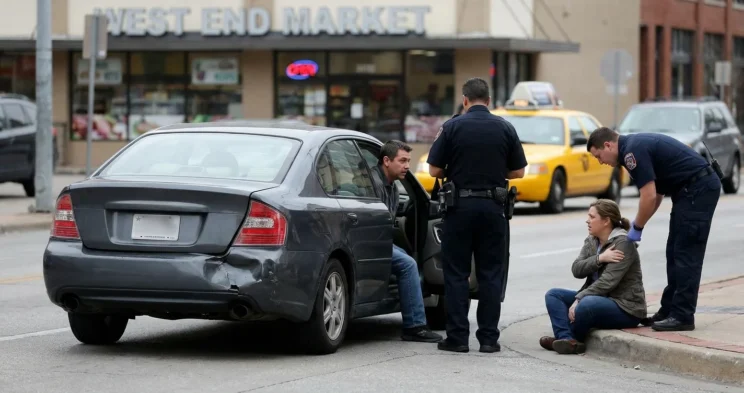
If you’re hurt in a Texas Uber Black trip operated as a commercial livery, start with the driver’s or transportation company’s commercial auto policy. Uber says its rideshare auto liability policies do not cover trips performed as a commercial driver, according to its commercial insurance FAQ.
When medical bills are arriving, identifying that insurer matters. Booking an Uber Black car service does not establish which policy pays or which company owes damages. The vehicle, commercial policy, operator’s agreement with Uber, and trip record help answer those questions.
Why the Uber Black Label Does Not Settle Insurance Coverage
Uber Black insurance questions begin with what kind of vehicle and trip you were in, not what the app called the ride. Texas built its rideshare insurance tiers around personal vehicles, and Texas Insurance Code §1954.001(2) excludes taxicabs, limousines, and similar for-hire vehicles from that personal-vehicle definition.
The same section also excludes rides using those for-hire vehicles from its definition of a prearranged ride. That matters because the familiar rideshare coverage rules attach to qualifying personal-vehicle rides.
How the Personal-Vehicle Rideshare Tiers Work
For a qualifying personal-vehicle ride, Chapter 1954 sets these liability minimums:
- While the driver is logged in and waiting for a request: $50,000 per injured person, $100,000 per incident for bodily injury or death, and $25,000 for property damage.
- During a prearranged ride: at least $1 million in liability coverage per incident.
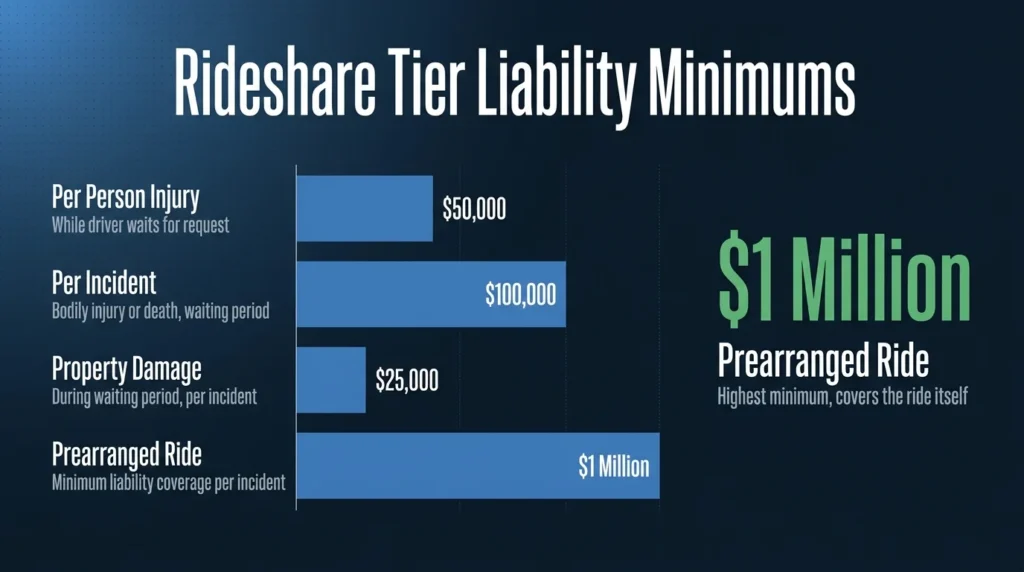
The law lets the driver, the rideshare company, or a combination of their policies meet these requirements. These figures are useful for comparison only. They do not describe Uber Black coverage, and they are not a promise of any recovery.
Why Classification Comes First
An app-booked premium ride and a qualifying personal vehicle ride can look the same from the back seat. Legally, they may be very different.
Whether your trip falls inside or outside Chapter 1954 depends on the actual vehicle and how it was operated. That is why the investigation starts with the car and its paperwork, not the product name on your receipt.
Which Policy May Cover a Commercial Black Car Crash?
When an Uber Black trip runs as commercial livery, the commercial auto policy on that operation is usually the first place to look. Uber’s current Black requirements call for commercial auto insurance and locally required commercial livery permits. Personal auto insurance does not qualify.
Uber’s commercial insurance coverage FAQ draws a clear line between commercial driver trips and standard rideshare trips. According to Uber, that line holds even when a commercial driver accepts an economy ride. Uber also states that a rideshare endorsement alone does not meet its commercial driver requirements.
Why the Usual Rideshare Chart May Not Apply
The familiar rideshare coverage chart separates periods when a driver is offline, waiting for a request, or handling an accepted ride. Chapter 1954 sets requirements for qualifying personal vehicle operations.
If the car is an excluded livery vehicle, you cannot simply apply that chart. Review the commercial policy’s own terms instead.
The Coverage Questions That Count
Read the commercial policy’s actual terms. Identify the named insured, covered vehicles and drivers, effective dates, liability limits, endorsements, and exclusions. Check for any excess policy that may provide another layer of coverage.
Other coverage may also be in play. If another driver caused the crash, that driver’s policy may factor in. Your own auto policy may offer passenger protection.
None of this works automatically. The Uber Black label does not establish your coverage limit, and you should not assume Uber provides uninsured motorist, underinsured motorist, or personal injury protection coverage on a commercial trip. Fault, trip facts, and policy terms decide which policies respond and in what order.
The insurers involved will run their own analysis. The adjuster’s job is to close your claim for as little as possible, and that is how the business works.
What Records Show Which Insurer & Operator Are Involved?
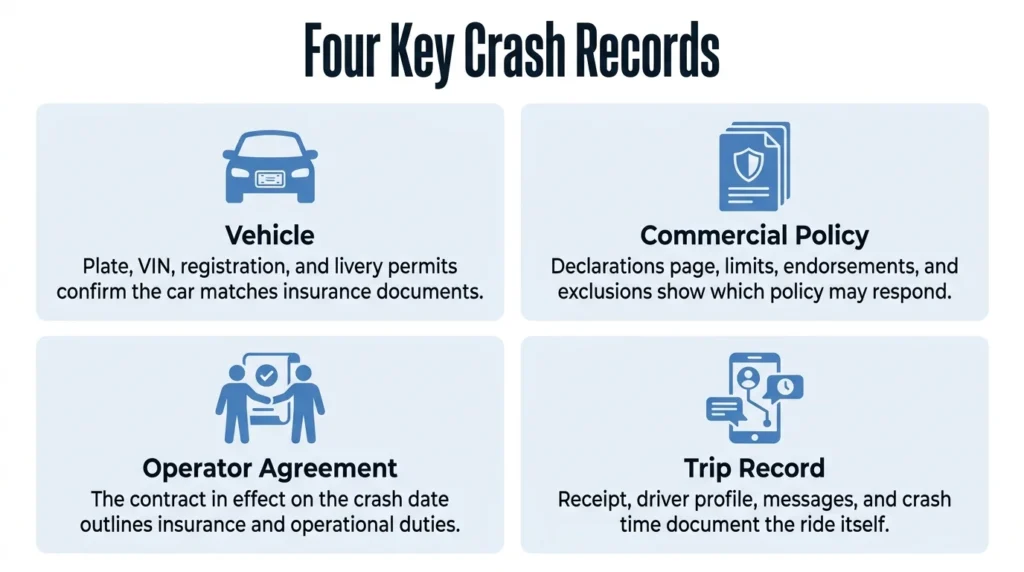
Four sets of records do most of the work, which are the vehicle’s registration and livery status, the commercial policy, the operator’s agreement with Uber, and the trip record. Together, they can point to potential insured parties and coverage.
None of them proves payment or liability by itself:
- Vehicle: Preserve the license plate and VIN. Seek the registration, ownership or lease records, and any livery permits. Then compare the actual car to the vehicle listed on the insurance documents.
- Commercial policy: Request the declarations page, effective dates, named insured, listed vehicles and drivers, limits, endorsements, exclusions, and any excess layer. A policy number alone does not tell you which person or activity is covered.
- Operator-platform agreement: Identify the transportation company connected to the driver’s account. Examine the agreement in effect on the crash date, including its insurance and operational duties. An old contract found online is no substitute.
- Trip record: Save the receipt, product designation, driver profile, messages, pickup and drop-off details, and the time of the crash. Platform and operator records can then be requested through proper channels.
These records often sit with different companies. Gathering them early keeps important details from getting lost.
Which Companies May Answer for the Driver’s Conduct?
Who pays and who is legally responsible are separate questions. Finding the insurer does not answer whether the driver, the transportation operator, or the platform owes damages. Each one’s role needs its own review.
Questions About the Driver & the Operator
Start with practical questions. Who hired or engaged the driver? Who supplied the vehicle? Who controlled the work? Which duties did each company take on under the agreement in effect that day?
The answers point toward responsibility. They are questions to resolve, not proof that every company named on a document owes you money.
Why the App Label Does Not Decide Employment Status
Texas law does not treat every driver the same way. Texas Occupations Code §2402.001 also excludes certain regulated vehicles from its personal vehicle definition.
Section 2402.114 treats drivers as independent contractors only when specific conditions are met.
Those conditions include a written agreement and limits on certain forms of company control. You cannot call a driver an employee or a contractor based on the Uber label alone.
How Chapter 150E Fits
A separate Texas law addresses rideshare company liability, and it reaches further than the insurance tiers. Texas Civil Practice and Remedies Code §150E.001 defines “network vehicle” to include black cars and other for-hire vehicles that meet its criteria.
Section 150E.002 limits which proceedings the chapter covers. Section 150E.003 places conditional limits on a rideshare company’s vicarious liability, meaning responsibility for a driver’s conduct. It also preserves specified liability for the company’s own negligence or gross negligence.
Falling outside Chapter 1954 does not mean a trip falls outside Chapter 150E. Uber is not automatically immune or automatically responsible. The applicable law and facts of your trip determine responsibility.
What Should a Passenger Do After an Uber Black Crash?
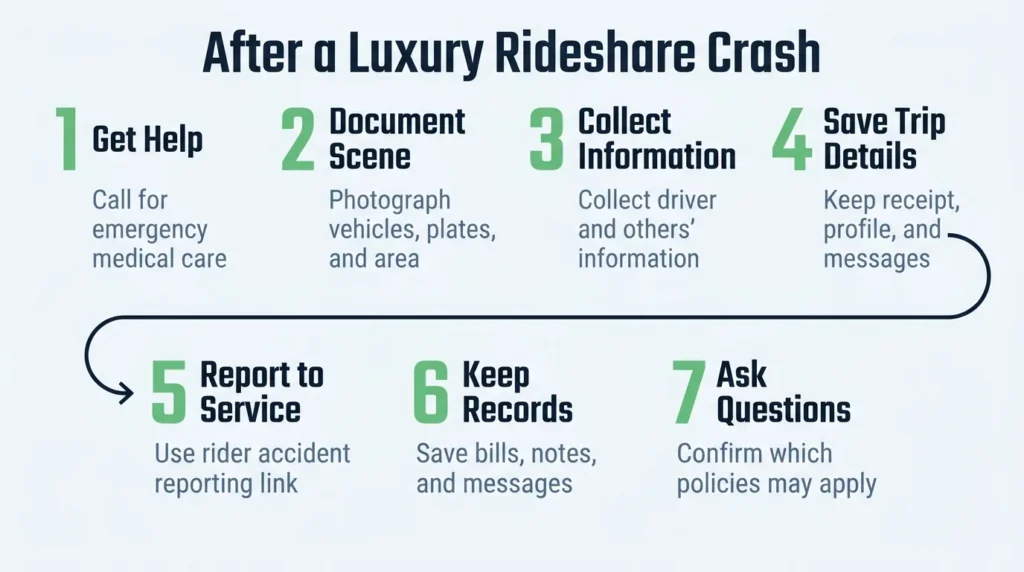
Focus first on your health, then on preserving the evidence. These steps protect your claim while the vehicle category, coverage, and responsible parties are sorted out:
- Get help. Call for emergency assistance if anyone is hurt, and get medical care for your injuries.
- Document the scene. When it is safe, photograph the vehicles, the plates, and the area around the crash.
- Collect information. Get the driver’s name, contact details, and insurance information, plus information from any other drivers involved.
- Save the trip details. Keep the app receipt, the driver profile, and any messages exchanged during the ride.
- Report the crash to Uber. Use the rider accident reporting link on Uber’s insurance and accident page.
- Keep your records. Hold on to medical bills, treatment notes, and every message with insurers or companies.
- Ask the right coverage questions. The Texas Department of Insurance recommends that passengers ask whether their own auto policy protects them, whether the driver’s policy covers the ride, and what the platform discloses. Also ask whether another motorist’s policy applies.
Get Help Reviewing the Policies & Trip Records
An Uber Black crash can involve a commercial insurer, a transportation company, the platform, and other drivers. Each has its own documents and its own interests. Sorting out who covers what starts with a close look at the vehicle, the commercial policy, the operator agreement, and the trip records.
The team at Angel Reyes & Associates can review the policies and trip records with you and explain your options.
Contact Angel Reyes & Associates for a free consultation to review your options.
Past results do not guarantee future outcomes.
Uber Black Accident Claim FAQs
Does Uber Black commercial insurance cover medical bills immediately after a crash?
Commercial auto liability insurance generally addresses damages for which an insured party is legally responsible, rather than automatically paying a passenger’s medical bills regardless of fault. Depending on the available policies, other benefits such as PIP or medical payments coverage may help pay medical expenses sooner.
Can I recover lost wages after an Uber Black accident in Texas?
Yes. If another party’s negligence caused your injuries, you may seek compensation for income lost while recovering, as well as reduced future earning capacity when supported by evidence. Pay records, employer statements, and medical documentation can help establish these losses.
How long do I have to file an Uber Black accident lawsuit in Texas?
Texas generally imposes a two-year statute of limitations for personal injury claims under Texas Civil Practice and Remedies Code §16.003, although exceptions may affect the deadline. Identifying the applicable deadline early can help prevent losing the opportunity to pursue compensation.
About the Authors

Angel Reyes
Writer
Angel L. Reyes, III is the Founder and Managing Partner of Angel Reyes & Associates. A nationally recognized trial attorney and business leader, Angel founded the firm in 1993, which has gone on to help over 70,000 injury victims recover more than $1 billion. Named to the Texas Super Lawyers list annually since 2008, Angel brings Wall Street experience, Ivy League education, and a deep commitment to client advocacy. He is a frequent legal commentator and published author with extensive contributions to legal scholarship, trial strategy, and consumer protection.

Kyle Nicolas
Editor
Kyle Nicolas is the Web Content & SEO Manager at Angel Reyes & Associates. He has more than 10 years of experience as a marketing co...

Angel Reyes
Reviewer
Angel L. Reyes, III is the Founder and Managing Partner of Angel Reyes & Associates. A nationally recognized trial attorney and business...