How Does Settling With One Driver Affect the Rest of Your Case?


Every article on this site is researched by our internal team, reviewed for legal accuracy against current Texas law, and held to State Bar of Texas advertising standards before publication. We do not publish content that overstates outcomes or makes promises about results.
Learn more about our
editorial standards .
Key Takeaways
- Texas law cuts your total recovery by the full dollar amount of every settlement.
- Non-settling defendants owe only their own jury-assigned share of the damages.
- Have a Texas attorney review the release and settlement amount before you sign.
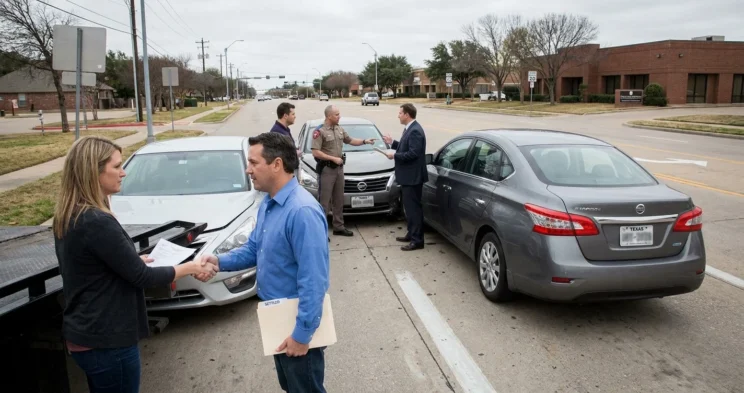
Two vehicles hit you on I-35, and one driver’s insurance company is already on the phone with an offer.
That check changes what you can collect from everyone else in the case. Under Texas law, settling with one driver before judgment reduces the total damages you can recover from the remaining defendants by the full dollar amount of that settlement.
The reduction is automatic, and it does not depend on how much of the crash was actually that driver’s fault. This rule is why settlement timing can be as important as the amount.
The Dollar-for-Dollar Settlement Credit Under Texas Law\
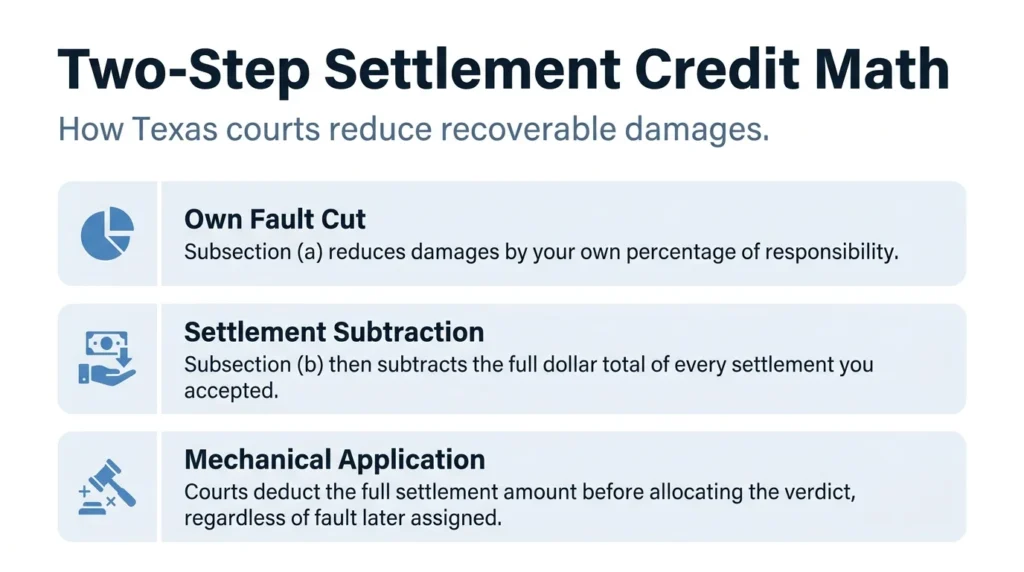
When you settle with one or more people before judgment, the court must reduce your total recoverable damages by the combined dollar amount of all settlements. Texas Civil Practice and Remedies Code § 33.012 requires the court to make this reduction.
The math runs in two steps. Subsection (a) first reduces your damages by your own percentage of responsibility. Subsection (b) then subtracts the full dollar total of every settlement you have already accepted.
The second step subtracts the settlement amount, not the settling driver’s share of fault. The reduction stays the same regardless of the percentage of responsibility later assigned to that driver.
The Texas Supreme Court applies this credit mechanically. In Drilex Systems, Inc. v. Flores, the court deducted the full settlement amount from the jury’s total verdict before allocating the remainder. It also rejected an attempt to structure a settlement to prevent the defense from receiving the full statutory credit.
Subsections (c) and (d) allow a choice between a dollar-for-dollar credit and a percentage-of-fault credit, but only in health care liability claims under Chapter 74.
In an ordinary multi-vehicle car accident case, the mandatory dollar-for-dollar rule in subsection (b) applies.
Why the Other Defendants Still Only Owe Their Own Share
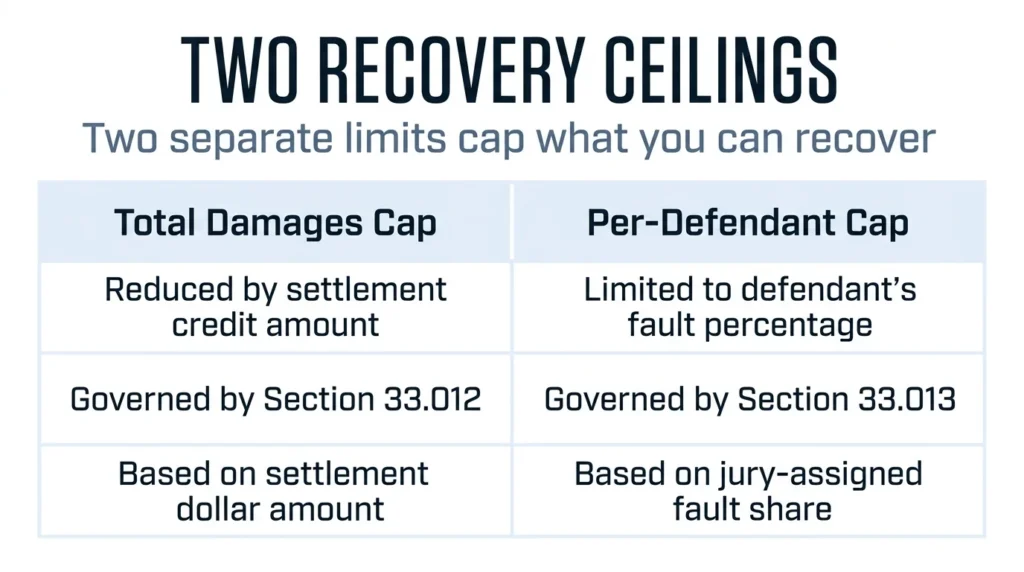
Each remaining defendant is generally responsible for its own share. Under Texas Civil Practice and Remedies Code § 33.013, a liable defendant usually pays the percentage of damages that matches the percentage of responsibility assigned by the jury.
Liability for the entire judgment is the narrow exception. Section 33.013(b) applies only when a single defendant’s percentage of responsibility exceeds fifty percent for that cause of action, or when the defendant acted with specific intent to harm someone committing certain listed intentional crimes.
Two separate ceilings sit over your recovery at the same time. One caps your total damages once the settlement credit comes off. The other caps what any one defendant can be made to pay.
Your actual recovery is governed by whichever ceiling is lower. Texas treats § 33.012 and § 33.013 as separate inquiries rather than one combined calculation.
This can create a problem in truck accident cases. Settling early with an underinsured individual driver feels harmless while the trucking company is still in the case. The carrier will still owe only its own percentage.
When a Cheap Early Settlement Costs More Than It Was Worth
A driver who settles does not disappear from the fault analysis. Under Texas Civil Practice and Remedies Code § 33.003, the jury may still assign responsibility to the claimant, each defendant, and each settling person when the evidence supports it.
The settlement locks in a fixed dollar credit on the day you sign it. The fault percentages are not decided until trial.
If the jury later decides the driver who settled carried more of the blame than the settlement amount reflected, no one is left to make up the difference. The remaining defendants owe their own percentages, and the credit still comes off the top of your recovery.
Suppose your damages are found to be $1 million, and you accepted $50,000 early from the first driver’s insurer. If the jury assigns that driver a large share of the blame, the remaining defendant still pays only its own share. You absorb the difference between what the settling driver paid and the share of responsibility later assigned to that driver.
In Sky View at Las Palmas, LLC v. Mendez, the Texas Supreme Court held that the one-satisfaction rule and settlement credit apply when a plaintiff suffered a single indivisible injury, regardless of the legal theories asserted against each defendant.
Roughly $2.3 million in pretrial settlements was credited against a verdict of roughly $2.67 million. The case involved a commercial dispute rather than an injury claim, but it demonstrates how the Chapter 33 credit operates.
The Evidence That Decides the Outcome
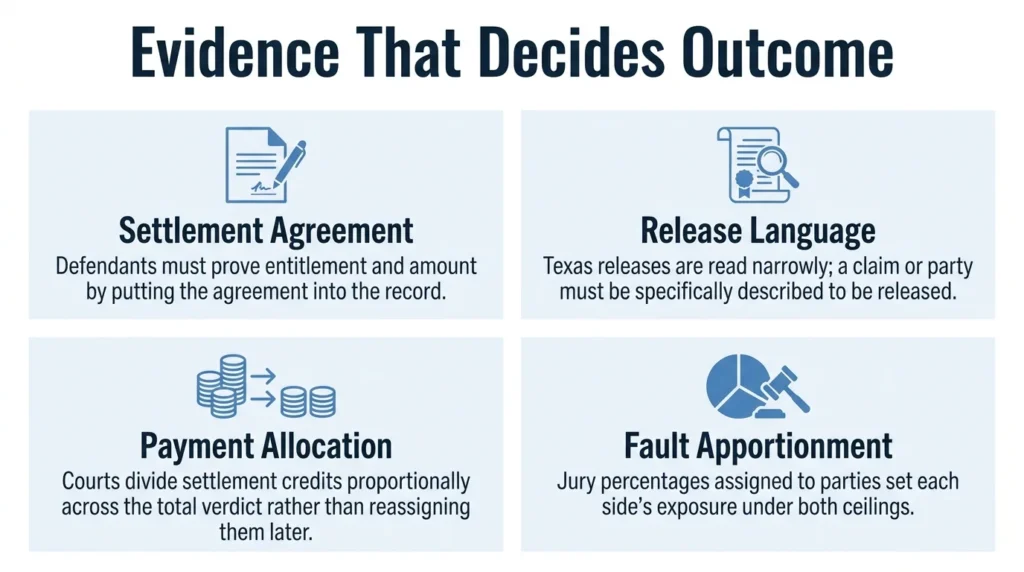
Four things control how this plays out, and you can review each one before you sign anything. Disputes over divided responsibility are especially common in wrongful death cases involving several defendants.
Disputes over divided responsibility also arise in multi-vehicle accidents where insurers must assign fault among several drivers.
- The settlement agreement and its stated amount. The defendant seeking the credit must prove both entitlement to it and the amount, usually by putting the settlement agreement or other proof of payment into the record.
- The exact language of the release. Texas releases are read narrowly. In Victoria Bank & Trust Co. v. Brady, the Texas Supreme Court held that a claim or party must be specifically described to be released, so broad “any and all claims” wording does not automatically discharge claims or parties it never describes.
- The allocation of a single settlement payment. When one settlement payment plausibly covers more than one claim or claimant, Drilex confirms that courts divide the credit proportionally across the total verdict rather than allowing either side to reassign it later.
- The apportionment analysis across every defendant. The percentages the jury assigns to settled and remaining parties are what set each side’s exposure under the two ceilings described above.
Stewart Title Guaranty Co. v. Sterling explains the one-satisfaction rule. When several claims seek compensation for the same injury, the claimant cannot recover more than once for that injury.
Talk to Angel Reyes & Associates Before You Settle With Any One Driver
Settling with one driver creates a fixed credit that can limit what you recover from the remaining defendants, even though no jury has assigned fault yet.
Have an attorney review the settlement agreement, the release language, and each defendant’s potential responsibility before you sign. Angel Reyes & Associates has guided injured Texans through decisions like this for over 30 years, with board-certified personal injury attorneys, investigators, and accident reconstruction specialists on our team.
Contact Angel Reyes & Associates for a free consultation.
Past results do not guarantee future outcomes.
Texas Settlement Credit FAQs
Can a settling driver still be blamed for a Texas car accident at trial?
Yes. A settling person may still be included in the jury’s allocation of responsibility when there is sufficient evidence that the person caused or contributed to the harm.
Can you sue a driver again after signing a settlement release in Texas?
Usually, a valid release prevents further recovery against that driver for the claims covered by the agreement. The specific language of the release determines which claims and parties are actually released.
What happens if an insurance settlement does not cover all of your accident damages?
An inadequate settlement can leave part of the loss unrecovered, particularly when the settling driver is later assigned substantial responsibility. Other defendants are not automatically required to pay the settling driver’s unpaid share.
Does settling with one driver affect uninsured or underinsured motorist coverage in Texas?
It can. A settlement may affect an uninsured or underinsured motorist claim depending on the policy terms and circumstances, so evaluate potential UM/UIM coverage before executing a release.
Can multiple insurance policies provide coverage after a multi-vehicle accident in Texas?
Yes. Depending on the facts, coverage may be available through policies covering different drivers, vehicle owners, employers, or the injured person. Still, each policy can have separate limits, exclusions, and coverage requirements.
About the Authors

Spencer Browne
Writer
Spencer Browne is a partner at Angel Reyes & Associates and a Board Certified personal injury trial lawyer with nearly 100 jury trials across Texas. He focuses on car, truck, and wrongful death cases, with notable verdicts including a landmark win in the Choctaw Casino bus crash case. A recognized speaker and legal educator, Spencer is a member of the American Board of Trial Advocates and has been honored as a Texas Super Lawyer and one of D Magazine’s Best Lawyers in Dallas. He brings deep trial experience and relentless advocacy to every client he represents.

Kyle Nicolas
Editor
Kyle Nicolas is the Web Content & SEO Manager at Angel Reyes & Associates. He has more than 10 years of experience as a marketing co...

Angel Reyes
Reviewer
Angel L. Reyes, III is the Founder and Managing Partner of Angel Reyes & Associates. A nationally recognized trial attorney and business...