Do Federal Trucking Rules Apply to In-State Texas Trucks?


Every article on this site is researched by our internal team, reviewed for legal accuracy against current Texas law, and held to State Bar of Texas advertising standards before publication. We do not publish content that overstates outcomes or makes promises about results.
Learn more about our
editorial standards .
Key Takeaways
- Texas adopts most federal trucking rules, so in-state trucks are not exempt.
- Intrastate Texas drivers may drive 12 hours after 8 off duty, not 11 after 10.
- Bills of lading and USDOT records classify each trip, not the truck's plates.
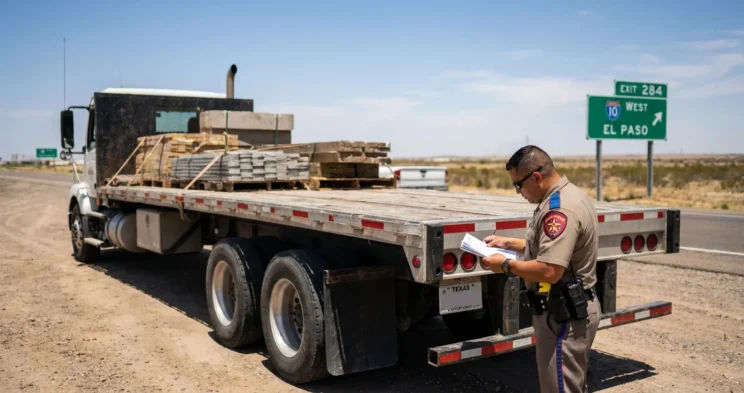
A tractor-trailer with Texas plates runs into the back of your car on I-35, and someone from the carrier mentions that the truck never leaves the state. The suggestion buried in that comment is usually the same one: federal trucking rules have nothing to do with this crash.
They have almost everything to do with it. A truck that operates only inside Texas is still held to nearly the entire federal safety rulebook, just not for the reason most people assume.
The federal regulations do not reach that truck on their own force. Texas adopted them as state law instead, and the few places where the Texas version differs from the federal one can decide whether a driver’s schedule or a driver’s age was legal on the day you were hurt.
Why the Federal Trucking Rules Don’t Automatically Cover a Texas-Only Truck
By their own terms, the Federal Motor Carrier Safety Regulations reach interstate commerce, not every truck on the road. 49 CFR § 390.3(a) applies Parts 390 through 399 to employers, employees, and commercial motor vehicles that transport property or passengers in interstate commerce.
Read that clause alone and the intuition holds up. A truck that starts and finishes every run inside Texas is not directly regulated by the federal rulebook.
What trips people up is the test for interstate commerce itself. 49 CFR § 390.5 defines interstate commerce as trade, traffic, or transportation between a place in one state and a place outside it, through another state, or as part of a movement that began or will end outside the state.
That is a trip-level test, not a truck-level one. The classification turns on the nature of the specific haul, not on where the truck is garaged, who painted the door, or which state issued the plates.
One piece of federal law crosses the line on purpose. Commercial driver’s license standards under 49 CFR Part 383 reach drivers who require a CDL in interstate or intrastate commerce alike, which sets a federal licensing floor that no state program can drop below.
If you are trying to work out whether the carrier that hit you was operating under a real safety rulebook, the answer is almost always yes. Our truck accident practice is built around finding which rulebook applies and where the carrier stepped outside it.
How Texas Adopts the Federal Rulebook for In-State Trucks
Texas closes the gap by adopting the federal safety regulations as state law. That single move is why an intrastate-only carrier cannot escape driver qualification, maintenance, and hours-of-service duties by pointing at the state line.
The authority comes from Tex. Transp. Code § 644.051, which directs the Department of Public Safety (DPS) director to adopt rules for the safe operation of commercial motor vehicles and the safe transportation of hazardous materials. Those rules must be consistent with federal regulations, and the director may adopt all or part of the federal safety regulations by reference.
DPS used that authority in 37 TAC § 4.11, which incorporates by reference 49 CFR Parts 40, 380, 382, 385-387, 390-393, and 395-397, as amended through September 1, 2022.
The adoption is not universal. Under Section 4.11(c), the rules reach intrastate vehicles over 26,000 pounds GVWR or GCWR (48,000 pounds for farm vehicles), vehicles designed to carry 16 or more passengers, and any vehicle placarded for hazardous materials.
For a commercial truck above those thresholds, the practical result is straightforward. Driver qualification under Part 391, driving rules under Part 392, parts and accessories under Part 393, hours of service under Part 395, and inspection and maintenance under Part 396 all apply to purely in-state Texas operations.
When the state and federal versions could point in different directions, Texas Transportation Code § 644.002 settles it. Federal regulations control for a commercial vehicle operated in interstate commerce, and the DPS-adopted state rule controls for a commercial vehicle operated in intrastate commerce.
Part 387, covering financial responsibility, sits on the adopted list as well. Insurance and coverage minimums raise a separate set of questions and are outside what this article covers.
For a closer look at how the state timing rules work in practice, our post on Texas truckers and hours of service walks through the schedule limits an in-state driver operates under.
Where the Interstate/Intrastate Line Actually Changes the Outcome

Hours of service and minimum driver age are where interstate vs intrastate trucking classification changes the actual number a carrier has to obey, and both of them show up in crash cases constantly.
Hours of service, interstate (federal rule):
- A maximum of 11 hours of driving after 10 consecutive hours off duty, under 49 CFR § 395.3
- No driving after the 14th consecutive hour on duty following that 10-hour break
- Weekly caps of 60 hours in 7 days or 70 hours in 8 days, resettable with a 34-hour restart
Hours of service, intrastate-only (Texas rule):
- Permitted to drive 12 hours following 8 consecutive hours off duty, under 37 TAC § 4.12
- May not drive after being on duty 15 hours following 8 consecutive hours off duty
The gap is real, and it runs in the driver’s favor. An intrastate-only Texas driver can legally drive one more hour, on two fewer hours of required rest, and stay on duty an hour longer than a driver hauling the same freight across a state line.
That matters enormously in a fatigue case. A schedule that is a clean hours-of-service violation for an interstate driver may be perfectly lawful for an intrastate one, so the classification question gets answered before anyone can say whether the rule was broken at all.
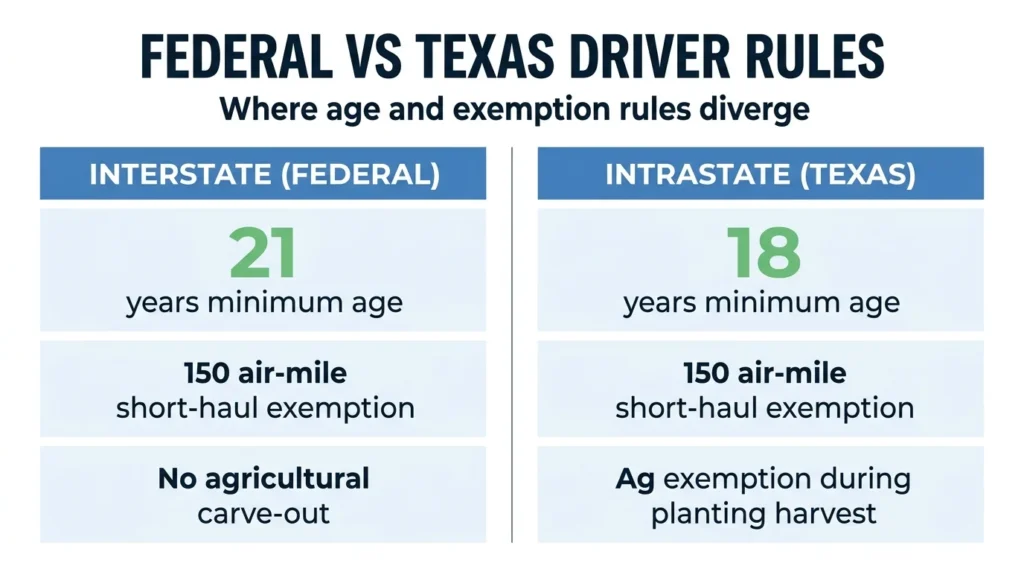
Minimum driver age, interstate (federal rule): a driver must be at least 21 years old to operate a commercial motor vehicle in interstate commerce under 49 CFR § 391.11(b)(1).
Minimum driver age, intrastate-only (Texas rule): the minimum age is 18, with a Texas CDL, under 37 TAC § 4.12.
A carrier that puts an 18-, 19-, or 20-year-old CDL holder on in-state routes has broken no age rule. Dispatch that same driver on a load bound for Oklahoma and the driver’s age becomes a qualification violation on its face, which is exactly the territory negligent hiring and negligent entrustment claims live in. Our discussion of truck accident liability covers how regulatory violations like these feed into a negligence case.
Two related points keep the comparison honest. The short-haul exemption is not a live distinction, because the current federal provision at 49 CFR § 395.1(e) and the current Texas provision both use a 150 air-mile radius with release within 14 consecutive hours. Texas does add an agricultural carve-out with no direct federal-interstate equivalent, exempting drivers hauling agricultural commodities intrastate within 150 air miles of the source during planting and harvest season from Part 395 entirely.
Maintenance is the clearest example of a rule the line does not touch. 49 CFR § 396.3 governs systematic inspection, repair, and maintenance, driver vehicle inspection reports, and maintenance recordkeeping, and Texas adopted it without a state-specific exception. A truck that never leaves Bexar County is held to the same inspection standard as one running to Chicago.
The Documents That Show Which Side of the Line a Carrier Is On
Classification is proved with paperwork, and the paperwork for the specific trip controls. These are the records that establish where a carrier and a particular load fall:
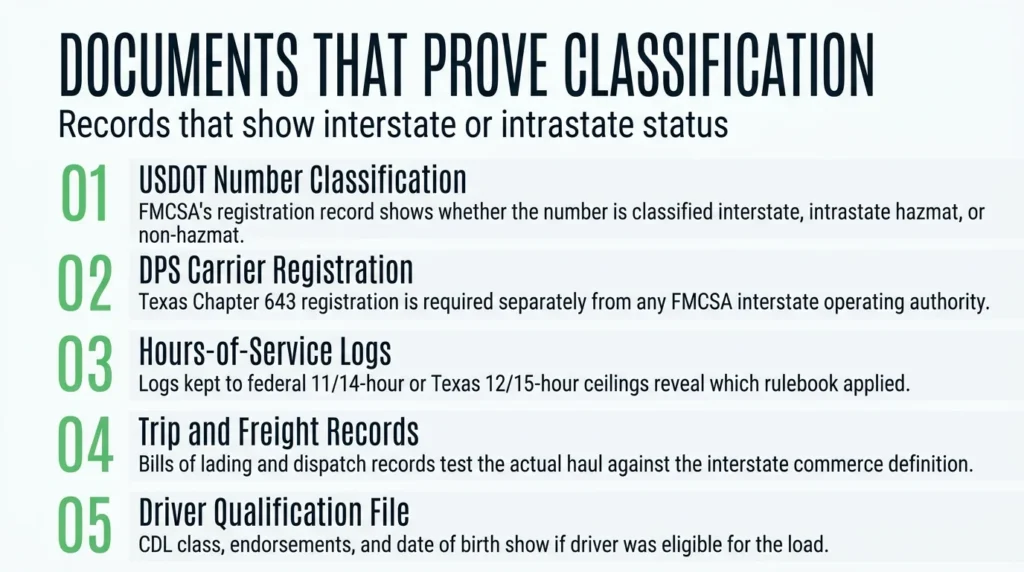
- The USDOT number and its registered classification. Tex. Transp. Code § 643.064 requires a motor carrier registering under Chapter 643 to maintain a USDOT number even for intrastate-only operation, and FMCSA’s registration record shows whether that number is classified interstate, intrastate hazmat, or intrastate non-hazmat.
- Texas DPS motor carrier registration under Chapter 643. Every motor carrier operating on Texas roads needs it, and it exists separately from any FMCSA interstate operating authority the carrier may also hold.
- Hours-of-service logs. Whether the driver’s logs were kept to the federal 11 and 14 hour ceilings or the Texas intrastate 12 and 15 hour ceilings shows which side of the line the carrier believed the trip was on.
- Trip and freight documentation. Bills of lading, dispatch records, and shipping origin and destination test the actual haul against the definition in 49 CFR § 390.5, which is what classifies a trip.
- The driver qualification file. CDL class, endorsements, and date of birth reveal whether the driver was eligible for an interstate load at all, or only for in-state work.
A carrier’s general reputation and its home terminal prove nothing here. The freight paperwork for the run that injured you is what answers the question.
Talk to Angel Reyes & Associates About a Texas Truck Accident Claim
Whether the truck that hit you was interstate or intrastate changes which hours-of-service ceiling the driver was under and whether that driver was old enough to be behind the wheel. Those are not academic distinctions. They decide what counts as a violation in your claim.
Angel Reyes & Associates has guided injured Texans through questions like these for more than 30 years from over 20 locations across the state, backed by a team that includes investigators who know which records to request. The firm works on contingency, meaning there is no upfront cost to you.
If you were hurt in a crash involving a commercial truck anywhere in Texas, contact us for a free consultation, and we will review what happened with you.
Past results do not guarantee future outcomes.
Texas Trucks and Federal Rules FAQs
Does a Texas company truck that never leaves the state still need a USDOT number?
Yes, Texas Transportation Code § 643.064 requires any motor carrier registering under Chapter 643 to maintain a USDOT number, and that requirement applies even to carriers that operate purely within Texas. FMCSA’s registration record for that number also shows how the carrier is classified: interstate, intrastate hazmat, or intrastate non-hazmat. That classification is one of the first documents used to determine which side of the interstate/intrastate line a given carrier and trip fall on.
Can a Texas-based driver under 21 legally drive a commercial truck if they never cross state lines?
Yes, in many cases. The federal minimum age to operate a commercial motor vehicle in interstate commerce is 21 under 49 CFR § 391.11(b)(1), but Texas sets the minimum age for an intrastate-only driver at 18 with a Texas CDL under 37 TAC § 4.12. An 18-, 19-, or 20-year-old CDL holder can lawfully be dispatched on Texas-only routes, but that same driver could not lawfully be sent on a load bound for another state.
If a Texas truck occasionally crosses into Oklahoma or Louisiana, does it become "interstate" for all its trips, or just that one?
Under 49 CFR § 390.5, whether a movement counts as interstate or intrastate commerce is a trip-level test tied to the origin, destination, and route of that specific haul, not a truck-level or carrier-level label. A truck that runs purely intrastate routes most of the time but occasionally crosses a state line, or carries freight that is part of a continuous interstate movement, is operating in interstate commerce only for those specific trips.
Do the Texas hours-of-service rules apply to intrastate hazmat carriers the same way they apply to general freight carriers?
The same numeric Texas intrastate hours-of-service limits apply either way: up to 12 hours of driving after 8 consecutive hours off duty, with no driving after 15 hours on duty, under 37 TAC § 4.12. What differs is which vehicles get pulled into Texas’s adopted rulebook in the first place. Under 37 TAC § 4.11(c), any vehicle placarded for hazardous materials is covered regardless of weight, while a general-freight vehicle only falls under the rule once it exceeds the 26,000-pound GVWR/GCWR threshold (48,000 pounds for farm vehicles).
Does this interstate/intrastate distinction affect a truck's insurance requirements?
That question is outside the scope of this article. The comparison here covers the operating rulebook: hours of service, driver qualification, and maintenance. It does not address insurance or financial-responsibility minimums, which fall under a separate set of rules (including 49 CFR Part 387) that were not analyzed as part of this coverage.
About the Authors

Angel Reyes
Writer
Angel L. Reyes, III is the Founder and Managing Partner of Angel Reyes & Associates. A nationally recognized trial attorney and business leader, Angel has helped over 70,000 injury victims recover more than $1 billion since founding the firm in 1993. Named to the Texas Super Lawyers list annually since 2008, Angel brings Wall Street experience, Ivy League education, and a deep commitment to client advocacy. He is a frequent legal commentator and published author with extensive contributions to legal scholarship, trial strategy, and consumer protection.

Graham Griffin
Editor
Graham Griffin is the Web & Content Manager at Angel Reyes & Associates, where he oversees content strategy, AI-powered workflows, a...

Angel Reyes
Reviewer
Angel L. Reyes, III is the Founder and Managing Partner of Angel Reyes & Associates. A nationally recognized trial attorney and business...