What Elbow Injuries Can a Car Accident Cause?


Every article on this site is researched by our internal team, reviewed for legal accuracy against current Texas law, and held to State Bar of Texas advertising standards before publication. We do not publish content that overstates outcomes or makes promises about results.
Learn more about our
editorial standards .
Key Takeaways
- A car crash's bracing reaction often fractures or dislocates the elbow.
- Radial head fractures and terrible triad injuries usually require surgery.
- Texas law gives you only two years to file a car accident injury claim.
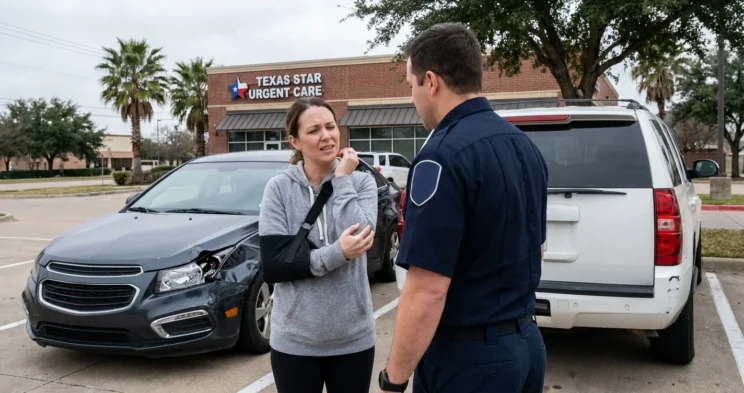
Your arm shot out instinctively the moment you saw the crash coming. It slammed into the steering wheel, the dashboard, or the door, and now your elbow will not fully straighten, will not fully bend, and will not stop aching.
A car accident can fracture the radial head, drive the elbow out of its socket, break the olecranon, or cause the three-part injury doctors call the terrible triad. Every one of these injuries starts the same way, with the arm braced and extended at the moment of impact.
How a Car Accident’s Bracing Reaction Injures the Elbow
The instinct to brace for impact during a Texas car accident is automatic. Your elbow locks and your hand drives into the wheel, dashboard, door, or window in the split second before the crash forces reach you.
That locked, extended position sends the crash’s force up your forearm and into your elbow. It is the same axial and valgus loading pattern doctors see when someone falls onto an outstretched hand, and motor vehicle crashes are a recognized high-energy cause of this kind of trauma, alongside falls from height.
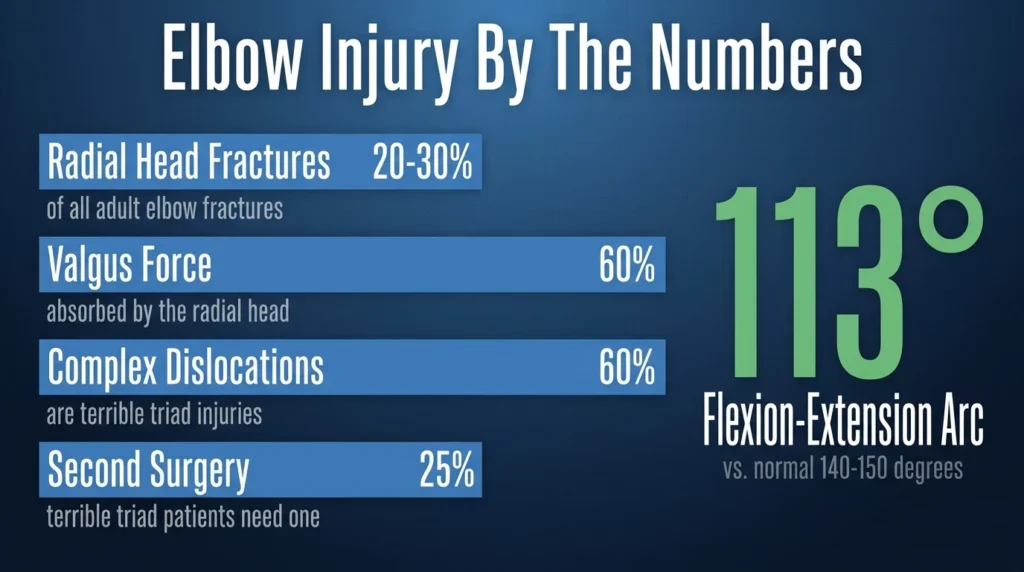
Within that load path, the radial head absorbs up to 60% of the valgus force moving from your wrist toward your humerus. A braced, extended arm concentrates force exactly where the radial head sits, which is why radial head fractures are such a common result.
The bracing reaction also has a direct-impact version. If your elbow strikes a door or window in a side-impact crash, or your triceps pulls hard against the bone during a braced fall, the result is often an olecranon fracture instead.
Radial Head Fractures & the Terrible Triad Pattern
Radial head fractures account for roughly 20% to 30% of all adult elbow fractures and peak between ages 30 and 50. A nondisplaced fracture may not even show up on an x-ray for days or weeks after the crash.
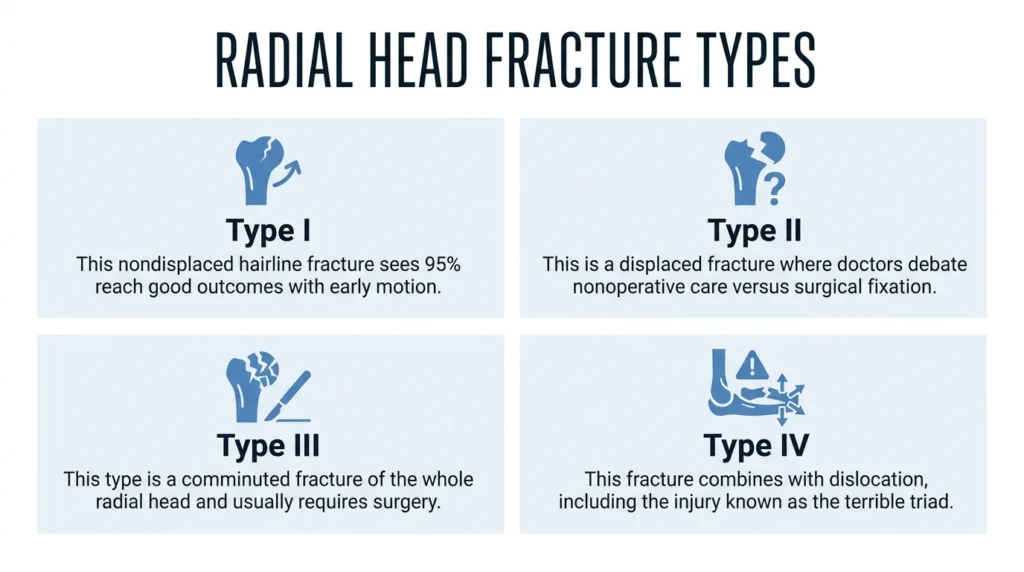
Doctors grade radial head fractures using the Mason classification, and where your injury falls on that scale drives both your treatment and your recovery:
- Type I: A nondisplaced, hairline fracture treated with early motion. About 95% of patients reach a good or excellent outcome.
- Type II: A displaced fracture. Doctors debate whether nonoperative care or surgical fixation serves the patient better.
- Type III: A comminuted fracture involving the whole radial head. Surgery, whether removing the fragment, repairing it, or replacing it, is usually required.
- Type IV: A radial head fracture combined with an elbow dislocation, the fracture-dislocation family that includes the terrible triad.
The terrible triad is the elbow’s most severe common injury pattern: a dislocation, a radial head or neck fracture, and a coronoid process fracture, all at once. It happens when axial loading combines with rotation and valgus force strong enough to tear through the elbow’s supporting ligaments from the outside in, and it accounts for roughly 60% of complex elbow dislocations.
Treating a terrible triad almost always means surgery, typically within 24 hours to 14 days of the crash. Even with modern surgical repair, patients are often left with a measurable deficit, such as an average flexion-extension arc of about 113 degrees, which is well short of the normal 140 to 150 degrees, and roughly one in four patients needs a second surgery.
Other Elbow Injuries a Car Accident Can Cause
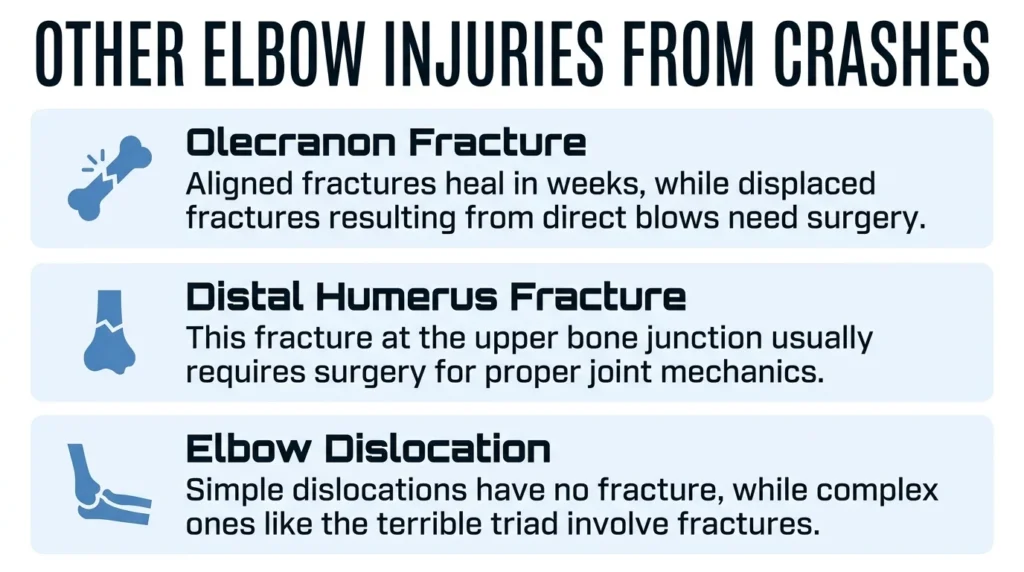
Radial head fractures and the terrible triad are not the only injuries this bracing mechanism causes. A car accident’s force through the elbow can also produce these injuries, each with its own path to recovery:
- Olecranon fracture. A direct blow to the point of your elbow, against a door, window, or dashboard, can fracture the olecranon, the bony tip at the back of the joint. Aligned fractures often heal within about two weeks in a splint followed by bracing and motion, while displaced fractures need surgical repair. Full recovery typically takes around four months, complete healing can take over a year, and stiffness remains the most common lasting complication.
- Distal humerus fracture. This injury, at the bottom of the upper arm bone where it meets the elbow, is less common than a radial head or olecranon fracture. It usually requires surgery because the joint’s mechanics depend on that section of bone healing correctly.
- Elbow dislocation. A simple dislocation involves no fracture. A complex dislocation, including the terrible triad, involves one or more fractures alongside the dislocation. The ulnar nerve, which wraps around the inside of your elbow, and the median nerve and brachial artery, which run along the front, are the structures doctors check most closely before and after they put the joint back in place.
Why Elbow Stiffness Is the Defining Long-Term Consequence
Every elbow injury from a car accident carries one shared long-term risk, which is stiffness. Doctors call this arthrofibrosis, and the elbow develops it more easily, and sheds it less easily, than almost any other joint in the body.
After an injury, the joint moves through bleeding, swelling, and scar formation. That scar tissue thickens the joint capsule and physically limits how far your elbow can bend, straighten, or rotate.
The elbow is especially prone to this because its bones fit together tightly, its joint space is confined, and its surrounding ligaments and muscles are built to stabilize rather than move freely. Bone can even form in the soft tissue around the joint, a condition called heterotopic ossification, in anywhere from roughly 2% to over half of cases depending on how severe the trauma and surgery were.
Starting gentle, monitored motion within about two days of the injury produces better long-term function than weeks of immobilization, without raising the risk of a repeat dislocation.
Normal elbow motion runs roughly 0 to 140 or 150 degrees of flexion and extension, plus 80 to 90 degrees of combined forearm rotation. Research measuring healthy adults found each side of the body typically differs by less than one degree, which means your own uninjured elbow is a reliable baseline for comparison.
This is why your medical record matters so much after an elbow injury. Imaging that classifies the fracture, regular range-of-motion measurements tracked against those benchmarks, and your occupational or physical therapy notes together show whether your elbow is truly recovering or left with a lasting deficit.
Texas Legal Considerations After an Elbow Injury Car Accident
Texas gives you two years from the date of your crash to file a personal injury lawsuit. This deadline comes directly from Texas Civil Practice and Remedies Code section 16.003(a), and missing it typically means losing your right to sue altogether.
That deadline means more than it might seem for an elbow injury claim. Stiffness and functional recovery take months to fully document through imaging, serial range-of-motion measurements, and therapy records, and building that evidence trail takes time you do not want to lose by waiting to act.
Talk to Angel Reyes & Associates About Your Elbow Injury Claim
An elbow injury from a car accident can affect your ability to work, drive, and handle basic daily tasks for months or years after the crash. You deserve to understand your options while that evidence is still being built.
Angel Reyes & Associates has guided Texans through car accident injury claims for over 30 years. Contact Angel Reyes & Associates for a free consultation to talk through what happened and what comes next.
Past results do not guarantee future outcomes.
Elbow Injuries From Car Accidents FAQs
Can an elbow injury from a car accident cause permanent loss of motion?
Yes. Severe fractures, ligament damage, scar tissue, and post-traumatic arthritis can leave lasting limitations in bending, straightening, or rotating the arm, even after treatment. The extent of permanent impairment depends on the injury and how the elbow heals.
What happens if an elbow fracture is missed after a car accident?
An untreated elbow fracture can lead to displacement, stiffness, improper healing, or ongoing pain. If elbow pain, swelling, or limited movement persists after a crash, a medical evaluation and appropriate imaging can help identify injuries that may not be obvious initially.
Can a car accident cause ulnar nerve damage in the elbow?
Yes. A crash can injure the ulnar nerve through direct impact, elbow dislocation, or swelling around the joint. Symptoms may include numbness or tingling in the ring and little fingers, hand weakness, or difficulty gripping objects.
How does an elbow injury affect a car accident settlement in Texas?
An elbow injury claim may involve medical expenses, lost income, pain and suffering, and compensation for lasting limitations when supported by the evidence. The value of a claim depends on factors such as the injury’s severity, treatment, recovery, and available proof of liability and damages.
Can you file a Texas car accident claim if your elbow injury was diagnosed weeks after the crash?
A delayed diagnosis does not automatically prevent a personal injury claim under Texas law. Medical records, the timing of symptoms, and evidence connecting the injury to the collision can help establish causation, while the applicable filing deadline and other legal requirements still matter.
About the Authors

Spencer Browne
Writer
Spencer Browne is a partner at Angel Reyes & Associates and a Board Certified personal injury trial lawyer with nearly 100 jury trials across Texas. He focuses on car, truck, and wrongful death cases, with notable verdicts including a landmark win in the Choctaw Casino bus crash case. A recognized speaker and legal educator, Spencer is a member of the American Board of Trial Advocates and has been honored as a Texas Super Lawyer and one of D Magazine’s Best Lawyers in Dallas. He brings deep trial experience and relentless advocacy to every client he represents.

Graham Griffin
Editor
Graham Griffin is the Web & Content Manager at Angel Reyes & Associates, where he oversees content strategy, AI-powered workflows, a...

Angel Reyes
Reviewer
Angel L. Reyes, III is the Founder and Managing Partner of Angel Reyes & Associates. A nationally recognized trial attorney and business...