How Serious Is a Skull Fracture From a Car Accident?


Every article on this site is researched by our internal team, reviewed for legal accuracy against current Texas law, and held to State Bar of Texas advertising standards before publication. We do not publish content that overstates outcomes or makes promises about results.
Learn more about our
editorial standards .
Key Takeaways
- A skull fracture proves the force of impact, which supports a brain injury claim.
- Battle's sign and raccoon eyes often appear one to three days after the crash.
- Texas gives you two years from the crash date to file a personal injury suit.
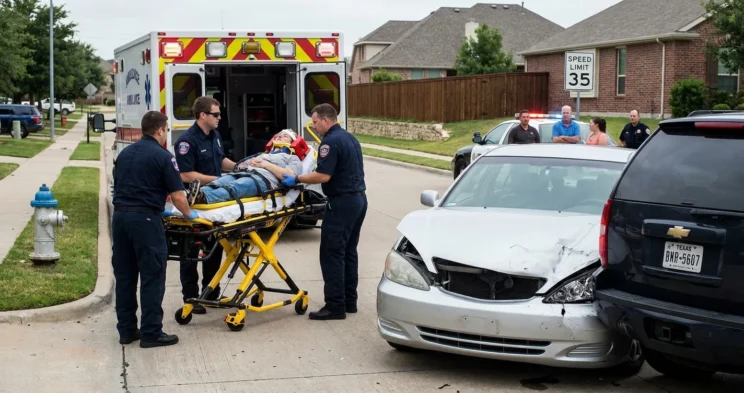
A skull fracture from a car accident can be anything from a thin crack that heals on its own to an injury that turns life threatening within hours. The break in the bone is rarely the real question.
What means far more is what that fracture says about the force that reached your head and the condition of the brain underneath it. A linear crack may need rest and observation. A depressed or basilar fracture can put your life at risk.
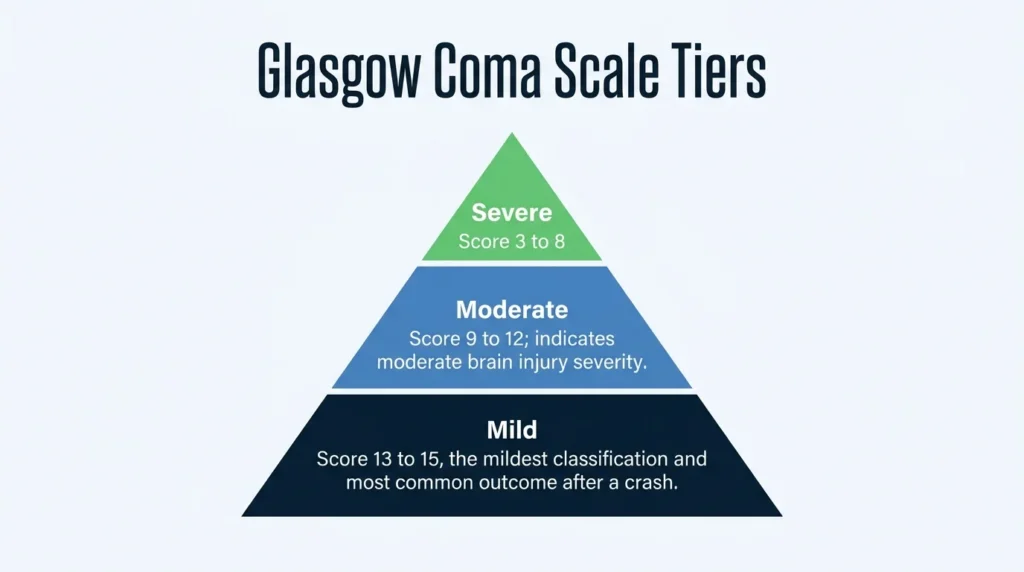
Hospitals grade the brain injury itself with the Glasgow Coma Scale. A score of 13 to 15 is classified mild, 9 to 12 moderate, and 3 to 8 severe, with 8 or below indicating coma.
Head trauma from car accidents is a well documented mechanism for this injury. Motor vehicle crashes accounted for 24.5 percent of traumatic brain injury hospitalizations in 2017 national data, second only to falls at 49.1 percent.
The Four Types of Skull Fractures
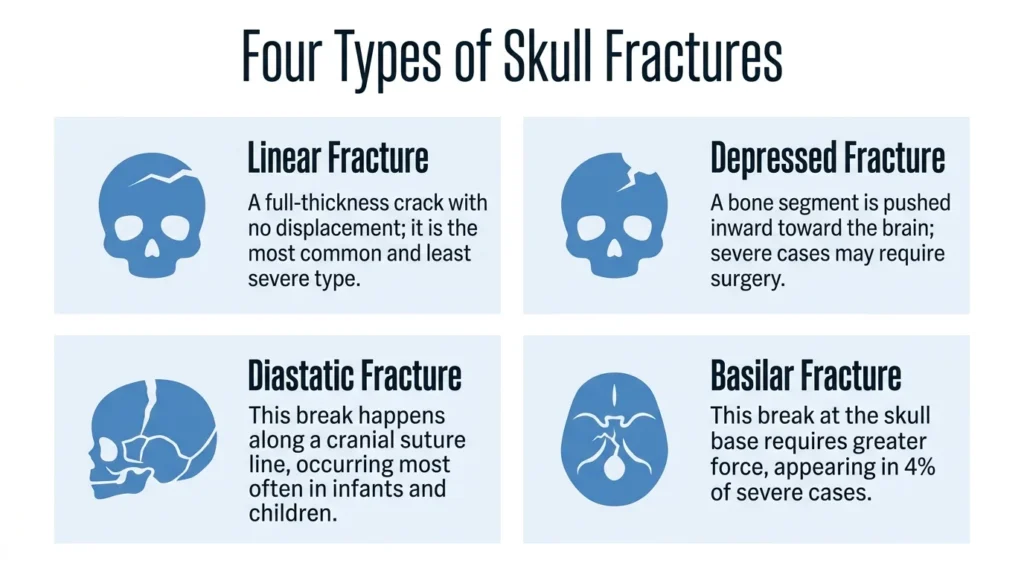
Doctors recognize four types of skull fracture, and each one carries a different risk profile:
- Linear fracture. A full-thickness crack in the bone with no displacement. It is the most common type and generally the least severe, though a linear break crossing the groove that carries the middle meningeal artery can tear that vessel.
- Depressed fracture. A segment of bone pushed inward toward the brain, most often in the frontal or parietal region. Severe cases can lacerate the dura or the brain tissue itself and may require surgery to elevate the bone.
- Diastatic fracture. A break that runs along a cranial suture line and widens it. It occurs most often in infants and young children, whose sutures have not fully fused.
- Basilar fracture. A break in the bones forming the base of the skull, in the anterior, middle, or posterior cranial fossa. The skull base is thicker and better protected, so a basilar skull fracture in a crash takes substantially more force than a vault fracture, and it appears as an isolated fracture in only about 4 percent of severe head injury cases.
Basilar Skull Fracture Signs After a Crash
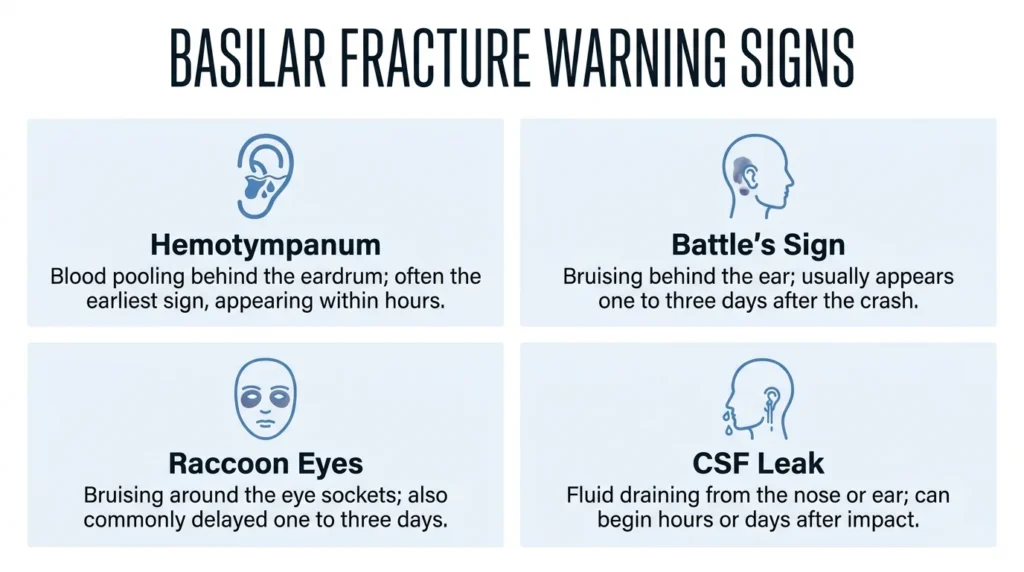
The physical signs of a basilar fracture are specific, and most of them arrive late:
- Hemotympanum. Blood pooling behind the eardrum, giving it a purple look. It can appear within hours and is often the earliest physical sign.
- Battle’s sign. Bruising over the mastoid bone behind the ear, pointing to a middle cranial fossa fracture. It is highly predictive but commonly takes one to three days to show up.
- Raccoon eyes. Bruising around the eye sockets, pointing to an anterior cranial fossa fracture. It is also commonly delayed one to three days.
- Cerebrospinal fluid leak. Fluid draining from the nose or the ear, sometimes leaving a halo ring pattern where it mixes with blood on cloth or paper. Leaks can also begin hours or days after the collision.
Complications tied specifically to these fractures include meningitis in fewer than 5 percent of cases, cranial nerve palsies, hearing loss, intracranial hemorrhage, and vascular injuries such as carotid artery dissection.
Treatment is often conservative, meaning observation in the hospital rather than an operation. Surgery is reserved for a persistent fluid leak, vascular injury, or significant bleeding.
How a Skull Fracture Signals a More Serious Brain Injury
A documented skull fracture is associated with worse brain injury outcomes, which is why the diagnosis deserves more attention than the bone alone would suggest.
A retrospective study of 5,430 traumatic brain injury patients found in-hospital mortality of 10.3 percent among patients with a skull fracture, compared with 5.6 percent among those without one. Fracture presence remained associated with roughly 1.4 to 1.7 times higher mortality risk after adjustment for age, sex, and other conditions.
That was a registry-based observational study, so it establishes an association rather than proof that the fracture itself, instead of the force of the collision behind it, drives the worse result.
One mechanism is concrete. A linear fracture crossing the temporal bone can tear the middle meningeal artery and cause an epidural hematoma. Skull fracture is present in about 75 percent of these cases, and untreated the injury carries up to a 15 percent mortality rate.
What makes it dangerous is the lucid interval. A person can seem alert and oriented for hours after the crash and then deteriorate quickly. How someone looks at the scene is not a reliable measure of what is happening inside the skull, and when a head injury proves fatal, surviving family members may have a wrongful death claim.
The risks also stretch well past the hospital stay. Brain injury involving a skull fracture carries a long-term risk of post-traumatic epilepsy, and about half of the cases that develop it do so within the first year, with elevated risk persisting up to 15 years after the most severe injuries. Persistent problems with memory, attention, and thinking are common too.
Why This Evidence Matters for a Texas Car Accident Claim
A radiologist-confirmed fracture on a CT scan is objective, imaging-based evidence that the crash delivered serious force to your head. That is far harder for an insurance adjuster to dispute than brain injury symptoms described in your own words.
Non-contrast CT is the standard first-line imaging study for a suspected skull fracture because it captures both the bone and the tissue beneath it. The radiologist’s report turns those images into a written diagnosis naming the fracture type, its location, and any associated bleeding.
Because Battle’s sign, raccoon eyes, and fluid leaks are commonly delayed, the initial emergency room exam can look unremarkable even when the fracture is real. The imaging and the report, not the first visual once-over, are the dependable objective record.
Three categories of documentation carry a skull fracture claim:
- The CT images and the radiologist’s written report identifying the fracture
- Operative records for any surgical intervention, including elevation of a depressed fracture or repair of a fluid leak
- Every neurological follow-up visit, referral, and test result after discharge
Surgical records corroborate severity because surgery is reserved for cases with neurological compromise, a persistent fluid leak, vascular injury, or significant hemorrhage, not routine fractures.
Follow-up records matter because epilepsy, cognitive deficits, and cranial nerve palsies can surface long after discharge, and a file that stops at the discharge paperwork understates what the injury actually cost you.
Texas also sets a hard deadline. Texas Civil Practice and Remedies Code Section 16.003 requires a person to bring suit for personal injury not later than two years after the claim accrues, which for a car accident generally means the date of the collision.
Your own share of the blame matters as well. Under Texas Civil Practice and Remedies Code Section 33.001, you cannot recover damages if your percentage of responsibility is greater than 50 percent, and your damages are otherwise reduced in proportion to your own percentage of fault.
Talk to an Attorney About Your Injury
A skull fracture gives your claim something many head injury cases lack, which is an imaging-confirmed record of serious force. Protecting that record starts with keeping the CT images, the radiologist’s report, and every neurological follow-up together in one place.
Angel Reyes & Associates has guided injured Texans through the claims process for over 30 years, with board-certified personal injury attorneys, investigators, and accident reconstruction specialists on the team. Request a free consultation to review your options while the two-year deadline is still ahead of you.
Past results do not guarantee future outcomes.
Car Accident-Related Skull Fracture FAQs
Can you have a skull fracture without realizing it after a car accident?
Yes. Some skull fractures cause few immediate symptoms, and signs of a basilar skull fracture may develop hours or days after the collision. A person who feels fine after a crash should still seek medical evaluation if they struck their head or have concerning symptoms.
How long does it take for a skull fracture to heal after a car accident?
Many uncomplicated skull fractures heal over several weeks, but recovery depends on the fracture type, location, and whether the brain or surrounding structures were injured. Follow-up imaging and medical appointments help determine when normal activities can safely resume.
What happens if a skull fracture causes a cerebrospinal fluid leak?
A cerebrospinal fluid leak can allow fluid to escape through the nose or ear and may increase the risk of infection, including meningitis. Some leaks resolve with observation, while persistent leaks may require surgical repair.
Can a skull fracture cause memory loss or personality changes after a car accident?
Yes. A skull fracture accompanied by a traumatic brain injury can lead to problems with memory, attention, emotional regulation, or behavior, even after the bone heals. The extent and duration of these changes depend on the brain injury and require medical assessment.
About the Authors

Angel Reyes
Writer
Angel L. Reyes, III is the Founder and Managing Partner of Angel Reyes & Associates. A nationally recognized trial attorney and business leader, Angel has helped over 70,000 injury victims recover more than $1 billion since founding the firm in 1993. Named to the Texas Super Lawyers list annually since 2008, Angel brings Wall Street experience, Ivy League education, and a deep commitment to client advocacy. He is a frequent legal commentator and published author with extensive contributions to legal scholarship, trial strategy, and consumer protection.

Kyle Nicolas
Editor
Kyle Nicolas is the Web Content & SEO Manager at Angel Reyes & Associates. He has more than 10 years of experience as a marketing co...

Angel Reyes
Reviewer
Angel L. Reyes, III is the Founder and Managing Partner of Angel Reyes & Associates. A nationally recognized trial attorney and business...