What Should You Do After a Drugged Driving Accident?


Every article on this site is researched by our internal team, reviewed for legal accuracy against current Texas law, and held to State Bar of Texas advertising standards before publication. We do not publish content that overstates outcomes or makes promises about results.
Learn more about our
editorial standards .
Key Takeaways
- A valid prescription is no defense to intoxicated driving under Texas Penal Code 49.10.
- Texas sets no per se drug limit, so proof turns on actual impairment at the wheel.
- Toxicology, pharmacy records, and officer observations build the impairment case.

The driver who ran the light on LBJ Freeway did not smell of alcohol. At the scene, they told the officer they take medication for back pain, and the bottle sat in the console with their own name on the label.
That detail can make an injury claim feel hopeless before it starts. If the medication was legal and the dose was correct, how can anyone be at fault?
Texas law answers that question directly. A prescription does not protect a driver who was too impaired to drive safely, and a drugged driving accident can support a civil injury claim the same way an alcohol crash does. What changes is the proof, and that is where these cases are won or lost.
Yes, a Valid Prescription Can Still Mean the Driver Was “Intoxicated” Under Texas Law
A valid prescription is not a defense. Texas Penal Code § 49.10 states plainly that the fact a driver is or has been entitled to use the alcohol, controlled substance, drug, dangerous drug, or other substance is not a defense to an intoxication offense.
The definition behind that rule is deliberately broad. Under Penal Code § 49.01(2)(A), “intoxicated” means not having the normal use of mental or physical faculties by reason of the introduction of alcohol, a controlled substance, a drug, a dangerous drug, a combination of two or more of those substances, or any other substance into the body.
There is no carve-out for a medication a doctor prescribed, and no gentler standard for a driver who followed the label.
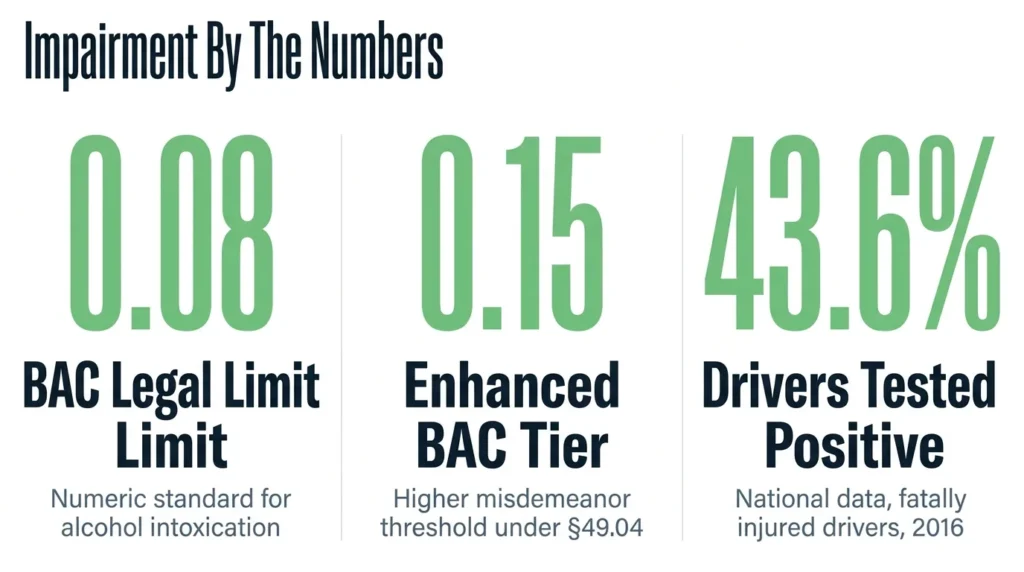
The numeric standard most people know exists only on the alcohol side. Section 49.01(2)(B) defines intoxication as having an alcohol concentration of 0.08 or more, and § 49.04 sets an enhanced misdemeanor tier at 0.15. Neither number has a drug equivalent in the statute.
So the offense under § 49.04(a) is the same regardless of what caused the impairment. A person commits it by being intoxicated while operating a motor vehicle in a public place, and prescription impaired driving fits whenever the medication left the driver without the normal use of their faculties.
Why a Drugged Driving Case Is Harder to Prove Than a Drunk Driving Case
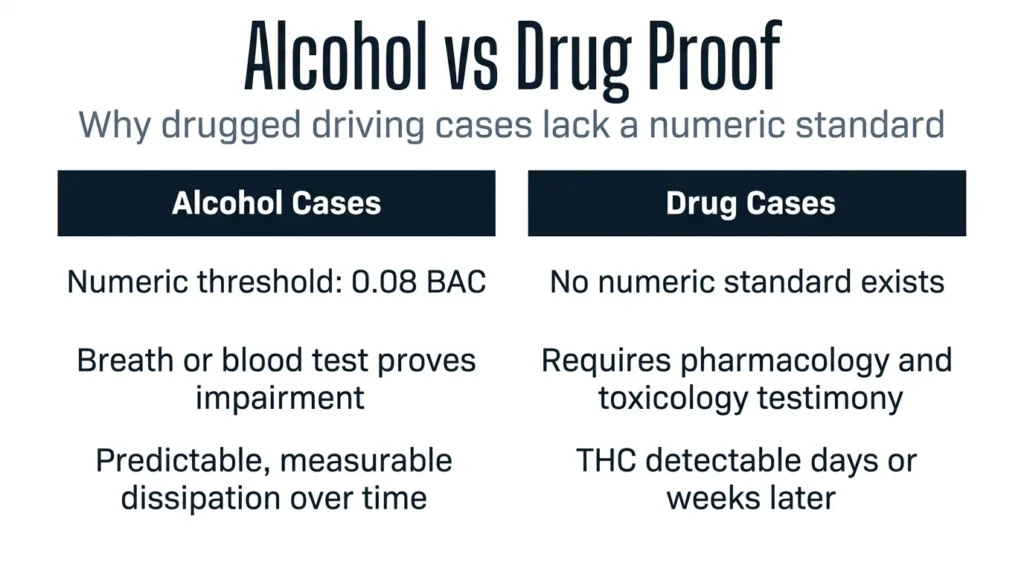
The difference comes down to a missing number. An alcohol case can rest on a lab result crossing a statutory line. A drug case has no line to cross, so it rests entirely on proving that the driver’s faculties were actually impaired at the moment of the crash.
That distinction changes the work involved. In an alcohol claim, the breath or blood number does much of the heavy lifting, which is why how a drunk driving claim is proven follows a more predictable path. In a drug claim, the same evidence that proves presence does not automatically prove impairment.
The science reflects that gap. The National Institute on Drug Abuse notes in its Drugged Driving DrugFacts publication that many states are waiting to develop laws until research can better define blood levels that indicate impairment, the way those levels are already defined for alcohol.
Timing complicates it further. NIDA points out that THC can be detected in body fluids for days or even weeks after use, so a positive test does not establish impairment at the time of driving.
None of that means prescriptions are a side issue. NIDA identifies prescription medicines, including benzodiazepines and opioids, as substances that can cause drowsiness, dizziness, and impaired cognitive functioning.
The scale is real, though the available figure is national rather than Texas-specific. NIDA cites 2016 data in which roughly 43.6% of fatally injured drivers tested positive for drugs, more than half of them for two or more.
How Impairment Actually Gets Proven: Toxicology, Pharmacology Testimony, and the Officer’s Observations
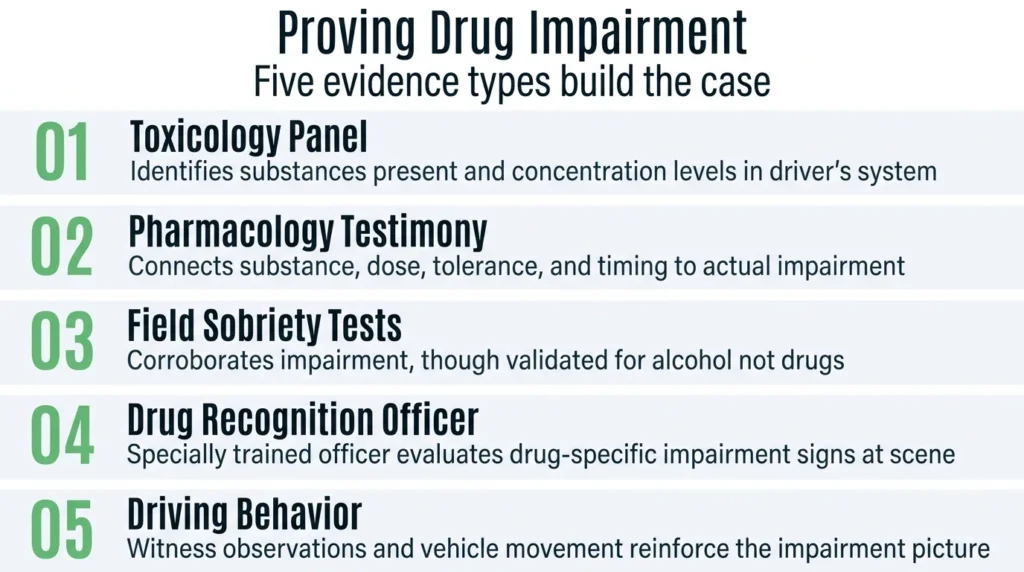
Without a per se number, impairment gets proven by assembling a chain rather than pointing at one test. Each piece answers a different question, and none carries the case alone.
- The toxicology panel establishes presence. It identifies what substances were in the driver’s system and, where the lab quantifies it, at what concentration. It does not, by itself, say the driver was impaired.
- Pharmacology and toxicology testimony supplies the missing link. A qualified witness connects the substance found, its concentration, the dose the driver took, the driver’s tolerance, and the timing of ingestion to actual impairment of driving-relevant faculties at the time of the crash.
- Standardized field sobriety tests provide corroboration, with a caveat. The familiar roadside battery of walk-and-turn, one-leg stand, and horizontal gaze nystagmus was developed and validated against blood alcohol concentration outcomes, not against drug impairment specifically.
- Some departments send an officer with additional drug-impairment training to evaluate a driver at the scene, because alcohol-focused roadside observations do not reliably identify which category of drug is involved. Published criticism of the methods behind that kind of evaluation means it belongs in the file as corroborating evidence rather than as the last word.
- The driving itself matters. How the vehicle moved before impact, what witnesses saw, and the driver’s demeanor at the scene all reinforce the impairment picture.
The officer’s observations are circumstantial support. They strengthen a case built on toxicology and qualified testimony, and cannot substitute for it.
Building the Case File: Blood Draws, Toxicology Panels, and Pharmacy Records
The evidence that decides these cases is created in the first hours and days after the crash. Knowing where it comes from means knowing the legal limits on reaching it.
- The mandatory blood specimen. Transportation Code § 724.012 requires an officer to obtain a blood specimen in defined circumstances, including where the person is arrested for an intoxication offense involving a vehicle, refuses to provide a voluntary specimen, and the officer reasonably believes the collision caused a death or serious bodily injury.
- The warrant question. Missouri v. McNeely, 569 U.S. 141 (2013) holds that the natural, gradual metabolization of a substance in the blood does not by itself create the exigency needed for a warrantless nonconsensual blood draw. A blood result obtained without a warrant and without a valid exception can face suppression in the criminal case, which can affect what toxicology evidence remains available for the civil claim.
- Pharmacy dispensing records. These show what was prescribed, at what dose, and when it was filled, which feeds directly into the dose, tolerance, and timing analysis.
- The access limits on prescription data. Texas’s Prescription Monitoring Program data under Health & Safety Code § 481.076 is confidential by statute, with access limited to specific regulatory boards, treating prescribers and dispensers, the patient, medical examiners, and law enforcement presenting a warrant, subpoena, or court order. The statute does not open that database to ordinary civil discovery.
- Where records realistically come from. In practice, pharmacy records in a civil case are more likely to come from the pharmacy’s own dispensing records, obtained through a subpoena or a HIPAA-compliant authorization, or from records already developed in the parallel criminal case.
Medical privacy rules also shape the picture. Texas Rule of Evidence 509 establishes a physician-patient privilege over confidential treatment records, with an exception where a party relies on their own physical, mental, or emotional condition as part of a claim or defense.
That exception fits an injured plaintiff’s own records cleanly. Reaching the at-fault driver’s prescription records is a separate discovery question that turns on case-specific relevance and privilege objections, so no one should promise an automatic path to them. That is why car accident claims involving medication need fast, professional evidence gathering.
How This Connects to Your Civil Injury Claim
Your claim is a civil case, not a criminal one, and it does not depend on a conviction. The criminal standard is important, because Texas law recognizes that violating a safety statute can establish the breach of the standard of care a negligence claim requires.
Impson v. Structural Metals, Inc., 487 S.W.2d 694 (Tex. 1972) is the classic Texas Supreme Court statement of that doctrine. An unexcused violation of a safety statute is negligence per se unless the defendant shows a legally acceptable excuse.
Texas courts do not apply that doctrine automatically to every statute. Perry v. S.N., 973 S.W.2d 301 (Tex. 1998) sets out the factors courts weigh before adopting a criminal statute as the civil standard of care, including whether the statute creates a new duty, whether it puts the public on clear notice, and how directly it connects to causation.
The takeaway is measured rather than absolute. Impairment evidence is powerful proof of negligence in a Texas injury case, and how a court frames it depends on the specific facts presented.
The stakes can also reach beyond ordinary damages. Civil Practice & Remedies Code § 41.008(c) provides that the statutory cap on exemplary damages does not apply where the defendant’s conduct constitutes certain felonies, expressly including intoxication assault under Penal Code § 49.07 and intoxication manslaughter under Penal Code § 49.08.
Those are the offenses a serious drug-impaired crash can produce. When they are in play, the financial picture of the case changes.
Talk to Angel Reyes & Associates About Your Drugged Driving Accident
Everything that makes these claims provable has a shelf life. Toxicology results, pharmacy records, officer notes, and witness memories get harder to secure as weeks pass, and no statutory number fills the gap if that evidence disappears.
Angel Reyes & Associates has guided injured Texans through the legal process for over 30 years, with board-certified personal injury attorneys, investigators, and accident reconstruction specialists working the evidence side of these cases. The team is reachable 24/7.
If a medicated driver hurt you or someone in your family, contact Angel Reyes & Associates for a free consultation and a clear read on your options. Every case is different, and past results do not guarantee future outcomes.
Past results do not guarantee future outcomes. Every case is unique.
Frequently Asked Questions
Does Texas law treat impairment from a legally prescribed drug any differently than impairment from an illegal drug?
No. Under Penal Code § 49.10, being legally entitled to use a substance, including a valid prescription, is not a defense to an intoxication offense. The definition of "intoxicated" in § 49.01(2)(A) covers alcohol, a controlled substance, a drug, a dangerous drug, or any other substance without distinguishing between one a doctor prescribed and one obtained illegally. What is important is whether the substance left the driver without the normal use of their mental or physical faculties, not how they obtained it.
Can over-the-counter or combined medications also count as "intoxication" under Texas's law, or only controlled substances?
The definition reaches further than controlled substances. Penal Code § 49.01(2)(A) defines intoxication as not having the normal use of mental or physical faculties by reason of alcohol, a controlled substance, a drug, a dangerous drug, a combination of those substances, or any other substance introduced into the body. That broad "any other substance" language means an over-the-counter medication, or a combination of medications, can support an intoxication finding if it actually impaired the driver, regardless of whether the substance required a prescription.
What happens to my case if the at-fault driver refused a blood test at the scene?
Refusal does not necessarily mean no blood evidence exists. Transportation Code § 724.012 requires an officer to obtain a blood specimen, even without consent, when a driver is arrested for an intoxication offense involving a vehicle, refuses to provide a voluntary specimen, and the officer reasonably believes the collision caused a death or serious bodily injury.
That said, Missouri v. McNeely established that a warrant or a recognized exception is still generally required for a nonconsensual draw. Whether that blood evidence exists and holds up depends on the specific circumstances of the stop and arrest.
Can I still prove the crash was caused by drugged driving if the police never ran a toxicology test?
A case can still move forward, but it leans more heavily on other evidence. Without a toxicology panel, the case relies on the officer’s field observations, including standardized field sobriety test performance and how the vehicle was driven before the crash, along with witness accounts and the driver’s demeanor at the scene.
Those observations are corroborating evidence rather than a substitute for toxicology, so how strong a case is without a toxicology test depends on how much other evidence was documented close to the time of the crash.
Could a drugged-driving crash increase the compensation available in my case?
It can affect more than the basic damages calculation. Civil Practice & Remedies Code § 41.008(c) provides that the statutory cap on exemplary damages does not apply where the at-fault driver’s conduct constitutes intoxication assault under Penal Code § 49.07 or intoxication manslaughter under Penal Code § 49.08. When a drugged-driving crash rises to that level, the cap that otherwise limits punitive damages does not apply.
About the Authors

Spencer Browne
Writer
Spencer Browne is a partner at Angel Reyes & Associates and a Board Certified personal injury trial lawyer with nearly 100 jury trials across Texas. He focuses on car, truck, and wrongful death cases, with notable verdicts including a landmark win in the Choctaw Casino bus crash case. A recognized speaker and legal educator, Spencer is a member of the American Board of Trial Advocates and has been honored as a Texas Super Lawyer and one of D Magazine’s Best Lawyers in Dallas. He brings deep trial experience and relentless advocacy to every client he represents.

Kyle Nicolas
Editor
Kyle Nicolas is the Web Content & SEO Manager at Angel Reyes & Associates. He has more than 10 years of experience as a marketing co...

Angel Reyes
Reviewer
Angel L. Reyes, III is the Founder and Managing Partner of Angel Reyes & Associates. A nationally recognized trial attorney and business...