How Do You Prove Fault With No Witnesses?


Every article on this site is researched by our internal team, reviewed for legal accuracy against current Texas law, and held to State Bar of Texas advertising standards before publication. We do not publish content that overstates outcomes or makes promises about results.
Learn more about our
editorial standards .
Key Takeaways
- Video, vehicle data, damage, and 911 records can help explain an unwitnessed crash.
- Texas fault depends on the applicable driving duty and what the evidence supports.
- Save original photos, camera locations, and vehicle details before repair or salvage.
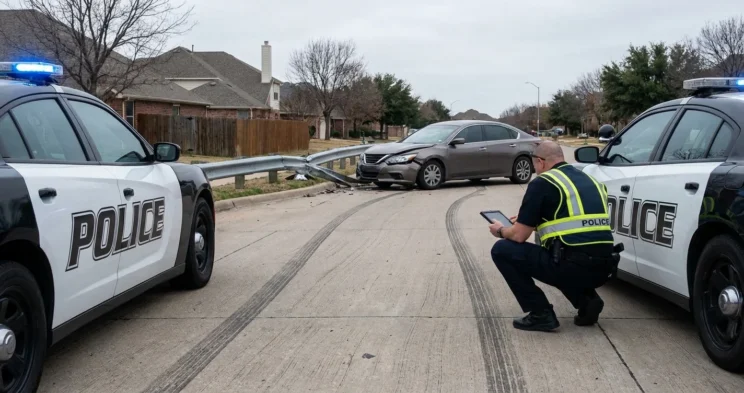
You had an accident in Dallas, which wasn’t your fault. Then you realized no one saw the crash.
You can prove fault after a car accident with no witnesses by using physical evidence, available recordings, vehicle data, and the drivers’ accounts. Those facts must show what happened and how a driver failed to meet a duty under Texas law. Conflicting accounts can feel overwhelming when medical bills arrive, but an independent eyewitness is only one possible source of proof.
What Goes Into Proving Fault in a Car Accident With No Witnesses?
The available evidence can support a reconstruction of the crash, although it may not resolve every dispute. Establishing the collision sequence and establishing fault are separate questions.
Investigators first assess the vehicles’ positions, movements, and impact. They then compare those findings with the driving duty that applied. The NHTSA Special Crash Investigations program combines scene and vehicle inspections, interviews, photographs, records, and available event data recorder information.
For example, in a hypothetical intersection dispute, an investigator might compare a business recording, impact points, and usable vehicle data against the applicable yield rule. Consistent evidence may support one driver’s account; missing timing or signal information may prevent a confident conclusion.
Impact location and the absence of witnesses do not automatically decide fault. Texas car accident lawyers can help evaluate what evidence is available when injuries prevent you from gathering it yourself.
Which Texas Driving Rules & Expert Opinions Matter?
The applicable driving rule identifies the duty at issue. Separate evidence rules govern whether a court can admit an expert’s reconstruction testimony.
Right-of-Way Duties Under Chapter 545
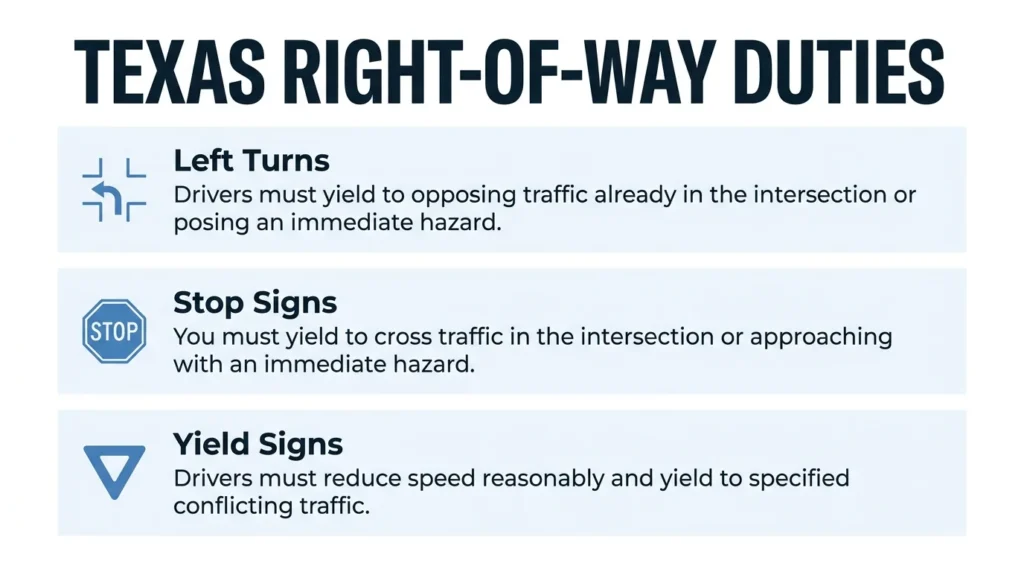
Texas Transportation Code § 545.152 requires a left-turning driver to yield to opposing traffic already in the intersection or close enough to pose an immediate hazard.
Section 545.153 addresses stop signs and yield signs. After stopping at a stop sign, a driver generally must yield to cross traffic in the intersection or approaching closely enough to pose an immediate hazard, subject to directions from police or an official traffic-control device. At a yield sign, a driver must reduce speed reasonably and yield to the specified conflicting traffic.
These duties depend on timing and position. A left turn does not automatically establish fault; reconstruction may help determine whether opposing traffic presented an immediate hazard.
Reconstruction Testimony Under Rule 702
Texas Rule of Evidence 702 permits a qualified expert to provide specialized knowledge that helps a judge or jury understand evidence or decide a disputed fact. Qualifications can come from relevant knowledge, skill, experience, training, or education.
The expert need not have witnessed the collision. Rule 703 permits reliance on appropriate facts or data, while Rule 705(c) excludes an opinion without a sufficient underlying basis.
In Gammill v. Jack Williams Chevrolet, Inc., the Texas Supreme Court required relevance and reliability for all Rule 702 expert evidence. Credentials alone are insufficient: the analysis must connect the evidence to the conclusion.
Not every case requires an expert. These are court admissibility rules, not an insurer’s mandatory claims procedure.
What Evidence Can Show How the Crash Happened?
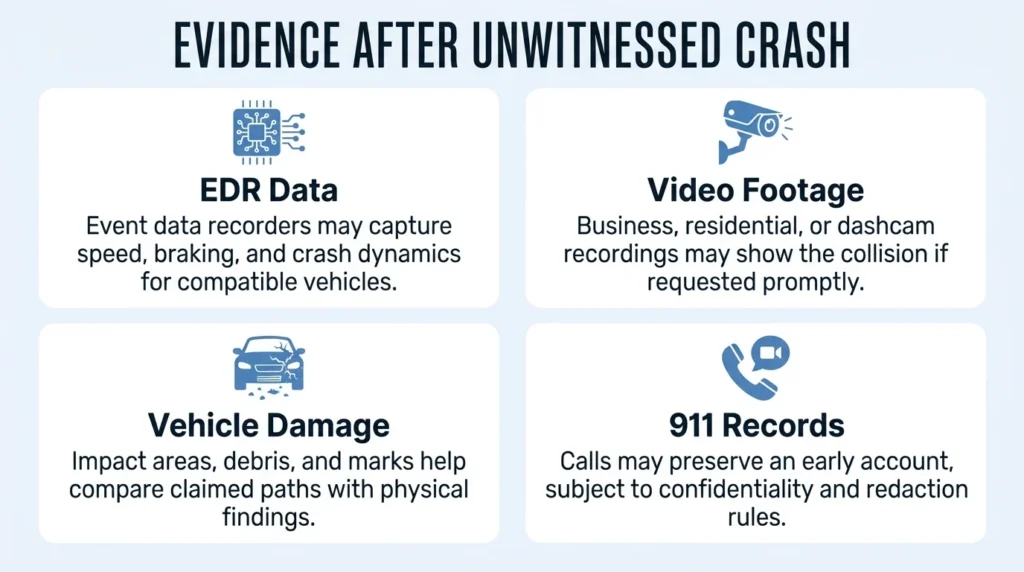
Vehicle data, recordings, damage, and scene evidence can help test competing accounts. Their usefulness depends on what exists, what it shows, and how it fits the other evidence.
Event Data Recorder Downloads
According to NHTSA, an event data recorder captures technical information around a crash event, potentially including vehicle dynamics, driver inputs, restraint status, and crash characteristics. It is not an audio or video recording of the trip.
A compatible vehicle may contain usable speed or braking data. Recorded fields, event capture, and interpretation must be checked for that vehicle.
Texas Transportation Code § 547.615 limits retrieval by someone other than the owner, with exceptions including owner consent and a court order. Counsel can assess lawful access and qualified retrieval; access to the other driver’s data is not automatic.
Business, Residential & Dashcam Video
TxDOT says its live traffic camera footage is not recorded. Its camera guidance distinguishes live monitoring from a recording you could request after a crash.
Nearby businesses, homes, parking facilities, or dashcams may have recorded the collision. Ask owners promptly whether footage exists and covers the relevant area and time. Partial views and incorrect timestamps need checking against other evidence.
Vehicle Damage & Scene Evidence
Investigators compare impact areas, debris, visible marks, resting positions, and road layout with the drivers’ accounts. Damage patterns can help assess whether a claimed path of travel fits the physical findings.
Damage alone does not establish exact speed, a traffic signal’s color, or which driver had priority.
911 Audio & Records
A 911 call may preserve an early account or reported location. Request available audio and incident information from the actual custodial agency; confidentiality, redaction, and its records process can limit access. Dallas police general orders, for example, address open-records handling and 911 audio redaction.
The caller may have seen only the aftermath. A recording is not automatically accurate or admissible; the Texas evidence rules’ present-sense-impression and excited-utterance exceptions apply only when their conditions are met.
What Should You Preserve in the First Days?
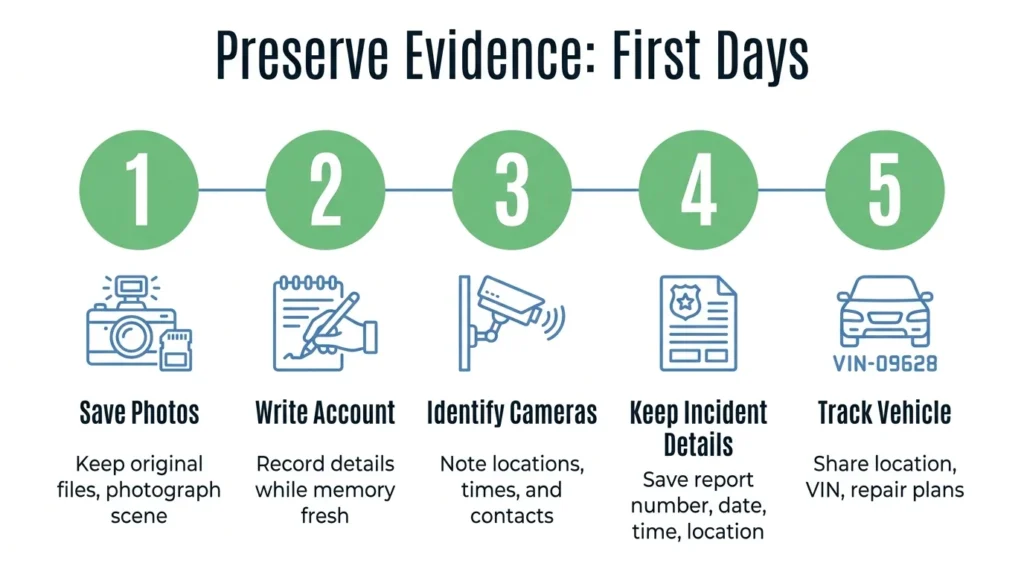
After attending to safety and medical needs, save original files, identify possible camera owners, and locate the damaged vehicle. Never enter active traffic or delay emergency care to gather evidence:
- Save photographs and messages. Keep original files and, when safe, photograph all involved vehicles, impact areas, signs, road layout, debris, and visible marks.
- Write your account. Record what you recall while it is fresh, including your direction of travel and the moments before impact.
- Identify cameras. Note locations, approximate crash time, travel direction, and contacts. Ask promptly to preserve the relevant time window; do not assume footage remains available.
- Keep incident details. Save the report or incident number, crash date, time, and location for requests to the agency holding 911 materials.
- Track the vehicle. Give counsel its location, ownership information, VIN if available, and any planned repair, sale, or salvage date. Do not remove modules or experiment with the vehicle.
Counsel can evaluate preservation requests, lawful data access, records, and expert involvement. These steps cannot guarantee that evidence exists or will be released.
In Brookshire Brothers, Ltd. v. Aldridge, the Texas Supreme Court explained that a preservation duty arises when a party knows or should know of a substantial chance of a claim and the material relevance of evidence in its possession or control. Courts decide remedies for lost evidence; missing footage does not automatically prove fault.
What If the Other Driver Left & There Were No Witnesses?
In a hit and run accident with no witnesses, identifying the departing vehicle is an additional task. Departure does not, by itself, establish who caused the impact.
Available video, scene evidence, damage, records, and early accounts may help. The vehicle may remain unidentified, or the evidence may be inconclusive. A crash where both drivers stayed can also have no independent witnesses.
Talk With Angel Reyes & Associates About an Unwitnessed Crash
Angel Reyes & Associates can review your situation and discuss what evidence may still be available, including whether data retrieval or expert help makes sense. Bring your photos, incident details, and vehicle information to a free consultation. Our attorneys are here to help.
Past results do not guarantee future outcomes.
Proving Fault With No Witnesses FAQs
Can I still recover compensation if I was partially at fault for a Texas car accident?
Possibly. Under Texas proportionate-responsibility law, a claimant generally cannot recover damages if the claimant’s percentage of responsibility is greater than 50 percent, while a claimant at 50 percent or less may recover a reduced amount.
Can text messages or cell phone records prove distracted driving after a Texas crash?
Potentially, records may provide evidence relevant to whether a driver was using a phone around the time of a collision. Access to those records and whether they establish distracted driving depend on the circumstances and available evidence.
Does admitting fault at the accident scene prove liability in Texas?
A statement made after a crash may become relevant evidence, but a driver’s statement alone does not necessarily establish legal liability. Its significance depends on the exact statement and the other evidence concerning how the collision occurred.
What if there is no police report after a Texas car accident with no witnesses?
A missing police report does not necessarily prevent someone from proving a claim, but it may mean there is one less contemporaneous source of information about the collision. Other evidence, including photographs, vehicle damage, medical records, video, and available electronic data, may still be relevant.
About the Authors

Angel Reyes
Writer
Angel L. Reyes, III is the Founder and Managing Partner of Angel Reyes & Associates. A nationally recognized trial attorney and business leader, Angel has helped over 70,000 injury victims recover more than $1 billion since founding the firm in 1993. Named to the Texas Super Lawyers list annually since 2008, Angel brings Wall Street experience, Ivy League education, and a deep commitment to client advocacy. He is a frequent legal commentator and published author with extensive contributions to legal scholarship, trial strategy, and consumer protection.

Kyle Nicolas
Editor
Kyle Nicolas is the Web Content & SEO Manager at Angel Reyes & Associates. He has more than 10 years of experience as a marketing co...

Angel Reyes
Reviewer
Angel L. Reyes, III is the Founder and Managing Partner of Angel Reyes & Associates. A nationally recognized trial attorney and business...