Why Do You Still Have Headaches After a Car Accident?


Every article on this site is researched by our internal team, reviewed for legal accuracy against current Texas law, and held to State Bar of Texas advertising standards before publication. We do not publish content that overstates outcomes or makes promises about results.
Learn more about our
editorial standards .
Key Takeaways
- Post-traumatic headache can begin days after a crash and still be a valid claim.
- Texas law treats a reporting gap as a causation argument, not a bar to recovery.
- A dated first headache complaint and neurology referral support expert causation.
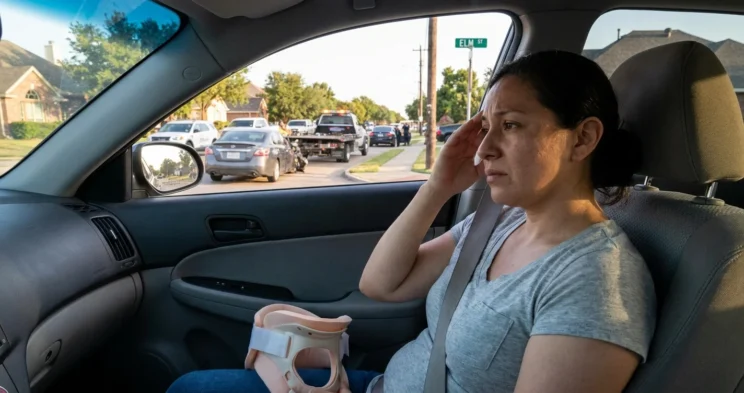
Three weeks after a rear-end collision on I-35, the headaches are still coming. They build behind your eyes by mid-afternoon, and nothing in the medicine cabinet touches them.
You still have headaches after a car accident because trauma to the head can keep generating pain long after the crash, and medicine has a name and a diagnostic standard for it. Post-traumatic headache is a recognized diagnosis, and it covers cases where the pain did not begin the day of the wreck.
That last part is where Texas claims get difficult. When your first headache complaint is dated weeks after the collision, the insurance company argues something else caused it.
The answer to that argument is not a better diagnosis. It is a better documented timeline.
What Counts as a “Post-Traumatic Headache,” Medically
Post-traumatic headache is the clinical name for a headache caused by trauma or injury to the head.
The International Classification of Headache Disorders, 3rd edition sets the criteria neurologists work from, and Section 5 is the part that applies after a collision.
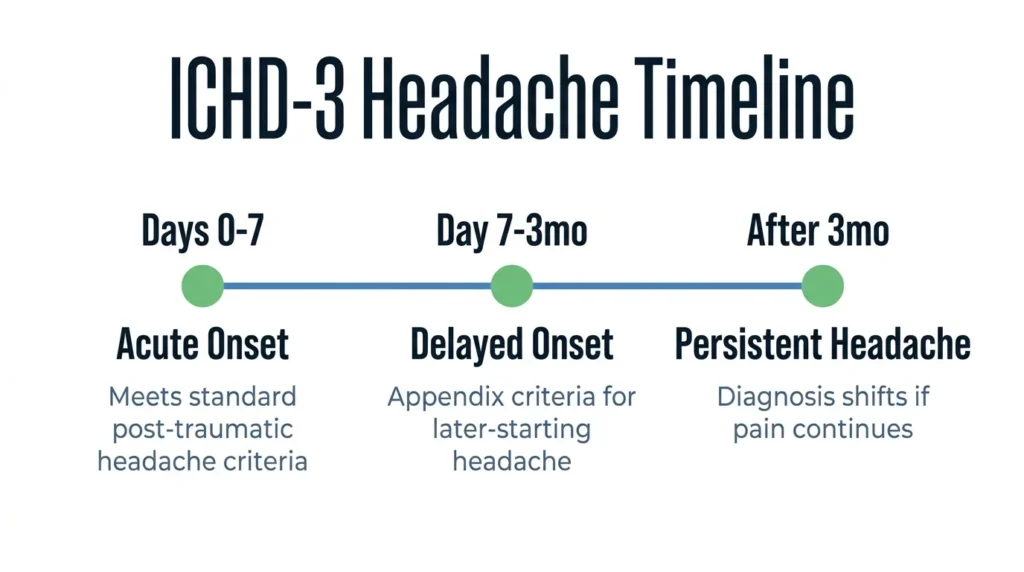
In the acute category, the headache lasts less than three months and follows a traumatic injury to the head, such as an impact or another external force. The formal criteria ask for onset within seven days of the injury, or within seven days of regaining consciousness or the ability to sense and report pain.
That seven-day line shapes how your records read, so it is worth knowing that ICHD-3 itself calls the cutoff “somewhat arbitrary.” The classification includes appendix criteria for delayed-onset headache that begins after the seven-day mark, up to the three-month boundary.
When the headache has not resolved within three months of the injury, the diagnosis shifts to persistent headache attributed to traumatic injury to the head.
The headache also rarely travels alone. Clinical references including StatPearls describe it alongside dizziness, fatigue, poor concentration, memory problems, insomnia, anxiety, irritability, and personality change.
How Common Is a Delayed Headache After a Crash?
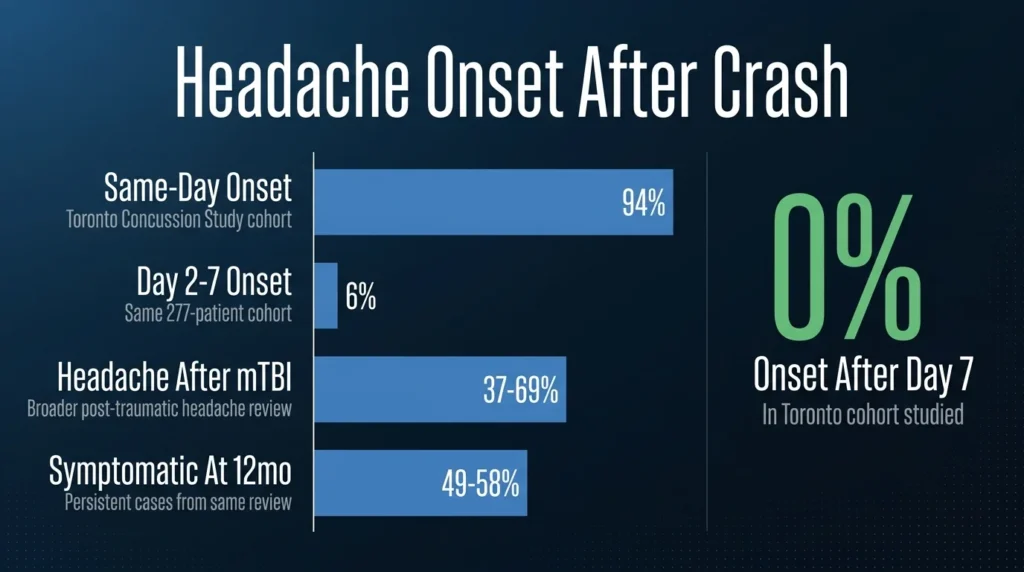
Most post-traumatic headaches start fast. A later start is less common, but it is documented in the clinical literature, and the diagnostic system was built to account for it:
- A peer-reviewed reanalysis of the Toronto Concussion Study, covering 277 emergency-department patients with post-concussion headache, found 94% reported onset the day of injury or the next day, 6% between day two and day seven, and none beyond day seven in that group. Those figures describe one post-concussion cohort, not every Texas crash.
- A broader review of post-traumatic headache reports the condition in 37% to 69% of patients after a mild traumatic brain injury, with 49% to 58% still symptomatic at 12 months.
- That same review describes delayed post-traumatic headache developing hours, days, or even weeks after the injury, less often than immediate onset but often enough to be a recognized presentation.
- Risk factors for a longer course include female sex, younger age, a history of migraine or other headaches, loss of consciousness, and co-occurring anxiety, depression, or PTSD.
A headache that first appeared on day ten is unusual, then. It is not medically unexplainable, and the classification has a pathway for it.
Why Insurers Fight a Delayed-Onset Headache Claim in Texas
An insurer blaming your headache on something other than the crash is making a causation argument, not citing a rule that ends your case. A gap between the collision and your first complaint affects the weight your evidence carries, not whether it can be used at all.
It is an argument you can answer, and it sits inside the same causation question every Texas car accident claim has to satisfy.
A Texas negligence claim requires proximate cause, which has two parts. Cause-in-fact asks whether the negligent act was a substantial factor without which the harm would not have occurred, and foreseeability asks whether the harm was a predictable result.
Proving that a crash caused one specific medical condition generally takes expert medical testimony. Texas courts allow a narrower route through lay testimony, but only for conditions within a layperson’s common experience that did not exist before the crash, appeared close in time to it, and are the kind of harm a layperson would recognize crashes as commonly causing.
Read that list again with a delayed headache in mind. A headache that began two weeks later is not close in time to the crash, so the lay shortcut is a poor fit for exactly the cases insurers fight hardest.
That leaves the expert path, and the expert path runs on records. A physician cannot form a causation opinion from your description alone, which is why the documented timeline does more work here than the diagnosis does.
No Texas statute or case decision sets a deadline for how quickly you must report a symptom. The specific day counts and discount figures circulating online come from claims-handling practice, not from law. The adjuster’s job is to close your file for as little as possible, and an unexplained gap is the cheapest tool available.
The Evidence That Connects Your Headache to the Crash
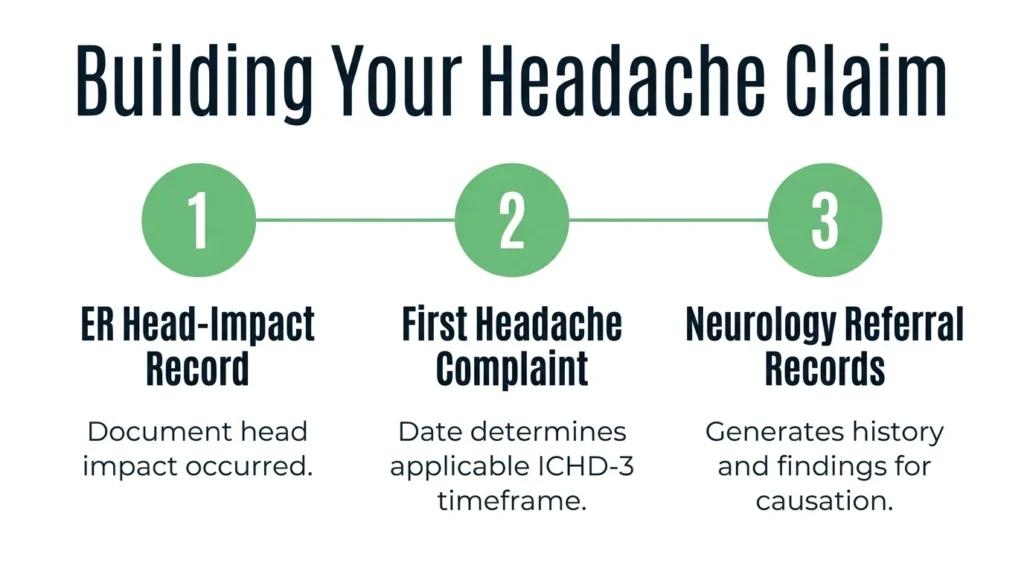
Three records carry most of the weight in a delayed-onset headache claim. Build them in this order:
- The emergency record documenting head impact. A short ER or urgent-care note stating that your head struck something, was struck, or sustained a head-injury mechanism anchors the injury to the crash date. A note describing whiplash or rapid deceleration alone is weaker than a documented impact, so answer intake questions about your head specifically.
- The first headache complaint, with its date. Because the ICHD-3 criteria turn on the interval between injury and onset, this date decides whether your headache fits the acute seven-day criteria, the delayed-onset appendix pathway, or looks unconnected. Report the symptom to whichever provider you see next, and confirm the date is in the chart.
- The neurology referral and the records it produces. A referral shows a provider took the complaint seriously enough to escalate care, and the workup generates the history, exam findings, and clinical impression a physician needs to form a causation opinion.
The practical rule across all three is the same. Tell a provider as soon as symptoms appear and get it in writing, because no source sets an optimal number of days and every day of silence is a day the defense can characterize differently.
If your symptoms come and go, say so at the visit. A charted note explaining a fluctuating course is far more useful later than a memory of it.
Talk to a Lawyer About Your Headache Symptoms
When an adjuster uses the date of your first headache complaint to argue your injury came from somewhere else, you do not have to assemble the response alone. Angel Reyes & Associates has guided injured Texans through the legal process for more than 30 years, and the firm works on contingency, so there is no upfront cost to you.
The work starts with collecting the emergency records, the dated first complaint, and the neurology referral that lets a physician speak to causation.
Request a free consultation to review where your records stand and what your options are.
Past results do not guarantee future outcomes.
Post-Car Accident Headache FAQs
Can I still file a claim if my headaches started weeks after my car accident?
Yes. A delayed headache complaint affects how much weight your evidence carries, not whether you can bring a claim. Texas law treats the gap as a causation argument, not an automatic bar to recovery, and documentation plus an expert medical opinion can answer it.
Do I need a doctor's opinion to prove my headache was caused by the crash, or can I testify to it myself?
Proving a crash caused a specific condition like a headache generally requires expert medical testimony. Texas courts allow a narrower lay-testimony shortcut only when the condition appeared close in time to the crash, which a delayed headache usually does not. That is why a documented timeline matters to the physician forming that opinion.
What should I do if I did not report a headache right after my accident?
Report the symptom to a provider as soon as it appears and make sure the date is noted in your chart. No source sets a fixed reporting deadline under Texas law, so the goal is simply a dated record. If symptoms come and go, mention that pattern at the visit so it is documented.
Does whiplash alone cause post-traumatic headaches, or does it require a direct head impact?
A documented head impact is stronger evidence for this diagnosis than whiplash or rapid deceleration alone. Post-traumatic headache under ICHD-3 requires traumatic injury to the head, so records noting that mechanism carry more weight. If your records only describe whiplash, tell your provider about any head impact you experienced.
About the Authors

Angel Reyes
Writer
Angel L. Reyes, III is the Founder and Managing Partner of Angel Reyes & Associates. A nationally recognized trial attorney and business leader, Angel has helped over 70,000 injury victims recover more than $1 billion since founding the firm in 1993. Named to the Texas Super Lawyers list annually since 2008, Angel brings Wall Street experience, Ivy League education, and a deep commitment to client advocacy. He is a frequent legal commentator and published author with extensive contributions to legal scholarship, trial strategy, and consumer protection.

Kyle Nicolas
Editor
Kyle Nicolas is the Web Content & SEO Manager at Angel Reyes & Associates. He has more than 10 years of experience as a marketing co...

Angel Reyes
Reviewer
Angel L. Reyes, III is the Founder and Managing Partner of Angel Reyes & Associates. A nationally recognized trial attorney and business...