How Are Loss of Use Damages Calculated in Texas?


Every article on this site is researched by our internal team, reviewed for legal accuracy against current Texas law, and held to State Bar of Texas advertising standards before publication. We do not publish content that overstates outcomes or makes promises about results.
Learn more about our
editorial standards .
Key Takeaways
- Loss of use damages pay for your time without a car, separate from the car's value.
- A 2016 Texas Supreme Court decision extended the claim to totally destroyed vehicles.
- Rental invoices, comparable rates, and a dated timeline are what prove the claim.
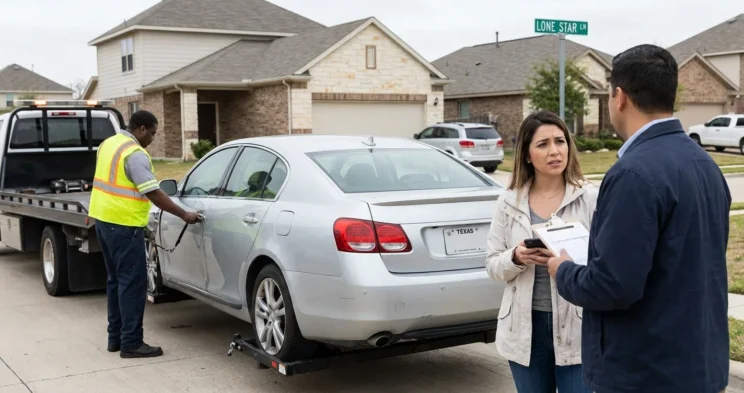
The crash took your car off the road, and everything that followed cost you something. You had to arrange rides, rearrange your mornings around someone else’s schedule, and wait for an adjuster to decide what your vehicle was worth.
Texas law recognizes those loss of use damages and treats them as their own claim, separate from the money that pays for the vehicle. It applies whether your car was repaired or written off as a total loss.
What Loss of Use Damages Pay For
Loss of use damages compensate you for the reasonable period you spent without your vehicle. Texas courts treat this as consequential damage, meaning it is separate from the direct damage to the vehicle itself.
Direct damages are the car’s value immediately before the crash. Loss of use damages cover the cost of being without the car during the reasonable time needed to repair or replace it.
The check for the vehicle does not absorb or cancel the claim for the days you had no vehicle. They are two separate line items, and an insurer that has paid one has not necessarily paid the other.
The Texas Supreme Court confirmed this distinction in its 2016 opinion on loss of use damages, describing the claim as compensation for the reasonable period of lost use of the property.
When another driver damages or destroys your vehicle, a Texas car accident claim may include both types of compensation.
The 2016 Texas Supreme Court Decision on Totaled Vehicles
The Texas Supreme Court changed this rule in 2016, primarily affecting drivers whose vehicles were declared a total loss.
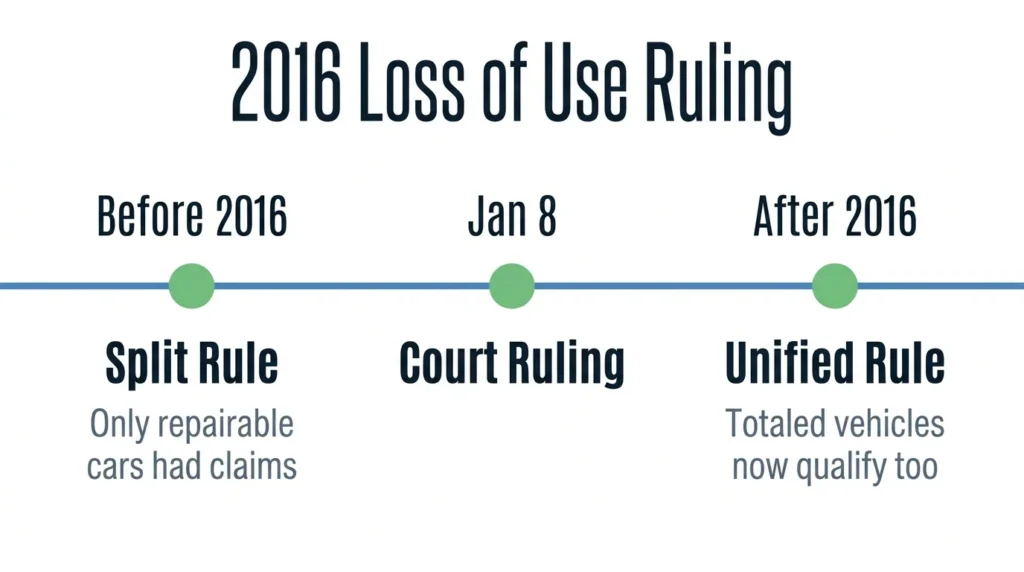
Before then, Texas allowed loss of use damages when a vehicle was repairable but barred them when the vehicle was destroyed. Two drivers could spend the same number of days without transportation, while only the person whose car could be repaired had a claim for that time.
On January 8, 2016, the Texas Supreme Court ended that split in J&D Towing, LLC v. American Alternative Insurance Corp., 478 S.W.3d 649 (Tex. 2016). The Court held that the owner of personal property that has been destroyed may recover loss of use damages in addition to the fair market value of the property immediately before the injury.
The case involved a towing company whose only tow truck was destroyed by a negligent driver, so the ruling directly addresses loss of use for work and commercial vehicles.
The holding uses general property terms and is not limited to commercial owners. The Court also relied on an earlier Texas case involving a personal automobile to explain how to measure damages. Whether a passenger vehicle owner can recover still depends on the claim’s facts and evidence.
How the Amount Is Measured & How Long the Clock Runs
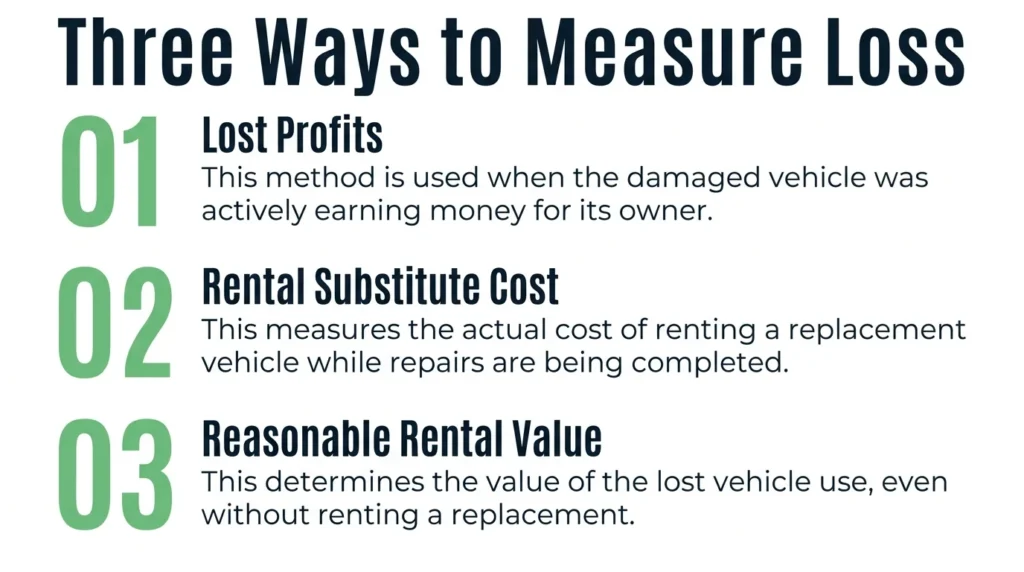
Your loss measures the amount, and the clock stops when waiting any longer is no longer reasonable. The Texas Supreme Court recognizes three ways to measure the loss:
- Lost profits, when the vehicle was earning money
- The cost of renting a substitute vehicle
- The reasonable rental value of the vehicle you lost
Rental Cost & Reasonable Rental Value
For an ordinary personal vehicle, the measure runs through rental value rather than lost profits. You do not have to rent a replacement to have a claim.
Texas law holds that the reasonable rental value of a substitute vehicle is enough evidence to support an award, even when a driver never rented anything. This allows someone who could not afford the upfront rental cost to seek compensation for the loss.
Rental value may be calculated by the day, week, or month, depending on the type of vehicle involved.
The Reasonable Replacement Period
You cannot recover for longer than the time reasonably needed to repair or replace the vehicle. You are also expected to take reasonable steps to limit the length of the loss.
You cannot base damages on guesswork. You do not need to prove the amount with mathematical precision, but you do need records or other evidence supporting the time and value claimed.
Texas law does not impose a fixed number of recoverable days. A judge or jury considers the claimant’s circumstances when deciding what period was reasonable.
The Records That Prove the Time Without a Vehicle
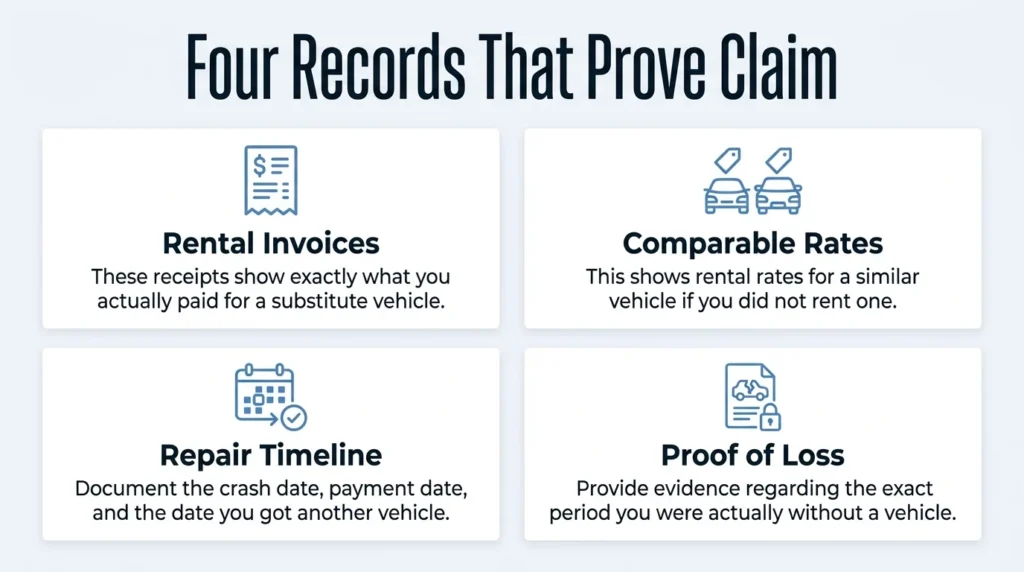
Four types of records can support a loss of use claim, and each is easier to gather while repairs or replacement are still in progress.
- Rental invoices and receipts showing what you actually paid for a substitute vehicle
- Comparable rental rates for a similar vehicle, when you did not or could not rent one
- The repair or replacement timeline, including the crash date, the payment date, and the date you got another vehicle
- Evidence of the period you were actually without a vehicle
Rental invoices directly show the amount charged. When you did not rent a vehicle, comparable rental rates can establish its reasonable rental value.
Texas courts have accepted testimony from someone in the rental business and testimony from the owner. No rule requires you to hire an expert.
The dated sequence helps establish the recoverable period and allows the adjuster to determine whether that period was reasonable.
Where Insurance Fits
Your right to loss of use damages runs against the at-fault driver. The Texas Department of Insurance says that the driver’s insurance should pay for your repairs, medical bills, and a rental car. However, that guidance does not guarantee payment in every claim.
Your own collision coverage may pay to repair or replace your car after a crash. Rental reimbursement is separate optional coverage that you must purchase before the crash.
An insurer may pay for a rental only for the time it believes is reasonable to repair or replace your car. The insurer’s approved rental period may be shorter than the time you were without transportation.
If a company refuses to pay, ask for the reason in detail and in writing, then treat that letter as evidence rather than a final answer. Texas generally gives you two years from the date a claim accrues to file suit over injury to your property or your person.
Talk to a Lawyer About Your Time Without a Vehicle
The days you spend without a vehicle are a loss, and the paperwork to prove them is easiest to assemble while the repair or replacement is still underway. Angel Reyes & Associates has guided injured Texans through claims like this for over 30 years.
Contact Angel Reyes & Associates for a free consultation and a plain review of your options.
Past results do not guarantee future outcomes.
Texas Loss of Use FAQs
Can I recover loss of use damages if I borrowed a car from a friend or family member?
Potentially. Texas law does not require you to rent a replacement vehicle to recover loss of use damages, so having access to borrowed transportation does not automatically eliminate a claim.
Can rideshare or taxi expenses be part of a Texas property damage claim?
Reasonable transportation expenses may show losses caused by being without your vehicle, although Texas courts commonly measure vehicle loss of use through reasonable rental value. The recoverable amount depends on the evidence and circumstances of the claim.
Does loss of use apply to motorcycles, trucks, and other vehicles in Texas?
Yes. The Texas Supreme Court’s loss of use rule applies broadly to personal property, not just passenger cars, so other types of vehicles may qualify when you can prove the required damages.
What happens to loss of use damages if the insurance company delays a total loss settlement?
An insurance delay does not automatically make every additional day compensable. The key question is whether the claimed period remained a reasonable amount of time to replace the vehicle under the circumstances.
Can I claim both diminished value and loss of use after a Texas car accident?
They compensate for different alleged losses: diminished value concerns a vehicle’s reduction in market value after damage and repair, while loss of use concerns being deprived of the vehicle. Whether both are recoverable in a particular case depends on the vehicle damage, the measure of direct damages, and the supporting evidence.
About the Authors

Spencer Browne
Writer
Spencer Browne is a partner at Angel Reyes & Associates and a Board Certified personal injury trial lawyer with nearly 100 jury trials across Texas. He focuses on car, truck, and wrongful death cases, with notable verdicts including a landmark win in the Choctaw Casino bus crash case. A recognized speaker and legal educator, Spencer is a member of the American Board of Trial Advocates and has been honored as a Texas Super Lawyer and one of D Magazine’s Best Lawyers in Dallas. He brings deep trial experience and relentless advocacy to every client he represents.

Graham Griffin
Editor
Graham Griffin is the Web & Content Manager at Angel Reyes & Associates, where he oversees content strategy, AI-powered workflows, a...

Angel Reyes
Reviewer
Angel L. Reyes, III is the Founder and Managing Partner of Angel Reyes & Associates. A nationally recognized trial attorney and business...