Can You Get Depression After a Car Accident?


Every article on this site is researched by our internal team, reviewed for legal accuracy against current Texas law, and held to State Bar of Texas advertising standards before publication. We do not publish content that overstates outcomes or makes promises about results.
Learn more about our
editorial standards .
Key Takeaways
- Depression after a car accident is common, but common does not mean legally compensable
- Texas requires proof of anguish that substantially disrupted your daily routine
- A formal diagnosis, treatment records, and expert causation testimony carry the claim
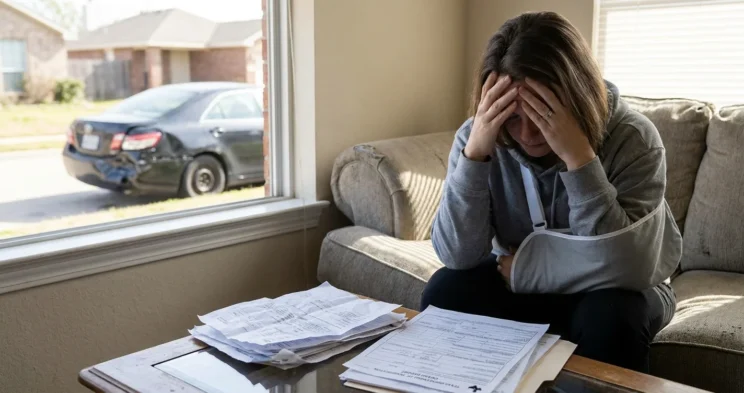
Weeks after the crash, the car is repaired and the bruises have faded. You still are not sleeping well. Merging onto I-35 tightens your grip on the wheel, and the things you used to look forward to feel flat.
Depression after a car accident is a common, clinically recognized reaction, and it is not a sign of weakness. Texas law, though, asks a narrower question than your doctor does.
Ordinary sadness and worry are not compensable in a Texas injury claim. A formally diagnosed condition, documented over time and connected to the crash by a qualified professional, can be.
Knowing where that line sits is what protects your claim.
Is Depression a Normal Reaction Following a Car Accident?
Depression and related emotional distress after a crash are common enough that researchers have studied them for decades. What the studies do not give us is one clean number.
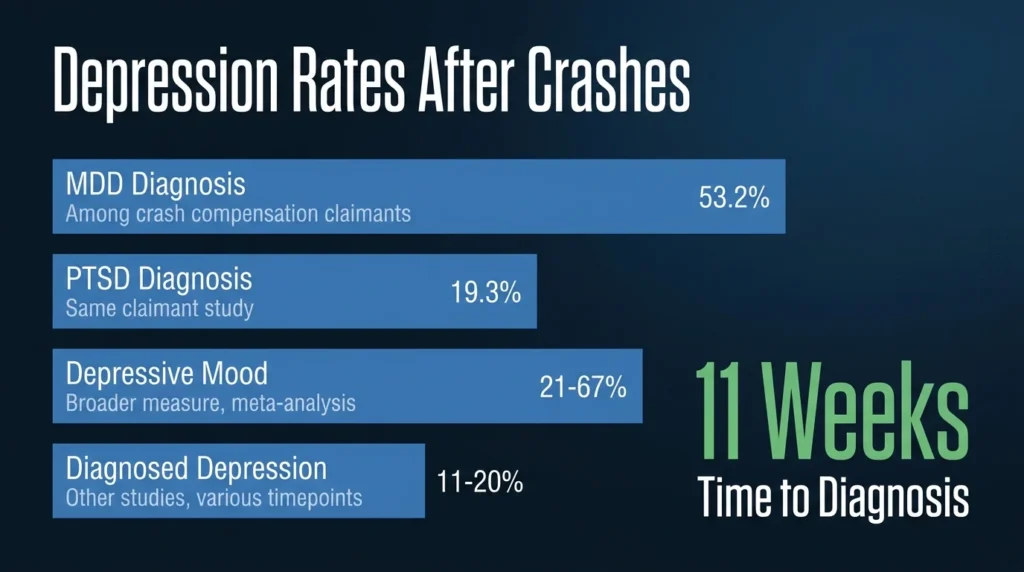
Reported rates move a great deal depending on how long after the crash people were screened, how severe their injuries were, and which screening tool researchers used:
- A study of adults injured in motor vehicle crashes who had filed compensation claims found that 53.2% met full criteria for major depressive disorder and 19.3% for post-traumatic stress disorder at an average of 11 weeks after the crash.
- A systematic review and meta-analysis of 24 studies covering 4,502 injured participants reported that 21% to 67% of crash survivors experience depressive mood, a broader measure than a formal diagnosis, with distress remaining elevated for at least three years in some injury groups.
- Other studies in the same body of literature land closer to 11% to 20% for diagnosed depression at various points after a crash.
Two cautions belong with those figures. Most of the underlying studies did not account for a person’s mental health before the crash or for the stress of pursuing a claim, and none of this research is specific to Texas.
After a crash, two diagnoses come up most often. An adjustment disorder is the time-limited reaction most people would call expected. A major depressive episode is the persistent, full condition. Which one a treating provider documents is what usually decides whether Texas law will compensate it.
How an Adjustment Disorder Differs From a Major Depressive Episode
The difference comes down to timing, severity, and whether the symptoms fade when the stressor does.
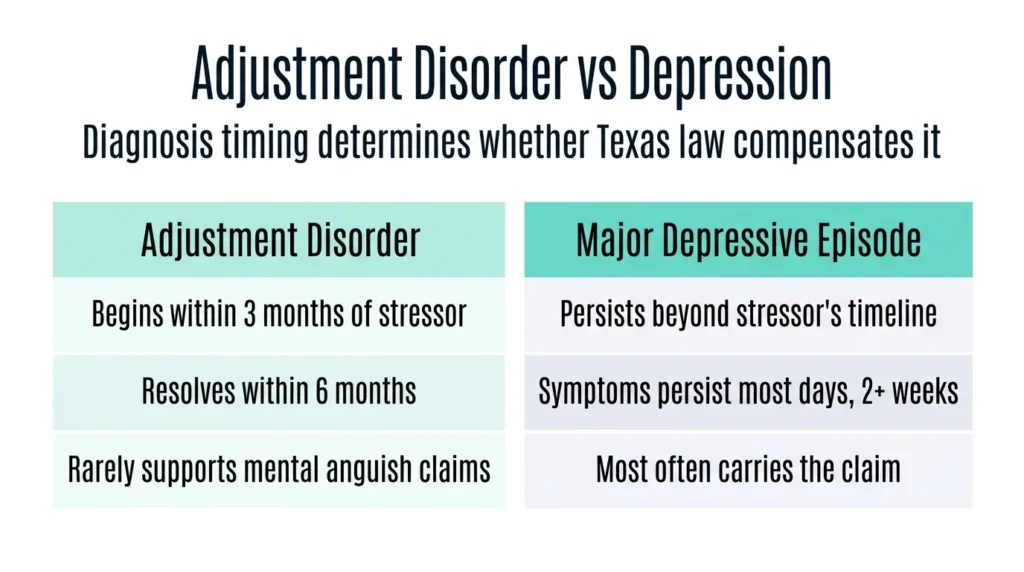
Under the DSM-5, an adjustment disorder requires emotional or behavioral symptoms that begin within three months of an identifiable stressor such as a crash. Those symptoms must be out of proportion to the stressor or must meaningfully impair daily functioning, and they must not persist more than six months after the stressor and its consequences have ended.
One rule inside that definition matters enormously for a claim. An adjustment disorder cannot be diagnosed if the person meets full criteria for another condition, including major depressive disorder.
A complete depressive syndrome gets diagnosed as depression, not as an adjustment reaction.
Major depressive disorder requires a depressed mood or loss of interest and pleasure, plus associated symptoms such as appetite or weight change, sleep disturbance, fatigue, feelings of worthlessness or guilt, trouble concentrating, or recurrent thoughts of death. Those symptoms must be present most of the day, nearly every day, for at least two weeks.
The practical distinction is that an adjustment disorder runs on the stressor’s timeline and resolves. A major depressive episode does not, and it is the diagnosis that most often carries a mental anguish claim.
The Texas Legal Standard for Mental Anguish Damages
Feeling shaken up after a wreck is not enough. Texas requires real evidence of something substantially worse.
In Parkway Co. v. Woodruff, the Texas Supreme Court defined mental anguish as a relatively high degree of mental pain and distress, well beyond mere disappointment, anger, resentment, or embarrassment. The court described compensable anguish in terms of painful emotions such as grief, severe disappointment, indignation, shame, or despair.
To support an award, a claimant needs direct evidence of the nature, duration, and severity of the anguish, enough to show a substantial disruption of daily routine. Other evidence of a high degree of mental pain and distress can also work, as long as it goes past ordinary worry, anxiety, vexation, or anger.
That proof can come from your own testimony, from people who know you, or from a treating professional.
Saenz v. Fidelity & Guaranty Insurance Underwriters adds a second requirement. There must be evidence supporting both the existence of the anguish and the amount awarded for it. A claimant who simply asserts distress, with nothing behind the assertion, recovers nothing for it.
A documented adjustment disorder or major depressive episode, backed by a treatment history, is the kind of necessary evidence. The same standard governs pain and suffering damages after a car accident more broadly.
Overcoming the Insurer’s Causation Defense
Expect the insurance company to argue that your depression came from somewhere else. A divorce, a job loss, a death in the family, or a prior episode of depression all become talking points for an adjuster. That is how the business works.
Texas law gives that argument real footing. In Guevara v. Ferrer, the Texas Supreme Court held that expert medical testimony is required to prove what caused a medical condition, unless the condition and its connection to the incident fall within the common knowledge and experience of ordinary people. The court’s example of what lay testimony can establish was obvious injuries such as broken bones or lacerations.
A psychiatric diagnosis is not that kind of obvious injury. It needs a qualified professional to connect it to the crash.
The court also rejected timing as a substitute for proof. Evidence that symptoms appeared after the crash raises suspicion, but suspicion is not legally sufficient to establish causation. “It started after the wreck” is not an argument that survives review.
Two things answer this defense. The first is a documented picture of your mental health before the crash, which is what rebuts the claim that this was already there or came from unrelated life stress.
The second is professional testimony explaining the clinical relationship between the crash and the onset or worsening of your condition, not just the sequence of dates.
If you were already managing depression or anxiety before the crash, that does not end your claim. Texas law has long recognized that a defendant is responsible for aggravating a pre-existing condition, even though damages are limited to the worsening the crash caused. Getting that distinction documented early protects you in a Texas car accident claim.
Building the Evidence Spine for Your Claim
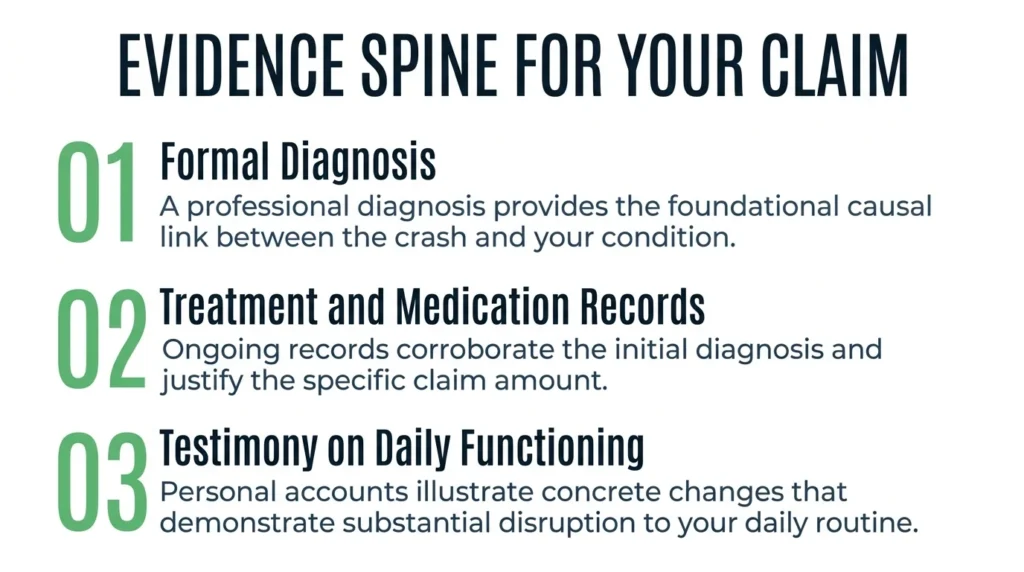
Three categories of evidence, used together, satisfy both the mental anguish standard and the causation requirement. No other theory is needed:
- A formal evaluation and diagnosis from a licensed psychiatrist, psychologist, or qualified mental health professional. This converts how you feel into a diagnosed condition measured against recognized criteria and tied to the crash.
- Treatment and medication records, including therapy notes, prescriptions, and any hospitalization records. These corroborate the diagnosis over time and support both the existence of the anguish and the amount claimed for it.
- Testimony about changed daily functioning from you, your family, friends, or coworkers. Concrete, observable changes such as withdrawing from activities, being unable to work or drive, or strain on close relationships supply the substantial disruption of daily routine that Texas requires.
The records prove the condition. The people in your life prove what it cost you. Missing either piece is what usually weakens an otherwise legitimate claim.
Talk to a Lawyer About Your Emotional Injuries
A diagnosed condition, a documented course of treatment, and clear evidence of how your daily life changed can support a claim for mental anguish damages in Texas. Getting those three things on the record early, before an adjuster builds a story about unrelated life stress, is the part that most often decides how the claim goes.
Angel Reyes & Associates has guided injured Texans through the legal process for over 30 years. Contact Angel Reyes & Associates for a free consultation to talk through your situation and your options.
Past results do not guarantee future outcomes.
Depression After a Car Accident FAQs
How long can depression last after a car accident?
There is no single recovery timeline. Symptoms may improve with treatment, while some people experience persistent depression or other trauma-related conditions that require longer-term care.
Can PTSD and depression occur together after a car accident?
Yes. A person can experience both post-traumatic stress disorder and a depressive disorder after a crash, although a qualified mental health professional must determine whether the diagnostic criteria for either condition are met.
Can depression after a car accident affect your ability to work?
Yes. If crash-related depression causes documented problems with concentration, attendance, productivity, or the ability to perform job duties, those limitations may be relevant to damages for lost earning capacity or income under Texas law.
What should I do if I develop depression months after a car accident?
Seek an evaluation from a qualified mental health professional and keep records of symptoms, treatment, medications, and changes in daily functioning so the condition and its relationship to the crash can be properly documented.
About the Authors

Angel Reyes
Writer
Angel L. Reyes, III is the Founder and Managing Partner of Angel Reyes & Associates. A nationally recognized trial attorney and business leader, Angel has helped over 70,000 injury victims recover more than $1 billion since founding the firm in 1993. Named to the Texas Super Lawyers list annually since 2008, Angel brings Wall Street experience, Ivy League education, and a deep commitment to client advocacy. He is a frequent legal commentator and published author with extensive contributions to legal scholarship, trial strategy, and consumer protection.

Kyle Nicolas
Editor
Kyle Nicolas is the Web Content & SEO Manager at Angel Reyes & Associates. He has more than 10 years of experience as a marketing co...

Angel Reyes
Reviewer
Angel L. Reyes, III is the Founder and Managing Partner of Angel Reyes & Associates. A nationally recognized trial attorney and business...