Who Pays When You Get Hit in a Company Vehicle Accident?


Every article on this site is researched by our internal team, reviewed for legal accuracy against current Texas law, and held to State Bar of Texas advertising standards before publication. We do not publish content that overstates outcomes or makes promises about results.
Learn more about our
editorial standards .
Key Takeaways
- Texas employers may answer for employee negligence within the scope of assigned work.
- Compare dispatch records, GPS data, and timesheets to establish the trip's work purpose.
- Review the full commercial policy to identify coverage, exclusions, and actual limits.
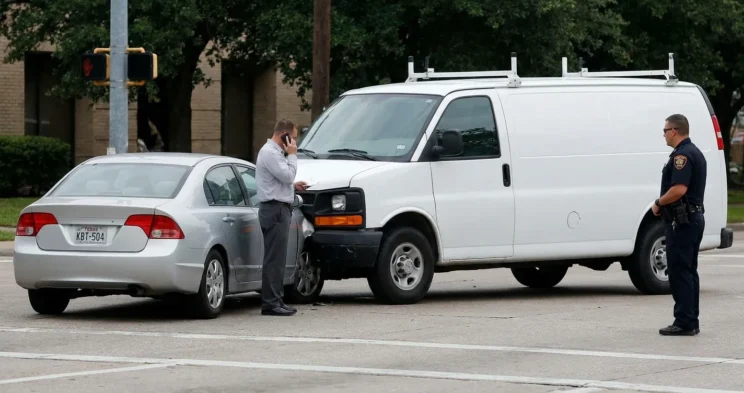
A delivery van hits you on I-35, and the company’s name is printed across the door. You may assume the business and its insurer will pay for your injuries.
In Texas, the negligent driver may be responsible, and the employer may also be liable if the employee was acting within the course and scope of employment. Who ultimately pays depends on the driver’s assignment, the trip’s purpose, and the terms of the applicable insurance policy.
Who Can Be Responsible After a Company Vehicle Accident?
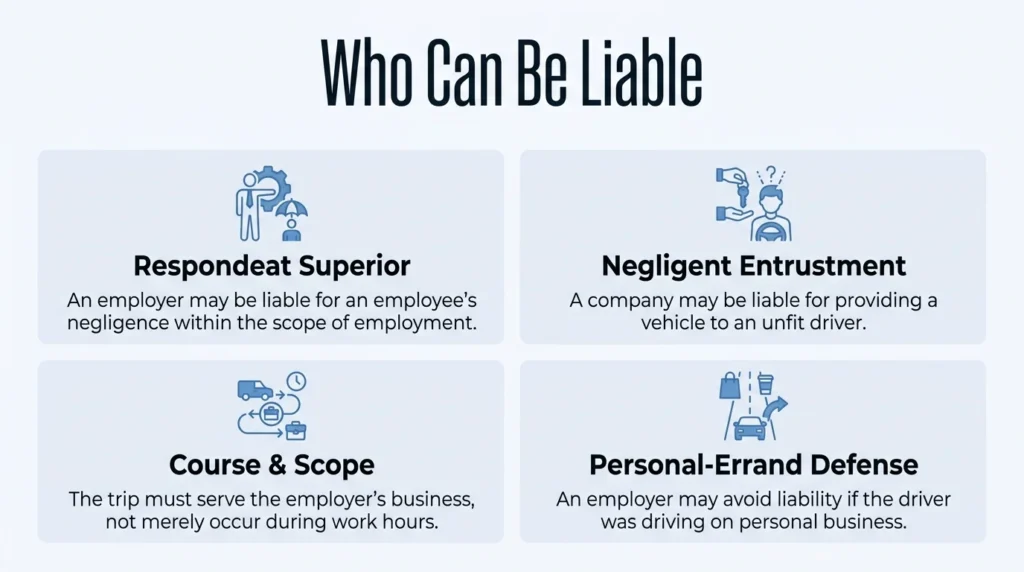
The negligent driver can be responsible, and an employer may also be liable for an employee’s negligence under respondeat superior. This rule applies when the employee acts within the course and scope of employment. The Texas Supreme Court explained it in Painter v. Amerimex Drilling I, Ltd.
Vehicle ownership does not settle that question. The driver’s actual employer, the vehicle’s owner, and the insurer can be three different entities, and each plays a different role in your claim.
A company may also face a negligent entrustment claim for giving a vehicle to a driver it knew or should have known was unlicensed, incompetent, or reckless. The claim also requires driver negligence and proximate causation, meaning a legally sufficient connection between the negligence and the crash, as explained in Goodyear Tire & Rubber Co. v. Mayes.
Identifying the applicable legal theory helps determine what evidence you need for a Texas car accident claim involving a company vehicle.
Was the Driver Working at the Time of the Crash?
To apply respondeat superior, Texas courts consider whether the driver was an employee and whether the negligence occurred while the driver was carrying out assigned duties that furthered the employer’s business. Being on the clock alone does not establish that the driver was acting within the course and scope of employment.
How Texas Determines Employee Status
Employee status turns on the employer’s overall right to control the work. The question is whether the company could direct how the driver did the job, not just what result it wanted.
The name on the truck may not belong to the company that controlled the driver. Identifying the employer is an early step in investigating responsibility.
How Texas Decides Whether the Trip Was Work
Courts judge scope objectively by examining the driver’s assigned duties and whether the trip served the employer’s business. Making an assigned delivery can support scope, while an ordinary commute or a purely personal errand generally falls outside it.
Travel can qualify when it involves regular or specially assigned employer-benefiting duties. In Painter, paid crew transportation raised a fact question about scope. The court sent the case back for further proceedings without finally deciding that the employer was liable.
The Personal-Errand Defense Employers Raise
An employer or insurer may argue that the driver was on personal business. If the facts support that defense, the employer may avoid responsibility under respondeat superior.
In Mayes, an employee used a company truck to buy cigarettes for his father. The truck contained tires awaiting a later delivery, and the employee had permission to use it personally and remained available by pager. Those facts did not make the errand part of his job, so the employer was not liable under respondeat superior.
A minor personal stop does not automatically end employer responsibility. When a trip combines work and personal purposes, the result depends on what the driver was doing when the crash occurred.
What Evidence Shows the Trip’s Purpose?
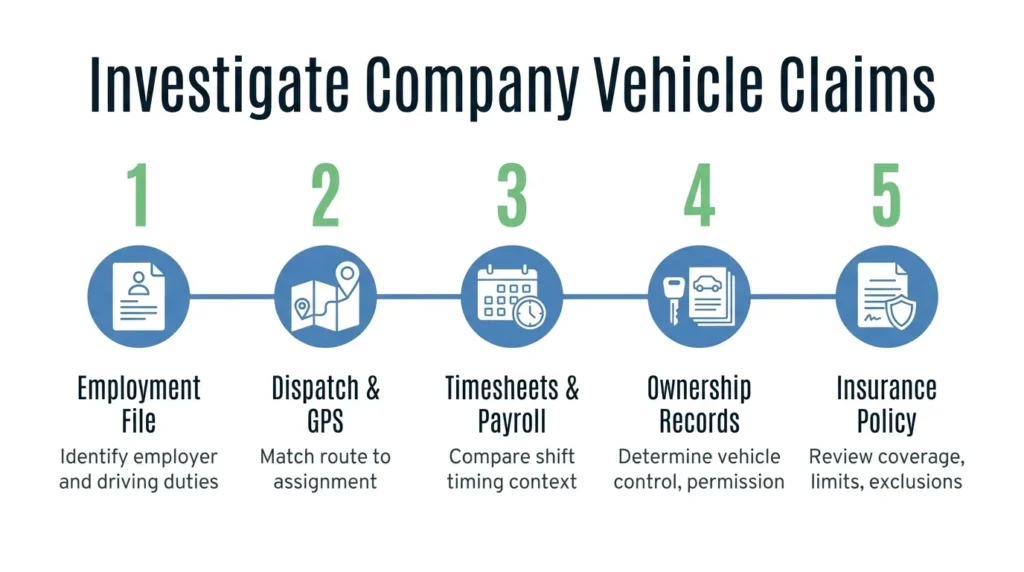
The investigation compares the driver’s assignment and route with any claimed personal detour. Records are most useful when read together, and their availability varies by case.
An attorney can use these steps to investigate responsibility and coverage:
- Review the employment file. Identify the actual employer, assigned driving duties, control over the work, pay arrangements, vehicle-use rules, and driving qualifications.
- Compare dispatch records and work orders with GPS data. Match the assigned customer, destination, and task to route information and timestamps. Location alone does not prove purpose.
- Check timesheets and payroll against the assignment. Shift timing and paid travel provide context, but do not replace evidence of what the driver was doing.
- Review ownership, registration, and lease records. Determine who owned or controlled the vehicle and investigate whether the driver had permission to use it.
- Compare accounts of the trip. Driver, dispatcher, supervisor, coworker, and witness accounts can help resolve conflicting descriptions.
- Obtain the complete commercial policy. Review declarations, coverage forms, endorsements, exclusions, insured identities, covered vehicles, effective dates, and limits. Investigate potentially applicable excess coverage too.
Many of these records remain with the company. Texas Rules of Civil Procedure 192.3 and 192.4 permit discovery of relevant, nonprivileged material, including electronic data and applicable insurance agreements, subject to procedural limits. They do not give you automatic access to a personnel file before a lawsuit.
An attorney can identify relevant records and seek them through appropriate channels without assuming that every requested item exists or is available.
Which Insurance Policy Could Pay, & How Much?
A commercial auto policy may provide substantially more coverage than a minimum-limits personal policy. The policy’s terms and limits control the coverage available for your claim.
An employer can be legally responsible while its insurer disputes coverage for the driver or vehicle involved. Reviewing the complete policy helps identify the available coverage and any relevant exclusions or endorsements.
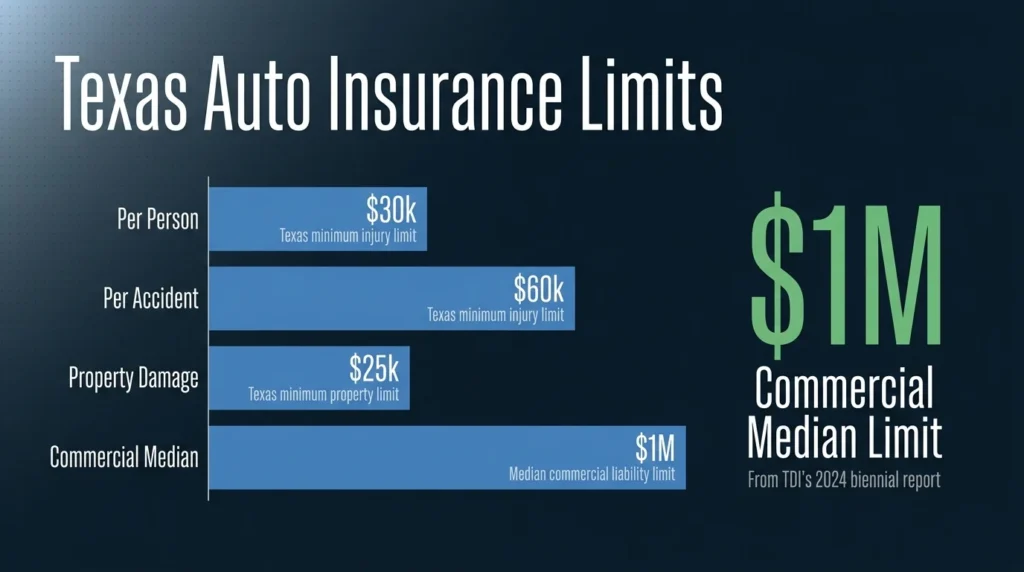
The Texas Department of Insurance’s 2024 Commercial Auto Biennial Report reported a $1 million median liability limit across vehicle types in the commercial market it studied. The study focused on the admitted insurance market and excluded detailed data for self-insured companies, certain large risks, surplus lines, and excess insurance. That finding does not establish the limit for your crash.
Texas minimum auto liability limits are $30,000 per injured person, $60,000 per accident, and $25,000 for property damage, according to the TDI auto insurance guide. Personal policyholders can purchase higher limits, so commercial coverage does not always exceed personal coverage.
Your personal injury protection or collision coverage may also help, depending on your policy. Your UM/UIM coverage after a company vehicle accident may apply when the responsible driver has no insurance or insufficient limits. None guarantees payment because a company vehicle was involved.
If a work truck hit you, special carrier insurance requirements may depend on its weight, operation, and regulatory category. TxDMV’s requirements and FMCSA’s requirements apply to different carrier categories. A company pickup is not automatically subject to the rules governing heavier or federally regulated vehicles, so you must classify the vehicle correctly in commercial truck accident claims.
Talk With Angel Reyes & Associates About Your Crash
Reviewing the driver’s job, the trip’s purpose, and the available policies can help clarify who may be responsible. You don’t have to investigate those questions alone while you’re healing.
Angel Reyes & Associates has guided injured Texans for over 30 years. Schedule a free consultation to discuss your company vehicle accident and the evidence available in your case.
Past results do not guarantee future outcomes.
Company Vehicle Accident FAQs
Can You Sue a Company if Its Driver Was an Independent Contractor?
Under Texas law, a company generally is not liable for an independent contractor’s negligence solely because it hired the contractor. However, liability may arise if the company retained control over the work that caused the accident or was negligent on its own.
What Happens if a Company Vehicle Accident Involves Multiple At-Fault Drivers?
Texas uses proportionate responsibility rules to assign fault among responsible parties. Under Texas Civil Practice and Remedies Code Section 33.001, an injured person generally cannot recover damages if their percentage of responsibility exceeds 50%.
Can You Recover Compensation if a Company Vehicle Accident Aggravates a Preexisting Injury?
Texas law allows injured people to seek compensation for the aggravation of a preexisting condition caused by another party’s negligence. Medical evidence can help distinguish the accident-related worsening from symptoms or limitations that existed beforehand.
How Long Do You Have to Sue a Company After a Vehicle Accident in Texas?
Texas Civil Practice and Remedies Code Section 16.003 generally gives injured people two years from the accident date to file a personal injury lawsuit. Certain exceptions may affect the deadline.
Can a Company Be Liable for an Accident Caused by Poor Vehicle Maintenance?
A company may face a negligence claim if it failed to reasonably maintain a vehicle and that failure contributed to the crash. Maintenance records, inspection reports, and evidence of known mechanical problems may help establish responsibility.
About the Authors

Alex Ivanov
Writer
Alex Ivanov is a personal injury attorney at Angel Reyes & Associates, focused on car, truck, and motorcycle accident cases. Licensed in Texas and multiple federal districts, Alex brings international legal experience and a global education to his practice. He earned his LL.M. from Texas A&M University School of Law after graduating from Belarussian State University in 2016. Alex is fluent in Russian, English, Ukrainian, and Belarussian, and is recognized by multiple national trial lawyer associations for his results and leadership under 40.

Graham Griffin
Editor
Graham Griffin is the Web & Content Manager at Angel Reyes & Associates, where he oversees content strategy, AI-powered workflows, a...

Angel Reyes
Reviewer
Angel L. Reyes, III is the Founder and Managing Partner of Angel Reyes & Associates. A nationally recognized trial attorney and business...