Dealing With a Nationwide Auto Accident Claim


Every article on this site is researched by our internal team, reviewed for legal accuracy against current Texas law, and held to State Bar of Texas advertising standards before publication. We do not publish content that overstates outcomes or makes promises about results.
Learn more about our
editorial standards .
Key Takeaways
- Check whether you are claiming under your own Nationwide policy or against its insured driver.
- Keep one dated file of every Nationwide request, response, call, and offer letter you receive.
- Chapter 542 deadlines apply to qualifying first-party claims, not a third-party settlement clock.

When Nationwide claim paperwork arrives while you are recovering from a crash, start by identifying whether you are claiming under your own Nationwide policy or against a driver Nationwide insures. That determines which coverage and Texas claim-handling deadlines may apply.
Report the accident, get a claim number, and keep dated requests and responses. Review any offer and release before signing.
Identify the Coverage Route & Report the Accident
Nationwide accepts reports online, through its mobile app, or by phone at 1-800-421-3535, according to its auto claims page. Explain whether Nationwide insures you or the other driver.
Information to Have Ready
Nationwide’s claims FAQ says to have your contact information, details about witnesses and injured people, information about the loss, and the policy number if available. A claims professional reviews the report and may request documents related to the crash and your medical treatment.
Before ending the report, take these steps:
- Save your claim number.
- Get the assigned claims professional’s name and contact information.
- Ask which documents Nationwide needs next.
Nationwide’s vehicle-claim process may include a damage evaluation, repairs or a total-loss review, and payment. Its repair network is optional, and Nationwide says participating shops can handle paperwork and receive payment directly. This vehicle-damage process does not set a deadline for resolving an injury claim.
Claims Under Your Own Nationwide Policy
Pull your declarations page first. The Texas Personal Automobile Consumer Bill of Rights lists the underwriting company, insured drivers and vehicles, policy dates, coverages, and deductibles.
If another driver’s insurer disputes payment for your car, your collision coverage may cover the damage, subject to your policy and deductible. Injury-related coverage depends on what your policy includes. The Texas Department of Insurance (TDI) auto insurance guide explains these separate coverage routes.
Claims Against a Driver Nationwide Insures
When the other driver carries Nationwide, you are a third-party claimant. Document fault and your losses, and use the claim number and adjuster’s contact information to follow the claim. You may not have access to Nationwide’s policyholder account system.
Keep a Dated Claim File & Review Adjuster Requests
Your claim number, declarations page, correspondence, and dated requests and responses show what Nationwide asked for and when. TDI explains that the adjuster works for the paying insurer and may inspect damage, review police reports, speak with witnesses, and request information.
Records to Preserve
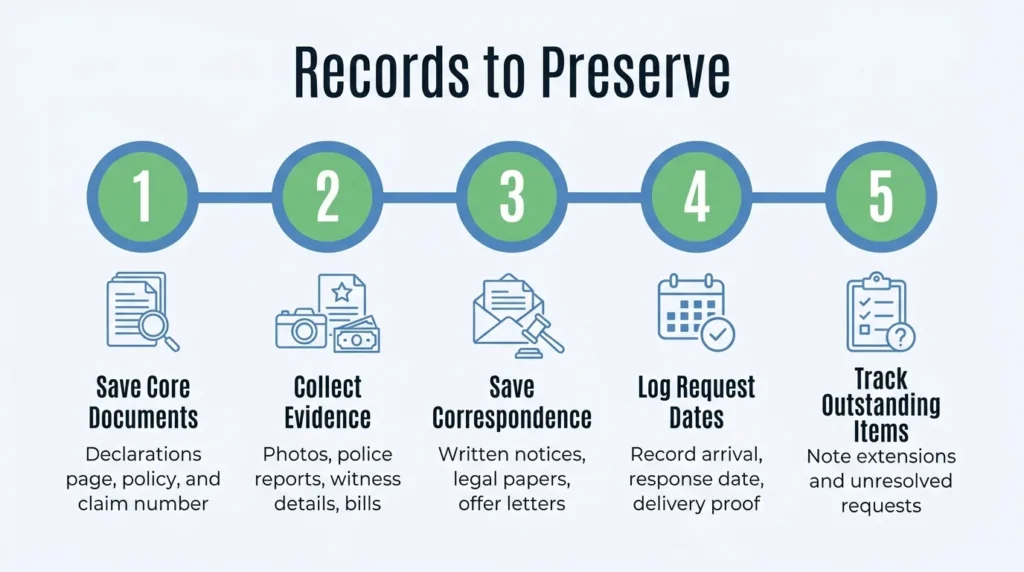
Build your file in these steps:
- Save the declarations page, policy, and claim number.
- Collect crash photos, police reports, witness details, repair estimates, receipts, and medical bills and records.
- Save written notices, legal papers, offer letters, and notes of calls.
- Record when each request arrived, when you responded, and proof of delivery.
- Track outstanding items and any explanation for an extension.
Forward accident-related notices and legal papers promptly. Follow calls with a short written summary, and ask the adjuster to identify missing information and relevant policy language in writing. TDI’s claim-filing tips recommend preserving records and documenting disagreements.
Recorded Statements & Medical Authorizations
If asked for a recorded statement, ask why it is needed and which policy provision, if any, requires cooperation. Do not ignore requests from your own insurer because your policy may require cooperation.
Before signing a medical authorization, check the providers, records, date range, recipients, and duration it covers. Ask for clarification on broad language, and have a lawyer review anything you do not understand before signing.
Track the Texas Chapter 542 Deadlines That Apply
For qualifying first-party claims, Texas Insurance Code Chapter 542, Subchapter B, sets deadlines tied to specific events. These are not guaranteed settlement deadlines for claims against another driver’s liability coverage.
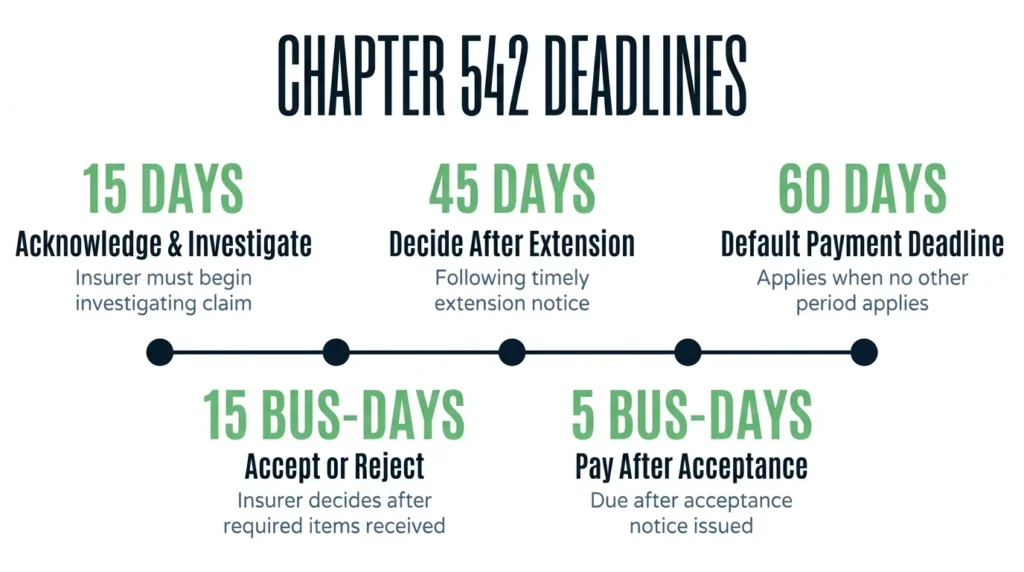
The statute defines notice as written notification, so preserve evidence of written reporting. Business days exclude weekends and state-recognized holidays. Different rules can apply to arson claims and certain weather-related catastrophes.
Section 542.058 separately addresses payment delayed beyond the applicable statutory period or, when no other period applies, more than 60 days after the insurer receives all reasonably requested and required items, statements, and forms. It does not guarantee payment or settlement.
Track the written notice, document requests and responses, extension notices, decision, and any payment conditions. A lawyer assessing a possible missed deadline needs the full claim record.
Assess Offers & Chapter 541 Settlement Concerns
Compare a Nationwide offer with your documented losses, policy terms, and the release’s scope. A low offer or delay alone does not establish a legal violation.
Reviewing an Offer Letter
Review property-damage and injury offers separately:
- Compare each offer with estimates, bills, and treatment records.
- Ask for the basis of any disputed amount, and the policy language relied on.
- Read the release to identify which claims it would end.
TDI’s auto guide advises discussing possible future treatment with your doctor before signing an injury settlement release. Signing an injury settlement release can prevent you from filing future claims related to the accident.
Chapter 541 Protections & Their Limits
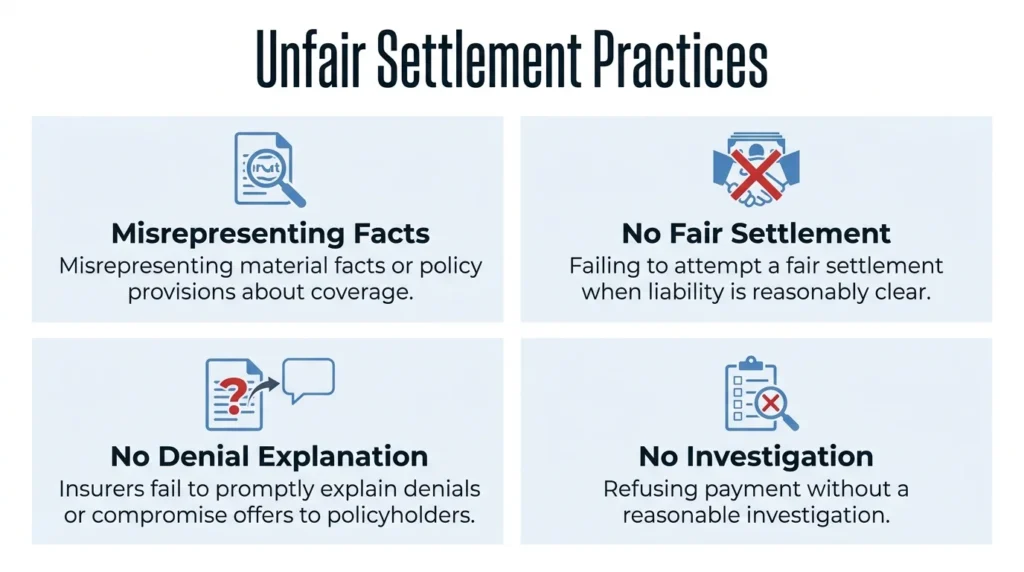
Texas Insurance Code § 541.060 addresses unfair settlement practices involving claims by insureds or beneficiaries, including:
- Misrepresenting material facts or policy provisions about coverage.
- Failing to attempt a fair settlement when liability is reasonably clear.
- Failing to promptly give a policyholder a reasonable explanation for a denial or compromise offer.
- Refusing payment without a reasonable investigation.
Section 541.060(b) does not provide a cause of action to a third party making a claim against someone covered by a liability insurance policy. Being injured by a Nationwide-insured driver does not by itself give you a bad-faith claim against Nationwide under this provision.
Escalate a Dispute & Decide When Legal Review Helps
First, raise a documented disagreement with Nationwide. Ask for its position and supporting policy language in writing, and send evidence supporting your view.
The Limits of a TDI Complaint
TDI’s auto insurance complaint guidance explains that it cannot decide fault, generally cannot help with complaints against another person’s insurer, and cannot compel payment without a legal or policy violation. Appraisal addresses damage amounts, not fault.
Reasons to Involve a Lawyer
Consider legal review when fault is disputed, injuries are serious or unresolved, coverage is denied, a release is unclear, or an applicable deadline passes without explanation.
Bring your claim number, declarations page, timeline, correspondence, estimates, medical records, and offer letters to Texas car accident lawyers. These documents help counsel assess the actual policy and your position as a policyholder or third-party claimant.
Contact Angel Reyes & Associates for a Free Consultation
A Nationwide car insurance claim can feel overwhelming while you are recovering. Angel Reyes & Associates has guided injured Texans for over 30 years, and you can reach the firm 24/7.
Angel Reyes & Associates has guided injured Texans for over 30 years. Bring your dated claim file to a free consultation so we can review your coverage route, correspondence, and offers.
Past results do not guarantee future outcomes.
Nationwide Auto Claim FAQs
How long do I have to file a lawsuit after a car accident involving Nationwide in Texas?
Under Texas Civil Practice and Remedies Code § 16.003, you must file most personal injury lawsuits within two years of the accident. Certain exceptions may apply, so the deadline depends on the circumstances.
What happens if the driver insured by Nationwide does not have enough coverage to pay for my injuries?
If the at-fault driver’s liability limits are insufficient, your own underinsured motorist coverage may provide additional compensation, depending on your policy. Texas law generally requires insurers to offer this coverage, although policyholders can reject it in writing.
Can Nationwide reduce my settlement if I was partially responsible for the accident?
Under Texas Civil Practice and Remedies Code § 33.001, an injured person generally cannot recover damages if their percentage of responsibility exceeds 50%. If their responsibility is 50% or less, their recoverable damages are reduced proportionally.
Does Nationwide have to pay for a rental car after an accident in Texas?
If a Nationwide-insured driver caused the accident, you may be able to recover reasonable loss-of-use expenses while your vehicle is being repaired or replaced. Rental reimbursement under your own Nationwide policy depends on whether you purchased that coverage and its terms.
Can I reopen a Nationwide car accident claim after accepting a settlement?
A signed settlement release generally prevents you from pursuing additional compensation for claims covered by that agreement, even if new injuries or expenses arise. Whether you can reopen a claim depends on the release’s wording and whether a legally recognized reason exists to challenge its enforceability.
About the Authors

Angel Reyes
Writer
Angel L. Reyes, III is the Founder and Managing Partner of Angel Reyes & Associates. A nationally recognized trial attorney and business leader, Angel has helped over 70,000 injury victims recover more than $1 billion since founding the firm in 1993. Named to the Texas Super Lawyers list annually since 2008, Angel brings Wall Street experience, Ivy League education, and a deep commitment to client advocacy. He is a frequent legal commentator and published author with extensive contributions to legal scholarship, trial strategy, and consumer protection.

Graham Griffin
Editor
Graham Griffin is the Web & Content Manager at Angel Reyes & Associates, where he oversees content strategy, AI-powered workflows, a...

Angel Reyes
Reviewer
Angel L. Reyes, III is the Founder and Managing Partner of Angel Reyes & Associates. A nationally recognized trial attorney and business...