Why Insurance Companies Request Recorded Statements


Every article on this site is researched by our internal team, reviewed for legal accuracy against current Texas law, and held to State Bar of Texas advertising standards before publication. We do not publish content that overstates outcomes or makes promises about results.
Learn more about our
editorial standards .
Key Takeaways
- You are not bound by law to provide a recorded statement to the other party’s insurance company after an accident.
- You may be obligated to do so for your own insurer. If you are, you may delay doing so until you have received a more thorough medical examination.
- If you do give a recorded statement, be concise, accurate, and truthful. Do not guess about things you aren’t sure of. You are allowed to say “I don’t know.”
Why Insurance Companies Request Recorded Statements
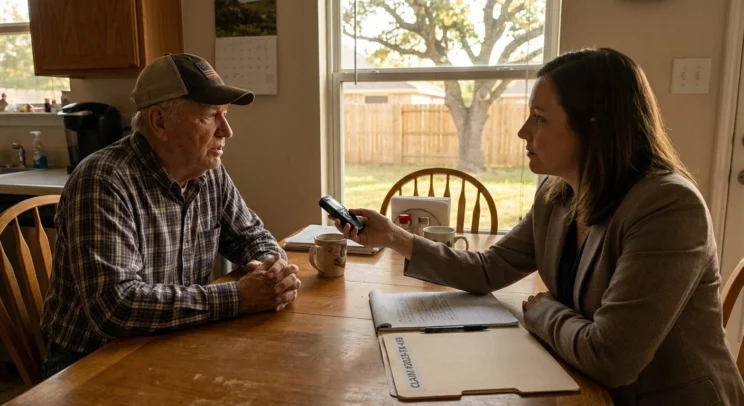
You were recently in a wreck on I-35 in Lewisville. You’re at the pharmacy picking up pain medication when your phone flashes you have a new voicemail. It’s from the adjuster, asking you again to call back for a “quick recorded statement.”
You want to cooperate, but something feels off about how fast this is moving. Why are they being so pushy? They called you two hours ago asking the same thing.
Unfortunately, this is not an uncommon experience, and it could be a sign that the insurer is trying to pressure you into making a mistake that might minimize your claim—or worse, allow them to assign you the majority of fault so they owe you nothing.
Do I Have to Give a Recorded Statement in Texas?
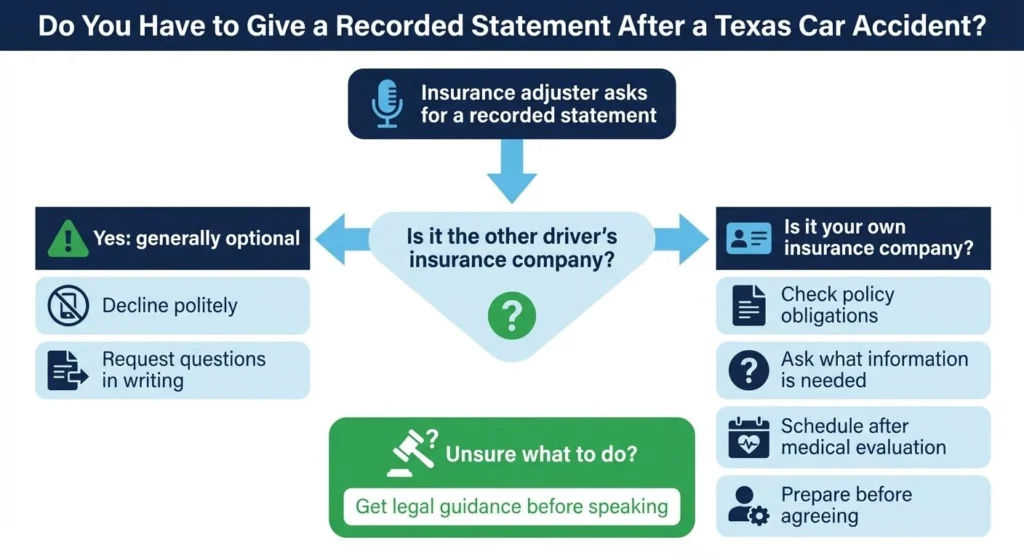
Texas law says no, you are not required to give a recorded statement to the other driver’s insurance company. That request is optional, no matter how routine the adjuster makes it sound. Remember: they work for the other side, and their job is to resolve your claim for as little as possible.
Your own insurer is a different situation. Your policy language may require you to provide information related to a claim. However, “cooperation” with this language doesn’t mean answering questions “right now, on a recording, without preparation.”
You are allowed to ask what information is needed, request questions in advance, and schedule the call after you’ve had a medical evaluation or spoken with an attorney. If you’re unsure what your policy requires, an attorney can review the language with you.
If an adjuster tells you a recorded statement is mandatory, ask them to identify the specific policy provision or legal requirement in writing. That request alone often changes the conversation.
Why Insurers Ask for Recorded Statements
A recorded statement is a question-and-answer session where an insurance adjuster asks about the crash, your injuries, and how everything happened. The conversation is recorded and saved as evidence in your claim file.
Adjusters often call within hours or days of a crash. They may say things like “this is standard procedure” or “we just need your side of the story to move things along.” The tone is friendly, but this timing is intentional.
Insurance companies want your statement early. They argue that it’s because the incident is fresh in your memory and you’re most likely to give accurate answers before your recollection of the event might fade. There is some truth to this.
However, they are also looking to collect your statement before you fully understand your injuries and before you’ve had time to review the police report or talk to a lawyer. Early statements are more likely to contain guesses, gaps, or phrases that can be used against you later.
There are two very different situations here:
- The other driver’s insurer is looking for reasons to pay you less or deny your claim entirely.
- Your own insurer may need information to process your coverage, but their interests aren’t perfectly aligned with yours either.
Speaking to the At-Fault Driver’s Insurance
If the other driver’s insurance reaches out to you, do not give them any more details than necessary. If they ask you to give a recorded statement, you are allowed to decline. Here’s a simple script if you don’t feel comfortable:
“I’m not going to give a recorded statement. If you have specific questions, please send them in writing. My attorney will be in touch.”
You can confirm basic contact information and let them know where your vehicle is located. Beyond that, you’re not obligated to provide anything.
Decline requests for a recorded statement, and also decline open-ended questions about fault, speed, distances, or your injuries. You can still pursue your claim. The insurance company will investigate using the police report, photos, witness statements, and other evidence.
Speaking to Your Own Insurance
Your insurer may have a legitimate reason to request information, especially if you’re filing a claim under your own policy for medical payments, collision coverage, or uninsured motorist benefits.
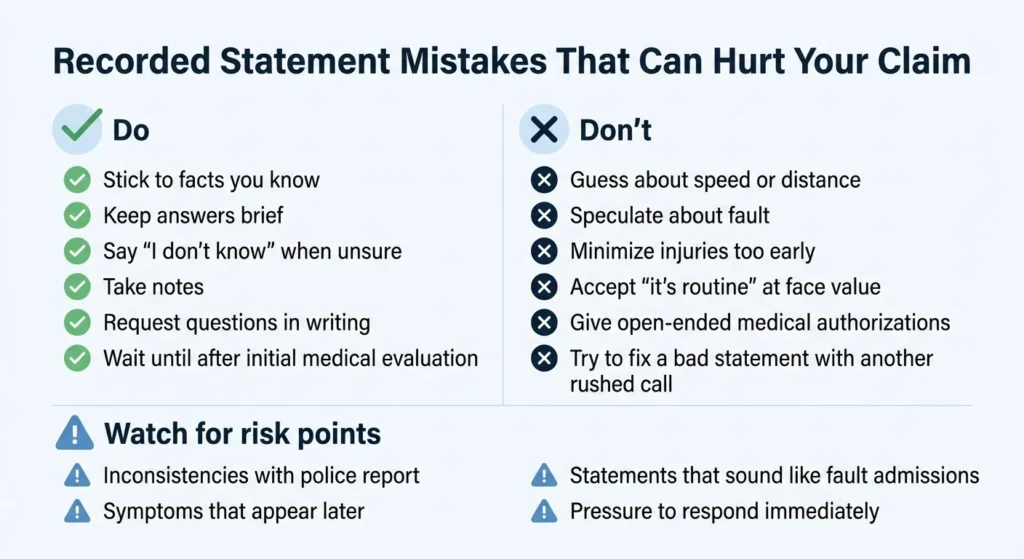
Even so, you can protect yourself:
- Ask what questions will be covered before agreeing to record
- Schedule the call after your initial medical evaluation
- Keep answers factual and brief
- Avoid guessing about fault or the full extent of your injuries
- Take notes on what was asked and what you said
If you’re uncomfortable with the process, an attorney can help you understand your policy obligations and prepare for the call.
How Recorded Statements Can Hurt a Texas Car Accident Claim
Insurance adjusters are trained to listen for inconsistencies. A small difference between what you say on a recorded call and what appears in the police report or medical records can be used to question your credibility.
Early statements are especially risky because you may not know the full picture yet. Symptoms from soft tissue injuries, concussions, and spinal problems often develop over days or weeks. If you say “I feel okay” on day two and then need surgery three months later, that early statement becomes a problem.
The 51% Bar Rule in Texas
Adjusters also listen for anything that sounds like an admission of fault. “I didn’t see them until the last second,” or “maybe I should have braked sooner,” can be pulled out of context and used to argue you share responsibility for the crash.
This is important because Texas follows a modified comparative fault rule under Texas Civil Practice and Remedies Code Chapter 33. If you’re found more than 50% responsible for the crash, you may recover nothing.
Even if you’re found partially at fault below that threshold, your recovery is reduced by your percentage of responsibility. A $100,000 claim with 30% fault assigned to you becomes a $70,000 recovery.
Fault in a crash can be complicated, especially with multiple vehicles, unclear right-of-way, or commercial trucks involved. Locking yourself into a narrative before the investigation is complete puts you at a disadvantage.
What to Do Right After a Crash in Texas
The best way to protect your claim is to build a strong evidence file from the start. That way, you’re not relying on a recorded statement to tell your story.
If you are involved in an accident, follow these steps immediately:
- Get medical attention, even if injuries seem minor
- Take photos of vehicle damage, the scene, skid marks, and traffic signs
- Exchange information with other drivers
- Get contact information from witnesses
- Request a copy of the police report
Under Texas Transportation Code Chapter 550, a crash must be reported to law enforcement if it involves injury, death, or property damage of $1,000 or more. The Texas Department of Public Safety provides additional guidance on reporting requirements.
If You Already Gave a Recorded Statement
If you have already given a statement to your insurance company or the other party’s insurer, don’t panic. Don’t try to “fix” it with another unplanned call—that usually makes things worse. Instead:
- Write down everything you remember saying
- Note the date, time, and name of the adjuster
- Request a copy of the recording or transcript if possible
- Focus on gathering objective evidence going forward
Medical records, photos, and witness statements carry weight regardless of what you said on a call. An attorney can help you understand how the statement might affect your claim and help you decide what steps to take next.
An attorney can be a powerful ally when taking on an insurer who is looking to minimize their financial responsibility. Consider requesting a case evaluation if:
- You have serious injuries or ongoing symptoms
- Fault is unclear or disputed
- Multiple vehicles were involved
- A commercial truck was involved
- The adjuster is being aggressive or pressuring you
- You’ve already given a statement and you’re worried about what you said
How Attorney-Led Communication Protects Your Claim
An attorney can take over communications with insurance companies, manage recorded statement requests, and make sure evidence is preserved properly. When an attorney handles insurance communications, information flows through a structured process. You provide what’s necessary without speculation or premature conclusions about your injuries.
This approach reduces the risk of inconsistencies and keeps the focus on documented facts. It also signals to the insurance company that you understand how the process works, which can affect how seriously they take your claim.
For crashes involving commercial trucks, the stakes are higher and the investigations more complex. Multiple insurers and corporate legal teams may be involved from day one. It’s important to have an experienced advocate and guide working on your side.
Next Steps with Angel Reyes & Associates
If you’ve been in a crash on I-35 in Austin, 635 in Dallas, or anywhere across Texas, you don’t have to deal with insurance companies and their requests for recorded statements alone.
Angel Reyes & Associates has helped injured Texans for over 30 years. Our team can review your situation, explain your options, and handle communications with insurance companies so you can focus on recovery.
Schedule a free consultation to talk through what’s happened and what comes next. There’s no upfront cost to you. You can also learn more about our firm and read what our prior clients have to say for yourself.
Recorded Statement FAQs
Can I ask the adjuster to communicate with me by email instead of by phone?
Yes. Keeping communications in writing can help you stay organized, avoid rushed answers, and create a record of what the insurer asked for and when.
Can I bring notes with me if I do agree to speak with my own insurance company?
Yes. Notes can help you stick to basic facts like the date, location, vehicles involved, and treatment received, which lowers the chance of guessing or misspeaking.
Do I have to sign a medical authorization form when the adjuster asks for it?
Not automatically. Some authorizations are very broad and may give the insurer access to medical records that have little or nothing to do with the crash. They will sometimes use this information to downplay your injuries by claiming your pain is not related to the incident.
Can posting on social media hurt my claim even if I never gave a recorded statement?
Yes. Photos, comments, check-ins, and videos can be taken out of context and used to argue that your injuries are not as serious as you claim. Even if your profile stays private, what you post could be used against you.
What if my own insurance company keeps delaying my claim while asking for more information?
Texas insurers generally have deadlines for acknowledging, investigating, and deciding first-party claims, although they can ask for needed information and sometimes extend the timeline. Repeated delay without a clear explanation can be a warning sign that the claim needs closer attention.
About the Authors

Angel Reyes
Writer
Angel L. Reyes, III is the Founder and Managing Partner of Angel Reyes & Associates. A nationally recognized trial attorney and business leader, Angel has helped over 55,000 injury victims recover more than $1 billion since founding the firm in 1993. Named to the Texas Super Lawyers list annually since 2008, Angel brings Wall Street experience, Ivy League education, and a deep commitment to client advocacy. He is a frequent legal commentator and published author with extensive contributions to legal scholarship, trial strategy, and consumer protection.

Graham Griffin
Editor
Graham Griffin is the Web & Content Manager at Angel Reyes & Associates, where he oversees content strategy, AI-powered workflows, a...

Spencer Browne
Reviewer
Spencer Browne is a partner at Angel Reyes & Associates and a Board Certified personal injury trial lawyer with nearly 100 jury trials a...