What To Do After a Federal Vehicle Accident?


Every article on this site is researched by our internal team, reviewed for legal accuracy against current Texas law, and held to State Bar of Texas advertising standards before publication. We do not publish content that overstates outcomes or makes promises about results.
Learn more about our
editorial standards .
Key Takeaways
- Use Standard Form 95 or another adequate written claim with a specific dollar demand.
- The proper agency must receive your FTCA claim within two years after it accrues.
- Texas negligence law applies to Texas crashes, but a judge tries an FTCA case.
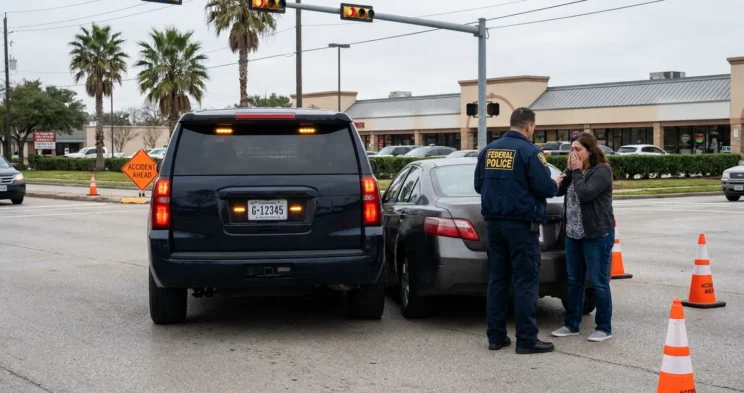
If a federal employee causes a Texas crash while driving within the scope of federal work, you may have a claim against the United States under the Federal Tort Claims Act (FTCA). You must first present a written claim to the responsible federal agency, usually using Standard Form 95 with a specific dollar demand.
When you’re facing medical bills and car repairs, identifying the right agency can feel like another burden. Start with the crash report and the driver’s employer. Federal deadlines apply even while you are gathering records.
Does a Crash With a Federal Vehicle Fall Under the FTCA?
An ordinary Texas road crash may qualify when a federal employee drove negligently within the scope of employment. A federal plate, agency logo, or uniform helps identify the vehicle or employer, but proves neither fault nor work status.
A car accident with a military vehicle may qualify because 28 U.S.C. § 2671 includes military
personnel and describes military scope as acting “in line of duty.” A federal employee car accident can also involve an agency vehicle or another vehicle driven on assignment. Contractors require separate analysis; the statute excludes them from its definition of a federal agency.
After a military crash, identify the service branch and confirm its claims office. Installation claims personnel or the U.S. Army Claims Service, for example, investigate Army claims. No single address serves every branch, and unusual circumstances, including an injured military claimant, need individual review.
The first steps overlap with any Texas car accident claim: get medical care, preserve the crash report, photograph the scene and agency markings, and collect witness contacts. Record the driver’s name, employer, and any details about the assignment, dispatch, orders, or destination. These are practical evidence steps that help establish fault and employment scope.
How Do You File Standard Form 95 With the Right Agency?
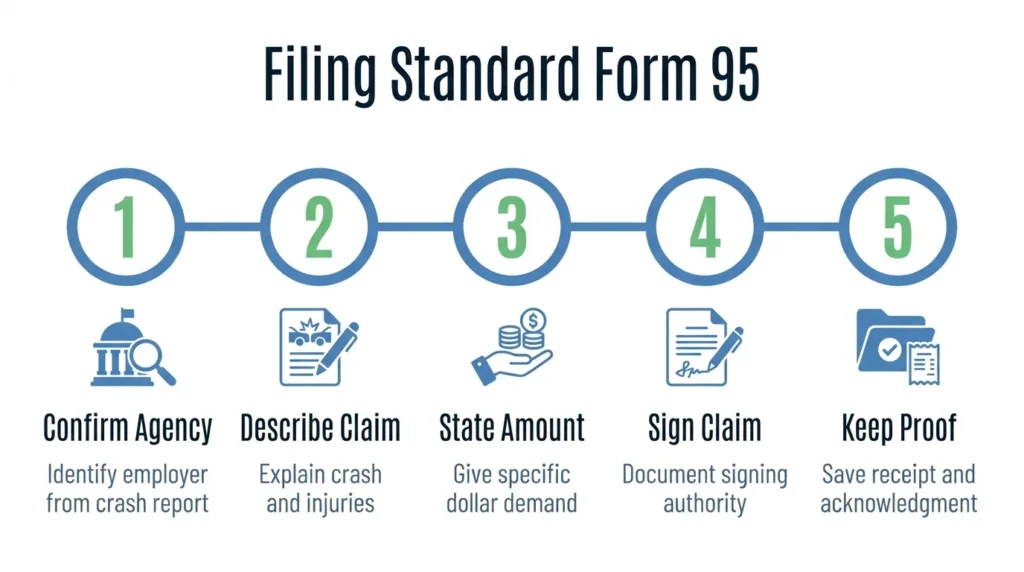
Present a written administrative claim to the federal agency responsible for the driver, with incident information and a definite dollar demand called a sum certain. Department of Justice guidance permits Standard Form 95 or another adequate written claim:
- Confirm the responsible agency. Use the crash report, driver details, and agency markings to identify the employer and correct filing destination.
- Describe the claim. Identify yourself, explain the crash and the government’s responsibility, and describe your injuries or property loss.
- State a specific total. DOJ points to block 12d on Standard Form 95. Do not leave the amount open or write “to be determined.”
- Sign the claim. A representative must document their authority to act for you.
- Keep proof of receipt. Save the signed claim, attachments, and delivery confirmation or agency acknowledgment.
Under 28 C.F.R. Part 14, presentation depends on receipt by the appropriate agency. Mailing alone is not enough, and you should not rely on the wrong agency to transfer the claim before your deadline.
Medical records, bills, prognosis and future-care information, wage-loss documents, proof of property ownership, and repair estimates or receipts support the demand. These records help establish its value; they are distinct from the requirements for presenting the claim.
Choose the amount carefully. Under 28 U.S.C. § 2675, a later lawsuit generally cannot seek more than the amount presented. Exceptions cover evidence that could not reasonably have been discovered earlier and intervening facts. Do not assume you can increase a low placeholder later.
What Are the FTCA Deadlines After a Federal Vehicle Crash?
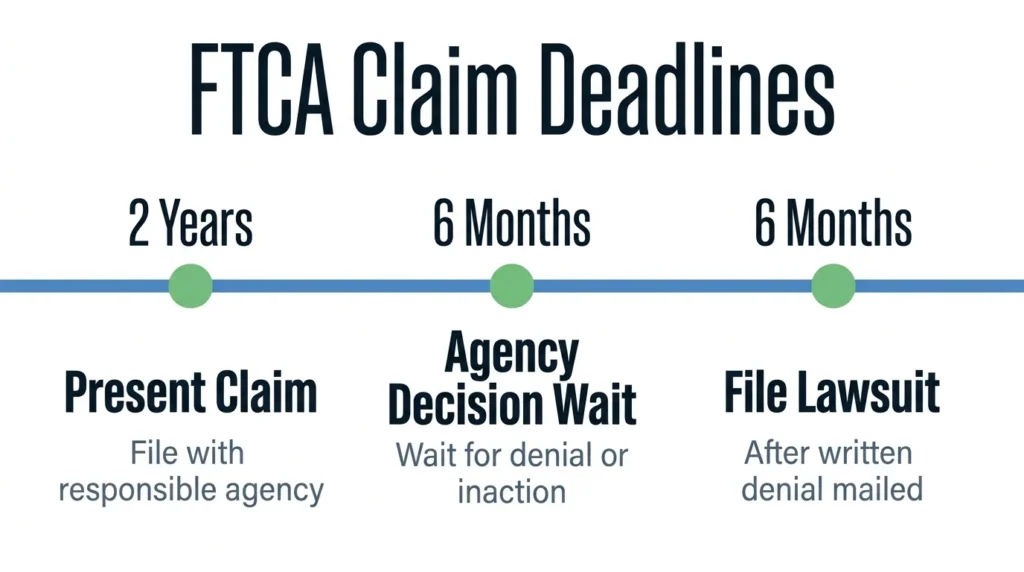
The claim generally must reach the appropriate agency within two years after accrual. The next deadline depends on the agency’s response:
- Presenting the claim. 28 U.S.C. § 2401(b) sets the two-year period. Record the collision date promptly and get advice about when your claim accrued and your actual deadline.
- Waiting for a decision. Under § 2675(a), you must receive a final written denial sent by certified or registered mail, or wait six months without final agency action, before filing the ordinary FTCA lawsuit. After six months of inaction, you may elect to treat the claim as denied.
- Suing after a denial. A formal final denial generally starts a separate six-month lawsuit deadline from the date the agency mails it by certified or registered mail, not the date you receive it.
Agency silence does not establish fault or guarantee payment. Measure six-month periods in calendar months, not 180 days. Missing a deadline can end a valid claim.
What If the Federal Driver’s Work Status Is Disputed?
Scope of employment turns on what the driver was doing for the employer, not simply whether someone calls the driver “on duty.” The trip’s purpose, assignment, destination, and any personal detour matter.
In Williams v. United States, the Fifth Circuit applied a Texas-law test asking whether conduct fell within the employee’s general authority, advanced the employer’s business, and served the work the employee was hired to do.
For an in-scope negligence claim, the Westfall Act generally makes the United States the defendant
in place of the employee. Under 28 U.S.C. § 2679, Attorney General certification triggers that substitution and moves a state-filed case to federal court. Certification does not prove negligence; courts can review it for substitution, while its effect on removal is distinct.
If the government refuses to certify scope, the employee may petition the court before trial to decide that question. If this petition comes from a state-filed case and the federal court finds the employee acted outside scope, the statute requires returning the case to state court.
A refusal to certify does not settle every question about liability or forum. If the driver ultimately acted outside scope, a lawyer can assess a claim against the driver and any available insurance.
How Does a Federal Vehicle Claim Differ From a Texas Government Vehicle Claim?
For an ordinary Texas road collision, Texas negligence law supplies the standard of care, while federal law controls the administrative claim and federal lawsuit. 28 U.S.C. § 1346(b) looks to the law where the negligent act occurred, not simply where the injured person lives.
The Texas Tort Claims Act concerns Texas governmental units and has separate notice rules, state-court procedures, and damages caps. Those rules do not replace the FTCA process, and its notice periods and caps do not carry over to an FTCA claim.
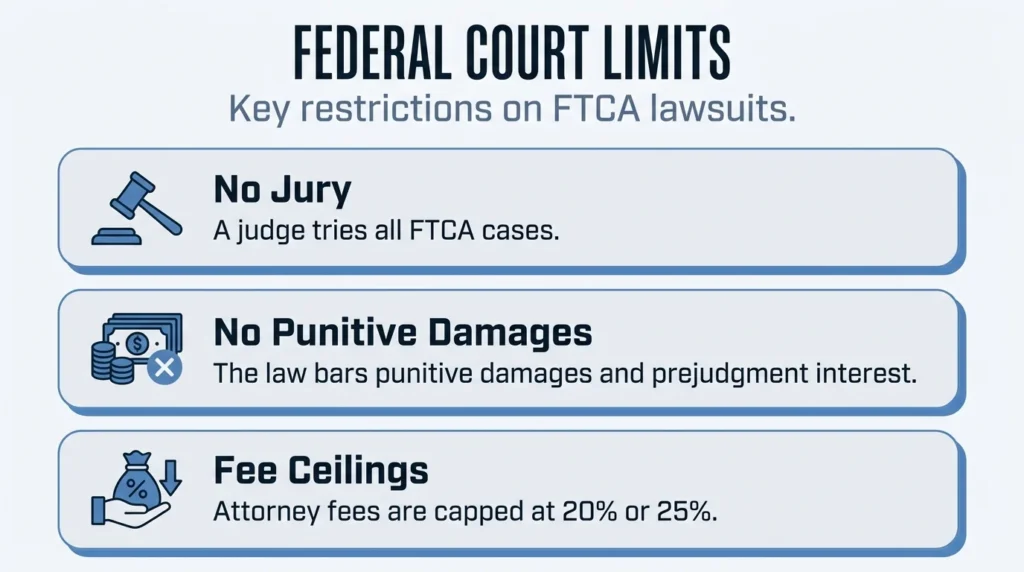
Federal litigation has specific limits:
- No jury. Under 28 U.S.C. § 2402, a judge tries an FTCA case.
- No punitive damages or prejudgment interest. 28 U.S.C. § 2674 bars both against the United States. Compensatory damages depend on proof under applicable law. The Texas Tort Claims Act also excludes exemplary damages.
- Attorney fee ceilings. 28 U.S.C. § 2678 limits fees to 20% of an administrative award, compromise, or settlement under § 2672, and 25% of a judgment under § 1346(b) or settlement under § 2677. These are maximums, not set fees or extra government payments.
Talk With Angel Reyes & Associates About a Federal Vehicle Crash
Angel Reyes & Associates has guided injured Texans for over 30 years. Contact Angel Reyes & Associates for a free consultation about your Texas crash and options.
Gather the crash report, driver and agency details, medical and repair records, any Standard Form 95 submission, proof of agency receipt, and agency responses.
Past results do not guarantee future outcomes.
Federal Vehicle Accident FAQs
Can you recover compensation for pain and suffering after a federal vehicle accident in Texas?
Yes, pain and suffering may be recoverable as compensatory damages when supported by evidence and permitted under applicable Texas law. The amount depends on the circumstances of the accident, the injuries, and the evidence establishing the resulting harm.
Can you recover lost wages after being injured in a federal vehicle accident?
Yes, lost income and reduced future earning capacity may be recoverable if they are supported by evidence and permitted under applicable Texas law. Pay stubs, employer statements, tax records, and medical documentation can help establish the financial impact of the injuries.
Can family members file an FTCA claim if a federal vehicle accident causes a death in Texas?
Eligible family members or representatives of the deceased person’s estate may have a wrongful death or survival claim, depending on the circumstances and applicable Texas law. The claim must also satisfy the FTCA’s administrative filing requirements and deadlines.
Can you file an FTCA claim if multiple vehicles contributed to a federal vehicle accident?
Yes, a claim may be possible when a federal employee’s negligence contributed to a crash involving multiple vehicles. Investigators must evaluate each driver’s conduct and how the applicable Texas liability rules affect responsibility for the injuries and losses.
What happens if your injuries get worse after you submit Standard Form 95?
If your condition worsens after filing, you may need to evaluate whether the new medical evidence supports an increased demand under an applicable FTCA exception or whether the agency claim can be amended. Because the amount stated in the original claim can limit later recovery, seek legal guidance before assuming the demand can be increased.
About the Authors

Spencer Browne
Writer
Spencer Browne is a partner at Angel Reyes & Associates and a Board Certified personal injury trial lawyer with nearly 100 jury trials across Texas. He focuses on car, truck, and wrongful death cases, with notable verdicts including a landmark win in the Choctaw Casino bus crash case. A recognized speaker and legal educator, Spencer is a member of the American Board of Trial Advocates and has been honored as a Texas Super Lawyer and one of D Magazine’s Best Lawyers in Dallas. He brings deep trial experience and relentless advocacy to every client he represents.

Kyle Nicolas
Editor
Kyle Nicolas is the Web Content & SEO Manager at Angel Reyes & Associates. He has more than 10 years of experience as a marketing co...

Angel Reyes
Reviewer
Angel L. Reyes, III is the Founder and Managing Partner of Angel Reyes & Associates. A nationally recognized trial attorney and business...