Why Did the Door Open and Eject an Occupant?


Every article on this site is researched by our internal team, reviewed for legal accuracy against current Texas law, and held to State Bar of Texas advertising standards before publication. We do not publish content that overstates outcomes or makes promises about results.
Learn more about our
editorial standards .
Key Takeaways
- Three distinct mechanisms cause door-opening ejections, each with a different defendant
- FMVSS 206 and FMVSS 216a exist to keep occupants inside the survival space
- As-found latch, hinge, and ejection path evidence must be preserved quickly
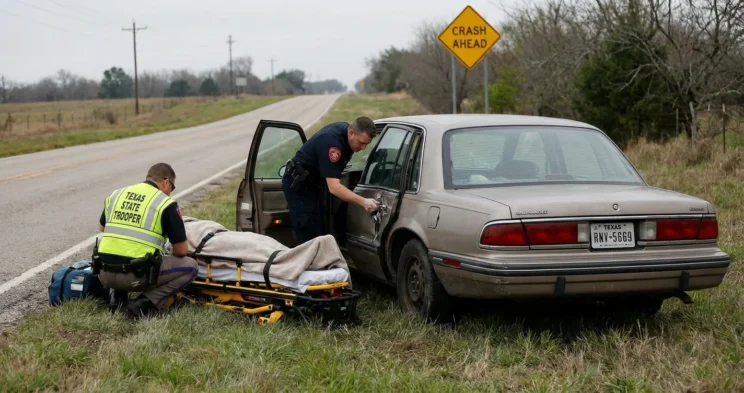
You are standing on the shoulder of I-35 outside Dallas. The passenger door of a wrecked car hangs open, and someone who was inside that car seconds earlier is now lying in the grass instead of in the seat.
The first question everyone asks is why the door came open. The honest answer is that a door-opening ejection traces back to one of three very different mechanisms, and each one points at a different party.
The primary latch and striker may have failed to hold under crash forces they were built to withstand. The door may never have been fully closed before the crash happened at all. Or the door and latch may have held while the occupant was ejected through a broken window or open glazing because a seatbelt was not on.
Sorting out which of these three happened is not a minor technical detail. It is the threshold step that decides who can be held responsible and what kind of Texas car accident claim actually exists.
Why Occupant Containment Is the Whole Point of FMVSS 206 and FMVSS 216a
Federal safety standards treat keeping an occupant inside the vehicle as the entire job of the door and roof structure. Understanding those standards explains why a door latch failure changes everything about a crash claim.
FMVSS 206, codified at 49 CFR 571.206, sets load requirements for door locks and door retention components so that occupants are not thrown from the vehicle on impact. The standard defines the latch that holds the door closed, the striker the latch grips, and the hinges that keep the door attached and swinging correctly.
Latches and hinges must each independently withstand thousands of newtons of force in the fully latched position, and reduced but still substantial force in the secondary latched position. FMVSS 206 also requires latches to resist an inertial, crash-pulse style load.
That requirement is the one most relevant to a door that pops open during the impact itself, rather than a door that was left ajar beforehand.
FMVSS 216a governs roof crush resistance in rollovers. Its purpose is to keep the roof from crushing down into the space where a seated occupant sits, a concept engineers describe as the vehicle’s survival space.
Every restraint system in the car depends on that survival space staying intact. A seatbelt and an airbag are engineered to manage crash forces on a body that stays in its seat, inside the vehicle shell.
Once a door latch failure or a broken window lets an occupant leave that space, restraint and airbag performance stop meaning anything, because those systems never get the chance to work on a person who is no longer inside the car.
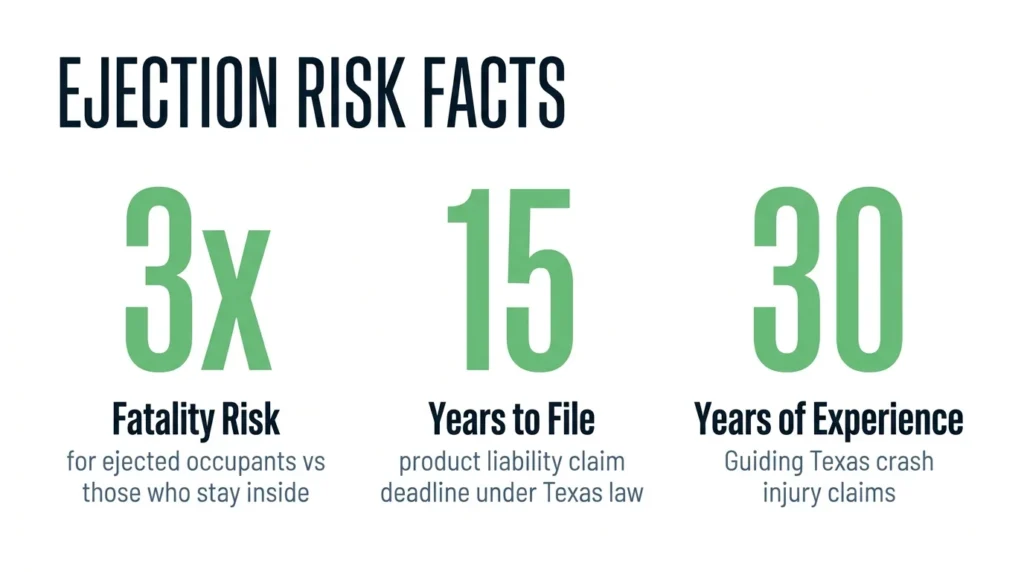
That is why ejection is treated as its own category of catastrophic injury. NHTSA research has found that the risk of fatality is over three times as great for an ejected occupant compared with an occupant who stays inside the vehicle.
Why It Matters Whether the Door Latch Failed, the Door Was Unlatched, or a Restraint Failed
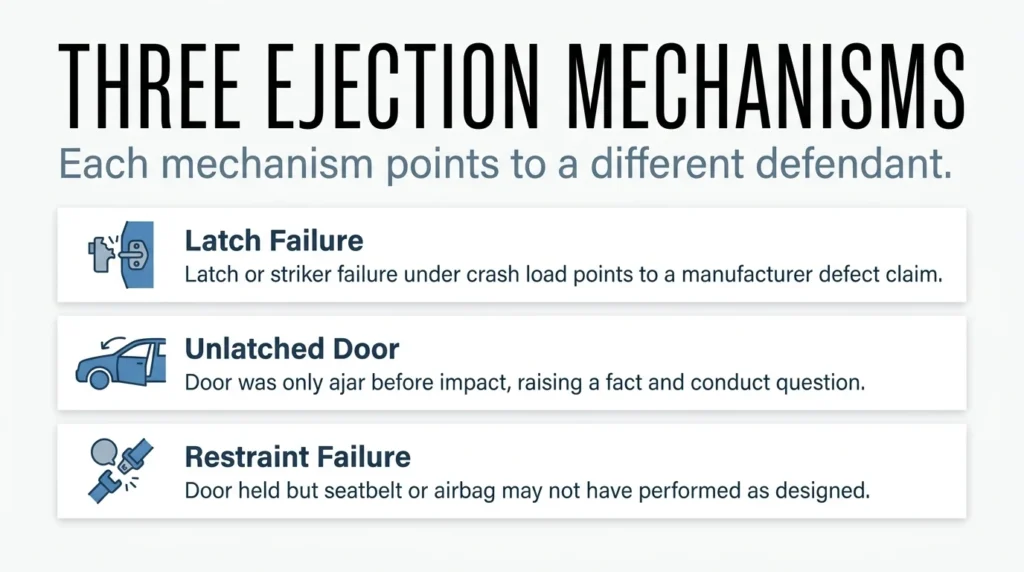
These three mechanisms are not interchangeable theories of the same case. Each one carries a different defendant, a different type of proof, and a different timeline under Texas law:
- Latch or striker failure under crash load points toward a product defect claim against the vehicle manufacturer or the maker of the latch or striker itself. This is the scenario FMVSS 206 exists to prevent, and it is the one most likely to justify a manufacturing or design defect claim.
- An unlatched or not-fully-closed door is a different story. If the latch and striker show no damage and the hardware performed within spec, but the physical evidence shows the door was only ajar or resting in the secondary latch position before impact, the real question becomes who closed the door last, whether a repair shop reassembled it correctly, or whether an aftermarket part was involved. That is a fact and conduct question, not automatically a defect claim.
- A restraint failure with the door and latch intact shifts the case again. If the hardware held and the occupant was still ejected, often through a window opening, the issue becomes whether a seatbelt was worn, whether a buckle or retractor performed as designed, or whether an airbag or curtain system engaged properly during the vehicle’s rotation.
Texas law treats seatbelt evidence as relevant. In Nabors Well Services, Ltd. v. Romero, the Texas Supreme Court held that evidence of whether a plaintiff wore a seatbelt is admissible to apportion responsibility under the state’s proportionate responsibility scheme. That rule applies to the restraint-failure theory, not to a claim that the door hardware itself was defective.
The product defect theory carries its own limitations on time. Texas Civil Practice and Remedies Code Section 16.012 generally requires a products liability claim against a manufacturer to be filed within 15 years of the vehicle’s first sale. That clock is one more reason the latch and striker need to be inspected and preserved quickly, before a claim built on a manufacturing defect runs out of time.
Given how often ejection proves fatal, families evaluating a possible wrongful death claim need to know which of these three theories actually fits their crash before a claim is filed against the wrong party.
The Evidence That Proves What Happened
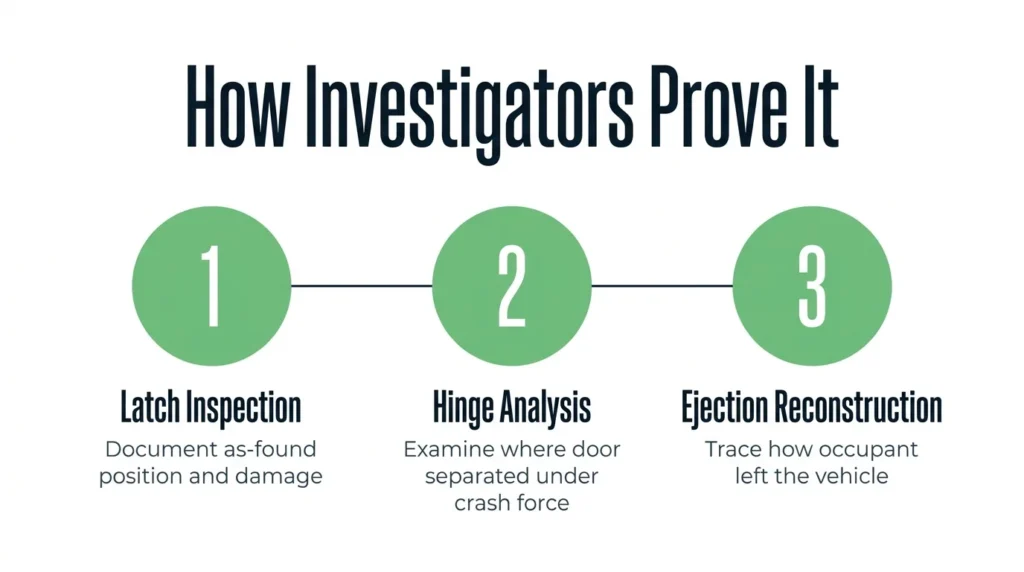
Telling these three mechanisms apart requires physical evidence gathered before anyone repairs, salvages, or disassembles the vehicle. Three categories of evidence do the real work:
- Latch and striker inspection in the as-found condition. Investigators document the latch and striker’s position, damage pattern, and witness marks before any disassembly. An inertial latch release in a rollover can leave little visible deformation, while a crash-force fork-bolt disengagement tends to leave a very different physical signature. Engineering research on latch design explains why this as-found documentation is what allows an expert to later distinguish a hardware failure from a door that was simply never latched.
- Door and hinge deformation analysis. Because FMVSS 206 sets separate load requirements for latches and hinges, investigators examine whether the door separated at the latch and striker interface, at the hinge, or through gross deformation of the door panel or frame that overpowered otherwise functional hardware.
- Occupant ejection path reconstruction. Reconstruction analyzes how and where the occupant actually left the vehicle, whether through the door opening, through broken window glazing, or both as the vehicle rolled. Research on occupant ejection trajectories shows the side window is a frequent exit route in rollovers, alongside the door opening itself.
Once the vehicle is repaired, scrapped, or sold, this evidence is usually gone for good.
Talk to Angel Reyes & Associates About Your Door-Latch or Ejection Case
Figuring out whether a door latch failure, an unlatched door, or a restraint failure caused an ejection takes prompt, hands-on evidence preservation. Waiting even a few weeks can mean the vehicle is repaired or sold before anyone inspects the latch and striker in their as-found condition.
Angel Reyes & Associates has guided injured Texans through serious crash claims for over 30 years, with investigators and accident reconstruction specialists who know how to secure and examine this kind of evidence before it disappears.
If someone in your family was ejected during a crash, contact Angel Reyes & Associates for a free consultation to find out whether you have grounds for an ejection crash lawsuit and which theory fits what happened to your vehicle.
Past results do not guarantee future outcomes.
Passenger Eject Accident FAQs
How much more dangerous is it to be ejected from a vehicle in a crash?
NHTSA research has found that the fatality risk is over three times as great for an ejected occupant as for one who stays inside the vehicle. That gap exists because seatbelts and airbags are engineered to manage crash forces on a person who remains in the seating position, not one who has already left the vehicle’s survival space.
What is a partial ejection?
A partial ejection is when a person is only part of the way out of a vehicle. Their torso or leg may get caught on something within the vehicle; however, a partial ejection can still cause major injuries.
What are some common ejection-related injuries?
Typical injuries can include head trauma, spinal cord injuries, bone breaks and fractures, organ damage, and internal bleeding. Depending on the nature of the accident, the injuries can be life-threatening.
About the Authors

Angel Reyes
Writer
Angel L. Reyes, III is the Founder and Managing Partner of Angel Reyes & Associates. A nationally recognized trial attorney and business leader, Angel has helped over 70,000 injury victims recover more than $1 billion since founding the firm in 1993. Named to the Texas Super Lawyers list annually since 2008, Angel brings Wall Street experience, Ivy League education, and a deep commitment to client advocacy. He is a frequent legal commentator and published author with extensive contributions to legal scholarship, trial strategy, and consumer protection.

Kyle Nicolas
Editor
Kyle Nicolas is the Web Content & SEO Manager at Angel Reyes & Associates. He has more than 10 years of experience as a marketing co...

Angel Reyes
Reviewer
Angel L. Reyes, III is the Founder and Managing Partner of Angel Reyes & Associates. A nationally recognized trial attorney and business...