Should Your Car’s Automatic Braking Have Stopped the Crash?


Every article on this site is researched by our internal team, reviewed for legal accuracy against current Texas law, and held to State Bar of Texas advertising standards before publication. We do not publish content that overstates outcomes or makes promises about results.
Learn more about our
editorial standards .
Key Takeaways
- AEB assists the driver in Texas crashes; it never replaces your duty to control the car.
- FMVSS 127 sets the AEB benchmark, but compliance is not required until 2029.
- Preserve module data before any dealer reflash; a software update can erase it.
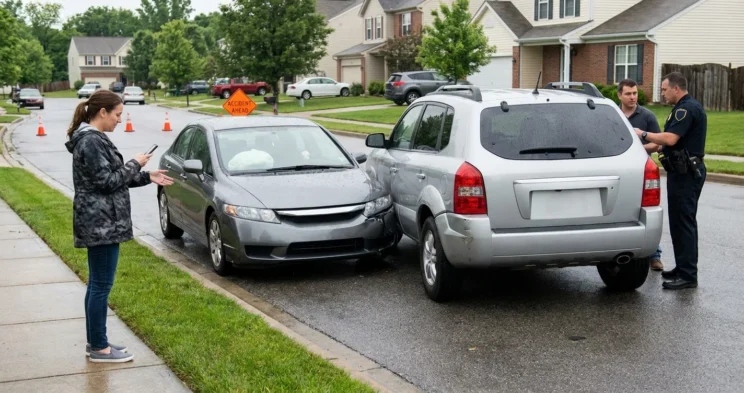
The airbags went off, your neck is stiff, and one question keeps circling. The car was supposed to brake on its own. Why didn’t it?
Automatic emergency braking does not work in every situation. However, if the system should have detected the danger and failed, the vehicle manufacturer may share responsibility for the crash.
What Automatic Emergency Braking Is & Isn’t
Automatic emergency braking is designed to assist the driver by detecting a possible collision and applying the brakes when needed. The driver remains responsible for controlling the vehicle.
Under the SAE J3016 levels of driving automation used by federal regulators, automatic braking, forward collision warning, and other advanced driver assistance systems sold under the ADAS label fall under Levels 1 and 2. The driver still performs part of the driving task and must supervise the system at all times. Only Level 3 and above hand the driving task to the vehicle.
Having automatic braking does not, by default, make the collision your fault, and a collision the system failed to prevent is not, by itself, proof that the vehicle was defective.
No braking system, including one that meets every published specification, is built to avoid every crash at every speed and in every condition.
A Texas car accident claim involving automatic braking may depend on whether the system performed as the manufacturer said it would under the conditions it was designed to handle.
The Performance Benchmark, & Why Most Cars Already Have AEB
The federal government has written down what automatic emergency braking is supposed to do. That standard does not yet apply to a single vehicle on the road today, so the measure that matters in your case is what your car’s maker promised.
- What the standard requires. FMVSS No. 127, codified at 49 CFR 571.127, requires light vehicles to brake automatically for an imminent collision with the vehicle ahead at speeds up to 90 mph, and to detect and brake for pedestrians in daylight and darkness up to 45 mph.
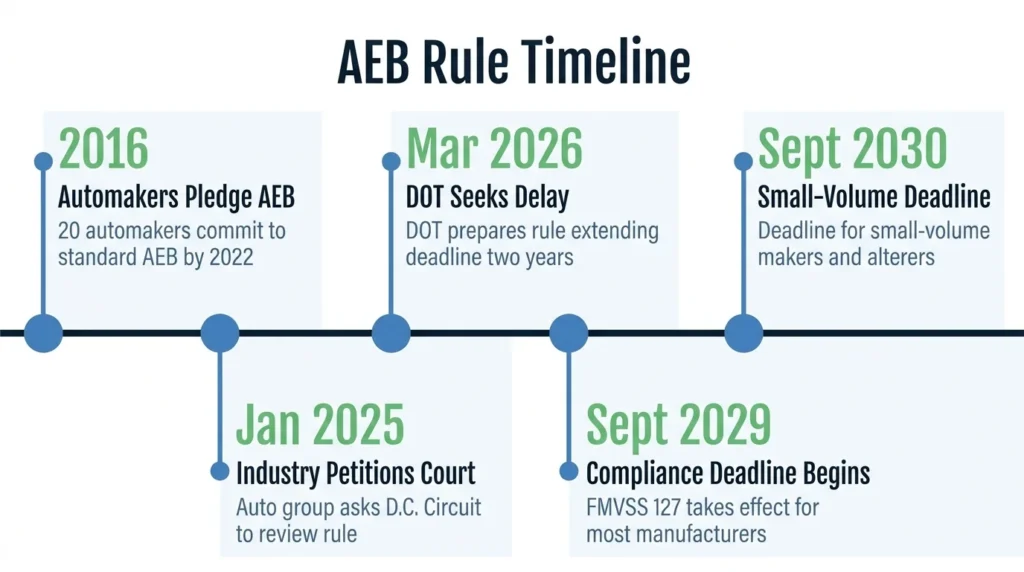
- When it takes effect. Compliance is not required until September 1, 2029 for most manufacturers, and September 1, 2030 for small-volume manufacturers and alterers.
- Why that date is not settled. An auto industry group asked the D.C. Circuit to review the rule in January 2025. In March 2026, the Department of Transportation told the court it was preparing a rule to extend the lead time by approximately two years. For now, the 2029 deadline remains in place.
- Why your car probably has it anyway. In 2016, 20 automakers voluntarily committed to making automatic emergency braking standard on virtually all new light-duty vehicles by September 1, 2022.
When an AEB Failure Becomes a Product Liability Claim
An AEB failure may lead to a product liability claim based on how the system performed or how it was designed and marketed. Similar questions arise in claims involving defective vehicle parts and product liability, although the evidence will depend on the specific vehicle and component at issue.
The System Failed Under Expected Conditions
The manufacturer said the system would detect and brake for a hazard at a certain speed and under certain conditions. If those conditions existed and the vehicle failed to respond, the system may not have performed as intended.
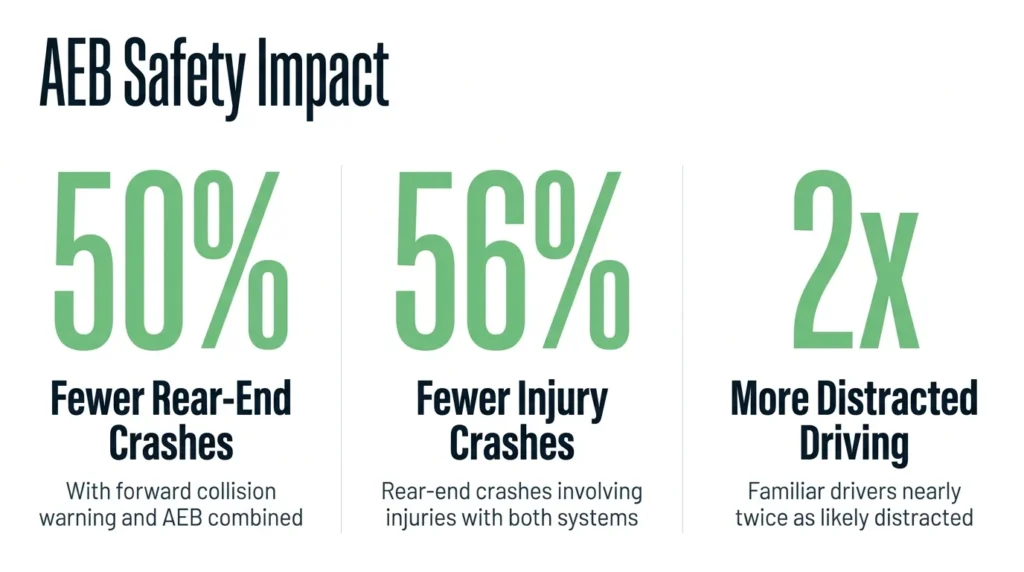
IIHS research found that vehicles equipped with forward collision warning and automatic braking had approximately 50% fewer rear-end crashes and 56% fewer rear-end crashes involving injuries. Those figures apply to the two technologies working together rather than automatic braking alone.
A Design That Invited Over-Reliance
A claim may also examine how the manufacturer presented the system to drivers. Its name, marketing, dashboard alerts, and driver-monitoring features can all influence how much control a driver believes the vehicle is taking.
Research from the AAA Foundation for Traffic Safety and Virginia Tech found that drivers familiar with assistance systems were nearly twice as likely to engage in distracted behavior while the features were active. Drivers remained more attentive when the technology was new, but their attention declined as they became more comfortable using it.
If the system foreseeably encouraged drivers to rely on it too heavily, the claim may involve its design or the manufacturer’s warnings. Evidence from the same crash may support both theories.
The Evidence That Decides These Claims
Important evidence may be stored inside the vehicle, and repairs or software updates can alter or erase it. Electronic records are also used as black box evidence after serious crashes, although the information recorded depends on the vehicle and its systems.
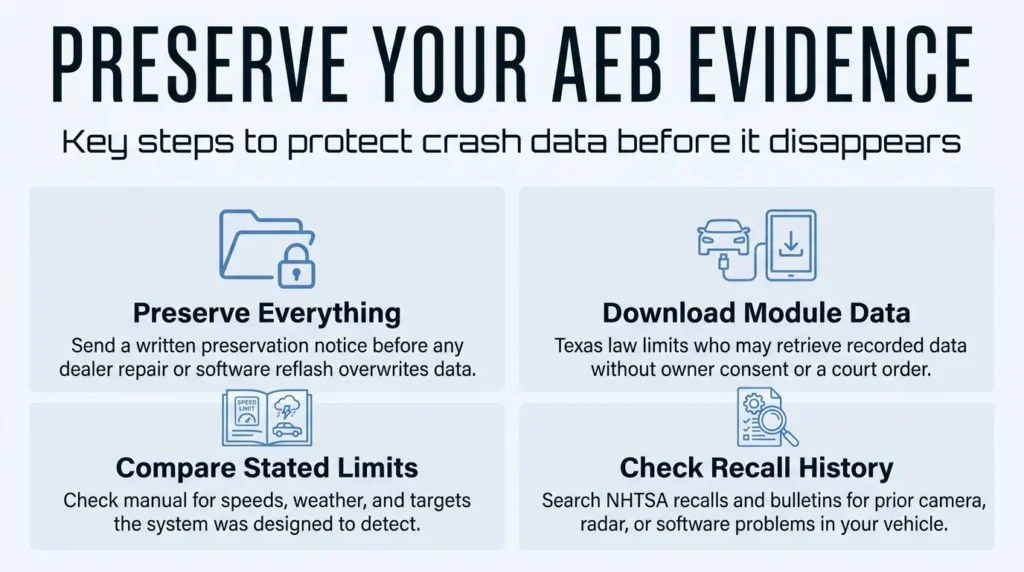
- Preserve everything before any dealer work. A post-crash software update, called a reflash, can overwrite the module data showing what the system saw and did. Send a written preservation notice to the dealership and manufacturer before the vehicle is repaired or traded in.
- Download the module data. Texas Transportation Code § 547.615 controls who may pull recorded data from a vehicle. No one other than the owner may retrieve it without the owner’s consent, a court order, or another narrow exception, so the download usually starts with a signed authorization.
- Compare the crash with the system’s stated limits. The owner’s manual and driver-assistance supplement spell out the speeds, weather, lighting, and target types the system was designed for. That is the baseline for whether it underperformed its own specification.
- Check recall and bulletin history. NHTSA’s recall search and technical service bulletin records may show prior problems with the camera, radar, or software in the same make, model, and year. A bulletin issued before the crash may also help establish what information was available to the manufacturer at the time.
Who Can Be Held Responsible, & How Much Time You Have
In most cases, the claim runs against the company that built the vehicle or the system, not the dealership that sold it.
- The manufacturer is usually the right defendant. Texas Civil Practice & Remedies Code Chapter 82 governs products liability actions against manufacturers and sellers. Section 82.003 generally shields a seller who only sold the vehicle, unless it modified the product, gave inadequate warnings, misrepresented it, knew of the defect, or the manufacturer cannot be reached in a Texas court.
- Texas generally gives you two years. Personal injury claims, including products liability claims, are normally subject to a two-year statute of limitations, with the discovery rule applying in some situations.
- A separate outer deadline also applies. Texas has a statute of repose for most product liability claims that runs from the date the product was sold rather than the date of the crash. This deadline can be especially important when the claim involves an older vehicle.
Talk to Angel Reyes & Associates About Your Crash
Module data, dealer records, and recall history are easiest to secure in the first weeks after a crash and hardest to recover once the car has been repaired or sold.
Angel Reyes & Associates has guided injured Texans through crash claims for more than 30 years and serves clients statewide. Consultations are free, you owe no attorney fee unless we recover for you, and we will explain how case costs and expenses are handled before you decide anything.
Contact Angel Reyes & Associates and have someone review what your vehicle recorded.
Every case is different, and past results do not guarantee future outcomes.
Automatic Emergency Braking FAQs
Can a driver still recover compensation if they were partly at fault?
Texas proportionate responsibility rules generally permit recovery even when a claimant is 50 percent or less responsible, though that percentage reduces the damages awarded.
Does a Texas AEB design defect claim require proof that a safer design was available?
Generally, yes. Under Texas Civil Practice & Remedies Code § 82.005, a design defect claimant must prove there was a safer alternative design that was economically and technologically feasible and would probably have prevented or significantly reduced the injury risk.
Can windshield replacement or other vehicle repairs affect automatic emergency braking?
Potentially. Because some AEB systems rely on cameras and other sensors, repairs involving those components or their mounting locations can raise questions about calibration, installation, and whether the system was functioning correctly before the crash.
Can automatic emergency braking activate when there is no collision threat?
Yes. AEB systems can sometimes brake unexpectedly or issue false collision warnings, and manufacturers have issued recalls involving software or sensing problems that caused unintended braking.
How long is the Texas statute of repose for a defective vehicle claim?
Texas Civil Practice & Remedies Code § 16.012 generally requires a products liability action to be filed within 15 years after the defendant sold the product, subject to statutory exceptions.
About the Authors

Angel Reyes
Writer
Angel L. Reyes, III is the Founder and Managing Partner of Angel Reyes & Associates. A nationally recognized trial attorney and business leader, Angel has helped over 70,000 injury victims recover more than $1 billion since founding the firm in 1993. Named to the Texas Super Lawyers list annually since 2008, Angel brings Wall Street experience, Ivy League education, and a deep commitment to client advocacy. He is a frequent legal commentator and published author with extensive contributions to legal scholarship, trial strategy, and consumer protection.

Kyle Nicolas
Editor
Kyle Nicolas is the Web Content & SEO Manager at Angel Reyes & Associates. He has more than 10 years of experience as a marketing co...

Angel Reyes
Reviewer
Angel L. Reyes, III is the Founder and Managing Partner of Angel Reyes & Associates. A nationally recognized trial attorney and business...