Archer Aviation Midnight’s Safety Record & the Future of Air Taxis in Texas


Every article on this site is researched by our internal team, reviewed for legal accuracy against current Texas law, and held to State Bar of Texas advertising standards before publication. We do not publish content that overstates outcomes or makes promises about results.
Learn more about our
editorial standards .
Key Takeaways
- FAA finalized airworthiness criteria establish what Archer must prove for certification, but finalized criteria does not mean the Midnight is approved for passengers.
- Texas proportionate responsibility rules can reduce or bar recovery if a claimant is found more than 50% at fault, making early evidence preservation critical.
- Multiple parties may share liability in an eVTOL incident, including operators, manufacturers, maintenance providers, and facility operators.
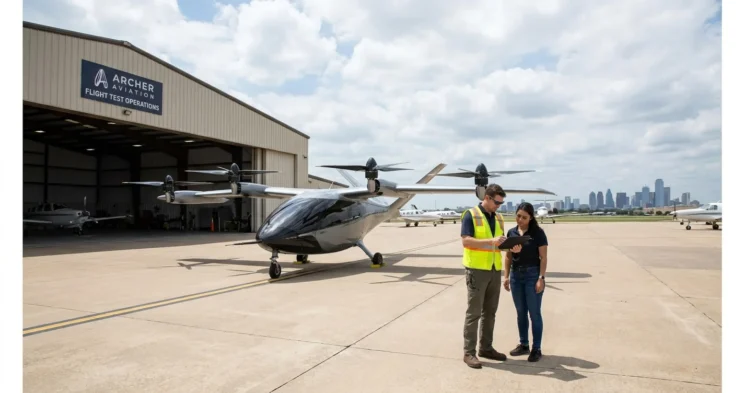
In September, 2025, Archer Aviation’s Midnight aircraft reached 7,000 feet and completed piloted flights covering 45 to 55 miles at speeds exceeding 120 mph. Headlines have called it a breakthrough. Could this be a landmark step toward autonomous flight?
You might be wondering what all of this actually means for passenger safety and when these air taxis might start operating in Texas cities like Dallas or Houston. These milestones signal progress, but they do not mean the aircraft is certified or ready for commercial passengers.
What Archer Publicly Reported: The Midnight Envelope Expansion
Archer Aviation’s September 2025 announcement documented several flight-test achievements. The Midnight aircraft reached a record altitude of 7,000 feet, covering 45 miles at speeds exceeding 120 mph. The company also referenced a prior 55-mile piloted flight at speeds above 126 mph.
These numbers represent what engineers call “envelope expansion,” or progressively pushing the aircraft to perform under broader conditions. Each expansion tests different systems: battery performance, thermal management, flight controls, and pilot workload.
Higher altitude introduces different challenges. Air density decreases, which affects how rotors generate lift and how batteries perform. Temperature variations at altitude can stress thermal management systems differently than ground-level operations.
Altitude also affects emergency planning. If something goes wrong at 7,000 feet, the aircraft needs sufficient performance margins and time for pilots to respond. Testing at these heights helps build the safety case for operations that might eventually cross varied terrain around Texas cities.
This is one input among many. Reaching 7,000 feet does not prove the aircraft is safe for passengers. It demonstrates the test program is exploring conditions the aircraft might encounter operationally.
Why 45–55 Mile Piloted Flights Matter
Longer flights stress systems that short hops do not. A 55-mile flight lasting over 30 minutes can reveal issues with battery degradation, vibration accumulation, software stability, and pilot fatigue that a five-minute test cannot surface.
Piloted testing adds another dimension. Human factors matter for certification. How does the pilot interface with controls during extended operations? What workload does the aircraft impose? These questions require pilots in the seat, not just remote operators.
Speed matters less as a standalone safety metric. Flying at 126 mph demonstrates the aircraft can achieve its intended operational profile. It does not independently prove safety.
FAA Final Airworthiness Criteria
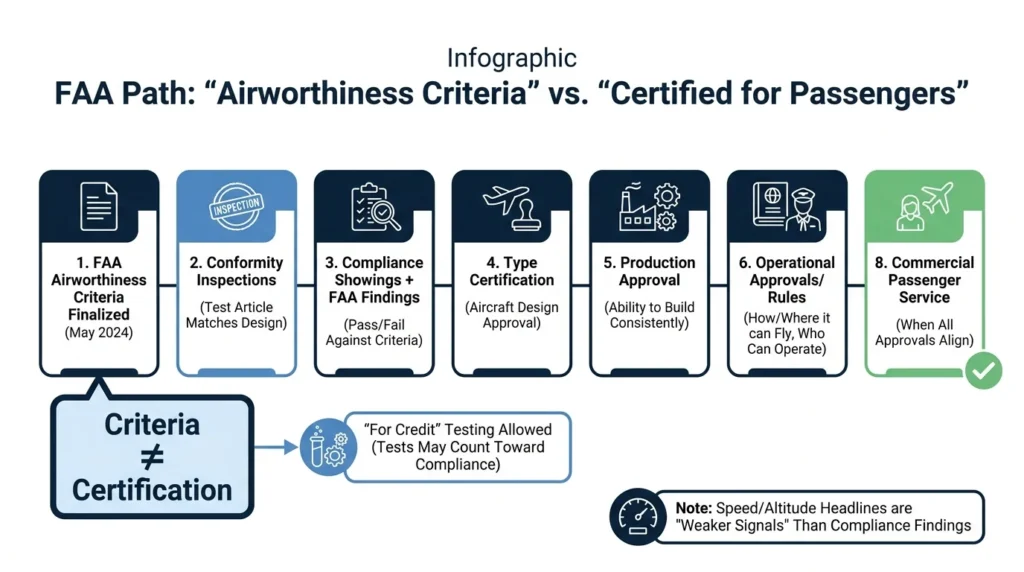
In May 2024, the FAA finalized special-class airworthiness criteria for Archer’s Model M001 (Midnight). Archer’s announcemen of this achievement described this as enabling “for credit” testing, meaning tests conducted under agreed conditions could count toward certification compliance.
The official criteria appear in Federal Register document 2024-11192. A readable summary is available through the DOT docket page.
“Airworthiness criteria” are the FAA’s defined safety and design expectations for this specific aircraft configuration. Think of them as the test the manufacturer must pass. The criteria establish what Archer must demonstrate through testing, analysis, and documentation.
What Finalized Criteria Does Not Mean
Finalized criteria does not equal type certification. The FAA has agreed on what Archer must prove. Archer has not yet proven it.
Several gates typically remain after criteria finalization: conformity inspections, compliance findings across all criteria, production approvals, and operational rules. Each requires documentation, review, and FAA acceptance.
“For credit” testing means tests conducted properly may be usable toward compliance showings. It does not mean the FAA has endorsed the results or concluded the aircraft is safe.
How Close Is Midnight to FAA Certification?
Predicting certification timing for novel aircraft categories is difficult. The powered-lift category that eVTOLs fall under is relatively new regulatory territory with rapidly evolving standards. Test findings can require design changes. Documentation cycles between manufacturer and regulator take time.
Stronger signals of certification progress would include: published compliance findings, conformity determinations, reliability and dispatch targets being met, and clarity on production readiness. Speed and altitude headlines are weaker signals.
Watch for continued envelope expansion, maturation of piloted testing, and any FAA publications or updates specific to the Midnight program.
eVTOL Safety Compared to Helicopters
Some people often wonder whether eVTOL air taxis are safer than helicopters. A direct comparison requires operational data that does not yet exist for commercial eVTOL operations. To put it simply, they haven’t been around long enough to have a comparable quantity of incident rates, exposure hours, and maintenance reliability statistics.
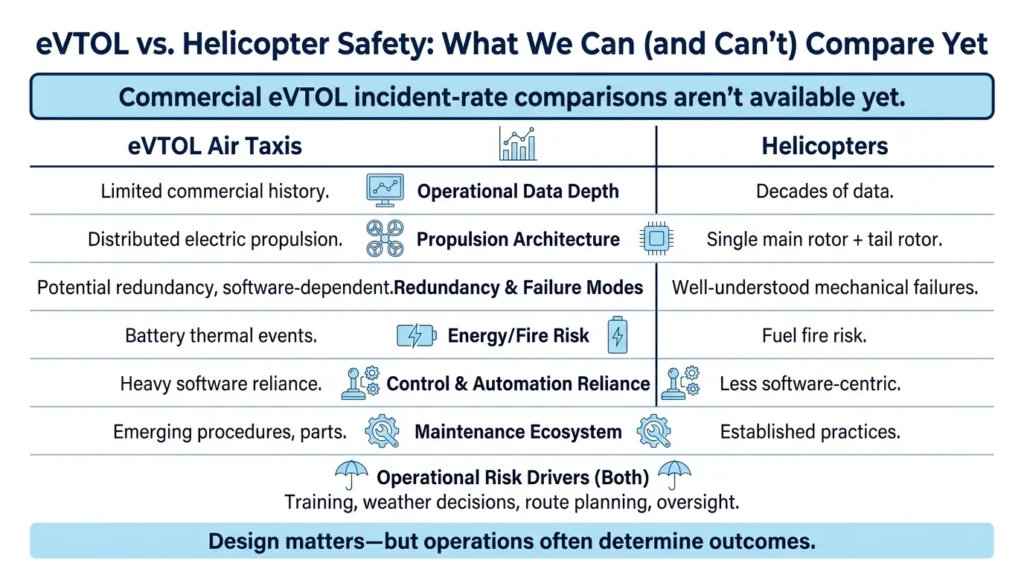
What we can compare are risk categories. eVTOLs typically use distributed electric propulsion with multiple rotors, which may provide redundancy if one fails. They rely heavily on flight control software. Battery thermal events present different risks than fuel fires.
Helicopters have decades of operational data, established maintenance practices, and well-understood failure modes. Their single main rotor architecture creates different emergency landing characteristics.
Safety depends heavily on operations: pilot training, maintenance practices, weather decision-making, route planning, and oversight. An aircraft with excellent design can still be operated unsafely.
Early eVTOL programs still have limited real-world data to answer safety questions definitively.
Texas Passenger & Operator Risk
If an eVTOL incident occurs in Texas, several scenarios are plausible: hard landings, loss of control, battery thermal events, rotor strikes, vertiport ground injuries, or impacts affecting people on the ground.
Multiple parties could potentially bear responsibility. The operator makes flight decisions and maintains the aircraft. The manufacturer designed and built it. Maintenance providers service it. Component suppliers provided parts. Vertiport operators manage ground facilities.
Documentation matters immediately after any incident. Flight logs, maintenance records, training records, videos, and eyewitness accounts all become relevant evidence. Texas roads like I-35 through Austin or Loop 610 in Houston see thousands of vehicle accidents annually. Air taxi incidents would follow similar investigative patterns but with additional aviation-specific considerations.
Operator-Side Risk Controls
What operators do, or fail to do, often becomes central in liability disputes. Pilot qualification and training establish baseline competency. Maintenance and inspection practices determine whether the aircraft remains airworthy. Deferred maintenance items or record gaps can become significant evidence.
Weather and operational decision-making frequently become fault-allocation battlegrounds. A “go” decision in marginal conditions that leads to an incident invites scrutiny of whether the operator exercised reasonable care.
Air Taxis & Product Liability in Texas
Texas product liability cases can involve three main theories: design defect, manufacturing defect, and failure to warn. Each requires different evidence.
Design defect claims argue the product’s design itself was unreasonably dangerous. Manufacturing defect claims argue something went wrong during production of the specific unit involved. Failure-to-warn claims argue the manufacturer did not adequately communicate known risks.
For eVTOLs, software and control systems add complexity. Software updates, configuration management, and flight data logs can all become relevant evidence. Regulatory compliance with FAA criteria may be relevant but is not always a complete shield in civil cases.
Texas Proportionate Responsibility: The 51% Bar
Texas Civil Practice and Remedies Code Chapter 33 establishes proportionate responsibility rules. Under § 33.001, if a claimant is found more than 50% responsible for their own injuries, they cannot recover damages.
If found 50% or less responsible, recovery is reduced by the assigned percentage. A passenger found 20% at fault would recover 80% of their damages.
Multiple parties can be allocated fault percentages. A jury might assign 40% to the operator, 35% to the manufacturer, 15% to a maintenance provider, and 10% to the passenger. Each defendant pays according to their share.
Common passenger fault arguments might include: ignoring safety instructions, interfering with crew, intoxication, or improper boarding. These arguments are not always successful, but they illustrate why documentation and evidence preservation matter.
Protecting Yourself from Unfair Fault Allocation
Follow posted instructions and crew directions. After any incident, document signage and safety briefings you observed. Preserve trip details: booking confirmations, app receipts, communications, and photos.
Avoid giving recorded statements to insurance representatives without understanding your rights, especially if injuries are serious. What you say early can affect fault allocation later.
If an eVTOL Incident Happens
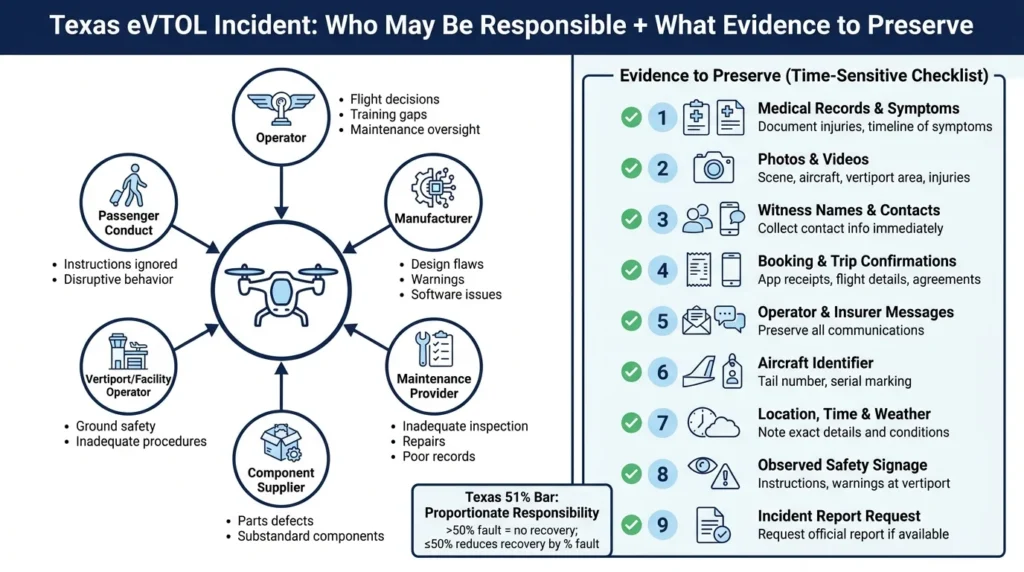
Medical care comes first. Seek emergency treatment, follow up as recommended, and track all symptoms. Early medical documentation establishes the connection between the incident and your injuries, similar to what you should do after a car accident.
When safe, document the scene. Take photos and video. Get contact information from witnesses. Request any incident reports the operator generates.
Preserve product and ride details: operator name, aircraft identifiers if visible, app receipts, and all communications. This information helps identify responsible parties and supports investigation.
When to Talk to a Texas Injury Lawyer
Consider consulting an attorney if you experience: hospitalization, fractures or burns, long-term disability, disputed fault, or situations involving multiple potentially responsible parties. Complex cases involving novel technology and aviation regulations benefit from experienced guidance.
Bring your medical timeline, expense records, communications, photos, witness list, and any incident reports. This information helps attorneys evaluate your situation efficiently.
Our firm has over 30 years of experience handling complex injury cases across Texas. We have recovered more than $1 billion for clients and operate on a contingency basis, meaning no fee unless we win. We have more than 20 locations statewide and offer service in Spanish.
If you or a family member is injured in any transportation incident, whether involving emerging technology or traditional vehicles, contact us for a free consultation. We can help you understand your options and protect your rights under Texas law.
Archer Aviation Midnight FAQs
Can passengers usually sue only the operator after an eVTOL injury in Texas?
No. Depending on the facts, claims may also involve the aircraft maker, a parts supplier, a maintenance company, or a vertiport or property operator.
Does FAA certification automatically protect a manufacturer from a Texas injury lawsuit?
Not necessarily. Regulatory approval can matter as evidence, but it does not automatically block a civil claim if there is proof of negligence, a defect, or inadequate warnings.
What evidence should someone keep after an air taxi or vertiport injury?
Try to save your booking receipt, photos or video, witness names, medical records, and any messages from the operator or insurer. If possible, also note the aircraft identifier, location, time, weather, and any safety instructions you were given.
Could bad weather affect who is at fault in an eVTOL accident?
Yes. Weather often becomes a key issue because investigators and insurers may look closely at whether the operator made a reasonable go-or-no-go decision for the conditions.
Are eVTOL flights likely to face the same insurance issues as other aviation claims?
Often yes, in the sense that coverage can depend on the policy language, the parties involved, and the cause of the incident. Early disputes may arise over which insurer applies, what exclusions exist, and how fault is divided among multiple parties.
About the Authors

Angel Reyes
Writer
Angel L. Reyes, III is the Founder and Managing Partner of Angel Reyes & Associates. A nationally recognized trial attorney and business leader, Angel has helped over 70,000 injury victims recover more than $1 billion since founding the firm in 1993. Named to the Texas Super Lawyers list annually since 2008, Angel brings Wall Street experience, Ivy League education, and a deep commitment to client advocacy. He is a frequent legal commentator and published author with extensive contributions to legal scholarship, trial strategy, and consumer protection.

Kyle Nicolas
Editor
Kyle Nicolas is the Web Content & SEO Manager at Angel Reyes & Associates. He has more than 10 years of experience as a marketing co...

Angel Reyes
Reviewer
Angel L. Reyes, III is the Founder and Managing Partner of Angel Reyes & Associates. A nationally recognized trial attorney and business...