Are Golf Carts Street Legal in Texas?


Every article on this site is researched by our internal team, reviewed for legal accuracy against current Texas law, and held to State Bar of Texas advertising standards before publication. We do not publish content that overstates outcomes or makes promises about results.
Learn more about our
editorial standards .
Key Takeaways
- Check the route's state permission or local authorization before driving a golf cart.
- A golf cart plate or 35 mph sign alone does not authorize driving on a Texas road.
- A cart rule violation may affect fault, but evidence must show what caused the crash.
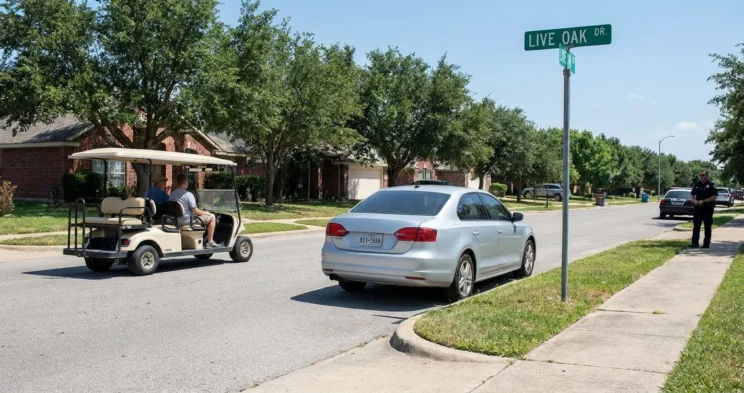
Yes, you can drive a golf cart on the road in Texas, but only where state law or valid local authorization permits it. Before taking yours to the neighborhood pool or golf course, check the route, plate requirements, and driver’s license. A low speed limit or a golf cart plate alone does not make every golf cart street legal.
When Can You Drive a Golf Cart on a Texas Road?
Texas Transportation Code Chapter 551, Subchapter F permits golf cart use in specific settings. Section 551.401 defines a golf cart by the manufacturer’s primary golf-course design; neighborhood electric vehicles, ATVs, and utility vehicles have different rules.
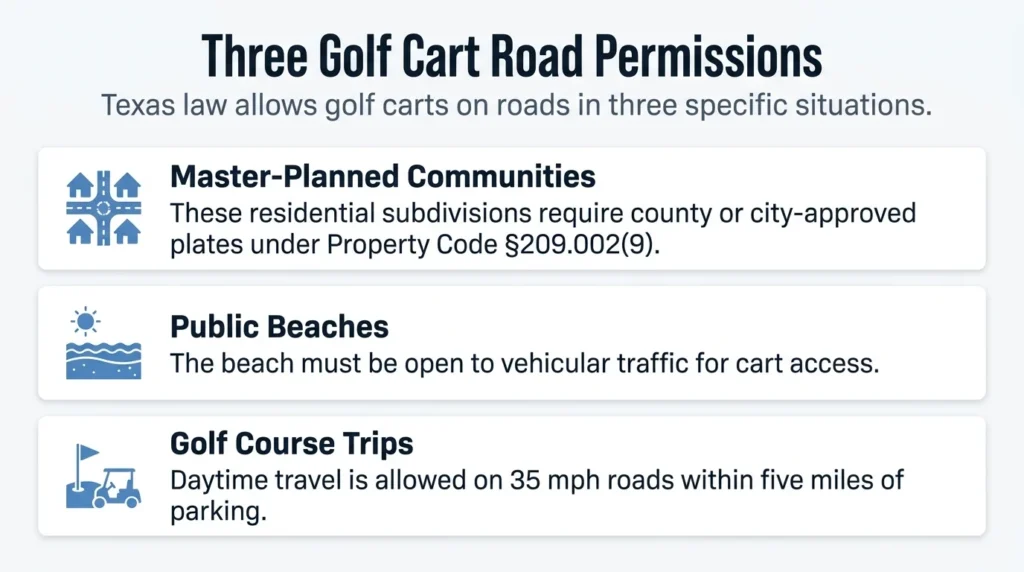
Section 551.403 provides three permissions:
- Qualifying master planned communities. The community must be a residential subdivision under Property Code §209.002(9) or have uniform restrictive covenants. In either case, a county or municipality must have approved one or more plates. An HOA or neighborhood name alone is insufficient.
- Beaches. The public or private beach must be open to vehicular traffic.
- Golf course trips. Travel must be to or from a golf course, on a road posted at 35 mph or less, during daytime, and within five miles of where the cart is usually parked.
The golf-course-trip conditions do not apply universally to every separately authorized community, beach, or local use. But an ordinary grocery trip does not qualify under the golf-course permission just because the store is nearby.
The five-mile distance reflects HB 1281’s 2021 amendment, which replaced the former two-mile limit. Use the current statute when older guidance conflicts with it.
How Do Local Rules & Road Crossings Change the Route?
Local authorization can allow additional routes, but a 35 mph sign does not establish that authorization. Check the actual ordinance or applicable county order before leaving.
Roads Cities & Counties Can Authorize
Under § 551.404, a municipality may authorize golf carts on all or part of roads within its boundaries posted at 35 mph or less. The authorization may cover specific streets, so check each part of your proposed route.
County authority applies only to eligible counties and qualifying roads in their unincorporated areas, also posted at 35 mph or less. Eligible counties border or contain part of the Red River, or border the
Gulf of Mexico and have fewer than 500,000 residents.
Section 551.4031 also lets a city, county, or TxDOT prohibit highway operation under § 551.403 for safety. A general state permission therefore does not settle every route question.
Crossing a Faster Highway
Section 551.405 permits crossing a highway at an intersection even when its posted speed limit exceeds 35 mph. That crossing permission does not authorize driving along the faster highway.
Check the jurisdiction, approved streets, speed signs, and any safety restrictions along your route. Match the trip’s purpose and time of day to the permission you rely on; added lights, a shoulder, or HOA approval cannot independently authorize a prohibited route.
The daytime and five-mile conditions belong to the golf-course-trip permission. Section 551.404 does not repeat those conditions, so read the local authorization for the rules governing a locally approved trip.
Does a Golf Cart Need a Plate, Registration, or Safety Equipment?
Highway operation ordinarily requires a golf cart license plate, but that plate is different from ordinary vehicle registration. Neither a plate nor new equipment expands the routes you may use.
Plates & the Community Exception
Section 551.402 bars TxDMV from registering golf carts for highway use, even after alterations. TxDMV directs plate applicants to their county tax assessor-collector.
Under § 551.403(b), a cart may operate without a plate inside a qualifying master planned community on a road posted at 35 mph or less. That exception also includes crossing an intersection with a higher-speed road.
Check the community’s legal qualifications before relying on the exception. The fact that neighbors routinely drive unplated carts does not establish that your road qualifies.
Equipment for Locally Authorized Operation
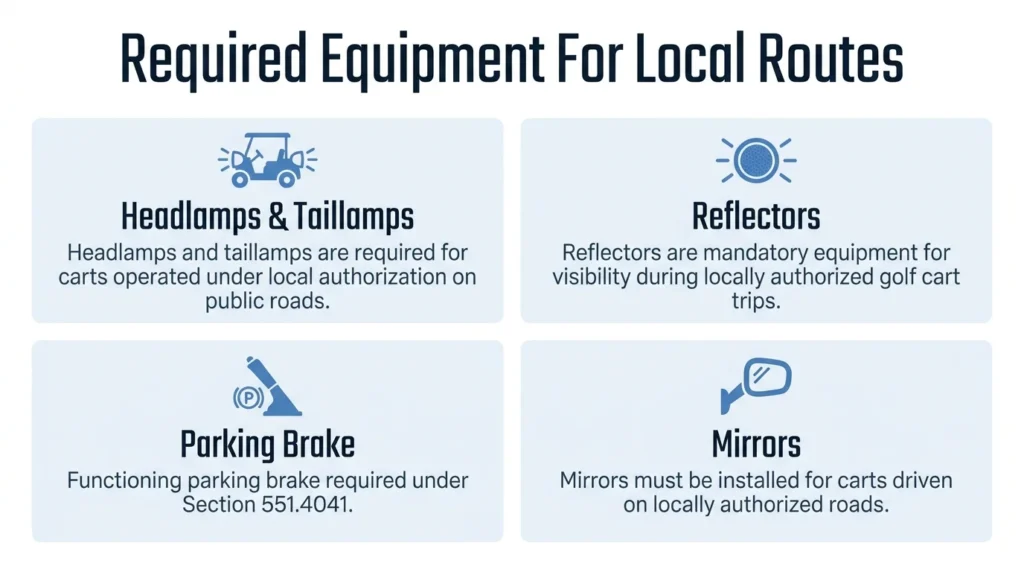
For carts operated under § 551.404, § 551.4041 requires:
- Headlamps and taillamps
- Reflectors
- A parking brake
- Mirrors
Separately, §547.703(d) requires a slow-moving-vehicle emblem when a golf cart operates on a highway at no more than 25 mph. Equipment compliance and permission to use the road are separate checks.
Who May Drive a Golf Cart on a Public Road?
A public-road golf cart driver generally needs a valid driver’s license. The driver’s age and a parent’s permission do not replace that requirement.
§521.021 requires a license to operate a motor vehicle on a highway unless an express exemption applies. In Opinion KP-0364, the Texas Attorney General concluded that golf cart provisions do not exempt drivers on publicly maintained ways open to vehicular traffic. This is an official interpretation, not a court ruling.
Texas ordinarily issues learner licenses at ages 15 through 17. Under § 521.222, learners must possess the license and have a qualified licensed person at least 21 years old, with at least one year of driving experience, in the adjacent seat. DPS learner guidance explains this category.
Teens ages 16 and 17 with provisional licenses may drive independently subject to their license restrictions. Check the actual license rather than assuming every 16-year-old may drive. These public-road rules are not a blanket rule for every private golf-course use.
What If a Golf Cart & a Car Collide?
A route, plate, or licensing violation may be relevant to fault, but a violation alone does not prove who caused the crash. It also does not excuse the car driver’s conduct.
Texas Civil Practice and Remedies Code Chapter 33 ties responsibility to conduct that caused or contributed to the harm. Evidence about speeding, distraction, or failure to yield still counts alongside the cart’s legal right to use the road.
Evidence to Preserve After a Collision
If you are able, document the route and each driver’s actions while details are fresh:
- Photograph the cart, its plate, lights, mirrors, and slow-moving-vehicle emblem.
- Photograph nearby speed limit signs and the collision scene.
- Record the route, trip purpose, and time of day.
- Save the applicable ordinance or county order.
- Preserve information about each driver’s age and license status.
- Collect witness names, available video, and the crash report.
These records help distinguish a missing required plate from a lawful community exception, or an unauthorized errand from a permitted golf-course trip. They also help show what happened before impact.
Shared Fault Can Affect Recovery
Under Texas Civil Practices and Remedies Code § 33.001, a claimant cannot recover when their responsibility exceeds 50%. Section 33.012 reduces otherwise recoverable damages by the claimant’s percentage of responsibility.
The analysis therefore requires evidence of both drivers’ conduct.
Talk With Angel Reyes & Associates About a Golf Cart Crash
After a cart-car collision, questions about road access and fault can add to the stress of an injury. Bring your route details, photographs, and crash report to a free consultation with the team at Angel Reyes & Associates.
Contact Angel Reyes & Associates to discuss your situation and options.
Past results do not guarantee future outcomes.
Golf Cart Legality on Texas Streets FAQs
Does golf cart insurance cover injuries after a Texas road accident?
Coverage depends on the policy, including whether it covers public-road use, bodily injury, and property damage. Review the policy’s exclusions and coverage limits rather than assuming a standard homeowners or auto policy covers the collision.
What should you do if a golf cart accident happens on private property in Texas?
Seek medical attention, document the scene, identify witnesses, and report the incident to the property owner or appropriate authorities when necessary. Liability may depend on who controlled the property, how the collision occurred, and whether a driver’s negligence contributed to the injuries.
Can you sue a golf cart manufacturer after a crash in Texas?
Potentially. If a defective component or an unreasonably dangerous design contributed to the crash or resulting injuries, an injured person may have a product liability claim under Texas law, depending on the available evidence.
About the Authors

Angel Reyes
Writer
Angel L. Reyes, III is the Founder and Managing Partner of Angel Reyes & Associates. A nationally recognized trial attorney and business leader, Angel founded the firm in 1993, which has gone on to help over 70,000 injury victims recover more than $1 billion. Named to the Texas Super Lawyers list annually since 2008, Angel brings Wall Street experience, Ivy League education, and a deep commitment to client advocacy. He is a frequent legal commentator and published author with extensive contributions to legal scholarship, trial strategy, and consumer protection.

Graham Griffin
Editor
Graham Griffin is the Web & Content Manager at Angel Reyes & Associates, where he oversees content strategy, AI-powered workflows, a...

Angel Reyes
Reviewer
Angel L. Reyes, III is the Founder and Managing Partner of Angel Reyes & Associates. A nationally recognized trial attorney and business...